Category Archives: Whisky column

My monthly whisky column in Prestige Magazine

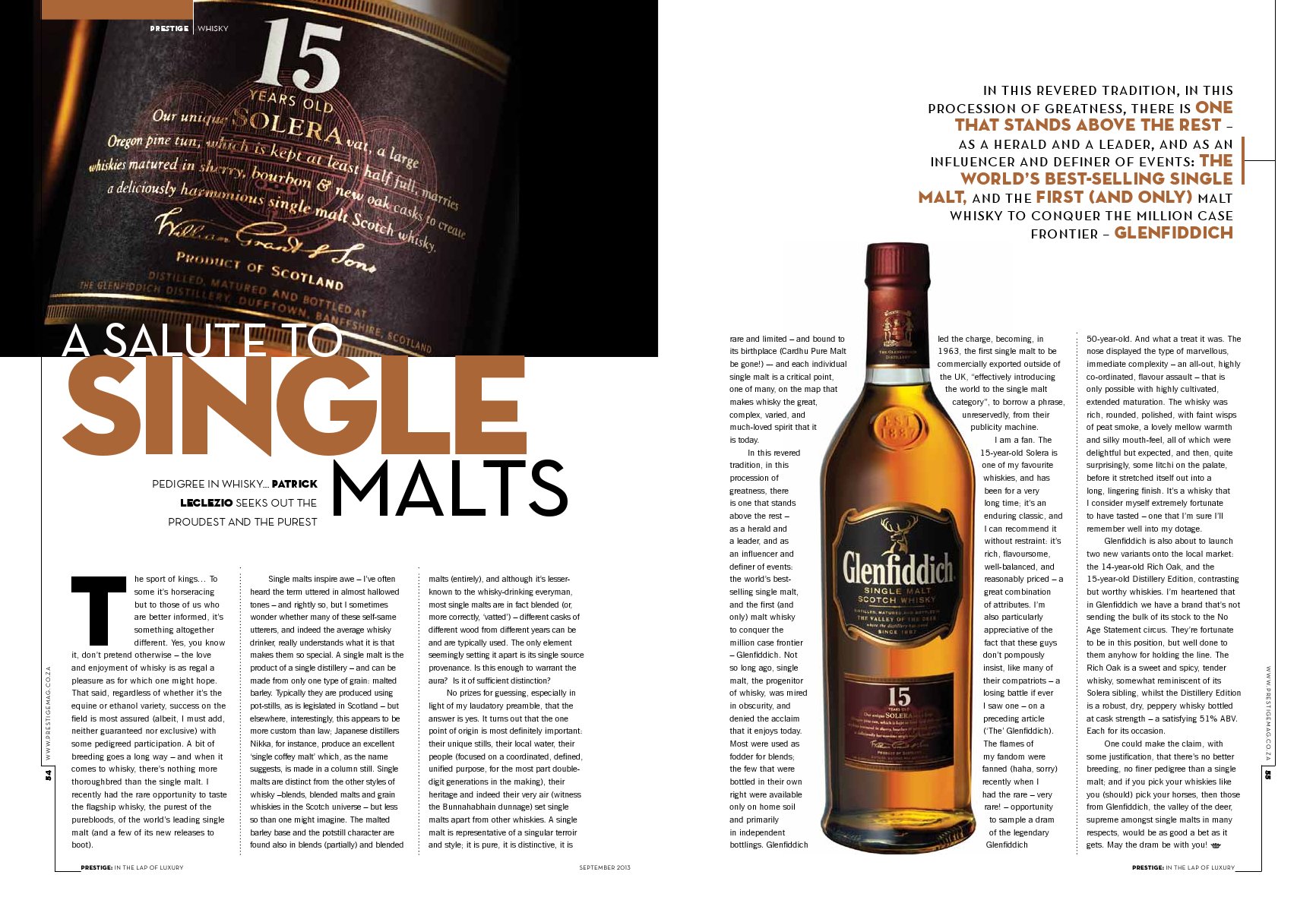
A salute to single malts

Pedigree in whisky…PATRICK LECLEZIO seeks out the proudest and the purest.

First published in Prestige Magazine (September 2013 edition).

As it appeared.

As it appeared.

The sport of kings… To some it’s horseracing but to those of us who are better informed, it’s something altogether different. Yes, you know it, don’t pretend otherwise the love and enjoyment of whisky is as regal a pleasure as for which one might hope. That said, regardless of whether it’s the equine or ethanol variety, success on the field is most assured (albeit, I must add, neither guaranteed nor exclusive) with some pedigreed participation. A bit of breeding goes a long way and when it comes to whisky, there’s nothing more thoroughbred than the single malt. I recently had the rare opportunity to taste the flagship whisky, the purest of the purebloods, of the world’s leading single malt (and a few of its new releases to boot).

Single malts inspire awe – I’ve often heard the term uttered in almost hallowed tones – and rightly so, but I sometimes wonder whether many of these self-same utterers, and indeed the average whisky drinker, really understands what it is that makes them so special. A single malt is the product of a single distillery – and can be made from only one type of grain: malted barley. Typically they are produced using pot-stills, as is legislated in Scotland but elsewhere, interestingly, this appears to be more custom than law; Japanese distillers Nikka, for instance, produce an excellent ‘single coffey malt’ which, as the name suggests, is made in a column still. Single malts are distinct from the other styles of whisky –blends, blended malts and grain whiskies in the Scotch universe – but less so than one might imagine. The malted barley base and the potstill character are found also in blends (partially) and blended malts (entirely), and although it’s lesser-known to the whisky-drinking everyman, most single malts are in fact blended (or, more correctly, ‘vatted’) – different casks of different wood from different years can be and are typically used. The only element seemingly setting it apart is its single source provenance. Is this enough to warrant the aura? Is it of sufficient distinction?

No prizes for guessing, especially in light of my laudatory preamble, that the answer is yes. It turns out that the one point of origin is most definitely important: their unique stills, their local water, their people (focused on a coordinated, defined, unified purpose, for the most part double-digit generations in the making), their heritage and indeed their very air (witness the Bunnahabhain dunnage) set single malts apart from other whiskies. A single malt is representative of a singular terroir and style; it is pure, it is distinctive, it is rare and limited – and bound to its birthplace (Cardhu Pure Malt be gone!) –- and each individual single malt is a critical point, one of many, on the map that makes whisky the great, complex, varied, and much-loved spirit that it is today.

In this revered tradition, in this procession of greatness, there is one that stands above the rest – as a herald and a leader, and as an influencer and definer of events: the world’s best-selling single malt, and the first (and only) malt whisky to conquer the million case frontier – Glenfiddich. Not so long ago, single malt, the progenitor of whisky, was mired in obscurity, and denied the acclaim that it enjoys today. Most were used as fodder for blends; the few that were bottled in their own right were available only on home soil and primarily in independent bottlings. Glenfiddich led the charge, becoming, in 1963, the first single malt to be commercially exported outside of the UK, “effectively introducing the world to the single malt category”, to borrow a phrase, unreservedly, from their publicity machine.

I am a fan. The 15-year-old Solera is one of my favourite whiskies, and has been for a very long time; it’s an enduring classic, and I can recommend it without restraint: it’s rich, flavoursome, well-balanced, and reasonably priced – a great combination of attributes. I’m also particularly appreciative of the fact that these guys don’t pompously insist, like many of their compatriots – a losing battle if ever I saw one – on a preceding article (‘The’ Glenfiddich). The flames of my fandom were fanned (haha, sorry) recently when I had the rare – very rare! – opportunity to sample a dram of the legendary Glenfiddich 50-year-old. And what a treat it was. The nose displayed the type of marvellous, immediate complexity – an all-out, highly co-ordinated, flavour assault – that is only possible with highly cultivated, extended maturation. The whisky was rich, rounded, polished, with faint wisps of peat smoke, a lovely mellow warmth and silky mouth-feel, all of which were delightful but expected, and then, quite surprisingly, some litchi on the palate, before it stretched itself out into a long, lingering finish. It’s a whisky that I consider myself extremely fortunate to have tasted – one that I’m sure I’ll remember well into my dotage.

Glenfiddich is also about to launch two new variants onto the local market: the 14-year-old Rich Oak, and the 15-year-old Distillery Edition, contrasting but worthy whiskies. I’m heartened that in Glenfiddich we have a brand that’s not sending the bulk of its stock to the No Age Statement circus. They’re fortunate to be in this position, but well done to them anyhow for holding the line. The Rich Oak is a sweet and spicy, tender whisky, somewhat reminiscent of its Solera sibling, whilst the Distillery Edition is a robust, dry, peppery whisky bottled at cask strength – a satisfying 51% ABV. Each for its occasion.

One could make the claim, with some justification, that there’s no better breeding, no finer pedigree than a single malt; and if you pick your whiskies like you (should) pick your horses, then those from Glenfiddich, the valley of the deer, supreme amongst single malts in many respects, would be as good a bet as it gets. May the dram be with you!


What’s in a glass?

It may not be as important as what’s in the glass, but choice of glassware will materially influence the whisky drinking experience.  Patrick Leclezio reviews the options.

First published in Prestige Magazine (August 2013 edition).

As it appeared.

If you’re a whisky cowboy riding about out there and exploring the range the weapon that you’re likely to be wielding more than most is a whisky glass.  A glass, if you think about it, is as basic as it gets: used for displacing liquid from bottle to mouth.  Is this worth worrying about?  Surely just about anything will do.  Well, actually, no. As with any of a wide array of ordinary, day-to-day products the features that distinguish one type of glass from another make only a subtle difference to its functioning; yet these can be sometimes be enough to both transform our experience of their use, and in many cases to command a substantial premium.  I recently assembled a panel of whisky luminaries – seasoned campaigners who’ve drawn just about every which glass from their holsters – to evaluate the various options available to us.

Our analysis focused more on casual drinking and less on professional tasting, where the opaque copita is king, but having said that we nonetheless gave due and full recognition to the appreciation of flavour.

The features that matter are both tangible and intangible; enjoyment, pleasure, even flavour are psychosomatic, so it’s important not to overlook or undervalue that latter class in a glass.  This notwithstanding in order of apparentness the conclusions from our review are as follows:

Shape

Some (many) whisky drinkers, much to their disadvantage, often overlook the aroma or nose (to use the proper parlance) of a whisky – which happens to be the most enabling medium through which to best appreciate the finer nuances of flavour, given that there are some 32 primary aromas but only five primary tastes.  A good whisky glass should taper inwards towards its rim, concentrating the rising vapours, hence promoting and focusing a person’s ability to savour the nose. Scottish manufacturers Glencairn produce the ideal glass for nosing – a bulbous receptacle at the base graduating into a narrow funnel towards the top; if I’ve had enough to drink I can almost swear that I can see the aromas swirling within it like an inverted tornado.  Doubters can employ a simple test to verify the significance of shape: stand a nosing-friendly glass side-by-side with a straight-walled tumbler and add equal measures of the same whisky (in our case we used the delicious Dewar’s 12YO) and water to both.  Nose one after the other and repeat – the difference is immediately palpable.

Rim

There are three factors relating to the rim about which we should be concerned: diameter, thickness and shape. 

The rim diameter should strike a harmonious balance between being too wide – thereby introducing sufficient area for vapour dispersal – and too narrow – obstructing the transition from nose to palate, especially for those of us with protruding proboscises (i.e. large schnozzes).  We found the Libbey 21cl L’Esprit du Vin glass to have the perfect dimensions – the inner rim measuring 45mm.

In terms of thickness there’s also a middle ground where drinking comfort becomes optimal, but this may be a matter of personal taste.  We tested a set of Normann Copenhagen rocking glasses whose chunky and cumbersome rims were almost suggestive of drinking out of a bowl.  Conversely the Glencairns are just too thin, too fine…whisky drinking requires a certain robust masculinity after all.

Lastly the shape of the rim can substantially enhance the experience of glass on lip, and subsequently of the introduction of the whisky into the mouth.  Riedel’s Vinum Single Malt glass is magnificent in this respect – a flared rim allows the whisky to pool at the lips before cascading over the teeth and onto the palate.  This glass does have its various drawbacks however: its curvature, its fragility, and its jaw-dropping cost combine to seriously inhibit one of whisky drinking’s greatest, most joyous rituals – that of toasting. 

Aesthetics and other intangibles

Design, clarity, weight, innovativeness, novelty, size and tradition all have a strong appeal; often this may not be explicitly and objectively explainable, but it is undeniable regardless.  I once owned a Mont Blanc pen (before I lost it, much to my chagrin); the shaft was ornate and substantial, the ink thick and lustrous, and the sight of it, well, it was arresting – I can still picture it perfectly now, in my mind’s eye, years later.  It was a beautiful, superbly-crafted instrument; still is I’m sure, to whoever found it.  But if I were to be measurably scientific, I’d have to say that I can write, and have subsequently written, with other pens – arbitrary, run-of-the-mill items – with much, if not exactly, the same observable results.  Yet, I definitely enjoyed writing with it, holding it, displaying it, impressing with it, far more than any of those others – for reasons that had nothing to do with its functional performance.  The experience of using it was special.  Similarly, even more compellingly – because its functional performance is undisputedly inferior – the straight-walled whisky tumbler, particularly its crystal incarnation, still occupies a certain pride of place amongst whisky lovers.  The guys at Spilhaus sent us a few of their finest examples – from Atlantis, Waterford and RCR – and we regaled in their use.  Their weight, or more descriptively, their heft, makes the suggestion of substance – of the glass, of the drink, and of the person.  It’s a serious glass for a serious drink – the badge of the gentlemen’s club tradition of whisky drinking, conveying affluence, power, civility and status.

And the winner is…

Once all these factors had been considered one glass towered above the others like a tippling titan: the Bowmore thistle glass.  It ticks all the boxes: a wide bowl, sitting on a thick, heavy base, curving pleasingly inwards before flaring to a well-proportioned rim.  It is not too small, not too large, sitting comfortably in the hand, and whilst its design may be deemed a bit tweed by younger, more modern enthusiasts, the thistle shape has a certain classic Scottish authenticity that will never be amiss for true adherents.  May the dram be with you – and in a damned good glass at that! 

Special thanks to Bernardo Gutman, Marsh Middleton, and Hector McBeth.

Out and about with whisky

The Cape Town episode.  It’s much more than just a collection of whisky bottles – Patrick Leclezio checks out the bigger picture at the Bascule Bar.

First published in Prestige Magazine (July 2013 edition).

As it appeared.

As it appeared.

When I first heard about the Bascule it was with reference to its impressive assortment of whiskies – 400 odd back then, supposedly the largest of any bar in the Southern Hemisphere.  Subsequently each mention of it, in the press in particular, fixated on this same angle; and whilst it’s admittedly worth the boast – what whisky lover wouldn’t be intrigued – it has also placed the bar in a bit of a one-dimensional pigeonhole: “Ah the Bascule, that’s the place with the large selection, right?”.  Things have moved on since then.  Firstly, any whisky bar worth its salt, and there are an increasing number available to us, should offer satisfyingly vigorous variety, and whilst the Bascule’s is now over 500 strong, there are others that come close to or even exceed it.  Secondly, the Bascule is far more than the sum of its whisky parts; it would be a grossly missed opportunity (and an injustice) to remain ignorant of its wider charms.  In this spirit I decided to dedicate an evening, some quality time, to get to know the place in-depth.

The bar takes its name – in case you were wondering – from the nearby bascule bridge (a type of moveable bridge that employs counterweights to open and close, hence giving access to naval traffic), the only one of its kind in the country.  It, the bar not the bridge, is ensconced in the Cape Grace hotel, amongst the Cape’s finest and a recent recipient of high accolades (from the TripAdvisor website – second best hotel in the world in their 2013 Travelers’ Choice Awards).  In a case of narrowly averted tragedy, a less travelled road (back then) almost not taken, the bar didn’t figure in the hotel’s original plans.  It was an afterthought – its existence indebted to the then-owner’s passion for whisky.  This may go some way to explain its position in the lower reaches of the structure.  As inadvertent as this might have been it doesn’t suffer as a result of it; actually quite the contrary – the subterranean floor level, the tunnel-like passages, the restricted natural light, the ship-type staircase (a “ladder” in nautical speak), and the direct access to the quayside all combine to give the place a certain unique cachet.  It’s cosy and intimate, elegant in a welcoming and comfortable manner, and, as I was to discover, infinitely interesting and engrossing.

My host for the visit was Bascule manager George Novitskas.  We sat down together – in the delightfully opulent high-backed chairs installed during the recent renovations – over craft draughts from the Cape Brewing Company (what better than some skilfully brewed barley to break-in the palate), a bottle of Highland Park 12YO (still in my opinion one of the most complete Scotch whiskies on the market), and a couple of mouth-wateringly delicious Wagyu burgers (the meat coming from cattle originating in Japan, and renowned for being the self-same source of the world famous Kobe beef) . This burger is the star attraction on a well-considered, elaborate, but mostly tapas-based menu, which is primarily intended as a snacking accompaniment for patrons.  George is very particular on this point: the Bascule is a bar, not a restaurant…although those seeking more extensive fare can always order from the hotel’s main eatery.

Inevitably, obligatorily, the whisky discussion began with the much lauded collection, which includes highlights such as the Glenfiddich 50YO, the Glenmorangie 1963, the Laphroaig 40YO, the Ardbeg 1975, the Glen Grant 1952, the Highland Park 30, and the Dalmore 1978 – enough to keep the more (most?) demanding connoisseurs well-satisfied – but this is only the beginning of the bar’s whisky attractions:  whilst the classics and some winter warmers are already available, a bespoke whisky-specific cocktail menu is being created for the Bascule by one of the country’s top mixologists;  customers can request to have their whisky served with a perfect ice-ball, made using a Taisin copper press, one of the few, if not the only one, in the country; and the bar also offers an extensive program of whisky tastings and a well-subscribed whisky club.

It’s worth dwelling on these last two offerings. 

Whisky tastings are all the rage at the moment – for corporate functions, for bachelor parties, or just simply for one’s general enjoyment and enrichment.  The Bascule provides two types of tastings.  The first is a self-tutored ‘flight’ of whisky – basically three related whiskies presented on a tasting mat that is inscribed with relevant information.  This strikes me as an ideal vehicle for musing over a couple of drams easily and on short-notice, whether in one’s own company or as a shared experience. The second is a tutored tasting – offered at three levels – the Introductory, the Intermediate and the Sommelier’s Choice – and conducted by one of the bar’s managers, each of whom, along with the rest of the staff, would have been trained on Dave Broom’s World Masterclass series.  These tutored tasting also feature the growing and (very) agreeable trend of pairing food with whisky.

The Bascule whisky club almost defies belief.  Members enjoy the place as if they’re in their own homes – and effectively that’s the whole premise of the thing.  One of the values of the Cape Grace hotel is to make visitors feel like they’re at home, and it has certainly succeeded with the club; for a nominal annual fee members are allocated a bottle locker which they can stock at much reduced prices.  To the gregarious, whisky-loving gadabout, and I know a few, this is like the proverbial manna from heaven.  Throw in six special, catered tasting events, an end-of-year members’ party, and the option to use the club for one personal function, and you’ve got a package that’s almost too good to be true.  The Bascule also gives each member a crystal tumbler with their name engraved on it – a discreet, understated symbol of their special status.

I may be under the influence of the Orkney peat buzz, the memory of that delectable marbled beef, or the lingering pleasure of an evening well spent, so dim my effusiveness down a notch if you will: the Bascule Bar is quite simply magnificent. The whisky community has embraced it, celebrities flock to it, and both locals and tourists are drawn to it persistently.  If you’re a South Africa-residing whisky lover then it is imperative that you should visit…often.  May the dram be with you.

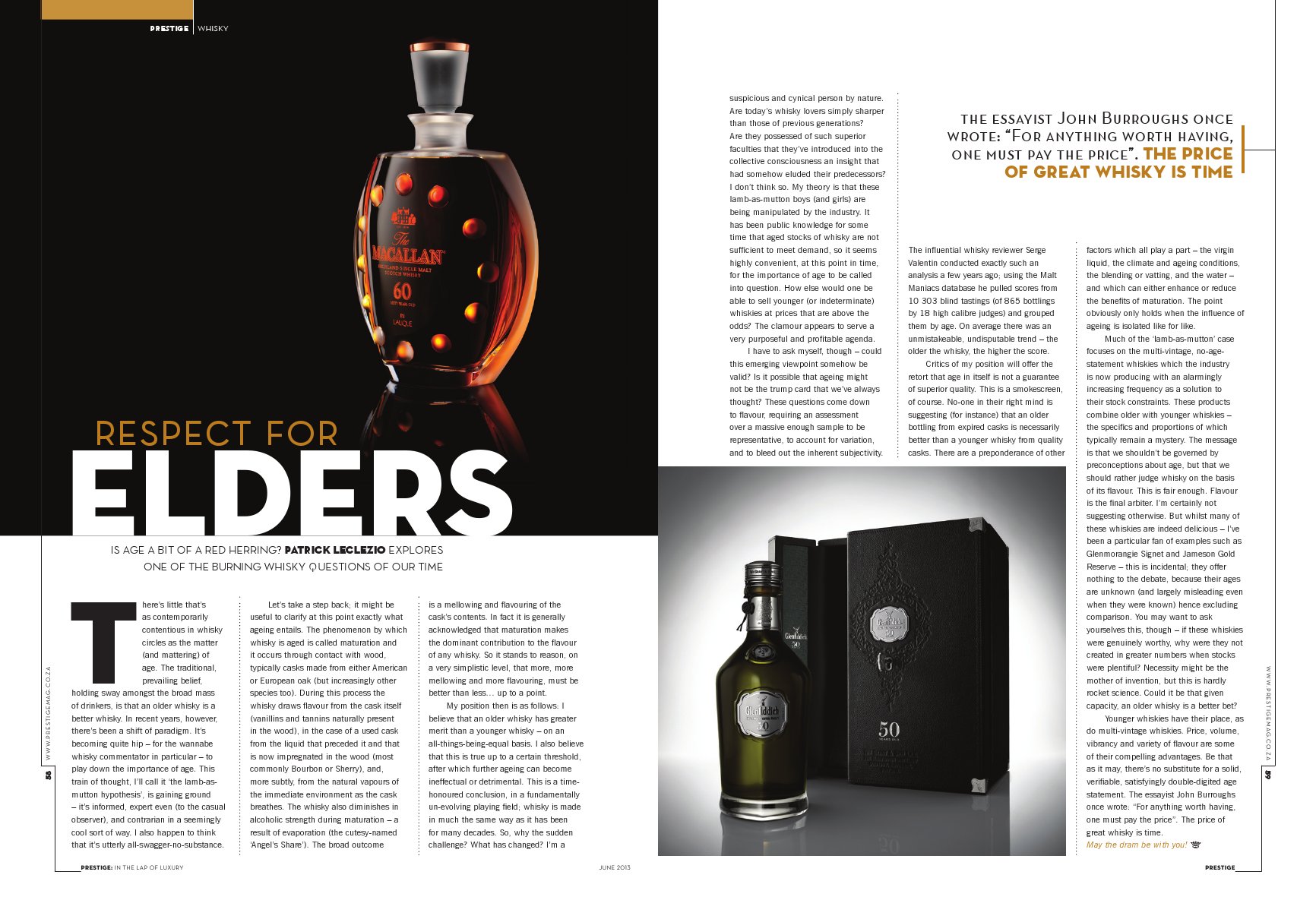
Respect for elders

Is age a bit of a red herring?  Patrick Leclezio explores one of the burning whisky questions of our time.

First published in Prestige Magazine (June 2013 edition).

As it appeared.

As it appeared.

There’s little that’s as contemporarily contentious in whisky circles as the matter (and mattering) of age. The traditional, prevailing belief, holding sway amongst the broad mass of drinkers, is that an older whisky is a better whisky.  In recent years however there’s been a shift of paradigm.   It’s becoming quite hip – for the wannabe whisky commentator in particular – to play down the importance of age. This train of thought, I’ll call it the lamb-as-mutton hypothesis, is gaining ground – it’s informed, expert even (to the casual observer), and contrarian in a seemingly cool sort of way. I also happen to think that it’s utterly all-swagger-no-substance erroneous.

Let’s take a step back; it might be useful to clarify at this point exactly what ageing entails.  The phenomenon by which whisky is aged is called maturation and it occurs through contact with wood, typically casks made from either American or European oak (but increasingly other species too).  During this process the whisky draws flavour from the cask itself (vanillins and tannins naturally present in the wood), in the case of a used cask from the liquid that preceded it and that is now impregnated in the wood (most commonly Bourbon or Sherry), and, more subtly, from the natural vapours of the immediate environment as the cask breathes.  The whisky also diminishes in alcoholic strength during maturation – a result of evaporation (the cutesy-named Angel’s Share).  The broad outcome is a mellowing and flavouring of the cask’s contents. In fact it is generally acknowledged that maturation makes the dominant contribution to the flavour of any whisky.  So it stands to reason, on a very simplistic level, that more, more mellowing and more flavouring, must be better than less…up to a point.

My position then is as follows: I believe that an older whisky has greater merit than a younger whisky – on an all-things-being-equal basis.  I also believe that this is true up to a certain threshold, after which further ageing can become ineffectual or detrimental.   This is a time-honoured conclusion, in a fundamentally un-evolving playing field; whisky is made in much the same way as it has been for many decades.  So, why the sudden challenge?  What has changed?

I’m a suspicious and cynical person by nature.  Are today’s whisky lovers simply sharper than those of previous generations?  Are they possessed of such superior faculties that they’ve introduced into the collective consciousness an insight that had somehow eluded their predecessors?  I don’t think so.  My theory is that these lamb-as-mutton boys (and girls) are being manipulated by the industry.  It has been public knowledge for some time that aged stocks of whisky are not sufficient to meet demand, so it seems highly convenient, at this point in time, for the importance of age to be called into question.  How else would one be able sell younger (or indeterminate) whiskies at prices that are above the odds?  The clamour appears to serve a very purposeful and profitable agenda.

I have to ask myself though – could this emerging viewpoint somehow be valid?  Is it possible that ageing might not be the trump card that we’ve always thought?  These questions come down to flavour, requiring an assessment over a massive enough sample to be representative, to account for variation, and to bleed out the inherent subjectivity.  The influential whisky reviewer Serge Valentin conducted exactly such an analysis a few years ago; using the Malt Maniacs database he pulled scores from 10 303 blind tastings (of 865 bottlings by 18 high calibre judges) and grouped them by age.  On average there was an unmistakeable, undisputable trend – the older the whisky the higher the score.

Critics of my position will offer the retort that age in itself is not a guarantee of superior quality.  This is a smokescreen of course.  No-one in their right mind is suggesting (for instance) that an older bottling from expired casks is necessarily better than a younger whisky from quality casks.  There are a preponderance of other factors which all play a part – the virgin liquid, the climate and ageing conditions, and the blending or vatting – and which can either enhance or reduce the benefits of maturation.  The point obviously only holds when the influence of ageing is isolated like for like. 

Much of the lamb-as-mutton case focuses on the multi-vintage, no-age-statement whiskies which the industry is now producing with an alarmingly increasing frequency as a solution to their stock constraints.  These products combine older with younger whiskies – the specifics and proportions of which typically remain a mystery.  The message is that we shouldn’t be governed by preconceptions about age, but that we should rather judge whisky on the basis of its flavour.  This is fair enough.  Flavour is the final arbiter.  I’m certainly not suggesting otherwise.   But whilst many of these whiskies are indeed delicious – I’ve been a particular fan of examples such as Glenmorangie Signet and Jameson Gold Reserve – this is incidental; they offer nothing to the debate, because their ages are unknown (and largely misleading even they were known) hence excluding comparison.  You may want to ask yourselves this though – if these whiskies were genuinely worthy why were they not created in greater numbers when stocks were plentiful?  Necessity might be the mother of invention, but this is hardly rocket science.  Could it be that given capacity an older whisky is better bet?

Younger whiskies have their place, as do multi-vintage whiskies.  Price, volume, and vibrancy and variety of flavour are some of their compelling advantages.  Be that as it may there’s no substitute for a solid, verifiable, satisfyingly double-digited age statement.  The essayist John Burroughs once wrote: “For anything worth having one must pay the price”.  The price of great whisky is time.  May the dram be with you!

The lone wolf of the north

What does an isolated distillery in the upper reaches of Scotland have to do with the fair city of Cape Town?

First published in Prestige Magazine (May 2013 edition).

As it appeared.

As it appeared.

Note: Apologies on behalf of Prestige Magazine for the factual error in the second paragraph of the printed version.  Wolfburn is not a town.

Wolfburn?  Never heard of it.  I thought that my colleague was making this up.  She’d recounted that in an office nearby a group of guys, specifically one with whom she occasionally met up over a smoke, had claimed to have built a Scotch whisky distillery (called Wolfburn).  I was dubious.  Granted the owners of BenRiach and GlenDronach happen to be Capetonians, but this isn’t Speyside; by and large whisky producers don’t exactly grow on our indigenous trees in the Mother City. It was worth investigation. So it was that a little later, over a glass of orange juice (I had been hoping for new-make Wolfburn, having heard that the stills had begun production in January), I met with one of the owners, an expatriate Scotsman who’d gathered up a team of local investors, to learn a bit more about this intriguing situation.

Wolfburn is located in the far northern Highlands, close to the towns of Thurso and Wick, the latter once having been a major fishing hub.  In the mid-nineteenth century upwards of a hundred thousand fishermen would descend on the area during the season.  This was hard work on a cold, rough sea and it invariably stoked their already considerable thirst for whisky.  There were two distilleries serving this demand, one of which was the original Wolfburn – named after the crystal-clear, pristine stream from which the distillery’s water, then and now, was and is drawn.  Few records remain, just a few references in excise documents, and there’s nothing left of the physical structure.  The only link to the past is in the name and the general location.  I found this sad in a sense – I’ve always been enchanted by the stories and the heritage of Scotch whisky – but we tend get caught up in the romance of history, and we often don’t realise that it comes with its burdens.  Old does not necessarily mean good, and old definitely does not mean efficient.

Freed of these shackles whilst honouring its predecessor nonetheless, the new Wolfburn has been designed to be as efficient as possible, but true to the spirit of whisky.  Its processes, equipment and layout are modern, but it operates on an entirely manual basis, with no computerisation whatsoever.  “It’s the right thing to do”, I’m quoting the visionary behind Wolfburn, “in a world where the bog corporates are building bigger and bigger soulless whisky factories that are barely even distilleries in the real sense of the name”.  This is the type of raw candour that stirs my blood; perhaps we have a new Mark Reynier entering the trade.  Wolfburn then is an up-to-date re-envisaging of whisky-making from the golden age. 

Producing whisky from scratch is an expensive and precarious endeavour; there’s no revenue for at least three years post ignition, and no significant profitability until long thereafter.  Not forgetting of course the usual business risks that come with any new venture.  Efficiency thus is key.  The core team assembled to make this philosophy a reality is made up of General Manager Shane Fraser, a long-time servant of whisky who’s worked at stellar distilleries such as Glenfarclas, Oban and Royal Lochnagar, and Mashman Matt Beeson who was stolen from the beer trade, where mastery of mashing is paramount.  No shortage of pedigree clearly.

What then of the whisky?  Because at the end of the day that’s what really matters.  The malt (made from Optic barley by Munton’s of Yorkshire) is all unpeated, and the still shape is similar to those at Glenfiddich.  The new-make – sadly missing at our meeting I’ll repeat (hint hint) – has had its flavour described as follows: “lovely malty notes with some great nuttiness”, and is being filled into a pleasingly broad variety of casks which should give the Master Distiller a splendid foundation for vatting: first-fill Bourbon barrels, first-fill Sherry hogsheads, second-fill Sherry butts, and second-fill Bourbon quarter casks (the first-fill was an Islay malt so the flavour  from these last casks is expected to be subtly smoky).  There are plans to sell young whisky, probably largely composed from the quarter casks, where maturation might be advanced because of the relatively extensive wood contact, but there’ll be no other compromises in pursuit of quick cash.  You won’t find Wolfburn in a blend (or a blended malt), you won’t find an independent bottling of Wolfburn, and you won’t find Wolfburn “spirit” (white dogs and whatnot).  The strict ethic that has been instituted calls for the production in its entirety to be dedicated to bottlings of proprietary single malts.  Go big or go home.

Wolfburn dunnage

Wolfburn dunnage.

Whilst we’ll all have to wait some three odd years before tasting the whisky, one can stake a claim pretty much immediately.  The first release – limited to 500 bottles – is already being sold at £135 per bottle, and disappearing rapidly I’m told: more than a quarter of the stock is gone.  Interested parties can send an email to info@wolfburn.com to get their purchase rolling. 

The pricing may seem steep for a whisky of barely legal age, but consider that although a few new distilleries have been commissioned in recent years it’s still a hell of a rare thing to own an inaugural bottling.  I’m not a speculator myself but this appears to be worth a long-term punt.  I know I speak for many whisky lovers though when I say that if I were to buy I would do so not for the investment but for the satisfaction that I would be one of the first – ever and for all time – to savour this sweet nectar.  And the almost fraternal Cape Town connection should make it all the sweeter.  May the dram be with you.

Out and about with whisky

The Islay episode.  A trip to the Big Smoke.

First published in Prestige Magazine (April 2013 edition).

As it appeared - p1 & p2.

As it appeared – p1 & p2.

As it appeared - p3.

As it appeared – p3.

I share a tradition with a great mate of mine: whenever we see each other the one who’s done the travelling will bring the other a good bottle of whisky.  It’s not expected, it’s something that has just evolved, unspoken; it happened one day and has kept happening since.   Unfortunately we don’t see each other often – a factor of distance and circumstance – but when we do we tend to sit down over a series of solid drams, partaking of the seamless camaraderie and easy conversation that comes from long acquaintance.  I’m describing a synergy, I would think, with which many whisky lovers can identify – whisky and friendship each enhanced by the other.  Recently, when I had it in my mind to embark on a whisky pilgrimage, he was the first person I contacted to accompany me.

There are many conceivable places to which one could travel to pay homage at the altar of whisky, but I’ll venture out on a limb in an attempt to narrow the field: the location of most significance, the Mecca, Jerusalem and Rome of whisky, the area on earth more than any other imbued with its very soul, is a waterlogged little island, stranded in the Hebrides off the west coast of Scotland, called Islay.  I ascribe this bold, rather categorical assertion to two observations:

Firstly, most obviously, is the voluminous presence of peat – the spongy, semi-decomposed vegetation to which the heritage of malt whisky is inextricably linked. It is at the heart of the lore. In the auld days it was peat which was most prolifically used to arrest the germination of barley and hence produce the malt for whisky.  Its contribution went beyond the functional purpose of creating a heat source, stretching into the essence of the whisky itself.  The smoky flavour which it imparts came to be a signature if not a defining feature of Scotch whisky.  And of all the whisky places in the entire whisky world there is none more synonymous with peat than Islay.

Secondly, less obviously from afar, but quite evident once you arrive, is the dedicated, unwavering, wholehearted, fixated focus on whisky.   Notwithstanding the sheep we spotted (and the odd cow), the few crops we were told were being grown somewhere (but of which we saw no signs), and the occasional lines that are likely cast in the water, there’s not much else happening on Islay other than whisky, whisky and more whisky.   I doubt that there’s any other self-contained area in the world that’s more committed to whisky – to the exclusion of everything else – than this curious place, which has fittingly established itself as one of the five official whisky regions of Scotland.

So Islay presents itself convincingly and self-assuredly as a destination of preference for the whisky tourist.  Getting there however is another matter entirely; combine the obscure geography with foul weather and you get what can often turn out to be a logistical challenge.  Our hideously-expensive, short flight from Glasgow – less than a third of the distance from Durban to Joburg, some three times the cost – was cancelled because of a bank of low-lying clouds prevailing over Islay’s Glenegedale Airport, throwing our plans into disarray.  We started frantically evaluating alternative options.  Another airline?  There are none servicing this route (or any other route into Islay).  Renting a car and catching the ferry?  There are only three ferries a day and we’d miss the last one.  Luckily, by outsprinting the others on the cancelled flight to the customer services counter (with some measure of guilt, many of them being geriatrics), we managed to get ourselves on the next morning’s flight (the only inbound flight on a Saturday).  The locals informed us that this was a regular occurrence, ostensibly the reason for the high cost of the flight (the airline probably has to feed and accommodate one in every three passengers).  There are thus, seemingly, a few vital qualities required of a potential visitor to Islay – persistence and flexibility.  Once there though prepare yourselves to enter an unparalleled whisky wonderland.

Islay is only 40 kilometres long by 24 broad yet it boasts eight distilleries within that small area – or rather, as was pointed out to me by an industry veteran, seven distilleries and a micro-distillery.  Short of gerrymandering a similar sized territory in Speyside, this is pretty much as impressive a distillery density as in existence; it takes no longer than an hour to drive from any one to any of the others (unless, like me, you opt for a few unscheduled stops on the side of the road to investigate the boggy peat banks dotting the landscape).  They range in scale from Kilchoman, the micro-producer, to Caol Ila, which devotes the bulk of its output to Diageo’s muscular blended whisky portfolio, most notably Johnnie Walker Black Label.

A quick aside at this stage to deal with the issue of pronunciation; Islay’s Celtic heritage is apparent in the names of its distilleries, which can be phonetically baffling to the uninitiated, but lyrical and meaningful once through the door.  This is important stuff.   You don’t want to be sitting amongst the locals at the White Hart in Port Ellen on a Saturday night butchering their language as you’re calling for a dram.  Indeed Islay (eye-la) itself is often botched as “eye-lay” or, most horrifically, “iz-lay”.  This cringe-worthy scenario is best avoided – read on.  The two distilleries (and whiskies of course) with which people usually have the most difficultly are coincidentally located adjacent to each other: Bunnahabhain (Bon-na-ha-ven), meaning “mouth of the river” and Caol Ila (Ka-lee-la), meaning “Sound of Islay”, the body of water over which it perches.  The quest for linguistic purity though is not always straightforward, especially in Scotland.  Even within its parent company, there’s no definitive consensus about Bunna’s pronunciation; some enunciate the first syllable as “bun” (as in a pastry), whilst others, including Distillery Manager Andrew Brown, opt for “bon” (as in Jovi).  Other pitfalls include the overtly deceptive Bruichladdich (brook-laddie), the more subtly deceptive Bowmore (bo-more), and the confounding Laphroaig (la-froyg), with its close cluster of vowels. The remainder, Lagavulin (la-ga-voo-lin), Ardbeg (ard-beg), and Kilchoman (kil-ho-min), roll themselves altogether more easily off an anglicised tongue.

Whilst we were out exploring the Port Ellen nightlife (somewhat limited), and exercising our Gaelic proficiency (somewhat erratic), my mate decided to order an Octomore, famed for being the most highly peated whisky ever produced.  As I alluded to earlier peat is central to life on Islay; it has been used by the islanders (Islayanders?) as a source of fuel since time immemorial, and whilst it might be less commonly used for that purpose today we were told that some people still haul out their “fals” (purpose-built peat hewing tools) and cut peat for the sport of it.  Peat is in their blood, metaphorically, and in their whisky, literally, although more so in some than others.  The peat levels in whisky are measured in parts per million phenols (ppm), and each distillery pegs an approximate point on the phenol scale for the bulk of its production. Ardbeg for instance has a standard peating level of 55ppm, the highest on Islay (and anywhere else), but will occasionally vary it for specific products: Blasda is much lower, Supernova is much higher.

Peat smoke is the most easily identifiable flavour in whisky, which I think is why it resonates with certain people.  This is probably a contributing reason for Islay’s iconic status.  I remember as a novice feeling a sense of satisfaction (hey, I’m getting this!) from being able to spot a peated malt.  The smoky flavour typical to Islay malts is even more distinctly recognisable; it is pungent and intense with medicinal, briny, and iodic overtones, stemming from the seaweed, and other coastal vegetation and material (including shells), from which the peat was compacted, and from its saturation by ocean spray.  This flavour sets it apart from other peated whiskies, made using other differentiated sources of peat – Highland, Orkney, Skye and so forth.  The Octomore (fifth release), which weighs in at a throat-constricting 169ppm, might be an Islay malt in name, but with its malt sourced from Bairds of Inverness in the Highlands, it doesn’t share the same defining genes as its peated Islay brethren.

Our itinerary kicked off at Bowmore, situated conveniently close the airport – especially given our delayed arrival.  Bowmore and Laphroaig, which unfortunately we didn’t get to visit, are in a sense the most complete distilleries on the island, in that they both still do their own maltings, or, rather, a proportion thereof, on site – a practice which has largely died out.  The others source malt either from the industrial maltings at Port Ellen, or from the mainland.  Now, a cautionary note:  distilleries are factories; they’re quaint, they’re old (mostly), and they’re picturesque, but they’re still factories.  They may fascinate me personally but I have (just) enough self-awareness to realise that this sentiment is unlikely to be universal.  So I’m going to focus on something altogether more consensually exciting – the whiskies!  As we meandered our way from distillery to distillery, enjoying the desolate Islay scenery through a steadily increasing perceptual haze, we enjoyed the most awesome of all whisky tasting adventures.  The magnificent bar at Bowmore, where we were poured stiff drams of the 15YO Darkest, the 18YO and the 10YO Tempest, gave way to the more rustic surrounds of Bruichladdich.  Energetic, experimental, and prolific; this distillery can probably claim the widest range of products on the island – certainly in the past decade.  What it lacks in aged stocks (there was no production between 1994 and 2000) it makes up in daring.  I was particularly pleased to taste Nostalgia, a limited edition 20YO whisky fast-finished (or aced) in Gaja Barolo casks – and a typical example of the distillery’s style for pre-closure distillations.   Our final stop on the first day was Lagavulin, where we were hosted to a tasting in an old style drawing room.  One of my favourite Islay malts, the Lagavulin 16YO, was trumped by the Distiller’s Edition (effectively the 16YO turbo-charged by a further three to six months of extra maturation in PX casks), and by the incredible 21YO, a treat of whisky, although somewhat steep at about R4900 equivalent.  We settled ourselves into the comfort of the leather armchairs, and, before we knew it, closing time had come and gone.  The distillery staff had to pry us loose to eject us from the premises – the whisky was that good.

The treasures didn’t ease up on the next round of visits.  Bunnahabhain served up the recently launched 40YO (outstanding!) and some sherry casks of less common variety, Manzanilla and Amontillado amongst them.  The distillery is splendidly isolated (even from nearby Caol Ila) on the Northern coast of the island; its casks in dunnage virtually on the water’s edge, greedily inhaling the ocean influence.  Finally, we made our way to our last stop, to Ardbeg, to arguably, and I do argue it, the most beautiful and picture-perfect of all Islay’s distilleries.   The white-washed walls, the elegant pagodas, and the seemingly-manicured layout of it spoke of a place in which tremendous pride has been invested.  In our good fortune we had resided in a superb, newly-renovated cottage on the premises (which is available to guests for rental) during the length of our sojourn, so from ambling around the grounds and soaking up the atmosphere our anticipation had been gradually building.  Ardbeg, like Bruichladdich, has gaps in its aged stocks; it was closed from 1981 to 1989, and it only operated on a limited basis between 1989 and 1996.  Necessity is the mother of invention and if ever proof was needed then Ardbeg’s portfolio duly provides it.  Using relatively young whiskies they’ve created a complex, integrated, unique and increasingly acclaimed range.  The Uigeadail, Corryvrecken and Alligator passed our lips – soothed against the cold by Ardbeg infused balm from the cottage – like three prodigies bringing gifts of incense…well, you get the drift.

My intention had been for an epic trip – of fast friends, great whisky, and moments to remember; I wasn’t disappointed.  The writer Iain Banks once suggested: “If you can’t find a Bowmore to fall in love with, you may have to consider very seriously the possibility that you’re wasting your money drinking whisky at all”.  I think the same philosophy is true of each and every distillery on Islay.  May the dram be with you!

Conversation with a master

Meet Ian MacMillan, a Scotsman’s Scotsman and a whisky legend who’s been crafting epic drams for most of his life. I caught up with him when he was in Cape Town recently.

First published in Prestige Magazine (March 2013 issue).

More or less as it appeared.  A few typesetting issues in this version.

More or less as it appeared. A few typesetting issues in this version.

I met with Ian at Harbour House in the Waterfront. I can’t share with you the details of the delicious lunch that we enjoyed, or the delectable wine, or even the crisp sunshine of that magical Cape day. These diversions though, pleasant as they might have been, were unimportant In the context of the occasion.What I can share with you are a few privileged insights from one of the world’s foremost whisky experts.

You’re the Group Master Blender and Head of Distilleries for Burn Stewart. Tell us about your path to this auspicious position.

I’ve spent 40 years in the industry, learning the trade from the ground up, and covering all aspects of distillation. Also, I consider myself lucky to have been blessed with good organoleptic ability, which is crucial, and to have been helped and guided along the way by some great mentors.

How do you spend your time outside of whisky?

I’m a passionate rugby fan. I support Scotland of course, and the Cheetahs when I’m in South Africa. I also have a serious interest in wine, to the point that I have a diploma to show for it.

You’ve visited the country often. What’s your impression of South Africa?

I’ve been coming here for 10 years, and I’ve thoroughly enjoyed each trip. I love the people, I’ve cultivated great friendships, and I can look back on some memorable, unforgettable experiences.

Is there any particularly special moment that you can share with us?

I once drank whisky out of the Currie Cup, shortly after it had been presented to the Cheetahs when they won the tournament. Our brand Scottish Leader is the official whisky of the Free State Rugby Union, so we had special access to the victory celebration. Special enough? (Hell yes)

South Africa regularly ranks within the top 10 markets for Scotch whisky exports. Why do you think whisky has become so popular in the country?

I’ve noticed that South Africans have cultivated palates, that they’re very inquisitive and keen to explore the differences evident in whisky, and that they’re highly motivated to become knowledgable about whisky. Correspondingly, for many years now, there have been lots of good people on the local scene who’ve been working to feed this fire and educate consumers about whisky.

Islay seems to have established itself as a whisky Mecca. Its peated whiskies have developed a cult following. Why do you think this is the case?

It’s a unique place – a small island accommodating seven distilleries and a micro distillery – and it has become iconic because it embodies the true tradition and style of Scotch whisky. Originally all Scotch was made by malting barley using peat fires. I can’t drink smoky whiskies all the time, but when I do I particularly enjoy Lagavulin.

I would imagine that the influx of tourists has risen steadily. Are you worried that this might change the character of the island?

No, not really. Islay thrives on tourism, which is great for the local economy. The inaccessibility of the place and the generally inclement weather puts a cap on numbers and keeps things under control.

Bunnahabhain is well-known as the least peated of the Islay whiskies – the ‘gentle taste of Islay’. In the past there have been significant peated expressions. Are there any plans in place to release new peated variants in the future?

Yes. We started distilling peated whiskies again in 2003, which we’ve infrequently put on the market as limited editions. A Bunnahabhain Mòine (gaelic for peat) 10YO is slated for release in 2014.

You recently launched an unchillfiltered range of Bunnahabhain, replacing the previously chillfiltered versions. Have you been happy with the reception that the new range has received in the market?

Absolutely. It has been a transformative initiative, and the response has been phenomenal. We were the first distillery to take an entire range unchillfiltered. It’s been personally very satisfying – I fought for this move for many years.

The conventional wisdom is that chillfiltration removes flavour, however I recently came across a blind tasting experiment in which a group of four experienced tasters unanimously preferred chillfiltered versions of the same whisky. Obviously it’s difficult to draw conclusions from such a limited sample, but it raises interesting questions. Perhaps chillfiltration in certain cases might remove offensive congeners and actually improve a whisky. How would you respond to such a claim?

It would depend on the whiskies involved, and on those individuals and their palates. Chillfilitration might well disguise or ‘correct’ an error in distillation and/or maturation. In terms of our whiskies at Burn Stewart, there is no doubt that they’ve been enhanced by the removal of the chillfiltration process. You might want to note that Dave Broom (a leading whisky writer) concurs.

Whisky has been made in much the same way for hundreds of years. What, in your opinion, is the most significant change that has taken place in the modern era?

I’m a traditionalist. I don’t believe that whisky making should be computerised and automated. I find it sad that some distilleries are now run with virtually no people. Taking away the human element destroys the myth and heritage of whisky, and eventually it will lead to a blandness in flavour.

What can we expect from Bunnahabhain – that you’re able to disclose – in the medium term?

Burn Stewart has only owned Bunnahabhain for 10 years. The only variant at the time of purchase was the 12YO. We’ve introduced 25 variants since that time. The Bunnahabhain spirit ages particularly well, and it’s an exciting whisky with which to work, so we’ll continue to experiment. I’m specifically very excited about Mòine.

What’s your favourite whisky, Bunnahabhain or otherwise, and how do you drink it?

Whatever’s in my hand when the question is asked! Seriously, whisky is a mood drink so my preferences vary accordingly. I appreciate many outside of our stable (I mentioned Lagavulin earlier). I have a great respect for others in the industry doing the same job.

And I usually drink my whisky with a dash of water.

A message from Ian to all Prestige Magazine readers: may the dram be with you!

Whisky heaven

This labour of love, the first of its kind, offers a whisky experience beyond that of just shopping.

First published in Prestige Magazine (February 2013 edition).

As it appeared - page 1.

As it appeared – page 1.

As it appeared - page 2.

As it appeared – page 2.


It’s rare that I lament being in Cape Town rather than Joburg. Recently however I experienced one of those moments, because my brother in whisky (and yours), Marc Pendlebury, opened South Africa’s first dedicated, speciality whisky store.  Located in Hyde Park Corner shopping centre (Hyde Park, Johannesburg) this gem of a shop is a mouth-watering development for local whisky lovers.  Marc is best known on the whisky scene as WhiskyBrother, one of the most established and prolific South African whisky bloggers.  I caught up with him long distance to ask him about the venture and about his whisky journey.

—-

When did you become passionate about whisky and how did it happen?

I was a “whisky drinker” for several years before the passion took hold, which was about 8 years ago. It began when I received an 18yo Speyside single malt. It was unlike anything I ever had drunk up and it sparked my curiosity and a desire to understand how and where the differences arise with regard to flavour and whisky styles.

What’s been the most magical moment on your whisky journey?

I’ve shared many memorable moments with various whisky friends quietly savouring a pour of something spectacular, but my trip to Islay a few months back definitely qualifies as the most magical. The whole island is shrouded in whisky magic, and to have had the opportunity to meet the people behind the wonderful Islay malts and taste whiskies directly from the casks in the warehouses was a moving experience for a whisky geek like me.

WhiskyBrother was originally (and still is) your blogging persona.  How did you come up with the name?

Knowledge is a life-long pursuit, and as a whisky enthusiast I am continually learning and experiencing new aspects of whisky every day.  I didn’t think that I qualified for a moniker like Dr Whisky or Whisky Guru. The brother extension was about showing my intermediateness, as well as the camaraderie I so often find among my fellow enthusiasts. Also, I thought brother was much more approachable and accurately reflected my personality.

Can you share with us a bit about your background and your life away from whisky?  What are some of your other pastimes?

I like to keep busy, so it’s a constant challenge to try to balance my work and personal life. I’m currently finishing my MBA – I probably should have done so before starting on the shop but you can’t keep a passionate idea supressed!

Time with my family and friends is important to me. I’m a bit of a news, tech and social media junkie so I’m often flipping through the various news channels/sites/magazines or engaging on various social platforms. I also play touch-rugby once a week and try squeeze in a run, gym session or walk in the park with my dogs whenever time allows.

Tell us about that moment (or perhaps it was a process) when you decided to pack it all in to start a whisky shop.

It was very much a process! As a serious enthusiast I wanted to frequent a store that specialised in whisky, and so, about five years ago, I thought it would be something great to create, if the time came and it still didn’t exist. Well the years passed and no store appeared, so in mid-2011 I considered it more seriously and started playing with the numbers and scribbling business plan ideas. One thing led to another, and once I was successful in raising the capital in early 2012 it was full-steam ahead.

You stock an extensive selection of whiskies and whisky-related items.  What are some of the highlights?  Is there anything that’s particularly special to you?

My first highlight is the extensive collection! Seeing so many brands under the same roof is a special sight to behold. If I had to name a few of which I’m particularly fond, I would have to include: Macallan Fine and Rare 1989 (the only one in the country), Dalmore 1978 31yo, Glenmorangie Pride (now sold) and Glenfiddich 40yo.

Apart from these more exclusive and limited items, I am equally pleased to stock the ranges from smaller, independent producers including BenRiach, Springbank, GlenDronach, Kilchoman, Compass Box and Michel Couvreur.

What makes the WhiskyBrother store different from other liquor speciality stores that focus (albeit not exclusively) on whisky?  What can whisky lovers expect that would delight them when they visit your store?

The fact that it is strictly whisky, and only whisky. Whisky is a specialty drink and it deserves a specialty store. The store was built intentionally to showcase the amazing whiskies available and the design has included many components of whisky production and history – from the use of copper and untreated oak staves, to the presence of used whisky casks and images of distilleries.

Next would be the large selection on offer. It’s not about only stocking the big brands with the big marketing budgets. I’d like to think all whiskies are equal on the WhiskyBrother shelves; it is up to the consumer to decide on preference. I have as many brands and expressions as is available in our market, as well as a whisky or two you won’t find anywhere else in SA.

Lastly, a specialty store must provide specialty service. I am personally working in the store for the foreseeable future. The whisky consumer deserves to be assisted by someone who has solid whisky experience and can recommend, engage and inform.

My intention is to provide an experience, not just retail whisky.

What’s on top of the list for your next whisky adventure?

I’m currently organising a group tour to Scotland (and plan to make it a quarterly activity), and I’m working on getting a cask bottled that I personally selected.

—-

Nice guy, great whiskies, impressive store.  Get over there and check it out.  May the dram be with you!

Walking tall

A few months ago I interviewed Taygan Govinden, the South African brand manager for Johnnie Walker.

First published in Prestige Magazine (November 2012 edition).

As it appeared.

As it appeared.

Note: Apologies on behalf of Prestige Magazine for the spelling error in the sub-title of the printed version.

PL: Locally you’re the man at the wheel of the world’s biggest whisky brand.  Tell us a bit about yourself.

TG: I’m Durban born and bred but I’ve also lived and worked in the UK and now I’m based in Cape Town.  My background is in analytics, which I think has stood me in good stead for what I’m doing now.  I’m a big cricket fan, and I enjoy sports in general.  Basically I’d describe myself in a nutshell as a passionately South African guy with strong family values.

PL: Johnnie Walker sold 18 million cases in 2011, leaving its rivals trailing by quite some distance.  The brand seems to be living its legend – keep walking indeed.  What’s the secret to its phenomenal success?

TG: The brand has a pioneering spirit that drives us to innovate as we respond and adapt to our changing consumer preferences.  Our heritage is based on the history and tradition of crafting big flavoured whiskies.

PL: The launch of Platinum Label forms part of some wider changes to the core portfolio.  Can you elaborate on what’s been involved?

TG: We’ve introduced two new variants – Platinum Label and Gold Label Reserve.  At the same time we’re gradually phasing out the old Gold and Green Labels.  We are committed to ensuring that our full range of whiskies meet both existing consumer demand and further positions us to fully realise the evolving consumer opportunities of today and tomorrow.  We believe that these changes will allow us to optimally realise these objectives.

PL: Whilst it’s still dwarfed by Blended whisky, Malt is on the rise.  Last year Glenfiddich became the first single malt to sell a million cases.  Green Label itself is the world’s fifth best-selling Malt whisky.  So it might be seen as somewhat curious – in an era showing early signs of an increasing appreciation for Malt whisky – that this variant should be discontinued.  Can you give us some insights into the rationale for this decision?

TG: We are evolving our range to meet existing consumer needs and build on our heritage of innovation of crafting flavours for contemporary tastes. The success we have seen with Gold Label Reserve in the Asian market gives us confidence that this variant offers a more compelling choice for our market.

PL: Will you be launching the Gold Label Reserve in South Africa?  If so, can you give us a sneak peek?

TG: Yes, we’re launching it locally in November. Our consumers can look forward to a blend of premium Scotch whiskies delivering a perfectly mixable whisky with a very smooth taste.

PL: Platinum Label replaces Gold Label, which will now be phased out.  What is the difference between the two?

TG: Platinum Label is an entirely new offering and not a reinterpretation of Gold Label.  It is crafted from the very best 18 year-old Scotch Whiskies with a new, distinct flavour profile.  While Gold Label is delicate and creamy, Platinum Label reflects a strong, sweet and elegant Speyside style with subtle smokiness, stewed fruit, malty cereal, smooth creamy vanilla, and tangerine sweetness.

PL: I recently passed through a duty-free store and I couldn’t help but notice that the price of Platinum Label is some 44% higher than Gold Label.   They’re both 18YO and I would imagine that Gold Label contains high-quality, well-aged whiskies.  What’s the basis for Platinum Label’s relatively more premium pricing?

TG: It should be priced at a 10% to 20% premium locally.  Platinum Label is a completely different whisky to Gold Label and so they should not be compared. The age statement is the only link between these two whiskies.

PL: What will be Platinum Label’s recommended retail pricing in South Africa?

TG: R999.99

Dear, dear drams

No, I’m not expressing affection for my favourite drink.  I’m reflecting on whether I can afford to part with a few limbs to enjoy it, because some whiskies really do cost an arm and a leg.

First published in Prestige Magazine (Best of the Best edition 2012).

As it appeared.

As it appeared.

I’ve always found the free market to be a wonderful concept.  Left to their own devices the complex forces that govern economics will invariably find equilibrium – a phenomenon which Adam Smith, one of the fathers of economic theory, articulated as the “invisible hand”.  In my Darwinian view of the world this idea resonates with the natural order of things – it just seems right.  But is it really?  This order has manifested itself in the whisky sphere in recent times in the guise of booming demand interacting with sparse supply, and it has led to situation of spiralling prices…an outcome that is apparently without limits.  By the time this column is published a bottle of whisky would have gone on sale on our shores for the heart-stopping price of R1.4 million.

This might potentially be a new high for South Africa (it needs to sell first), but the trend towards extravagantly priced whisky is well established.  Globally the oldest and rarest whiskies from the most prestigious brands, Macallan, Glenfiddich, Dalmore and others, have been commanding millions (of Rands) for some time.  Right here the Balvenie 50YO very recently sold for R230,000, joining a handful of bottles to clear the R100 000 mark on the local market.  Even for whisky lovers like myself, for those of us who truly do appreciate the value of great whisky, these numbers are absolutely staggering, almost perverse.  We could just shrug our shoulders, dismiss the matter and carry on with our lives; and at the end of the day that’s exactly what we’ll have to do – after all there’s enough good whisky priced on reasonable enough scales to cater for most people – but it’s worth giving it a little bit of thought and asking a few questions nonetheless.

First though a little bit about the whisky with the golden, nay diamond, price tag: the Diamond Jubilee Blended Scotch Whisky by John Walker & Sons.  This is the same house that produces Johnnie Walker, the world’s best-selling brand of whisky, but somewhat confusingly, they’ve corralled some of their premium whiskies under a separate trademark.  For all intents and purposes though this is a Johnnie Walker whisky.  It was inspired by the Queen’s Diamond Jubilee, an auspicious occasion no doubt for those interested in that type of thing, but also a bandwagon for limited edition products of every stripe.  Regardless of whether the hallmark has been devalued by this stampede, the John Walker version stands out as the remarkable product that it is.  It’s a blend, as the name suggests, not a single-malt, which I found surprising for a whisky at this price level.  But perhaps I should question myself?  Many whisky producers are at pains to put out the message to that blends can be every bit as good as single malts.  This is probably self-serving, but I tend to agree, especially on an intrinsic basis.  Anyhow, the product comes with various jubilee cute-isms – all components are vintage whiskies from the same year as the Queen’s coronation, the marrying casks are made from oak from the Queen’s estates, the diamond-shaped decanter stands on six legs (one for each decade of the Queen’s rule), and bottling was effected exactly sixty years to the day from that of the Queen’s accession – and a long collection of accoutrements of which I’ll just list a few highlights – a silver decanter collar set with a half-carat diamond (the decanter itself being de rigueur Baccarat), a pair of bespoke lead crystal tumblers hand engraved with wildlife scenes from the Queen’s estates, and a cabinet made from oak from the same harvest and source as the marrying casks, as well as special timbers drawn from around the Commonwealth.  It goes beyond mere product – it is an objet d’art.  Indeed this is probably the one advantage of the elevated cost of such whiskies: it creates an opportunity to do something particularly special and imaginative with the packaging.  The Balvenie 50YO is notably accommodated in a cylindrical box made of 49 rings of seven Scottish grown timbers.

Impressed?  I am.  But the questions won’t go away.  I asked this one of various whisky creators:  Premium whisky has become so expensive that many of the oldest and rarest whiskies are completely out of reach for the average whisky lover.  Some of the pricing seems completely overblown and markedly unrelated to the cost of creating the whisky.  It could be argued that the industry is exploiting the current market dynamics to harvest excessive profits at the expense of its genuine, long-term, loyal consumers.  How would you answer such a claim?  The response that most struck a chord for me came from David Stewart of Balvenie who commented as follows: “I’m not involved in pricing but premium whisky has always been an expensive item, appreciated by few”.  Fair or not depending on how one might choose to interpret the word “appreciated”.

I personally don’t begrudge the situation.  The finer things in life, be they whisky or anything else, cost money, and, generally, are only available to a minority.  This is the natural order.  And it makes the moment of consumption – anticipated, hard-earned (in most cases), and long awaited – all the more special.  The lingering regret for me is that many of these types of whiskies are bought for collections or as investments.  There is a high probability that they might never be drunk.  This means that many of the ostensibly finest whiskies in the world are destined to remain locked in glass in perpetuity.  The John Walker Diamond Jubilee is sold with a 10cl taster bottle, but most of these won’t be opened either I would think because it’ll potentially reduce the value of the investment.  On that rather sad note – may the dram (make it a special one for the festive season) be with you!