Vodka versus vodka

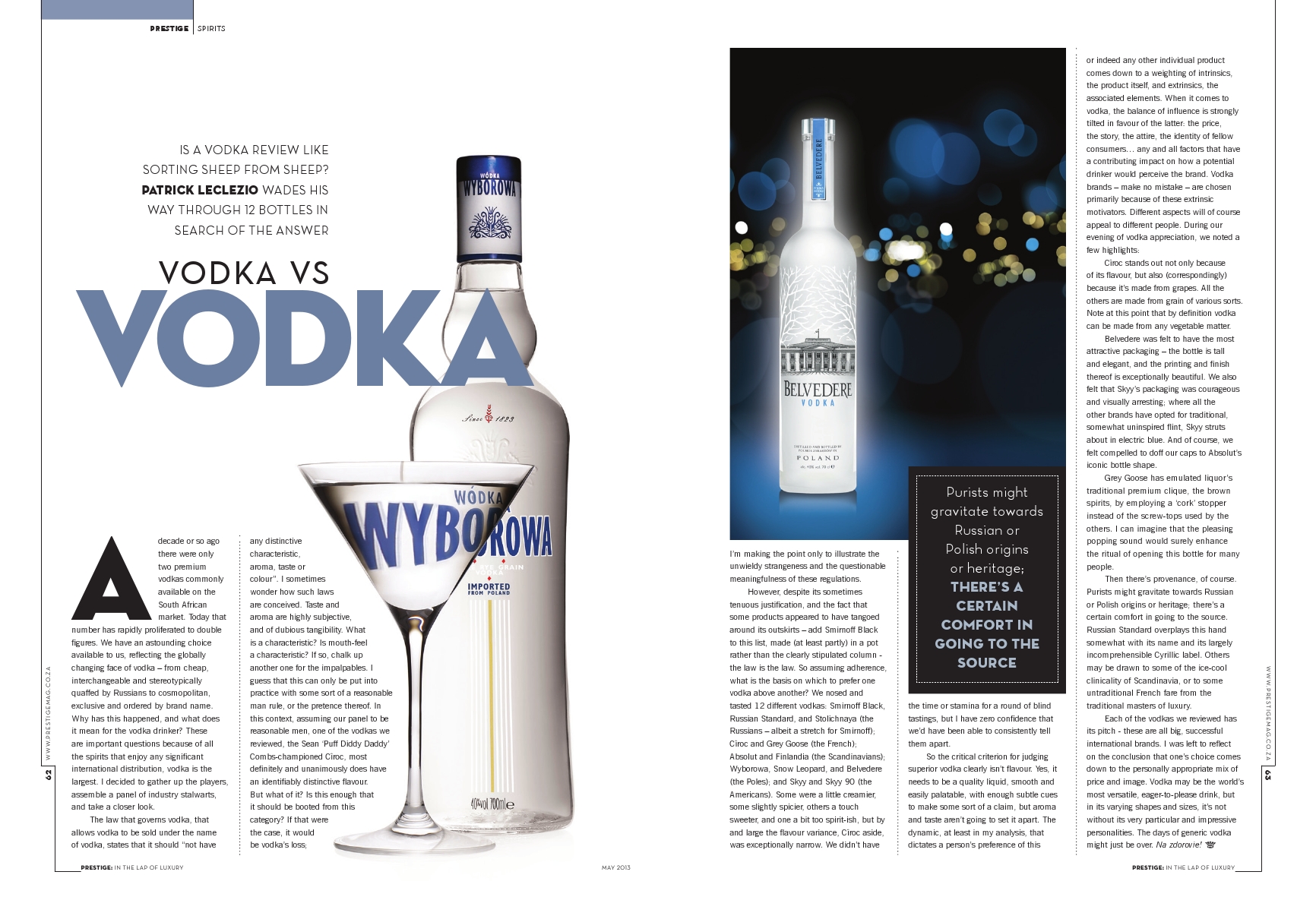
Is a vodka review like sorting sheep from sheep?  I waded my way through twelve bottles in search of the answer.

First published in Prestige Magazine (May 2013 edition).

As it appeared.

As it appeared.

A decade or so ago there were only two premium vodkas commonly available on the South African market. Today that number has rapidly proliferated to double figures.  We have an astounding choice available to us, reflecting the globally changing face of vodka – from cheap, interchangeable and stereotypically quaffed by Russians to cosmopolitan, exclusive and ordered by brand name.  Why has this happened, and what does it mean for the vodka drinker?  These are important questions because of all the spirits that enjoy any significant international distribution vodka is the largest. I decided to gather up the players, assemble a panel of industry stalwarts, and take a closer look.

The law that governs vodka, that allows vodka to be sold under the name of vodka, states that it should “not have any distinctive characteristic, aroma, taste or colour”.  I sometimes wonder how such laws are conceived.  Taste and aroma are highly subjective, and of dubious tangibility.  What is a characteristic?  Is mouth-feel a characteristic?  If so chalk up another one for the impalpables.  I guess that this can only be put into practice with some sort of a “reasonable man” rule, or the pretence thereof. In this context, assuming our panel to be reasonable men, one of the vodkas we reviewed, the Sean “Puff Diddy Daddy” Combs-championed Cîroc, most definitely and unanimously does have an identifiably distinctive flavour.  But what of it? Is this enough that it should be booted from this category?  If that were the case it would be vodka’s loss; I’m making the point only to illustrate the unwieldy strangeness and the questionable meaningfulness of these regulations.

However despite its sometimes tenuous justification, and the fact that some products appeared to have tangoed around its outskirts – add Smirnoff Black to this list, made (at least partly) in a pot rather than the clearly stipulated column – the law is the law.  So assuming adherence what is the basis on which to prefer one vodka above another?  We nosed and tasted twelve different vodkas: Smirnoff Black, Russian Standard, and Stolichnaya (the Russians – albeit a stretch for Smirnoff); Cîroc and Grey Goose (the French); Absolut and Finlandia (the Scandinavians); Wyborowa, Snow Leopard, and Belvedere (the Poles); and Skyy and Skyy 90 (the Americans).  Some were a little creamier, some slightly spicier, others a touch sweeter, and one a bit too spirit-ish, but by and large the flavour variance, Cîroc aside, was exceptionally narrow.  We didn’t have the time or stamina for a round of blind tastings but I have zero confidence that we’d have been able to consistently tell them apart.

So the critical criterion for judging superior vodka clearly isn’t flavour.  Yes, it needs to be a quality liquid, smooth and easily palatable, with enough subtle cues to make some sort of a claim, but aroma and taste aren’t going to set it apart.  The dynamic, at least in my analysis, that dictates a person’s preference of this or indeed any other individual product comes down to a weighting of intrinsics, the product itself, and extrinsics, the associated elements.  When it comes to vodka the balance of influence is strongly tilted in favour of the latter: the price, the story, the attire, the identity of fellow consumers…any and all factors that have a contributing impact on how a potential drinker would perceive the brand.  Vodka brands – make no mistake – are chosen primarily because of these extrinsic motivators.  Of course different aspects will appeal to different people; during our evening of vodka appreciation, we noted a few highlights:

Cîroc stands out not only because of its flavour but also (correspondingly perhaps) because it’s made from grapes.  All the others are made from grain of various sorts.  Note at this point that by definition vodka can be made from any vegetable matter. 

Belvedere was felt to have the most attractive packaging – the bottle is tall and elegant, and the printing and finish thereof is exceptionally beautiful.  We also felt that Skyy’s packaging was courageous and visually arresting; where all the other brands have opted for traditional, somewhat uninspired flint, Skyy struts about in electric blue.  And naturally we felt compelled to doff our caps to Absolut’s iconic bottle shape.

Grey Goose has emulated liquor’s traditional premium clique, the brown spirits, by employing a “cork” stopper instead of the screw-tops used by the others.  I can imagine that the pleasing popping sound would enhance the ritual of opening this bottle for many people.

Then there’s provenance of course.  Purists might gravitate towards Russian or Polish origins or heritage – there’s a certain comfort in going to the source.  Russian Standard overplays this hand somewhat with its name and its largely incomprehensible Cyrillic label.  Others may be drawn to some of the ice-cool clinicality of Scandinavia, or to some untraditional French fare from the traditional masters of luxury.

Each of the vodkas we reviewed has its pitch – these are all big, successful international brands.  I was left to reflect on the conclusion that one’s choice comes down to the personally appropriate mix of price and image.  Vodka may be the world’s most versatile, eager-to-please drink but in its varying shapes and sizes it’s not without its very particular and impressive personalities.  The days of generic vodka might just be over. Na zdorovie!

Big thanks to Hector McBeth, Ross Shepherd, and Grant McDonald.

The lone wolf of the north

What does an isolated distillery in the upper reaches of Scotland have to do with the fair city of Cape Town?

First published in Prestige Magazine (May 2013 edition).

As it appeared.

As it appeared.

Note: Apologies on behalf of Prestige Magazine for the factual error in the second paragraph of the printed version.  Wolfburn is not a town.

Wolfburn?  Never heard of it.  I thought that my colleague was making this up.  She’d recounted that in an office nearby a group of guys, specifically one with whom she occasionally met up over a smoke, had claimed to have built a Scotch whisky distillery (called Wolfburn).  I was dubious.  Granted the owners of BenRiach and GlenDronach happen to be Capetonians, but this isn’t Speyside; by and large whisky producers don’t exactly grow on our indigenous trees in the Mother City. It was worth investigation. So it was that a little later, over a glass of orange juice (I had been hoping for new-make Wolfburn, having heard that the stills had begun production in January), I met with one of the owners, an expatriate Scotsman who’d gathered up a team of local investors, to learn a bit more about this intriguing situation.

Wolfburn is located in the far northern Highlands, close to the towns of Thurso and Wick, the latter once having been a major fishing hub.  In the mid-nineteenth century upwards of a hundred thousand fishermen would descend on the area during the season.  This was hard work on a cold, rough sea and it invariably stoked their already considerable thirst for whisky.  There were two distilleries serving this demand, one of which was the original Wolfburn – named after the crystal-clear, pristine stream from which the distillery’s water, then and now, was and is drawn.  Few records remain, just a few references in excise documents, and there’s nothing left of the physical structure.  The only link to the past is in the name and the general location.  I found this sad in a sense – I’ve always been enchanted by the stories and the heritage of Scotch whisky – but we tend get caught up in the romance of history, and we often don’t realise that it comes with its burdens.  Old does not necessarily mean good, and old definitely does not mean efficient.

Freed of these shackles whilst honouring its predecessor nonetheless, the new Wolfburn has been designed to be as efficient as possible, but true to the spirit of whisky.  Its processes, equipment and layout are modern, but it operates on an entirely manual basis, with no computerisation whatsoever.  “It’s the right thing to do”, I’m quoting the visionary behind Wolfburn, “in a world where the bog corporates are building bigger and bigger soulless whisky factories that are barely even distilleries in the real sense of the name”.  This is the type of raw candour that stirs my blood; perhaps we have a new Mark Reynier entering the trade.  Wolfburn then is an up-to-date re-envisaging of whisky-making from the golden age. 

Producing whisky from scratch is an expensive and precarious endeavour; there’s no revenue for at least three years post ignition, and no significant profitability until long thereafter.  Not forgetting of course the usual business risks that come with any new venture.  Efficiency thus is key.  The core team assembled to make this philosophy a reality is made up of General Manager Shane Fraser, a long-time servant of whisky who’s worked at stellar distilleries such as Glenfarclas, Oban and Royal Lochnagar, and Mashman Matt Beeson who was stolen from the beer trade, where mastery of mashing is paramount.  No shortage of pedigree clearly.

What then of the whisky?  Because at the end of the day that’s what really matters.  The malt (made from Optic barley by Munton’s of Yorkshire) is all unpeated, and the still shape is similar to those at Glenfiddich.  The new-make – sadly missing at our meeting I’ll repeat (hint hint) – has had its flavour described as follows: “lovely malty notes with some great nuttiness”, and is being filled into a pleasingly broad variety of casks which should give the Master Distiller a splendid foundation for vatting: first-fill Bourbon barrels, first-fill Sherry hogsheads, second-fill Sherry butts, and second-fill Bourbon quarter casks (the first-fill was an Islay malt so the flavour  from these last casks is expected to be subtly smoky).  There are plans to sell young whisky, probably largely composed from the quarter casks, where maturation might be advanced because of the relatively extensive wood contact, but there’ll be no other compromises in pursuit of quick cash.  You won’t find Wolfburn in a blend (or a blended malt), you won’t find an independent bottling of Wolfburn, and you won’t find Wolfburn “spirit” (white dogs and whatnot).  The strict ethic that has been instituted calls for the production in its entirety to be dedicated to bottlings of proprietary single malts.  Go big or go home.

Wolfburn dunnage

Wolfburn dunnage.

Whilst we’ll all have to wait some three odd years before tasting the whisky, one can stake a claim pretty much immediately.  The first release – limited to 500 bottles – is already being sold at £135 per bottle, and disappearing rapidly I’m told: more than a quarter of the stock is gone.  Interested parties can send an email to info@wolfburn.com to get their purchase rolling. 

The pricing may seem steep for a whisky of barely legal age, but consider that although a few new distilleries have been commissioned in recent years it’s still a hell of a rare thing to own an inaugural bottling.  I’m not a speculator myself but this appears to be worth a long-term punt.  I know I speak for many whisky lovers though when I say that if I were to buy I would do so not for the investment but for the satisfaction that I would be one of the first – ever and for all time – to savour this sweet nectar.  And the almost fraternal Cape Town connection should make it all the sweeter.  May the dram be with you.

The water of life

A short, distracted history of distillation, and a tribute to those who made it happen.  I ponder the origins of the fine spirit.

First published in Prestige Magazine (April 2013 edition).

As it appeared.

As it appeared.

An elegant bar.  The gentle clink of rocks glasses.  An array of bottles on burnished shelves.  Unobtrusive service.  Another, sir?  I don’t mind if I do.  Small, measured sips.  An explosion of flavour.  Expanding ripples of relaxation.  Laughter and conversation.  This is a ritual enjoyed by spirits drinkers the world over – a ritual made possible by the magic of distillation.

I’ve often sat back and wondered to myself how it was that this phenomenon came to pass.  By whom, how, and where, in the distant past, the product of a startling imagination, was this remarkable exploitation of nature conceived?  Fermentation I get.  It lends itself to accidental discovery; the juice of a fruit or a sugary plant left standing, the presence of the right organisms, and cheers: a realistic, probable happenstance.  The details of the theory might have had to wait for Pasteur and others, but fermentation was evident enough that people were getting merrily toasted for multiple millennia beforehand.  Distillation though would have been a tougher, altogether-more-deliberate nut to crack.

The basic process, once known, is actually very simple. It uses the different boiling temperatures of the components of a liquid to separate them from each other, and then, once separated, to specifically collect or concentrate one or the other; it is the conversion of sugar to alcohol in fermentation which provides the base which is then concentrated.  The legendary Homer (Simpson, not the guy who wrote the Iliad and the Odyssey) once said:  “In America, first you get the sugar, then you get the power, then you get the women!”  Truer words have never been spoken.  The alcohol from sugar, specifically ethyl alcohol, has a lower boiling temperature than water, its most abundant companion in fermented mixtures, so it can easily be evaporated in isolation and then condensed elsewhere in the form of a powerful, infinitely interesting, and complex liquid known as a distilled spirit.

It is likely then that nature served as the inspiration.  The observation of evaporating and condensing water, and then other liquids put on the boil, would have triggered a dawning realisation.  There are suggestions that distillation was being conducted in various places in the distant past, as far back as 800 BC in China, but the first undisputed evidence of it dates to the Greek colonies in Egypt in the first century AD, where it was being used by alchemists to distil essences for perfumes, balms and other such uninteresting purposes.  It was only much later, certainly in terms of documented fact, in the now teetotalling Arab world ironically (although to be fair it was intended for medicinal purposes), that distillation techniques were applied to alcohol, using a device called an alembic – al-anbīq in Arabic, meaning “still”.

This technology spread gradually to various areas, most impactfully to Europe, where it was added to and refined upon, and used vociferously for the making of acqua vitae, the water of life, which became the basis for our modern spirits tradition.  Stills were developed in various shapes and forms, notably the Charentais used to make Cognac, and the bulbous pot stills used to make whisky.  The structure of a still is believed to have a significant influence on the character of the final liquid, to the point where whisky makers will deliberately reproduce dents and other structural blemishes when replacing their exhausted stills.  Later still (sorry), starting in the early 1820’s and culminating with the device invented by Aeneas Coffey, the Coffey Still, came the onset of continuous distillation, just in time for the Industrial Age with its greater yields, and purer distillates.

Today, sitting in that bar, we’re able to reap the fruits of the toil of our long-gone brothers, selecting from a broad multitude of spirits to satisfy our every whim.  Let’s take break, every now and again, between the brandy and the Benedictine, to doff our caps to those who came before and made all of this possible.  It’s not classical Greek, but let’s not split hairs: Stin Iyiamas!

Out and about with whisky

The Islay episode.  A trip to the Big Smoke.

First published in Prestige Magazine (April 2013 edition).

As it appeared - p1 & p2.

As it appeared – p1 & p2.

As it appeared - p3.

As it appeared – p3.

I share a tradition with a great mate of mine: whenever we see each other the one who’s done the travelling will bring the other a good bottle of whisky.  It’s not expected, it’s something that has just evolved, unspoken; it happened one day and has kept happening since.   Unfortunately we don’t see each other often – a factor of distance and circumstance – but when we do we tend to sit down over a series of solid drams, partaking of the seamless camaraderie and easy conversation that comes from long acquaintance.  I’m describing a synergy, I would think, with which many whisky lovers can identify – whisky and friendship each enhanced by the other.  Recently, when I had it in my mind to embark on a whisky pilgrimage, he was the first person I contacted to accompany me.

There are many conceivable places to which one could travel to pay homage at the altar of whisky, but I’ll venture out on a limb in an attempt to narrow the field: the location of most significance, the Mecca, Jerusalem and Rome of whisky, the area on earth more than any other imbued with its very soul, is a waterlogged little island, stranded in the Hebrides off the west coast of Scotland, called Islay.  I ascribe this bold, rather categorical assertion to two observations:

Firstly, most obviously, is the voluminous presence of peat – the spongy, semi-decomposed vegetation to which the heritage of malt whisky is inextricably linked. It is at the heart of the lore. In the auld days it was peat which was most prolifically used to arrest the germination of barley and hence produce the malt for whisky.  Its contribution went beyond the functional purpose of creating a heat source, stretching into the essence of the whisky itself.  The smoky flavour which it imparts came to be a signature if not a defining feature of Scotch whisky.  And of all the whisky places in the entire whisky world there is none more synonymous with peat than Islay.

Secondly, less obviously from afar, but quite evident once you arrive, is the dedicated, unwavering, wholehearted, fixated focus on whisky.   Notwithstanding the sheep we spotted (and the odd cow), the few crops we were told were being grown somewhere (but of which we saw no signs), and the occasional lines that are likely cast in the water, there’s not much else happening on Islay other than whisky, whisky and more whisky.   I doubt that there’s any other self-contained area in the world that’s more committed to whisky – to the exclusion of everything else – than this curious place, which has fittingly established itself as one of the five official whisky regions of Scotland.

So Islay presents itself convincingly and self-assuredly as a destination of preference for the whisky tourist.  Getting there however is another matter entirely; combine the obscure geography with foul weather and you get what can often turn out to be a logistical challenge.  Our hideously-expensive, short flight from Glasgow – less than a third of the distance from Durban to Joburg, some three times the cost – was cancelled because of a bank of low-lying clouds prevailing over Islay’s Glenegedale Airport, throwing our plans into disarray.  We started frantically evaluating alternative options.  Another airline?  There are none servicing this route (or any other route into Islay).  Renting a car and catching the ferry?  There are only three ferries a day and we’d miss the last one.  Luckily, by outsprinting the others on the cancelled flight to the customer services counter (with some measure of guilt, many of them being geriatrics), we managed to get ourselves on the next morning’s flight (the only inbound flight on a Saturday).  The locals informed us that this was a regular occurrence, ostensibly the reason for the high cost of the flight (the airline probably has to feed and accommodate one in every three passengers).  There are thus, seemingly, a few vital qualities required of a potential visitor to Islay – persistence and flexibility.  Once there though prepare yourselves to enter an unparalleled whisky wonderland.

Islay is only 40 kilometres long by 24 broad yet it boasts eight distilleries within that small area – or rather, as was pointed out to me by an industry veteran, seven distilleries and a micro-distillery.  Short of gerrymandering a similar sized territory in Speyside, this is pretty much as impressive a distillery density as in existence; it takes no longer than an hour to drive from any one to any of the others (unless, like me, you opt for a few unscheduled stops on the side of the road to investigate the boggy peat banks dotting the landscape).  They range in scale from Kilchoman, the micro-producer, to Caol Ila, which devotes the bulk of its output to Diageo’s muscular blended whisky portfolio, most notably Johnnie Walker Black Label.

A quick aside at this stage to deal with the issue of pronunciation; Islay’s Celtic heritage is apparent in the names of its distilleries, which can be phonetically baffling to the uninitiated, but lyrical and meaningful once through the door.  This is important stuff.   You don’t want to be sitting amongst the locals at the White Hart in Port Ellen on a Saturday night butchering their language as you’re calling for a dram.  Indeed Islay (eye-la) itself is often botched as “eye-lay” or, most horrifically, “iz-lay”.  This cringe-worthy scenario is best avoided – read on.  The two distilleries (and whiskies of course) with which people usually have the most difficultly are coincidentally located adjacent to each other: Bunnahabhain (Bon-na-ha-ven), meaning “mouth of the river” and Caol Ila (Ka-lee-la), meaning “Sound of Islay”, the body of water over which it perches.  The quest for linguistic purity though is not always straightforward, especially in Scotland.  Even within its parent company, there’s no definitive consensus about Bunna’s pronunciation; some enunciate the first syllable as “bun” (as in a pastry), whilst others, including Distillery Manager Andrew Brown, opt for “bon” (as in Jovi).  Other pitfalls include the overtly deceptive Bruichladdich (brook-laddie), the more subtly deceptive Bowmore (bo-more), and the confounding Laphroaig (la-froyg), with its close cluster of vowels. The remainder, Lagavulin (la-ga-voo-lin), Ardbeg (ard-beg), and Kilchoman (kil-ho-min), roll themselves altogether more easily off an anglicised tongue.

Whilst we were out exploring the Port Ellen nightlife (somewhat limited), and exercising our Gaelic proficiency (somewhat erratic), my mate decided to order an Octomore, famed for being the most highly peated whisky ever produced.  As I alluded to earlier peat is central to life on Islay; it has been used by the islanders (Islayanders?) as a source of fuel since time immemorial, and whilst it might be less commonly used for that purpose today we were told that some people still haul out their “fals” (purpose-built peat hewing tools) and cut peat for the sport of it.  Peat is in their blood, metaphorically, and in their whisky, literally, although more so in some than others.  The peat levels in whisky are measured in parts per million phenols (ppm), and each distillery pegs an approximate point on the phenol scale for the bulk of its production. Ardbeg for instance has a standard peating level of 55ppm, the highest on Islay (and anywhere else), but will occasionally vary it for specific products: Blasda is much lower, Supernova is much higher.

Peat smoke is the most easily identifiable flavour in whisky, which I think is why it resonates with certain people.  This is probably a contributing reason for Islay’s iconic status.  I remember as a novice feeling a sense of satisfaction (hey, I’m getting this!) from being able to spot a peated malt.  The smoky flavour typical to Islay malts is even more distinctly recognisable; it is pungent and intense with medicinal, briny, and iodic overtones, stemming from the seaweed, and other coastal vegetation and material (including shells), from which the peat was compacted, and from its saturation by ocean spray.  This flavour sets it apart from other peated whiskies, made using other differentiated sources of peat – Highland, Orkney, Skye and so forth.  The Octomore (fifth release), which weighs in at a throat-constricting 169ppm, might be an Islay malt in name, but with its malt sourced from Bairds of Inverness in the Highlands, it doesn’t share the same defining genes as its peated Islay brethren.

Our itinerary kicked off at Bowmore, situated conveniently close the airport – especially given our delayed arrival.  Bowmore and Laphroaig, which unfortunately we didn’t get to visit, are in a sense the most complete distilleries on the island, in that they both still do their own maltings, or, rather, a proportion thereof, on site – a practice which has largely died out.  The others source malt either from the industrial maltings at Port Ellen, or from the mainland.  Now, a cautionary note:  distilleries are factories; they’re quaint, they’re old (mostly), and they’re picturesque, but they’re still factories.  They may fascinate me personally but I have (just) enough self-awareness to realise that this sentiment is unlikely to be universal.  So I’m going to focus on something altogether more consensually exciting – the whiskies!  As we meandered our way from distillery to distillery, enjoying the desolate Islay scenery through a steadily increasing perceptual haze, we enjoyed the most awesome of all whisky tasting adventures.  The magnificent bar at Bowmore, where we were poured stiff drams of the 15YO Darkest, the 18YO and the 10YO Tempest, gave way to the more rustic surrounds of Bruichladdich.  Energetic, experimental, and prolific; this distillery can probably claim the widest range of products on the island – certainly in the past decade.  What it lacks in aged stocks (there was no production between 1994 and 2000) it makes up in daring.  I was particularly pleased to taste Nostalgia, a limited edition 20YO whisky fast-finished (or aced) in Gaja Barolo casks – and a typical example of the distillery’s style for pre-closure distillations.   Our final stop on the first day was Lagavulin, where we were hosted to a tasting in an old style drawing room.  One of my favourite Islay malts, the Lagavulin 16YO, was trumped by the Distiller’s Edition (effectively the 16YO turbo-charged by a further three to six months of extra maturation in PX casks), and by the incredible 21YO, a treat of whisky, although somewhat steep at about R4900 equivalent.  We settled ourselves into the comfort of the leather armchairs, and, before we knew it, closing time had come and gone.  The distillery staff had to pry us loose to eject us from the premises – the whisky was that good.

The treasures didn’t ease up on the next round of visits.  Bunnahabhain served up the recently launched 40YO (outstanding!) and some sherry casks of less common variety, Manzanilla and Amontillado amongst them.  The distillery is splendidly isolated (even from nearby Caol Ila) on the Northern coast of the island; its casks in dunnage virtually on the water’s edge, greedily inhaling the ocean influence.  Finally, we made our way to our last stop, to Ardbeg, to arguably, and I do argue it, the most beautiful and picture-perfect of all Islay’s distilleries.   The white-washed walls, the elegant pagodas, and the seemingly-manicured layout of it spoke of a place in which tremendous pride has been invested.  In our good fortune we had resided in a superb, newly-renovated cottage on the premises (which is available to guests for rental) during the length of our sojourn, so from ambling around the grounds and soaking up the atmosphere our anticipation had been gradually building.  Ardbeg, like Bruichladdich, has gaps in its aged stocks; it was closed from 1981 to 1989, and it only operated on a limited basis between 1989 and 1996.  Necessity is the mother of invention and if ever proof was needed then Ardbeg’s portfolio duly provides it.  Using relatively young whiskies they’ve created a complex, integrated, unique and increasingly acclaimed range.  The Uigeadail, Corryvrecken and Alligator passed our lips – soothed against the cold by Ardbeg infused balm from the cottage – like three prodigies bringing gifts of incense…well, you get the drift.

My intention had been for an epic trip – of fast friends, great whisky, and moments to remember; I wasn’t disappointed.  The writer Iain Banks once suggested: “If you can’t find a Bowmore to fall in love with, you may have to consider very seriously the possibility that you’re wasting your money drinking whisky at all”.  I think the same philosophy is true of each and every distillery on Islay.  May the dram be with you!

Ambush Marketing

Blast from the past just for fun, and for those interested in Marketing.

First published in Marketing Mix (Vol. 22, no 8, sometime in 2004).

As it appeared p1.

As it appeared p1.

As it appeared p2.


Figuring out the French

They’re the captains of fine liquor, but navigating their spirituous seas can be challenging.  I charted a course to the heart of French brandy.

First published in Prestige Magazine (March 2013 edition).

As it appeared – p1.

As it appeared - p2.

As it appeared – p2.

The fruit of the vine is often described as noble, with good reason.  Its contribution to our liquid landscape is arguably unparalleled, having given us wine, in all of its myriad splendour; champagne and its fellow bubblies; sherry, port and their other lessor-known fortified brethren; assorted liqueurs; grappa; eaux de vie; and, last but not least, a variety of brandies.  It was in France that the arts of exploiting the grape first reached its current cultivated proportions; specifically it is where the making of grape brandy became established and renowned.  Today the French dominate this sphere – their brandies are globally the most highly acclaimed, and the most widely and voluminously sold.  If you enjoy your brandy then you’d be well advised to seek out and appreciate their delicious nectar, if you haven’t already.  The latter though may not be as straightforward as it seems, at least not fully; the French are an indecipherable bunch at the best of times, and their brandies, replete with seemingly unintelligible jargon, are no exception.  Here then is a short guide to traversing the top tier.

What does AOC mean?

French brandy comes in three broad types, distinguished from one another by the Appellation d’Origine Contrôlée or AOC.  The AOC is the system by which France governs the production and marketing of certain of its agricultural products.  It is largely but not wholly based on the concept of terroir; essentially certain regions have acquired an exclusive right to assign their names to traditional product categories, and to legally compel production according to particular methods and standards.  This status confers a special cachet to subscribing products, which generally translates to a price premium in the marketplace.  There are two appellations specific to brandy: Cognac, the most well-known, and Armagnac, the most ancient. Additionally, for the sake of completeness, one should note that there are also often “sub” appellations to which distinct rules apply; Armagnac for instance can be Bas-Armagnac, Armagnac-Ténarèze, Haut-Armagnac, and Blanche d’Armagnac.  Cognac is slightly different in that it allows for the specification of Crus, much like Champagne, denominating strictly classified areas within the region in which the grapes used in the so-labelled products were grown – examples of these being Grand Champagne, Petit Champagne and Fin Bois.

Brandies from any other region, or those not conforming to the regulations, constitute the third type: simply brandy that cannot be assigned either, or indeed any, appellation.

What’s the difference between Cognac and Armagnac?

The most obvious difference – dare I even say it – is that each must be produced in its distinct named region.  This means that they are subject the influence of varying soil, climate and water (collectively terroir), which eventually percolates into their flavour.

There are other subtle but impactful differences at all stages of the crafting process. Each is made using recipes with different ingredients.  Cognac primarily uses the Saint-Emilion grape (better known internationally as Ugni Blanc) to make its base distillate, whilst Armagnac typically favours a basket of grapes including Ugni Blanc, Colombard and Folle Blanche amongst others. Cognac must be double distilled in copper alembics (pots with a regulated shape) whilst most, but not all, Armagnacs are column distilled.  This may be loosely comparable to the difference between a clay and an electric oven in making pizza, although that may not be entirely fair – some pundits actually reckon that Armagnac is noticeably more fragrant and aromatic because of its distillation method.  Once distilled Cognac is racked in casks from Limousin and Tronçais, whilst Armagnac is matured in oak from the Monlezun forest.

Most tellingly perhaps – certainly for the devoted explorer – is the manner in which these two brandies have manifested themselves on the market.  There are many exceptions of course but by and large Cognac tends to be blended, the output of large marques with multiple estates. The four principal brands – Hennessy, Martell, Remy Martin and Courvoisier – are utterly dominant, commanding between them some 90% of the spirit’s global sales.  Armagnac meanwhile is smaller and artisanal, often the production of single vineyards, and traditionally bottled as vintages, its flavour heritage able to be followed like a trail of crumbs in a fairy tale.

How does one determine the age of a French brandy?

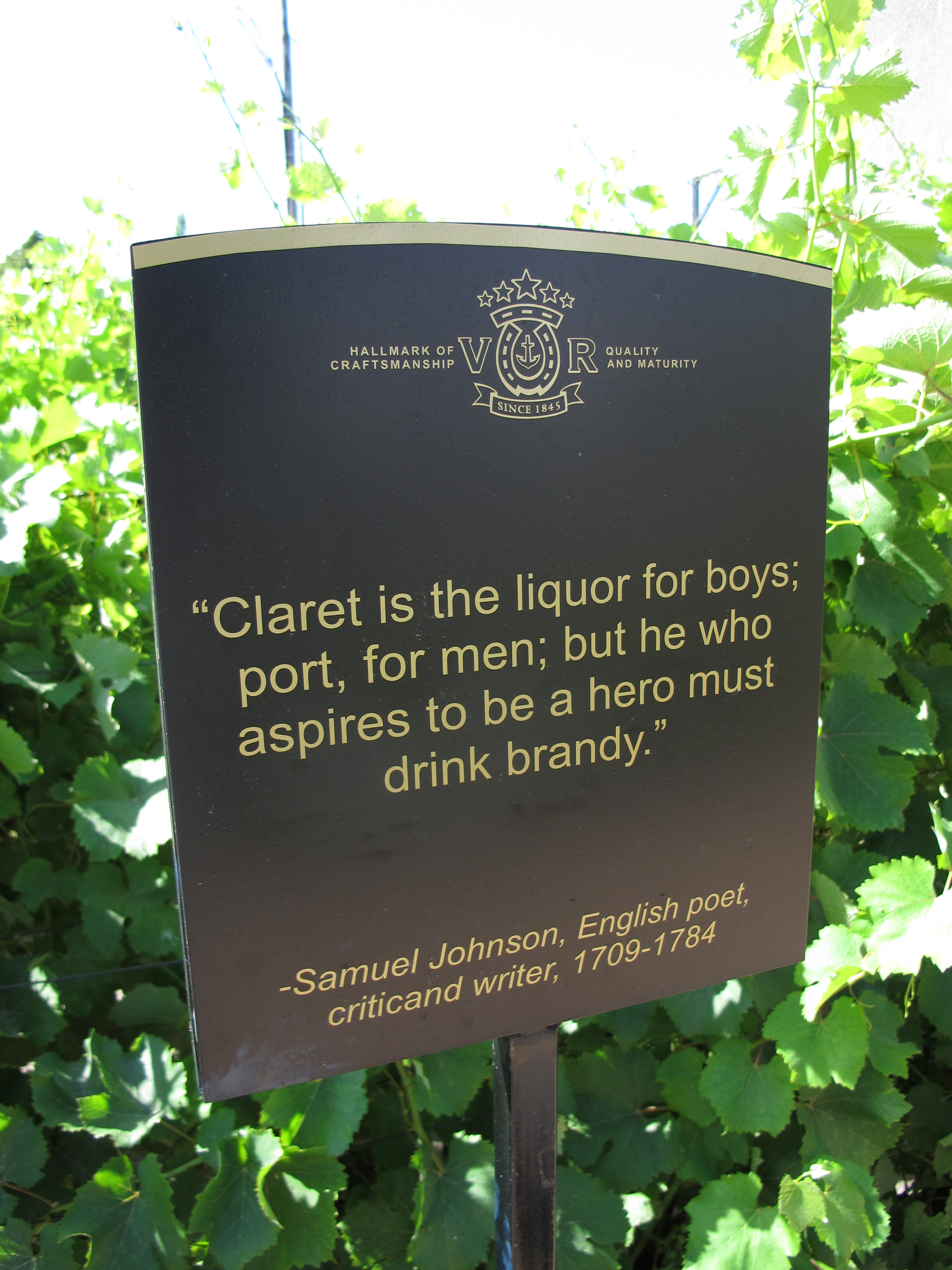
The English author Samuel Johnson once wrote: “Claret is the liquor for the boys; port, for the men; but he who aspires to be a hero must drink brandy”.  I’m not sure that I’d necessarily endorse this sentiment, but it certainly takes a particular dedication, a certain heroic perseverence, to get to grips with some of the baffling French brandy terminology.  Why be so blunt as to put a number on a bottle when you can indulge in a little bit of romantic intrigue instead?  My particular favourite – with reference only to the poetry of it – is the wonderfully evocative Very Superior Old Pale (VSOP).

The standard age grades are as follows: VS (Very Special) or Three Star, which for both Cognac and Armagnac refer to liquid in which the youngest component has been matured for at least two years; the aforementioned VSOP, a minimum five years old for Armagnac and four years old for Cognac; and XO (Extra Old), denoting something of no less than six years of age.  It’s important to note that in each case the average age can often be significantly older than designated by the grade.  There are various other lesser used but equally poetic grades: Napoleon, Extra, Vieille Réserve, and Hors d’Âge (which literally means out of age or beyond age).  Some of these grades share the same legal definition, but are used in practice to show a distinction in scale.  So the grading is somewhat limiting a guide, driven by convention rather than precision, and leaving you – fittingly – to rely on your nose, your palate and your senses as the final arbiters. Santé!

Conversation with a master

Meet Ian MacMillan, a Scotsman’s Scotsman and a whisky legend who’s been crafting epic drams for most of his life. I caught up with him when he was in Cape Town recently.

First published in Prestige Magazine (March 2013 issue).

More or less as it appeared.  A few typesetting issues in this version.

More or less as it appeared. A few typesetting issues in this version.

I met with Ian at Harbour House in the Waterfront. I can’t share with you the details of the delicious lunch that we enjoyed, or the delectable wine, or even the crisp sunshine of that magical Cape day. These diversions though, pleasant as they might have been, were unimportant In the context of the occasion.What I can share with you are a few privileged insights from one of the world’s foremost whisky experts.

You’re the Group Master Blender and Head of Distilleries for Burn Stewart. Tell us about your path to this auspicious position.

I’ve spent 40 years in the industry, learning the trade from the ground up, and covering all aspects of distillation. Also, I consider myself lucky to have been blessed with good organoleptic ability, which is crucial, and to have been helped and guided along the way by some great mentors.

How do you spend your time outside of whisky?

I’m a passionate rugby fan. I support Scotland of course, and the Cheetahs when I’m in South Africa. I also have a serious interest in wine, to the point that I have a diploma to show for it.

You’ve visited the country often. What’s your impression of South Africa?

I’ve been coming here for 10 years, and I’ve thoroughly enjoyed each trip. I love the people, I’ve cultivated great friendships, and I can look back on some memorable, unforgettable experiences.

Is there any particularly special moment that you can share with us?

I once drank whisky out of the Currie Cup, shortly after it had been presented to the Cheetahs when they won the tournament. Our brand Scottish Leader is the official whisky of the Free State Rugby Union, so we had special access to the victory celebration. Special enough? (Hell yes)

South Africa regularly ranks within the top 10 markets for Scotch whisky exports. Why do you think whisky has become so popular in the country?

I’ve noticed that South Africans have cultivated palates, that they’re very inquisitive and keen to explore the differences evident in whisky, and that they’re highly motivated to become knowledgable about whisky. Correspondingly, for many years now, there have been lots of good people on the local scene who’ve been working to feed this fire and educate consumers about whisky.

Islay seems to have established itself as a whisky Mecca. Its peated whiskies have developed a cult following. Why do you think this is the case?

It’s a unique place – a small island accommodating seven distilleries and a micro distillery – and it has become iconic because it embodies the true tradition and style of Scotch whisky. Originally all Scotch was made by malting barley using peat fires. I can’t drink smoky whiskies all the time, but when I do I particularly enjoy Lagavulin.

I would imagine that the influx of tourists has risen steadily. Are you worried that this might change the character of the island?

No, not really. Islay thrives on tourism, which is great for the local economy. The inaccessibility of the place and the generally inclement weather puts a cap on numbers and keeps things under control.

Bunnahabhain is well-known as the least peated of the Islay whiskies – the ‘gentle taste of Islay’. In the past there have been significant peated expressions. Are there any plans in place to release new peated variants in the future?

Yes. We started distilling peated whiskies again in 2003, which we’ve infrequently put on the market as limited editions. A Bunnahabhain Mòine (gaelic for peat) 10YO is slated for release in 2014.

You recently launched an unchillfiltered range of Bunnahabhain, replacing the previously chillfiltered versions. Have you been happy with the reception that the new range has received in the market?

Absolutely. It has been a transformative initiative, and the response has been phenomenal. We were the first distillery to take an entire range unchillfiltered. It’s been personally very satisfying – I fought for this move for many years.

The conventional wisdom is that chillfiltration removes flavour, however I recently came across a blind tasting experiment in which a group of four experienced tasters unanimously preferred chillfiltered versions of the same whisky. Obviously it’s difficult to draw conclusions from such a limited sample, but it raises interesting questions. Perhaps chillfiltration in certain cases might remove offensive congeners and actually improve a whisky. How would you respond to such a claim?

It would depend on the whiskies involved, and on those individuals and their palates. Chillfilitration might well disguise or ‘correct’ an error in distillation and/or maturation. In terms of our whiskies at Burn Stewart, there is no doubt that they’ve been enhanced by the removal of the chillfiltration process. You might want to note that Dave Broom (a leading whisky writer) concurs.

Whisky has been made in much the same way for hundreds of years. What, in your opinion, is the most significant change that has taken place in the modern era?

I’m a traditionalist. I don’t believe that whisky making should be computerised and automated. I find it sad that some distilleries are now run with virtually no people. Taking away the human element destroys the myth and heritage of whisky, and eventually it will lead to a blandness in flavour.

What can we expect from Bunnahabhain – that you’re able to disclose – in the medium term?

Burn Stewart has only owned Bunnahabhain for 10 years. The only variant at the time of purchase was the 12YO. We’ve introduced 25 variants since that time. The Bunnahabhain spirit ages particularly well, and it’s an exciting whisky with which to work, so we’ll continue to experiment. I’m specifically very excited about Mòine.

What’s your favourite whisky, Bunnahabhain or otherwise, and how do you drink it?

Whatever’s in my hand when the question is asked! Seriously, whisky is a mood drink so my preferences vary accordingly. I appreciate many outside of our stable (I mentioned Lagavulin earlier). I have a great respect for others in the industry doing the same job.

And I usually drink my whisky with a dash of water.

A message from Ian to all Prestige Magazine readers: may the dram be with you!

A nosing with Gordon Motion

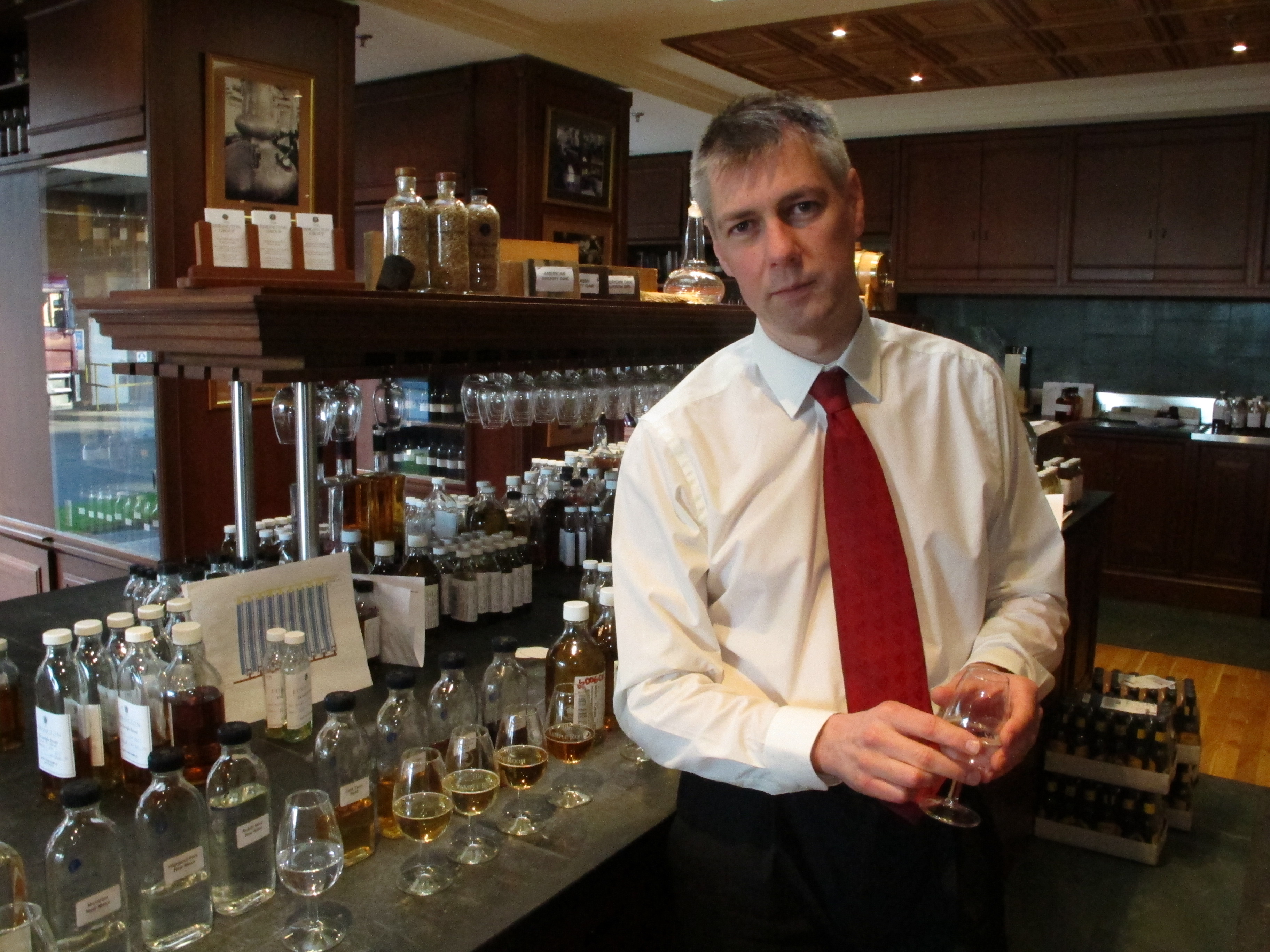
Every now and again life treats you to a glorious surprise.  I was privileged during a recent visit to The Edrington Group’s head office in Glasgow to get to meet Gordon Motion and to be invited into his sample room for a nosing session.

Gordon amidst the tools of his trade,

Gordon amidst the tools of his trade.

This was my first foray into a Master Blender’s domain, so I was a little uncertain about what to expect beyond the obvious.  It proved to be a sensory feast.   I was told that the space was a re-creation of the sample room from their bygone offices of a bygone era – and indeed it exuded the old-style elegance of a Victorian library…that had substituted bottles for books.

Wood panelled splendour.

Wood panelled splendour.

Whilst the aesthetics were undeniably appealing and worth a linger, the focus soon shifted from the visual to the olfactory.   We nosed a variety of samples – those that happened to be on Gordon’s menu of tasks for the day – including new make spirit from North British, the grain distillery jointly owned by Edrington and Diageo, and Ruadh Maor, a peated Glenturret intended for Black Grouse.  It was particularly interesting to learn (or to be reminded, I had an inkling of it) that North British is the only grain distillery in Scotland using (more expensive) maize rather than wheat in its mashbill – the purpose being to achieve a buttery flavour and mouthfeel (similar to that of Bourbon).

Grain of a different sort.

Grain of a different sort.

Probably the most fascinating aspect of the experience though was the opportunity to nose the same original spirit of equivalent age from various different casks.  The massive influence of wood on the character of whisky doesn’t really need reinforcement, but in this case there was an added twist.  People often refer to European casks and Sherry casks interchangeably, as if they were the same thing.  The wood from which the cask was made, and the liquid which seasoned the cask are two different elements, and it’s worth bearing in mind that each makes distinct contributions to flavour.  Whilst most Sherry casks are made from European oak, this is not a universal rule; Edrington in particular has been seasoning American white oak casks with Sherry, and consequently producing whisky with a different category of flavour.  If I ever had any doubts about the scale of this variation they were quickly dispensed by the nosing, conducted side-by-side with a traditional Sherry cask sample (and a Bourbon cask sample for good measure).

The wood factor.

The wood factor.

I’ve always been a Macallan and a Highland Park fan.  The whiskies are sensational of course, but that’s just part of it; I generally like the way they go about their business.   You might have noticed, tangentially, that almost every whisky drinking moment in an influential movie or television series seems to involve a Macallan – not by random chance I’ll warrant.  These guys are a class act, and this visit served to confirm my impressions.

Brave new world

The most special of South African special releases was launched last year.  I went to the source to take a look. 

First published in Prestige Magazine (February 2013 edition).

As it appeared.

As it appeared.

Amusing signage at the Van Ryn's distillery.

Amusing signage at the Van Ryn’s distillery.

The ability of luxury whiskies and cognacs to command top dollar is a long-established reality, but these days, and actually for quite some time now, everyone seems to be getting in on the act.  I was at Hediard some time ago, the famed épicerie on the Place de la Madelaine in Paris, and I noticed bottles of armagnac and calvados with price tags well into the tens of thousands of Rands.  Why should the Scots and the French be cornering all of this lavish lucre for themselves?  We make a noble aged spirit right here, the finest exponents of which have repeatedly won international awards.  So why have we not been partaking? Wait though.  It had to come and it has come indeed – behold AU.RA, a ground-breaking South African brandy created by Van Ryn, probably the most celebrated distillery in the country.

I should start by qualifying my rallying – my feelings are less gung-ho than they appear.  Who would benefit from brandy at sky-high prices?  The distillery and brand owners?  The economy as a whole – via its contribution to our tax coffers?  The implications for the brandy drinker are not quite so conclusively positive.  It’s quite likely that this type of a top tier would drag the rest of the market upwards, or parts of it at the very least, resulting in higher prices largely across the board.  On the other hand, compensatingly, it may also amplify the scrutiny applied to quality and innovation – as the industry comes under added pressure to justify incremental premiums.  Every cloud has a silver lining, and every silver lining also has a cloud.

Anyhow, onto AU.RA.  The unusual (looking if not sounding) name is explained as follows: “an amalgamation of the symbol of gold (Au) and Ra, the ancient Egyptian sun god”.  Cute.  In attempting to live up to its name AU.RA does indeed radiate with a certain brilliant amber…aura.  And I guess that at R14k odd a bottle so it should, maybe with a bit of singing and dancing thrown in too.  Well, whilst it may not be able to strike up a tune or do a little jig, AU.RA does have a few tricks of its own.  I could argue that the 20YO Van Ryn’s and its KWV counterpart sell for less than a tenth of that price, but that would be neither here nor there.  In this league it’s all about rarity and exclusivity, and this fine brandy seems to hold its own:  most compellingly it is the oldest South African brandy ever bottled – the youngest component in the blend is 30 years old (the spirit was all distilled between 1972 and 1982) – and the release has been limited to a scant 107 decanters.

On a visit to the Van Ryn’s distillery, where I was hosted to a tour (well worth the trip for the aromas in the maturation cellar alone) and a tasting by the charming Brandy Master Marlene Bester, I decided to look a little further into AU.RA’s supposed rarity and exclusivity.  The press release calls it a “once-off editon” that “cannot be repeated”.  This is true, but tenuously so.  Yes, only the claimed 107 units of this specific blend have been released, but an undisclosed volume of brandy remains in the several casks that were used – to be employed quite likely to create a similar product in the future, depending on AU.RA’s success.  This point is worth keeping in mind as one weighs up the purchase, but it doesn’t change the fact that AU.RA is a damned rare, first-of-a-kind, pioneering creation.

It’s almost an inevitability with luxury spirits that one needs to reserve a fair share of the attention for the packaging; in this case as in many others these elements are a bespoke work of art.  I was particularly taken with the crystal decanter, hand blown by David Reade – probably because I’m partial to his Murano-style creations, a range of which I recently had the pleasure of viewing at the startlingly impressive Robertson Art Gallery.  A solid oak presentation box, and a teardrop neckpiece complete the beautiful ensemble.  The only liquor packaging that I’ve seen produced in this country that’s remotely as elaborate was for Malus, an apple spirit produced in Elgin that whilst interesting definitely doesn’t have the same chops as AU.RA.

It’ll be interesting to see how AU.RA performs and whether South African brandy can stake and sustain a claim in this sector of the market.  On reflection the initiative can best be described as a courageous foray.  The obscure spirits that I mentioned earlier have well developed niches, and the rest of this market is made up of powerful, internationally renowned brands such as Remy Martin, Macallan, Martell and the like.  Van Ryn for all its heritage and all its awards is simply not in this class.  AU.RA is being targetted at the local market, where the brand has the most traction, but conversely where people are less accustomed at paying these types of prices.  Whatever happens it’ll be a watershed initiative.

A sad note in conclusion.  During my visit I was given a little booklet which refers to AU.RA somewhat ambitiously as “the epitome of pure perfection”. I am, to my great disappointment, unable to comment on this statement with any authority whatsoever because I never got to taste it.  I was informed that there was exactly enough spirit available only for the bottling.  Hmm…until the next release that is.

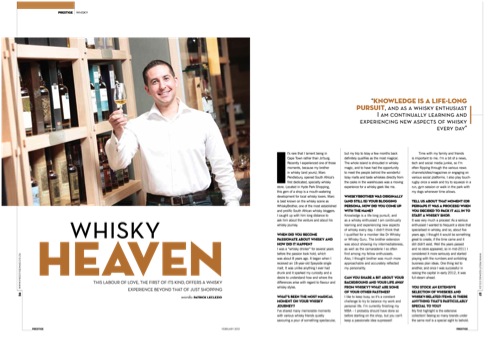
Whisky heaven

This labour of love, the first of its kind, offers a whisky experience beyond that of just shopping.

First published in Prestige Magazine (February 2013 edition).

As it appeared - page 1.

As it appeared – page 1.

As it appeared - page 2.

As it appeared – page 2.


It’s rare that I lament being in Cape Town rather than Joburg. Recently however I experienced one of those moments, because my brother in whisky (and yours), Marc Pendlebury, opened South Africa’s first dedicated, speciality whisky store.  Located in Hyde Park Corner shopping centre (Hyde Park, Johannesburg) this gem of a shop is a mouth-watering development for local whisky lovers.  Marc is best known on the whisky scene as WhiskyBrother, one of the most established and prolific South African whisky bloggers.  I caught up with him long distance to ask him about the venture and about his whisky journey.

—-

When did you become passionate about whisky and how did it happen?

I was a “whisky drinker” for several years before the passion took hold, which was about 8 years ago. It began when I received an 18yo Speyside single malt. It was unlike anything I ever had drunk up and it sparked my curiosity and a desire to understand how and where the differences arise with regard to flavour and whisky styles.

What’s been the most magical moment on your whisky journey?

I’ve shared many memorable moments with various whisky friends quietly savouring a pour of something spectacular, but my trip to Islay a few months back definitely qualifies as the most magical. The whole island is shrouded in whisky magic, and to have had the opportunity to meet the people behind the wonderful Islay malts and taste whiskies directly from the casks in the warehouses was a moving experience for a whisky geek like me.

WhiskyBrother was originally (and still is) your blogging persona.  How did you come up with the name?

Knowledge is a life-long pursuit, and as a whisky enthusiast I am continually learning and experiencing new aspects of whisky every day.  I didn’t think that I qualified for a moniker like Dr Whisky or Whisky Guru. The brother extension was about showing my intermediateness, as well as the camaraderie I so often find among my fellow enthusiasts. Also, I thought brother was much more approachable and accurately reflected my personality.

Can you share with us a bit about your background and your life away from whisky?  What are some of your other pastimes?

I like to keep busy, so it’s a constant challenge to try to balance my work and personal life. I’m currently finishing my MBA – I probably should have done so before starting on the shop but you can’t keep a passionate idea supressed!

Time with my family and friends is important to me. I’m a bit of a news, tech and social media junkie so I’m often flipping through the various news channels/sites/magazines or engaging on various social platforms. I also play touch-rugby once a week and try squeeze in a run, gym session or walk in the park with my dogs whenever time allows.

Tell us about that moment (or perhaps it was a process) when you decided to pack it all in to start a whisky shop.

It was very much a process! As a serious enthusiast I wanted to frequent a store that specialised in whisky, and so, about five years ago, I thought it would be something great to create, if the time came and it still didn’t exist. Well the years passed and no store appeared, so in mid-2011 I considered it more seriously and started playing with the numbers and scribbling business plan ideas. One thing led to another, and once I was successful in raising the capital in early 2012 it was full-steam ahead.

You stock an extensive selection of whiskies and whisky-related items.  What are some of the highlights?  Is there anything that’s particularly special to you?

My first highlight is the extensive collection! Seeing so many brands under the same roof is a special sight to behold. If I had to name a few of which I’m particularly fond, I would have to include: Macallan Fine and Rare 1989 (the only one in the country), Dalmore 1978 31yo, Glenmorangie Pride (now sold) and Glenfiddich 40yo.

Apart from these more exclusive and limited items, I am equally pleased to stock the ranges from smaller, independent producers including BenRiach, Springbank, GlenDronach, Kilchoman, Compass Box and Michel Couvreur.

What makes the WhiskyBrother store different from other liquor speciality stores that focus (albeit not exclusively) on whisky?  What can whisky lovers expect that would delight them when they visit your store?

The fact that it is strictly whisky, and only whisky. Whisky is a specialty drink and it deserves a specialty store. The store was built intentionally to showcase the amazing whiskies available and the design has included many components of whisky production and history – from the use of copper and untreated oak staves, to the presence of used whisky casks and images of distilleries.

Next would be the large selection on offer. It’s not about only stocking the big brands with the big marketing budgets. I’d like to think all whiskies are equal on the WhiskyBrother shelves; it is up to the consumer to decide on preference. I have as many brands and expressions as is available in our market, as well as a whisky or two you won’t find anywhere else in SA.

Lastly, a specialty store must provide specialty service. I am personally working in the store for the foreseeable future. The whisky consumer deserves to be assisted by someone who has solid whisky experience and can recommend, engage and inform.

My intention is to provide an experience, not just retail whisky.

What’s on top of the list for your next whisky adventure?

I’m currently organising a group tour to Scotland (and plan to make it a quarterly activity), and I’m working on getting a cask bottled that I personally selected.

—-

Nice guy, great whiskies, impressive store.  Get over there and check it out.  May the dram be with you!