Whisky at the movies

Late last year I attended the première of Angel’s Share, hosted by Bunnahabhain in association with WHISKYdotcoza.  A whisky movie is a rare beast so for whisky lovers Angel’s Share is worth watching on that basis alone.  The only other whisky-themed movie of which I’m aware, courtesy of Mark from the Whisky Tasting Fellowship, is 1949’s Whisky Galore.  Angel’s Share also happened to win the Jury Prize at the Cannes Film Festival – so ostensibly it has more merit than just whisky.

It made for pleasant if not exhilarating viewing, although I should qualify that I’d been sailing on the Bunna ship for a fair while before kick-off.  Anyhow, I won’t give much away but let me say that my most and least favourite moments were the demonstration of “flogging the bung” (new knowledge for me) and the heart-stopping Irn-Bru incident respectively.

It was also interesting to note that the Deanston distillery, the brand home of the locally prominent Scottish Leader, featured as the venue for some of the whisky scenes.  I need to get word to them that they’ll increase their visits tenfold if they hire the tour guide from the movie.  Whisky legend Charles MacLean, less comely but dispatching his duties with aplomb nonetheless, also featured in the significant role of “Whisky Master”.

May the dram (Malt Mill please) be with you!

BTW – Malt Mill was a real distillery.  Check this out (spoiler alert).

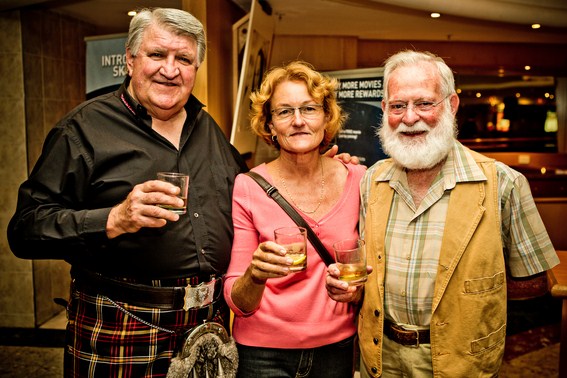
Pierre Meintjes with Dave and Lorna Hughes.

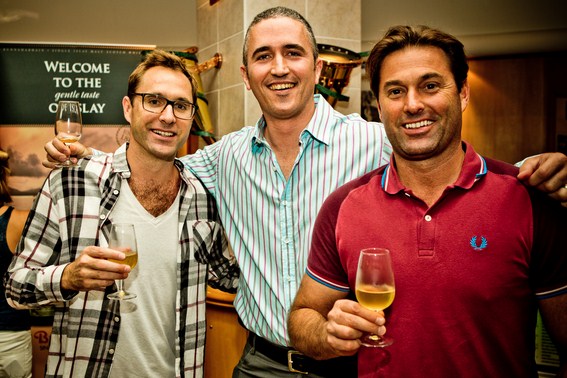
With the Allardie, David and Saul

Marsh Middleton with Bunnahabhain Brand Manager Johann Botha

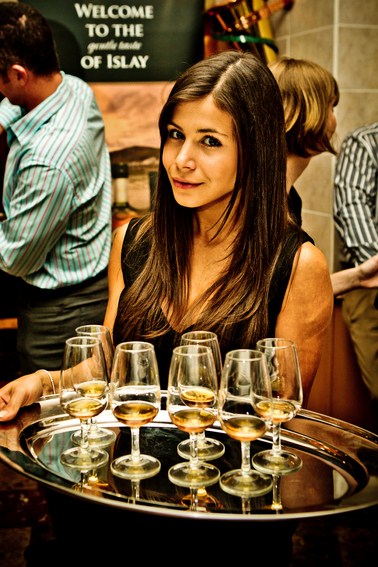
Yes please!

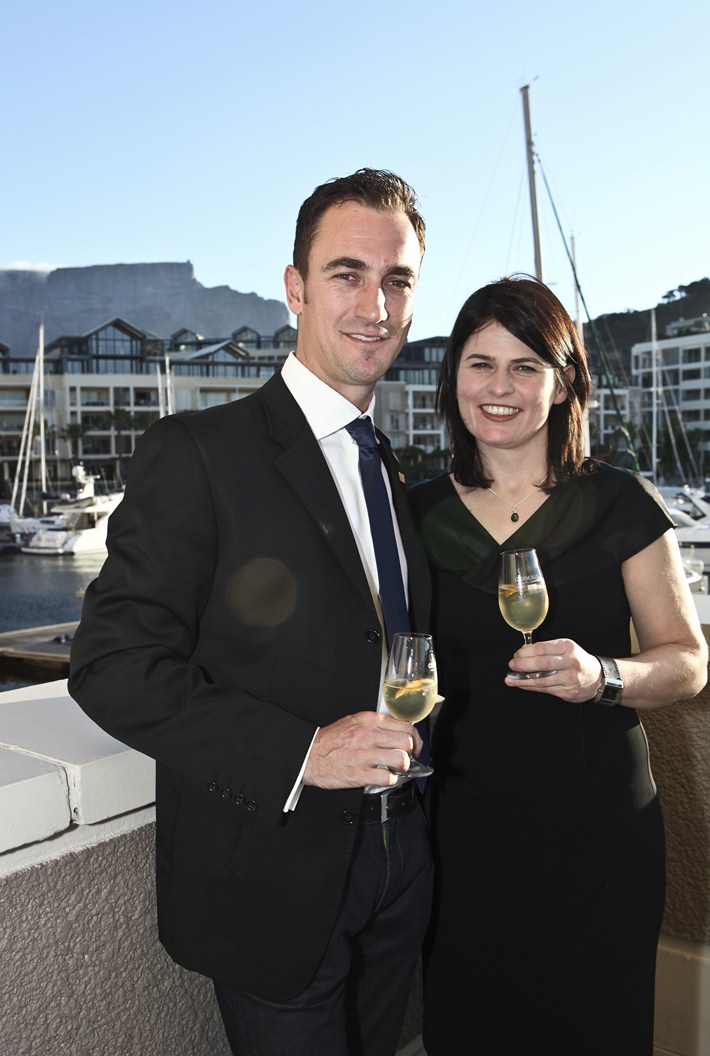
Lin Murray and Alvin Visser


Pendock Uncorked…and Sulphurous

It seems that in my capacity as a writer I may need thicker skin.

I came across the post below whilst I was doing some web research for an upcoming piece.

Whisky Bloggers: an underutilized resource

Posted: October 24th, 2012 | By Neil Pendock

Apart from the obvious pleasures of eating Garth Schnier’s amazing food and sipping a wee dram of 50 year old Balvenie, the highlight of yesterday’s Sandton Sun tasting was meeting a brace of bloggers: Marc from Whisky Brother and Mark from Whisky Tasting Fellowship.  While it is well known that most people in wine are called Thys, seems that Marc/k is the whisky world equivalent.  Which reminds me of how a single malt column for late, lamented Wine magazine had me enthusing about a fabulous single malt from Mark Alan (Macallan, geddit?)

Well SA whisky writing really needs a whole barrel full or Marc/k’s if the double page spread on what to drink at Whisky Live in the BA in-flight magazine High Life, is any indication.

Five whiskies are recommended:

Johnnie Red (I kid you not);

Jameson (served in poverty class on BA, so that one’s a no-brainer);

Michel Couvreur (imported by “whisky whiz” Patrick Leclezio who wrote the story, so that one’s a no-brainer too, although a disclosure would have been nice, if not essential);

Ardbeg, claimed to be the most peaty malt at “an eye-watering 55 ppm” of phenol even though the Ardbeg site claims only 50 ppm;

60 year old Macallan in Lalique crystal decanter.  The third edition is recommended and the second went for R139K.  A decade older than the Balvenie and half the price, it sounds like a deal to me.

This is worse than that old fraud Mr. Min alliterating all over the place in Sawubona.  Come on, BA, pull up y’re socks!  I bumped into an old friend on the 7:45pm BA flight to Cape Town who told me that if you export SA brandy to France and keep it there for six months, it miraculously becomes French brandy.  As the Chinese word for luxury is “French”, this sounds like a plan for Distell.  How about it, Dr. Caroline Snyman, queen of brandy?

I was the author of that High Life spread (as the post explicitly points out) so I feel inclined to respond.

A selection of this kind is of course subjective by its very nature – any number of whiskies could have been justifiably chosen.  Given the parameters of the brief (each whisky had to be most something), and the publication and its audience, I stand by my particular selection; the mix ranged from the accessible and popular for the novice, and the voyeuristic and iconic for the initiated, to the obscure for the aficionado.

Neil Pendock’s rather scathing denunciation – of something that at the time seemed like an innocuous exercise – takes exception with each and every whisky in the selection.   So, point-by-point then:

–        A good measure of his disdain is reserved for the presence of Johnnie Walker Red Label.  One would think that someone who professes “healthy disregard for the anoraks, bowties and Emperors of drink and their new clothes” would champion the novice, but it seems not.  Too dumbed-down?  I don’t agree.  Johnnie Red is a definitive Scotch.  I maintain that if you’re starting out in whisky you should try it as a priority.  Its variety of flavours – smoke, salt, spice, and sweetness (oops, is that too alliterative?) – are beautifully representative of the broader character of Scotch whisky.

–        The implication that Jameson was selected because it’s served on BA is ludicrous.  It’s not only blatantly untrue, but also somewhat paranoid.  There’s no low-level, high altitude conspiracy at play here.  The selection was left entirely to me.   Jameson is on my list because it’s the whiskey that I most recommend to people who are unsure about or hesitant to try whisky.  Its flavours are interesting but understated, and it doesn’t have the overpowering ‘whisky taste’ that can sometimes put off the unaccustomed.

–        I am indeed one of the importers of Michel Couvreur whisky.  This information is readily available to anybody to whom it’s of interest.  I’m sure that Neil was able to learn of it with ease by either doing a Google search or by speaking to anyone within the whisky fraternity who knows me.  It’s worth noting that I retail each of the whiskies in the selection – and that it was clearly disclosed that I’m the owner of an online whisky shop.  I suppose one could make the case that I should have further disclosed that I don’t just sell but also import the Michel Couvreur.  It just didn’t occur to me at the time.   It certainly hasn’t been my intention to conceal the information, either in High Life or anywhere else.  My sincere apologies then to those who felt conned or misled by the inadequate extent of my disclosure.  Regardless though I think the merit of this whisky within the (important) context in which it was selected is difficult to dispute.  I would challenge anyone to identify a whisky easily available in this country that’s clearly more unusual than those from Michel Couvreur.

–        The issue of whether or not Michel Couvreur can be legitimately referred to as a French whisky is tenuous, but I don’t think that I’m stepping out of reasonable bounds by doing so.  It certainly can’t be called a Scotch whisky, and it’s only fair to give it some sort of an identity.  I’m sure that many products that are assembled in a particular country and claim to be made in that country don’t necessarily source all their components from the self-same country.  But that’s just an observation – this isn’t my fight.

–        I’m not sure to which Ardbeg site Neil is referring.  The official site doesn’t seem to reference a specific ppm value under its product information for the 10YO: http://www.ardbeg.com/ardbeg/whisky/ten-years-old, although I can’t discount that this may be shown elsewhere on the site.  I sourced my information directly from the local representatives of Ardbeg, and I then had it confirmed by Marsh Middleton, one of this country’s leading whisky presenters.  There are also a multitude of web references to 55 ppm.  I understand (and I entirely endorse) that factual accuracy is important, but if there’s an error here, which I highly doubt, it’s one that was made in good faith, and not through any lack of application.

–        Admittedly not too many people will get to try the Macallan but it inspires me as I’m sure it does others to know that it’s out there.  The appreciation of whisky is a journey, and aspirational destinations are part of what makes it so special.

Some might dispute my selection, absolutely, as it’s clear that Neil does.  There is always a measure of subjectivity involved in these types of exercises.  It may not be optimal, depending on your point of view, but I ask myself: does it warrant public insult?  And not just of the selection itself but of the author…  The pointed reference to whisky whiz in inverted commas seems unnecessary; to label me worse than a fraud even more so.  Neil has never met me and has never had anything to do with me, and he’d presumably only read one of my articles (he doesn’t mention anything else).   It seems astounding then (at least to me) that he’s taken it upon himself, on the basis of dubious justification and incorrect information, to publicly humiliate me and cast aspersions, without even the courtesy of courting a response.  Poor show.

I put the cool in caustic!

I put the cool in caustic!


Whisky diplomats charm South Africa

The world of whisky is so gracious and so evolved that it even has its own emissaries.  I recently had the privilege of meeting with and interviewing the Global Brand Ambassadors of two of Scotland’s leading single malts: Karen Fullerton from Glenmorangie and Ian Millar from Glenfiddich.

Big thanks to the local Glenmorangie and Glenfiddich teams, and to Manny and Phillip Myburgh, the inimitable owners of Café Della Salute on Sandton Square, for setting up and hosting the interviews.

Ian with the Myburgh brothers

Ian with the Myburgh brothers

Karen with local sidekick Niel Hendriksz

Note: The interviews were conducted separately, but the questions were the same so I’ve consolidated them below.

WOW: You’re the Global Brand Ambassador for Glenmorangie/Glenfiddich.  Tell us a little bit about yourself, your work and your time away from work.

KF: I was born on the west coast of Scotland, and then I moved to England as a young lass.  I started my career in wine, but I’d inherited a love of Scotch whisky from my father and my grandfather.  In 2002 I joined Glenmorangie in a sales capacity, and shortly thereafter I had the opportunity to work as the brand’s Ambassador in the United States for some five years.  I left the company at the time of the Moet Hennessy acquisition, to work on Dewar’s at Bacardi.  It was a fulfilling experience, and it gave me the opportunity to work with blended whisky, but I always dreamt of returning to Glenmorangie, which I was then lucky enough to do when I was offered this role.  In my leisure time I enjoy the outdoors – spending time in the mountains, running, and playing golf and hockey.

IM: I’ve spent 40 years of my life working in the whisky industry.  In fact I’m about to turn 60 and I’ll be celebrating the occasion with two very special bottles: 1952 vintages of Glenfarclas and Linkwood.  I worked in production until 2006, managing distilleries for first Diageo and then William Grant’s, before moving into my current role.  My responsibilities are varied: aside from my ambassadorial duties I work on whisky innovation, I manage a team of 18 ambassadors, and I act as a guardian of the Glenfiddich brand.

WOW: What do you most like and dislike about your job?

KF: My likes: travelling to interesting places, meeting amazing, likeminded people, the variety inherent in the role (every day is different), the access to special insights, and, I won’t lie, the perks: I get to stay in the best hotels, eat in the best restaurants and taste the best samples from the Glenmorangie and Ardbeg distilleries.

My dislike: the industry isn’t as progressive as I’d ideally want it to be, and this occasionally impacts on my ability to do my job.

IM: My likes: experiencing different cultures and meeting different people.

My dislikes: travel problems – I’ve just had a nightmare journey to get to South Africa.

WOW: I would imagine that you meet a tremendous number of whisky drinkers, and that you must have close insight into the latest developments in the market.  In your opinion what are the latest whisky consumer trends?

KF: We’re seeing the introduction of more and more multi-vintage, no age statement whiskies (for malt as well as blended whisky).  There’s a lot of mixing of whisky taking place in developing markets, particularly for blends; malt whisky to a large extent is still being drunk traditionally.  Most encouraging for those of us in this sector is the continued strong growth of malt whisky.

IM: Let me respond rather on both whisky development and consumer trends, which are somewhat interlinked. Malt whisky only makes up 9% of the Scotch whisky market but it’s driving innovation in my opinion.  There are large numbers of interesting new expressions being released onto the market and attracting people to malt whisky, an example at Glenfiddich being Snow Phoenix.  Whisky tourism is growing, people are experimenting increasingly, and we’re seeing a proliferation of no age statement whisky as whisky stocks (not ours, I should add) come under increasing pressure.  Glenfiddich will be introducing only a small percentage of no age statement whisky, but with transparency about the contents.

WOW: Glenfiddich cracked the million case mark last year – the first single malt to do so.  Whilst this signals the increasing prominence of malt whisky, the market remains very much dominated by blends.  What’s your view of the future of the whisky market?

KF: I think that the market will always remain dominated by blends, but continuing education about whisky, and the introduction of younger malt whiskies intended to bring down the price gap will continue to makes malt whisky increasingly prominent in the future.

IM: As long as the price difference remains blends will continue to dominate – although having said that the weighting will continue to shift.  I would predict that malts will make up 15% of the market in 10 years’ time.  Higher disposable incomes, increasing longevity, younger malt whisky drinkers and the opening of new markets are all contributing to a bright future for malt whisky.

WOW: You’ve been to South Africa before.  You’re pretty much obligated to tell me that you enjoy visiting so I’m not going to ask you that question.  Rather what is it about the country firstly and about the Whisky Live Festival secondly that you most enjoy?  What sets them apart in your experience from other countries and other Festivals?

KF: I really enjoy interacting with South Africans who I find to be energetic, warm and progressive. And of all the whisky festivals in the world I most enjoy SA and Stockholm.  SA’s Whisky Live is a lifestyle event; it’s social and there’s a great balance between seriousness and fun.  It’s broken down barriers to engaging with whisky.  I always find it refreshing to see the large proportions of women and younger people attending the festival.

IM: I find it a joy to visit this country.  It has a rich history and culture, and the people are happy.  It’s a great environment in which to work.  I particularly enjoy the SA social scene.  The festival is the biggest in the world and it gives us the opportunity to engage directly with the consumer which is an important area of focus for Glenfiddich.

WOW: South Africa regularly ranks within the top 10 markets for Scotch whisky exports.  Whisky Live South Africa has become the most well attended Whisky Live Festival in the world.  Why do you think whisky is so popular in this country?

KF: For many of the reasons that it has succeeded elsewhere: whisky tastes great, it offers complexity, there’s a depth, a story behind Scotch whisky, and it’s a well regulated product.  The local education programs are also generally excellent.

IM: African spirits consumers are looking for something with credibility, and in this regard whisky stands on its own.  It makes a statement, and people are proud to be seen to be ordering whisky.

WOW: Wood is generally acknowledged as the principal influence on the flavour of a whisky.  Peat smoke is probably the most obvious.  What are the other influences that might be perceptible to the casual drinker?

KF: That’s not an easy one to answer.  In fact our Signet logo is made up of 32 interconnected icons, signifying that no single element dominates.  Having said that I’d suggest location and water source for Glenmorangie.  Our hard mineral water, which filters through stone for 100 years before we use it, has a significant influence on the fermentation process, producing particularly fruity esters.  Our tall stills, the tallest in Scotland (they’re about the height of an adult giraffe), also contribute to a distinctly lighter and finer spirit.

IM: Fermentation time.  This is crucial in building spirit character.  It brings out the fruity, floral and nutty flavours which we enjoy in so many whiskies.

WOW: What makes Glenmorangie / Glenfiddich such a special whisky?

KF: The tall stills that I’ve just mentioned.  Our expertise in wood management, which is highly scientific: we use a carefully calibrated mix of early and late growth white oak from the Ozarks.  Glenmorangie was also one of the first whiskies to use ex-Bourbon wood for maturation, and it was one of the pioneers of extra maturation (what others call “finishing”).  Our first extra matured whisky, a 1963 Glenmorangie, was released on the market as far back as 1987.

IM: Its long term credibility and trustworthiness.  You can be guaranteed that any Glenfiddich whisky will be enjoyed.  There’s also comfort in the fact that the brand is long established and is still owned by the same Scottish family.

WOW: What do you drink when you’re not drinking Glenmorangie / Glenfiddich?

KF: Wine, G ‘n’ T, and hoppy beers.  I also enjoy certain island style whiskies – salty, spicy whiskies with a rich sherry influence.

IM: I drink from my top 10, which is as follows: Glenfiddich 15YO, Glenfiddich 30YO, Glen Elgin 12YO, Scapa 14YO, Glenfarclas 14YO, Mortlach 16YO, Springbank 15YO, Edradour 10YO, Balvenie 21YO, and Bowmore 12YO.

WOW: Are you a purist?  How do you respond if someone asks you to mix a dram of Signet / 15YO with Coke?

KF: Don’t do that!

IM: I would certainly discourage it.

WOW: Lastly, how do you prefer to drink your whisky when you’re just having a casual dram with friends?

KF: It depends on the mood and time of day.  When it’s warm I’ll drink Glenmorangie Original on the rocks with orange zest, although I’m not generally a fan of whisky cocktails.  In the late evenings I’ll tend to favour older whiskies drunk neat.  For the most part though I’ll drink whisky with a splash of water.

IM: It depends on the whisky.  I take my drams of Glenfiddich 12YO with two drops of water, and I find that water is not needed with the 15YO.

Thanks again to Karen and Ian for sharing time with me.

Let’s go 2013!

Compliments of the season whisky lovers.  I’m looking forward to sharing whisky thoughts, whisky adventures,  general whisky musings, and maybe even a little bit of whisky itself (more on this later) with you in the coming year.

Please note that Words on Whisky can henceforth be found at www.wordsonwhisky.com.  New year, new resolve, new address.

May the dram be with you in 2013.

Let’s make it a good one!

Walking tall

A few months ago I interviewed Taygan Govinden, the South African brand manager for Johnnie Walker.

First published in Prestige Magazine (November 2012 edition).

As it appeared.

As it appeared.

Note: Apologies on behalf of Prestige Magazine for the spelling error in the sub-title of the printed version.

PL: Locally you’re the man at the wheel of the world’s biggest whisky brand.  Tell us a bit about yourself.

TG: I’m Durban born and bred but I’ve also lived and worked in the UK and now I’m based in Cape Town.  My background is in analytics, which I think has stood me in good stead for what I’m doing now.  I’m a big cricket fan, and I enjoy sports in general.  Basically I’d describe myself in a nutshell as a passionately South African guy with strong family values.

PL: Johnnie Walker sold 18 million cases in 2011, leaving its rivals trailing by quite some distance.  The brand seems to be living its legend – keep walking indeed.  What’s the secret to its phenomenal success?

TG: The brand has a pioneering spirit that drives us to innovate as we respond and adapt to our changing consumer preferences.  Our heritage is based on the history and tradition of crafting big flavoured whiskies.

PL: The launch of Platinum Label forms part of some wider changes to the core portfolio.  Can you elaborate on what’s been involved?

TG: We’ve introduced two new variants – Platinum Label and Gold Label Reserve.  At the same time we’re gradually phasing out the old Gold and Green Labels.  We are committed to ensuring that our full range of whiskies meet both existing consumer demand and further positions us to fully realise the evolving consumer opportunities of today and tomorrow.  We believe that these changes will allow us to optimally realise these objectives.

PL: Whilst it’s still dwarfed by Blended whisky, Malt is on the rise.  Last year Glenfiddich became the first single malt to sell a million cases.  Green Label itself is the world’s fifth best-selling Malt whisky.  So it might be seen as somewhat curious – in an era showing early signs of an increasing appreciation for Malt whisky – that this variant should be discontinued.  Can you give us some insights into the rationale for this decision?

TG: We are evolving our range to meet existing consumer needs and build on our heritage of innovation of crafting flavours for contemporary tastes. The success we have seen with Gold Label Reserve in the Asian market gives us confidence that this variant offers a more compelling choice for our market.

PL: Will you be launching the Gold Label Reserve in South Africa?  If so, can you give us a sneak peek?

TG: Yes, we’re launching it locally in November. Our consumers can look forward to a blend of premium Scotch whiskies delivering a perfectly mixable whisky with a very smooth taste.

PL: Platinum Label replaces Gold Label, which will now be phased out.  What is the difference between the two?

TG: Platinum Label is an entirely new offering and not a reinterpretation of Gold Label.  It is crafted from the very best 18 year-old Scotch Whiskies with a new, distinct flavour profile.  While Gold Label is delicate and creamy, Platinum Label reflects a strong, sweet and elegant Speyside style with subtle smokiness, stewed fruit, malty cereal, smooth creamy vanilla, and tangerine sweetness.

PL: I recently passed through a duty-free store and I couldn’t help but notice that the price of Platinum Label is some 44% higher than Gold Label.   They’re both 18YO and I would imagine that Gold Label contains high-quality, well-aged whiskies.  What’s the basis for Platinum Label’s relatively more premium pricing?

TG: It should be priced at a 10% to 20% premium locally.  Platinum Label is a completely different whisky to Gold Label and so they should not be compared. The age statement is the only link between these two whiskies.

PL: What will be Platinum Label’s recommended retail pricing in South Africa?

TG: R999.99

My festive spirits

Take it up a notch. You deserve it. It’s been a long year. Here are my picks to amplify the festivities this season.  

First published in Prestige Magazine (Best of the Best edition 2012).

As it appeared.

As it appeared.

There’s really no point in working hard if you’re not going to reward yourself.  So let’s just continue under the assumption that come the end of 2012 this will indeed be your very committed purpose.  You’ve put in the graft, now it’s time to ease back and treat yourself to some quality time.  If you have any sense whatsoever this will involve, at some stage or other, or at multiple stages, the displacement of a distilled alcoholic substance from bottle to bloodstream.  In case that sounds cavalier be advised that my intentions here are to advocate responsible proportions – quality over quantity.  The finer things in life…roll that around in your mouth.  It sounds good, it feels even better.  These are the elixirs to make this your mantra.

Vodka

Vodka – the most supremely versatile of spirits – is always a good place to start.  You can mix vodka with just about anything, and because of its subtle (some might say neutral) taste and aroma it’ll simply enhance its companion’s flavour with the desired kick. It will also suit any and every occasion.  Whether you’re drinking James Bond-esque martinis (shaken not stirred of course) at an elegant soiree, sipping sundowners overlooking a powder-white beach, downing iced-shots with Russian lingerie models, or priming a Red Bull injection before dancing away the night, vodka will stand you in good stead (unless you’ve had too much of it, in which case any kind of standing might be a challenge).  Now, there are vodkas and there are vodkas, and amongst the latter, towards the top of the heap, is Belvedere Vodka: Polish, made from 100% Dankowskie Gold Rye (I’m no rye expert but it sounds impressive), and quadruple distilled.  Belvedere is undoubtedly silky-smooth and of exceptional quality and heritage, but the tasting notes also suggest that there’s a little more to it: “Leaving notes of vanilla and rye on the palate, the finish is crisp and clean with lingering white pepper spice. It has a distinctive, creamy mouth feel. Its aroma is a blend of vanilla, rye and white pepper”.  Look out for their jeroboam (3l) and methuselah (6l) bottles – seated in magnificent cradles (so as not to spill a precious drop whilst pouring) – as you’re painting the town this summer.

Tequila

I shudder at the mere sound of the word. Most of us have had our fair share of misadventures involving tequila. I have a group of friends who have been known to pursue this Mexican gold with the enthusiasm of modern-day conquistadors. Once, crazed by ‘tequila feva’, two of them pinned me down whilst I was asleep, and a third squirted tomato sauce into my mouth till it seeped out of my nose. True story…probably best forgotten.  Anyhow, much as it may surprise you tequila is in fact a fine spirit, of the likes of whisky and cognac.  Once you pierce through the salt-and-lemon layer you’ll discover that there’s a wealth of elegant tequilas available to the more discerning drinker.  At least that’s the case internationally.  Here the selection is somewhat more limited; but fear not one of the world’s great tequilas is within reach.  My tequila pick for this festive season is Don Julio – the self-proclaimed “luxury drop” and Mexico’s best-selling luxury tequila.  I’m not too if “luxury tequila” is industry standard terminology but let’s not quibble – this stuff is damn good.  Aged in American whiskey barrels in the same way as is Scotch, Irish, and other whiskies, this is the type of drink that you sip and savour…but if you’re adamant about taking your tequila in shots you’ll be pleased to learn that the extensive cask maturation has smoothed out the customary rough edges: Don Julio won’t leave your face crinkled up like an old prune.

Rum

If we were to declare a definitive festive summer drink it would be rum – with its island heritage and fun-in-the-sun character it epitomises relaxation and good times; and none more so than Mauritian rum.  Renowned for its sugar plantations, which once produced more sugar than any other territory on the planet – astounding for such a small place, the island’s rum industry has exploded in recent times, with a proliferation of superb products such as those from New Grove and Chamarel.  Most recently though my fascination has been captured by Pink Pigeon, a vanilla-infused rum named after the one of the island’s more fortunate indigenous birds (that narrowly managed to avoid the same fate as its Dodo brethren).  Made at the Medine Estate, one of islands leading sucreries, it is has a stylish, laid-back aura about it – the bottle is tall, dark and sleek with a he-who-shall-no-longer-be-named style rubber bracelet around its neck and a cap covered by a pleasingly authentic wax seal.  Pink Pigeon has the potential to be the island’s first superbrand.  Ok, this is perhaps a bit optimistic but it won’t stop those of you in the know from enjoying it in the meantime – to best effect with your feet dipped in the ocean and accompanied by some sega music.  As they say in Mauritius – Position? Korek!  With the appropriate accent please.

Other

I wouldn’t want to forget my old friends gin and cognac. ‘Tis the season to be jolly, after all.  So I’ll be having my mid-afternoon tonics seasoned with Beefeater 24 and I’ll be bringing in the New Year with a few measures of Courvoisier XO (partnered with a Romeo y Julieta).  A word to the wise: their labels depict a stiff-upper lipped English yeoman and a shadowy Napoleon Bonaparte.  You may want to keep them well separated.

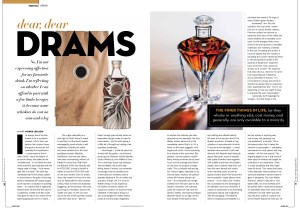
Dear, dear drams

No, I’m not expressing affection for my favourite drink.  I’m reflecting on whether I can afford to part with a few limbs to enjoy it, because some whiskies really do cost an arm and a leg.

First published in Prestige Magazine (Best of the Best edition 2012).

As it appeared.

As it appeared.

I’ve always found the free market to be a wonderful concept.  Left to their own devices the complex forces that govern economics will invariably find equilibrium – a phenomenon which Adam Smith, one of the fathers of economic theory, articulated as the “invisible hand”.  In my Darwinian view of the world this idea resonates with the natural order of things – it just seems right.  But is it really?  This order has manifested itself in the whisky sphere in recent times in the guise of booming demand interacting with sparse supply, and it has led to situation of spiralling prices…an outcome that is apparently without limits.  By the time this column is published a bottle of whisky would have gone on sale on our shores for the heart-stopping price of R1.4 million.

This might potentially be a new high for South Africa (it needs to sell first), but the trend towards extravagantly priced whisky is well established.  Globally the oldest and rarest whiskies from the most prestigious brands, Macallan, Glenfiddich, Dalmore and others, have been commanding millions (of Rands) for some time.  Right here the Balvenie 50YO very recently sold for R230,000, joining a handful of bottles to clear the R100 000 mark on the local market.  Even for whisky lovers like myself, for those of us who truly do appreciate the value of great whisky, these numbers are absolutely staggering, almost perverse.  We could just shrug our shoulders, dismiss the matter and carry on with our lives; and at the end of the day that’s exactly what we’ll have to do – after all there’s enough good whisky priced on reasonable enough scales to cater for most people – but it’s worth giving it a little bit of thought and asking a few questions nonetheless.

First though a little bit about the whisky with the golden, nay diamond, price tag: the Diamond Jubilee Blended Scotch Whisky by John Walker & Sons.  This is the same house that produces Johnnie Walker, the world’s best-selling brand of whisky, but somewhat confusingly, they’ve corralled some of their premium whiskies under a separate trademark.  For all intents and purposes though this is a Johnnie Walker whisky.  It was inspired by the Queen’s Diamond Jubilee, an auspicious occasion no doubt for those interested in that type of thing, but also a bandwagon for limited edition products of every stripe.  Regardless of whether the hallmark has been devalued by this stampede, the John Walker version stands out as the remarkable product that it is.  It’s a blend, as the name suggests, not a single-malt, which I found surprising for a whisky at this price level.  But perhaps I should question myself?  Many whisky producers are at pains to put out the message to that blends can be every bit as good as single malts.  This is probably self-serving, but I tend to agree, especially on an intrinsic basis.  Anyhow, the product comes with various jubilee cute-isms – all components are vintage whiskies from the same year as the Queen’s coronation, the marrying casks are made from oak from the Queen’s estates, the diamond-shaped decanter stands on six legs (one for each decade of the Queen’s rule), and bottling was effected exactly sixty years to the day from that of the Queen’s accession – and a long collection of accoutrements of which I’ll just list a few highlights – a silver decanter collar set with a half-carat diamond (the decanter itself being de rigueur Baccarat), a pair of bespoke lead crystal tumblers hand engraved with wildlife scenes from the Queen’s estates, and a cabinet made from oak from the same harvest and source as the marrying casks, as well as special timbers drawn from around the Commonwealth.  It goes beyond mere product – it is an objet d’art.  Indeed this is probably the one advantage of the elevated cost of such whiskies: it creates an opportunity to do something particularly special and imaginative with the packaging.  The Balvenie 50YO is notably accommodated in a cylindrical box made of 49 rings of seven Scottish grown timbers.

Impressed?  I am.  But the questions won’t go away.  I asked this one of various whisky creators:  Premium whisky has become so expensive that many of the oldest and rarest whiskies are completely out of reach for the average whisky lover.  Some of the pricing seems completely overblown and markedly unrelated to the cost of creating the whisky.  It could be argued that the industry is exploiting the current market dynamics to harvest excessive profits at the expense of its genuine, long-term, loyal consumers.  How would you answer such a claim?  The response that most struck a chord for me came from David Stewart of Balvenie who commented as follows: “I’m not involved in pricing but premium whisky has always been an expensive item, appreciated by few”.  Fair or not depending on how one might choose to interpret the word “appreciated”.

I personally don’t begrudge the situation.  The finer things in life, be they whisky or anything else, cost money, and, generally, are only available to a minority.  This is the natural order.  And it makes the moment of consumption – anticipated, hard-earned (in most cases), and long awaited – all the more special.  The lingering regret for me is that many of these types of whiskies are bought for collections or as investments.  There is a high probability that they might never be drunk.  This means that many of the ostensibly finest whiskies in the world are destined to remain locked in glass in perpetuity.  The John Walker Diamond Jubilee is sold with a 10cl taster bottle, but most of these won’t be opened either I would think because it’ll potentially reduce the value of the investment.  On that rather sad note – may the dram (make it a special one for the festive season) be with you!

What is The Angel’s Share?

Perhaps not what you thought.  It’s the first whisky-themed movie of all time…to the best of my knowledge.  So for all whisky lovers it’s a must-see.  In this regard I might be able to help.  Read on.

Bunnahabhain, in association with WHISKYdotcoza, will be hosting an exclusive nationwide première of The Angel’s Share on Wednesday 28 November at Cavendish Square in Cape Town.  Readers of this blog, WHISKYdotcoza Facebook friends and Twitter followers, and WHISKYdotcoza customers are being offered the opportunity to win five double tickets to the event.

The invitation.

If you want to be amongst the first people in the country to see this movie then please write to us at  info@whisky.co.za and provide us with your name and contact details.  Note that you’ll only be eligible if you “like” our Facebook page. The deadline for entries is Sunday 25 November at 22h00.

The ultimate liquor shopping experience

In the town where I was born lived a man who sailed to sea and he told us of his life in the land of duty-free. 

First published in Prestige Magazine (November 2012 edition).

As it appeared.

Note: Apologies on behalf of Prestige Magazine for the grammatical error in the first line of the printed version.

The Beatles’ classic is actually a children’s song – not, as many would believe, a cryptic drug anthem.  It overflows with an unbridled, childlike enthusiasm, which I wanted to reference here right now, because it’s how I feel, as I’m sure does any lover of fine spirits, whenever I step into the duty-free liquor wonderland.  The expression “like kid in a candy store” has never been more apt.  You may think that this sounds like an overblown infatuation, perhaps a contextual attraction – after all what else is there to do in airport whilst you wait for a flight?  If you did you would be wrong.  There are several rational, emphatic reasons why duty-free (sometimes referred to as travel retail) is as good as it gets when it comes to buying booze.

Price

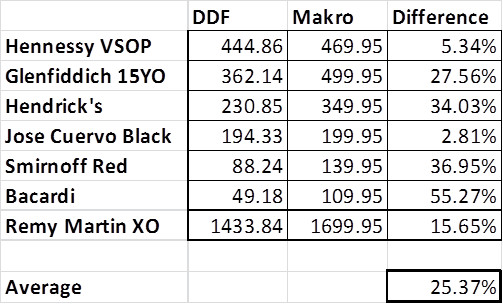
The original (and on-going) purpose of a duty-free store is to offer for sale goods that are exempt from certain taxes and duties which would otherwise be levied within that jurisdiction.  This doesn’t always guarantee good pricing – as with all retail businesses it depends on the individual operator.  It does however confer a significant advantage, and, given an efficient retailer, a nexus where competition, good purchasing, and effective management have satisfactorily come together, the results can be astounding, so much so that many of these duty-free retailers have become redistributors as well.  It’s cheaper for many in the trade to buy from them because of the volume discounts that they command than to buy directly from official distributors or even the suppliers themselves.  My regular port of call is Dubai Duty-Free, one of the muscular superheroes of this milieu.  I’ve taken the liberty of noting a few random examples, adjusted for bottle size, alcohol content and exchange rate, and comparing them to local pricing (as represented by Makro, our most cost-effective retailer, to further make the point).

The extent of the advantage varies from product to product but the general trend is unmistakable.  An average discount of 25% across this basket speaks for itself.

Premiumness

I don’t have access to any data but common sense suggests that frequent travellers would be wealthier, and have a tendency to command more disposable income than less frequent travellers or non-travellers, in a very general sense of course.  They are also a focused and entirely captive audience. Travel retail has thus evolved into a highly prestigious shopping ambit.  Airports accommodate many of the world’s most exclusive luxury brands, the Cartiers and Louis Vuittons, the Dom Perignons and Cohibas, precisely to capitalise on this phenomenon.  In the sphere of distilled spirits this translates into a benefit that I find particularly interesting.  The latest, premium offerings are almost always available in duty-free before they’re launched anywhere else.  Suppliers often use travel retail outlets, specifically those in busy high-profile airports such as Heathrow, CDG, Changi or Hong Kong, as a showcase for their brightest stars. As a result the duty-free shopper will invariably have immediate access to the best-of-the-best, and at the best pricing to boot.

Variety

A well-stocked duty-free shop is a veritable Aladdin’s cave.  You may not find the sheer volume of variety that you would in a wholesaler or liquor superstore, especially in the budget categories, but there is always broad range of quality, international brands on offer.  You’re likely to find products that may not be available at all in your home country, or limited edition duty-free exclusives that are unavailable anywhere other than duty-free.  I recently came across a Yoichi 20 year-old Japanese whisky, the 2008 World Whisky Award winner for best single malt.  Good luck finding this in South Africa.  The duty dynamic, the fact that many countries allow repatriation of duty-free purchases calculated by bottle instead of volume, has also led to the proliferation of unusual sizes in duty-free, most commonly the 1l bottle, but 3l and 4.5l bottles, rare everywhere else, also abound.

Promotions

In case the preferential price isn’t enough motivation, suppliers tend to reserve a big chunk of their promotional budgets for duty-free.  The most popular is the buy-two-get-something-free deal.  And the something-free can be significant indeed – a high-quality bag or case, or a 350ml bottle – especially when you consider that the pricing is already razor sharp.

A quick note in conclusion

The idea of a duty-free shopping was conceived by Irishman Brendan O’Regan who opened the first store at Shannon Airport in Ireland 1947.  I’m already grateful enough to the Irish for inventing whiskey, but this really puts them over the top.   I think I’m going to wear green permanently in tribute.

Out and about with whisky

The James Sedgwick episode.   You don’t have to fly to the auld country to visit a top-notch distillery.  They’ve got the old and brown at Sedgwick’s in Wellington…and I’m not talking about sherry.

First published in Prestige Magazine (November 2012 edition).

As it appeared.

PS: The title in the printed version is not mine.  I wouldn’t refer to whisky made in SA as Scotch, even jokingly.

The dominant feature at South Africa’s premier whisky distillery, the sight that first attracts the eye on arrival, is an iconic-looking pagoda.  It may be vestigial, like most of its counterparts in Scotland, but it’s impressive and imposing nonetheless; like a steeple it proclaims the presence of holy ground, although of a different sort.  This particular pagoda is modelled (like the stills too) after the one at Bowmore.  In fact it soon becomes obvious that the Scottish influence is everywhere.  Most of the whisky produced here at Sedgwick’s is clearly Scotch in style and flavour.  Even the surroundings, the arresting, picture-perfect mountain vistas, suggest a fleeting resemblance to the Highlands.  It’s an observation that stirs mixed feelings for me.  I’m glad that I’ve made the trip, but somewhat embarrassed that it’s taken me so long.

In past years the products made here were criticised for being poor quality facsimiles of the genuine thing, inferior substitutes to be bought on a budget.  Today these outdated perceptions can be consigned to a rubbish tip where they belong.  The whisky is top-class.  Of course, as if often the case with South Africans, it often takes foreign validation before we believe this of one of our own.  Three Ships, the distillery’s flagship brand, was given one of the industry’s greatest accolades earlier this year when its 5 year-old was named the best blended whisky by the World Whisky Awards.   Let me clarify in no uncertain terms exactly what this means: that’s the award for the best blended whisky in the world, including those from all the big guns: Scotland, Ireland, and even Japan, one of the most prolific countries of recent times in the accumulation of whisky prizes.  Last year Suntory’s Hibiki, the Japanese whisky which Bill Murray so memorably turned into a household name (I use the term loosely – whisky households only), specifically the 21 year-old, took this selfsame award.  So the magnitude of this achievement for a young whisky from a young, isolated, whisky producing country is massive indeed.

Strolling around the distillery it’s easy to see how this came to pass.  The word that comes to mind, appropriately in more ways than one, is “shipshape”.  It’s modern and clean, so much so that I could have eaten my lunch off the floor.  The equipment is dazzling – I mentioned the pot stills but also worth noting is a gleaming automated column that looks like it could have flown me to the moon during its leisure time.  I couldn’t put this to the test because it was hard at work distilling grain whisky.  These buggers are very expensive, so clearly there’s been sufficient confidence in the product and its prospects to have laid down some serious investment.  Most importantly however there’s a sense that these guys, the brains behind the operation, have high-level insight into the making of great whisky – which they’re systematically putting into practice; our host explained to us how malt whisky, and separately grain whisky, was best distilled during particular seasons of the year for optimal results.  It’s an operation with an undeniable pedigree.

Notwithstanding the accents, the column stills (there are two in fact – the other’s an older, manual model) and the good weather, there isn’t much difference between Sedgwick’s and the better Scotch malt distilleries.  And it’s no accident.  The source of the Bowmore connection is Master Distiller Andy Watts, who trained at that eminent Islay facility, and subsequently implemented the fruits of his early experience locally, clearly to great effect.  This is all well and good – who better to learn from than the best – but I was also hoping, maybe for no other reason than to stay my own discomfort, for some local flavour.  It had taken the award for me to pay any significant attention to the distillery and its whiskies, to my discredit as a South Africa-based whisky lover, and now it seemed important to me that they should be something more than a Scottish (or other) clone, however good.

This is obviously not a novel idea.  Sedgwick’s however is owned by Distell, a brandy-focused behemoth, for whom whisky is still a bit-part player.  There are twelve year-old casks lying around in their maturation warehouse, ready, mature, delicious, waiting for the call.  That’s not to say that nothing has happened.  Things have definitely happened – Bain’s Cape Mountain whisky, whilst not intrinsically unique (I find it somewhat bourbon-ish), makes for an interesting proposition in that it is distilled entirely from local maize – and are set to continue happening – apparently there are experiments in progress to develop whiskies with a Pinotage cask finish.

Is this enough though?  I can’t help but think of a parallel.  During the darkest days of malt whisky, when blends had completely taken over, it was the independent bottlers who kept the tradition of the single malt alive.  Sedgwick’s juice is kept strictly in-house by company policy, but imagine the possibilities if this were to be relaxed.  Something radical perhaps, a bold new genre – a muscadel cask finish or maturation in indigenous wood.  Who knows what may happen yet.  May the dram be with you!