The bourbon review

First published in MUDL Magazine (November 2013 edition).
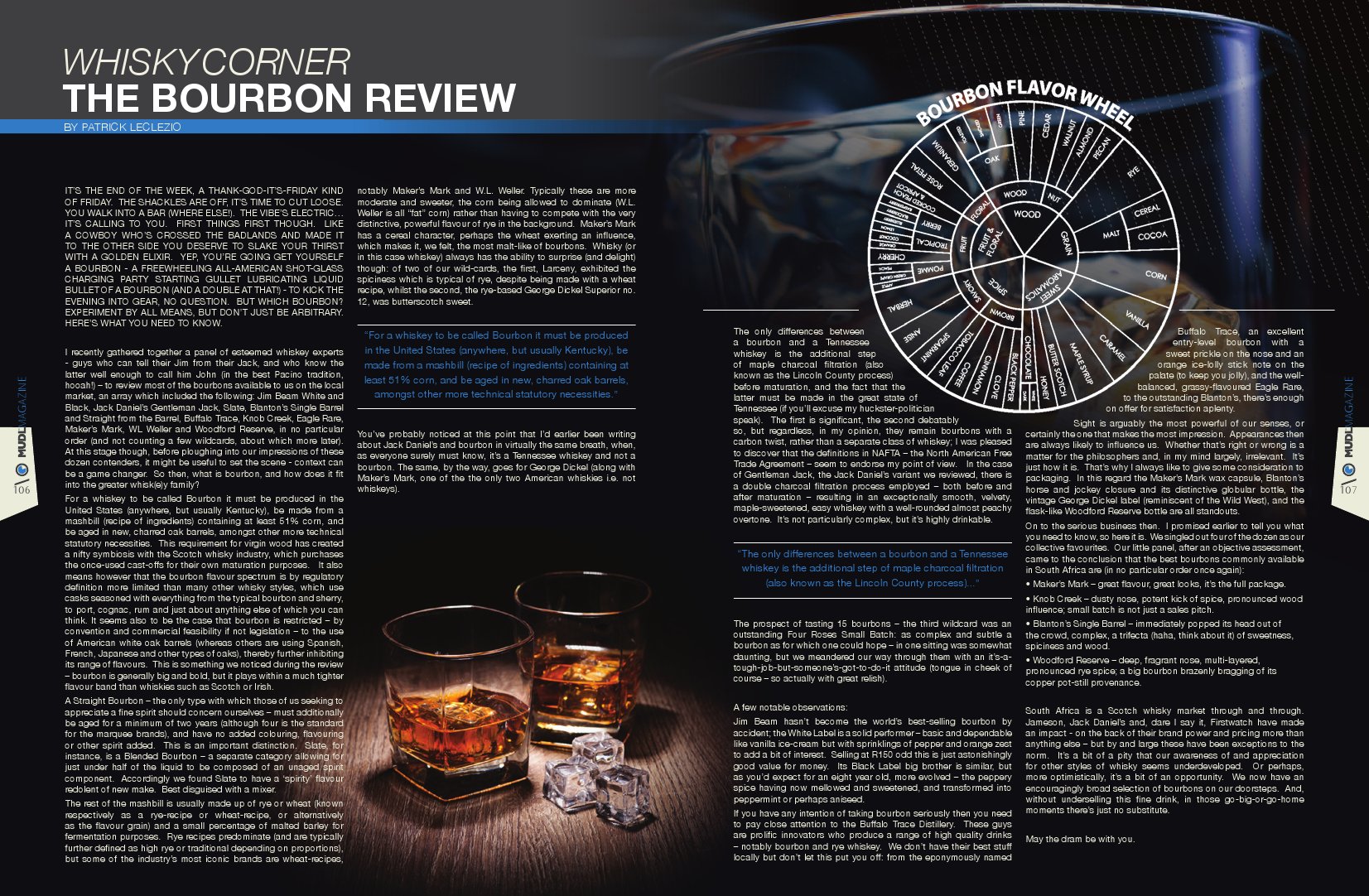
As it appeared.

It’s the end of the week, a thank-God-it’s-Friday kind of Friday.  The shackles are off, it’s time to cut loose.  You walk into a bar (where else!).  The vibe’s electric…it’s calling to you.  First things first though.  Like a cowboy who’s crossed the badlands and made it to the other side you deserve to slake your thirst with a golden elixir.  Yep, you’re going get yourself a bourbon – a freewheeling all-American shot-glass charging party starting gullet lubricating liquid bullet of a bourbon (and a double at that!) – to kick the evening into gear, no question.  But which bourbon?  Experiment by all means, but don’t just be arbitrary.  Here’s what you need to know.

I recently gathered together a panel of esteemed whiskey experts – guys who can tell their Jim from their Jack, and who know the latter well enough to call him John (in the best Pacino tradition, hooah!) – to review most of the bourbons available to us on the local market, an array which included the following: Jim Beam White and Black, Jack Daniel’s Gentleman Jack, Slate, Blanton’s Single Barrel and Straight from the Barrel, Buffalo Trace, Knob Creek, Eagle Rare, Maker’s Mark, WL Weller and Woodford Reserve, in no particular order (and not counting a few wildcards, about which more later).   At this stage though, before ploughing into our impressions of these dozen contenders, it might be useful to set the scene – context can be a game changer.  So then, what is bourbon, and how does it fit into the greater whisk(e)y family?

For a whiskey to be called bourbon it must be produced in the United States (anywhere, but usually Kentucky), be made from a mashbill (recipe of ingredients) containing at least 51% corn, and be aged in new, charred oak barrels, amongst other more technical statutory necessities.  This requirement for virgin wood has created a nifty symbiosis with the Scotch whisky industry – which purchases the once-used cast-offs for their own maturation purposes.   It also means however that the bourbon flavour spectrum is by regulatory definition more limited than many other whisky styles, which use casks seasoned with everything from the typical bourbon and sherry, to port, cognac, rum and just about anything else of which you can think.    It seems also to be the case that bourbon is restricted – by convention and commercial feasibility if not legislation – to the use of American white oak barrels (whereas others are using Spanish, French, Japanese and other types of oaks), thereby further inhibiting its range of flavours.  This is something we noticed during the review – bourbon is generally big and bold, but it plays within a much tighter flavour band than whiskies such as Scotch or Irish.

A straight bourbon – the only type with which those of us seeking to appreciate a fine spirit should concern ourselves – must additionally be aged for a minimum of two years (although four is the standard for the marquee brands), and have no added colouring, flavouring or other spirit added.  This is an important distinction.  Slate, for instance, is a blended bourbon – a separate category allowing for just under half of the liquid to be composed of an unaged spirit component.  Accordingly we found Slate to have a ‘spirity’ flavour redolent of new make.  Best disguised with a mixer.

The rest of the mashbill is usually made up of rye or wheat (known respectively as a rye-recipe or wheat-recipe, or alternatively as the flavour grain) and a small percentage of malted barley for fermentation purposes.  Rye recipes predominate (and are typically further defined as high rye or traditional depending on proportions), but some of the industry’s most iconic brands are wheat-recipes, notably Maker’s Mark and W.L. Weller. Typically these are more moderate, sweeter – the corn being allowed to dominate (WL Weller is all “fat” corn) rather than having to compete with the very distinctive, powerful flavour of rye in the background.  Maker’s Mark has a cereal character, perhaps the wheat exerting an influence, which makes it – we felt – the most malt-like of bourbons.  Whisky (or in this case whiskey) always has the ability to surprise (and delight) though: of two of our wild-cards, the first, Larceny, exhibited the spiciness which is typical of rye, despite being made with a wheat recipe, whilst the second, the rye-based George Dickel Superior no. 12, was butterscotch sweet.

You’ve probably noticed at this point that I’d earlier been writing about Jack Daniel’s and bourbon in virtually the same breath, when, as everyone surely must know, it’s a Tennesse whiskey and not a bourbon – the same, by the way, goes for George Dickel (also along with Maker’s Mark the only American whiskies i.e. not whiskeys).  The only differences between a bourbon and a Tennessee whiskey is the additional step of maple charcoal filtration (also known as the Lincoln County process) before maturation, and the fact that the latter must be made in the great state of Tennessee (if you’ll excuse my huckster-politician speak).  The first is significant, the second debatably so, but regardless, in my opinion, they remain bourbons with carbon twist, rather than a separate class of whiskey; I was pleased to discover that the definitions in NAFTA – the North American Free Trade Agreement – seem to endorse my point of view.   In the case of Gentleman Jack, the Jack Daniel’s variant we reviewed, there is a double charcoal filtration process employed – both before and after maturation – resulting in an exceptionally smooth, velvety, maple-sweetened, easy whiskey with a well-rounded almost peachy overtone.  It’s not particularly complex, but it’s highly drinkable.

The prospect of tasting 15 bourbons – the third wildcard was an outstanding Four Roses Small Batch: as complex and subtle a bourbon as for which one could hope – in one sitting was somewhat daunting, but we meandered our way through them with an it’s-a-tough-job-but-someone’s-got-to-do-it attitude (tongue in cheek of course – so actually with great relish).

A few notable observations:

Jim Beam hasn’t become the world’s best-selling bourbon by accident; the White Label is a solid performer – basic and dependable like vanilla ice-cream but with sprinklings of pepper and orange zest to add a bit of interest.  Selling at R150 odd this is just astonishingly good value for money.  Its Black Label big brother is similar, but, as you’d expect for an eight year old, more evolved – the peppery spice having now mellowed and sweetened, and transformed into peppermint or perhaps aniseed.

If you have any intention of taking bourbon seriously then you need to pay close attention to the Buffalo Trace Distillery.  These guys are prolific innovators who produce a range of high quality drinks – notably bourbon and rye whiskey.  We don’t have to their best stuff locally but don’t let this put you off: from the eponymously named Buffalo Trace, an excellent entry-level bourbon with a sweet prickle on the nose and an orange ice-lolly stick note on the palate (to keep you jolly), and the well-balanced, grassy-flavoured Eagle Rare, to the outstanding Blanton’s, there’s enough on offer for satisfaction aplenty.

Sight is arguably the most powerful of our senses, or certainly the one that makes the most impression.  Appearances then are always likely to influence us.  Whether that’s right or wrong is a matter for the philosophers and in my mind largely irrelevant.  It’s just how it is.  That’s why I always like to give some consideration to packaging.  In this regard the Maker’s Mark wax capsule, Blanton’s horse and jockey closure and its distinctive globular bottle, the vintage George Dickel label (reminiscent of the Wild West), and the flask-like Woodford Reserve bottle are all standouts.

On to the serious business then.  I promised earlier to tell you what you need to know, so here it is.  We singled out four of the dozen as our collective favourites.  Our little panel, after an objective assessment, came to the conclusion that the best bourbons commonly available in South Africa are (in no particular order once again):

Maker’s Mark – great flavour, great looks, it’s the full package.

Knob Creek – dusty nose, potent kick of spice, pronounced wood influence; small batch is not just a sales pitch.

Blanton’s Single Barrel – immediately popped its head out of the crowd, complex, a trifecta (haha, think about it) of sweetness, spiciness and wood.

Woodford Reserve – deep, fragrant nose, multi-layered, pronounced rye spice; a big bourbon brazenly bragging of its copper pot-still provenance.

South Africa is a Scotch whisky market through and through.  Jamesons, Jack Daniel’s and, dare I say it, Firstwatch have made an impact – on the back of their brand power and pricing more than anything else – but by and large these have been exceptions to the norm.  It’s a bit of a pity that our awareness of and appreciation for other styles of whisky seems underdeveloped.  Or perhaps, more optimistically, it’s bit of an opportunity.  We now have an encouragingly broad selection of bourbons on our doorsteps.  And, without underselling this fine drink, in those go-big-or-go-home moments there’s just no substitute.  May the dram be with you.

Big thanks to luminaries Marsh Middleton, Bernardo Gutman, and Hector McBeth.

Beleaguered brandy

What’s happening to South Africa’s signature spirit? PATRICK LECLEZIO looks below the surface.

First published in Prestige Magazine (September 2013 edition).

As it appeared.

As it appeared.

There’s a philosophy which suggests that dissent is the highest form of patriotism. I generally subscribe to this type of thinking, be it for political or any other pursuits (in this case spirituous), because I believe it to be true – absolutely – but also, I have to admit, because I’m just a bit of a truculent character. I have in the past been a critic of South African brandy – not because I don’t like it (I do) and not because I have any kind of hidden agenda (I don’t). Simply, I believe that discussion, discourse and dissemination can only do good to the lots of both the brandy industry, and more importantly, the brandy layman; brandy drinkers – former, current and potential – need to be informed and empowered because it’s only through pressure to serve their interests that anything meaningful will get done. Let’s stoke the necessity – it is, as they say, the mother of invention.

The backdrop here, for those you don’t know it, is that local brandy has taken a battering in recent years. It is mired in a downward spiral – with no immediate recovery in sight, despite some encouraging developments (of which details later); its once-majority share of the country’s spirits market has plummeted by approximately 20% (give or take, depending on the source) over the last seven years. I think it’s fair to say that this is a business in crisis.

In a sense, this situation seems rather surprising. Our brandy compares favourably to most others, exceedingly so – consistently winning awards at the world’s most credible spirits competitions; Van Ryn, KWV, and Oude Molen in particular, but by no means exclusively, have flown the flag and flown it high, bagging the prestigious IWSC trophy for worldwide best brandy on no fewer than 11 occasions during the past three decades, quite aside from a plethora of more minor accolades. So what’s the deal? Why is performance on the swigging field not living up to potential on the calligraphed certificates?

I would suggest, perhaps contentiously, that South African brandy’s status relative to foreign brandies is largely irrelevant. The overwhelming bulk of sales are derived from the local market, in which, for all intents and purposes, there isn’t a single one of the theoretically vanquished present for actual vanquishing. These competitors compete for little more than pride and bragging rights.

Rather, the real threat is cross category; and it’s in this context – the measuring up against a drink like whisky, a go-to brown spirits alternative – that the problem becomes evident. As brandy’s fortunes have waned so whisky’s have risen. Broadly this can be – and often is –ascribed to macroeconomic circumstances (the exchange rate in particular making appealing imports such as whisky more affordable), and cyclical fluctuations in consumer choice (the inevitable ebb and flow of trends); and there’s no doubt that these are impacting factors. However there’s an additional Occam’s Razoresque explanation – a reality from which the industry seems to shy – that surely must have occurred to anyone who’s given it any thought: that it may be the case, just maybe, that people are switching because whisky is inherently simply a better drink than brandy.

My logic on this point hinges on one single but vitally important component of the brandy and whisky-making processes: the wood. Let’s start with whisky – and I’m focusing on the Scottish variety because that’s the overwhelming majority of what’s being consumed locally: every drop of any Scotch, be it a grain whisky, a single malt, a blended malt or a blend, can be fully, absolutely, completely relied upon to have been matured (aged) in oak casks for no less than three years. Age matters, and it matters greatly – it is universally acknowledged as the single most important contributing element to the flavour (read ‘quality’) of brown spirits. Conversely, of the three defined types of South African brandy – potstill, vintage and blended – there isn’t one that is legislatively required (yet) to be completely matured; each allows, in what are clearly short-sighted cost concessions, for a proportion of new-make (ie ‘unaged’) spirit. Whisky thus, subjectivities aside, is by definition a superior spirit, and this is something which, by osmosis if not explicitly, has become apparent to an increasingly discriminating and knowledgeable public.

Encouragingly, some attempt has been made to address this problem: two years ago the industry regulated of its own accord to strip this unaged… I’ll call it ‘impediment’… from the constitution of potstill brandies; so all bottlings since that decision have been fully matured. Hooray! But why did it take this crisis, one might reasonably ask, to prompt the initiative? Regardless, it’s certainly a move in the right direction; much is the pity, however, that courage could not be found for more widespread changes. Potstill is a small – but, also encouragingly, growing! – and premium segment of the wider market, so this would have been a relatively easy and painless motion to carry. Vintage brandy is even smaller – as far as I can tell there are only three currently being produced – yet its regulatory makeup remains unchanged. Why?

The guts of the problem, though, reside in the mass-volume Blended sector – where up to 70% of the bottle can be filled virtually straight off the still. The scale of the problem is appreciable. How can this type of product, in this day and age, be expected to compete with blended whisky? It can’t. In my estimation it’s obvious that there’s a tier missing in the brandy hierarchy – ie that of a fully-aged blended brandy – but correcting this might be a step too far for a conservative industry; it would put a spotlight on this ‘weakness’ in their titan brands. A large part of the challenge here is that brandy’s innards have always been kept somewhat defensively shrouded – like a family secret, made shameful more by its guarding than anything else. The typical response I’ve been given when I’ve engaged with stakeholders on the subject of blended brandy is that it’s “designed to be mixed”. This is a nonsensical position, not only because it’s untrue: it’s designed to be cost-effective to produce, the mixing is incidental (ie to make it palatable); but also because it’s hardly flattering – I wouldn’t publicise that I’d designed a drink to have its flavour camouflaged. It’s also a justification that is at odds with almost every product-use image generated by the industry, which shows brandy poured neat or “met ys ja…met ys”. Why not just be forthright? Perhaps the product doesn’t justify the pricing… but that’s just conjecture; I really don’t know.

This attitude is changing to some extent. I’ve been impressed with the education and promotional programmes initiated by the SA Brandy Foundation – although the cocktail malarkey is dubious. Brandy is our signature spirit. It’s part of the fabric of our country. No-one wants to see it fail. Here’s hoping it reclaims lost ground and rises to new heights. Gesondheid!

A salute to single malts

Pedigree in whisky…PATRICK LECLEZIO seeks out the proudest and the purest.

First published in Prestige Magazine (September 2013 edition).

As it appeared.

As it appeared.

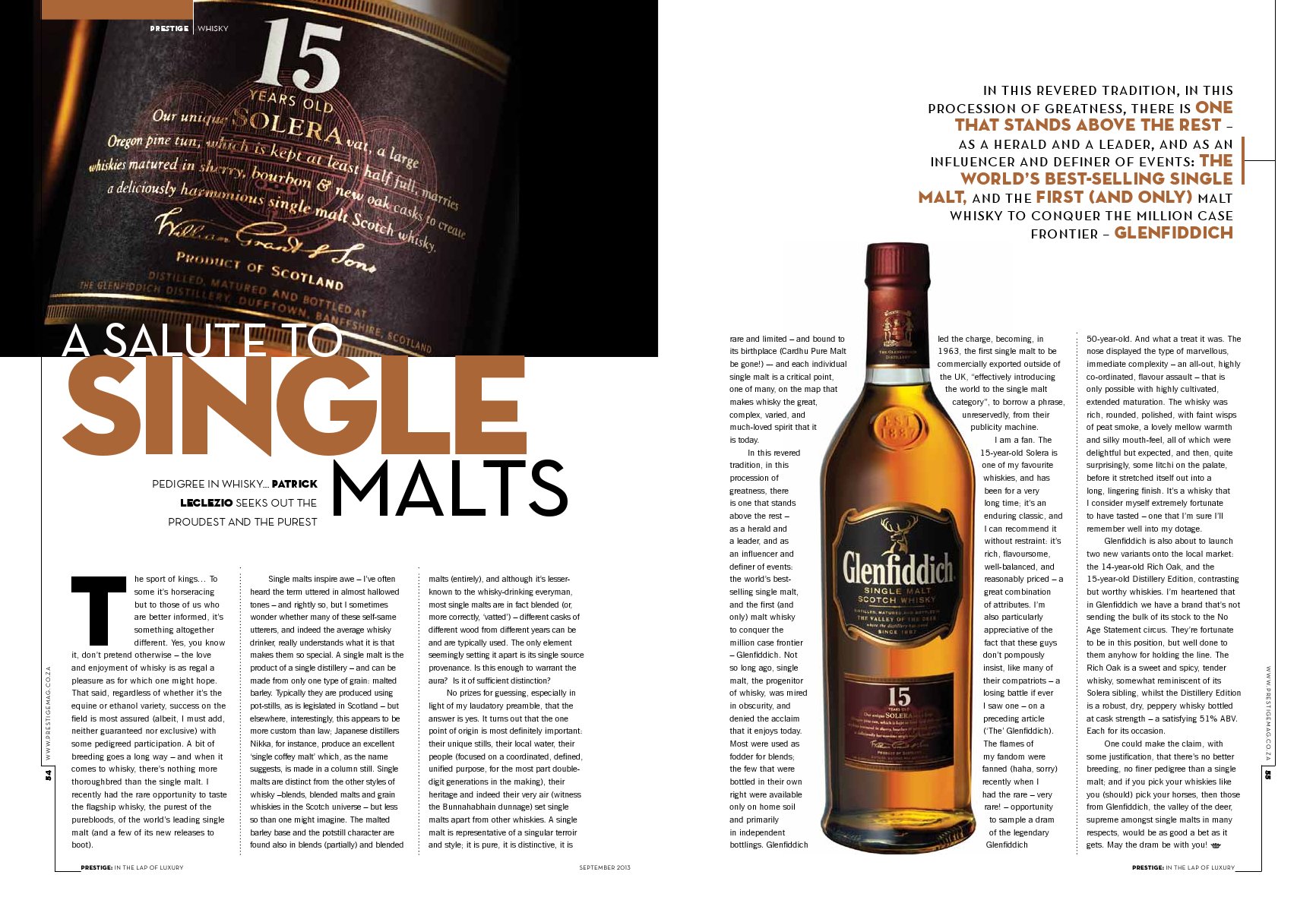
The sport of kings… To some it’s horseracing but to those of us who are better informed, it’s something altogether different. Yes, you know it, don’t pretend otherwise the love and enjoyment of whisky is as regal a pleasure as for which one might hope. That said, regardless of whether it’s the equine or ethanol variety, success on the field is most assured (albeit, I must add, neither guaranteed nor exclusive) with some pedigreed participation. A bit of breeding goes a long way and when it comes to whisky, there’s nothing more thoroughbred than the single malt. I recently had the rare opportunity to taste the flagship whisky, the purest of the purebloods, of the world’s leading single malt (and a few of its new releases to boot).

Single malts inspire awe – I’ve often heard the term uttered in almost hallowed tones – and rightly so, but I sometimes wonder whether many of these self-same utterers, and indeed the average whisky drinker, really understands what it is that makes them so special. A single malt is the product of a single distillery – and can be made from only one type of grain: malted barley. Typically they are produced using pot-stills, as is legislated in Scotland but elsewhere, interestingly, this appears to be more custom than law; Japanese distillers Nikka, for instance, produce an excellent ‘single coffey malt’ which, as the name suggests, is made in a column still. Single malts are distinct from the other styles of whisky –blends, blended malts and grain whiskies in the Scotch universe – but less so than one might imagine. The malted barley base and the potstill character are found also in blends (partially) and blended malts (entirely), and although it’s lesser-known to the whisky-drinking everyman, most single malts are in fact blended (or, more correctly, ‘vatted’) – different casks of different wood from different years can be and are typically used. The only element seemingly setting it apart is its single source provenance. Is this enough to warrant the aura? Is it of sufficient distinction?

No prizes for guessing, especially in light of my laudatory preamble, that the answer is yes. It turns out that the one point of origin is most definitely important: their unique stills, their local water, their people (focused on a coordinated, defined, unified purpose, for the most part double-digit generations in the making), their heritage and indeed their very air (witness the Bunnahabhain dunnage) set single malts apart from other whiskies. A single malt is representative of a singular terroir and style; it is pure, it is distinctive, it is rare and limited – and bound to its birthplace (Cardhu Pure Malt be gone!) –- and each individual single malt is a critical point, one of many, on the map that makes whisky the great, complex, varied, and much-loved spirit that it is today.

In this revered tradition, in this procession of greatness, there is one that stands above the rest – as a herald and a leader, and as an influencer and definer of events: the world’s best-selling single malt, and the first (and only) malt whisky to conquer the million case frontier – Glenfiddich. Not so long ago, single malt, the progenitor of whisky, was mired in obscurity, and denied the acclaim that it enjoys today. Most were used as fodder for blends; the few that were bottled in their own right were available only on home soil and primarily in independent bottlings. Glenfiddich led the charge, becoming, in 1963, the first single malt to be commercially exported outside of the UK, “effectively introducing the world to the single malt category”, to borrow a phrase, unreservedly, from their publicity machine.

I am a fan. The 15-year-old Solera is one of my favourite whiskies, and has been for a very long time; it’s an enduring classic, and I can recommend it without restraint: it’s rich, flavoursome, well-balanced, and reasonably priced – a great combination of attributes. I’m also particularly appreciative of the fact that these guys don’t pompously insist, like many of their compatriots – a losing battle if ever I saw one – on a preceding article (‘The’ Glenfiddich). The flames of my fandom were fanned (haha, sorry) recently when I had the rare – very rare! – opportunity to sample a dram of the legendary Glenfiddich 50-year-old. And what a treat it was. The nose displayed the type of marvellous, immediate complexity – an all-out, highly co-ordinated, flavour assault – that is only possible with highly cultivated, extended maturation. The whisky was rich, rounded, polished, with faint wisps of peat smoke, a lovely mellow warmth and silky mouth-feel, all of which were delightful but expected, and then, quite surprisingly, some litchi on the palate, before it stretched itself out into a long, lingering finish. It’s a whisky that I consider myself extremely fortunate to have tasted – one that I’m sure I’ll remember well into my dotage.

Glenfiddich is also about to launch two new variants onto the local market: the 14-year-old Rich Oak, and the 15-year-old Distillery Edition, contrasting but worthy whiskies. I’m heartened that in Glenfiddich we have a brand that’s not sending the bulk of its stock to the No Age Statement circus. They’re fortunate to be in this position, but well done to them anyhow for holding the line. The Rich Oak is a sweet and spicy, tender whisky, somewhat reminiscent of its Solera sibling, whilst the Distillery Edition is a robust, dry, peppery whisky bottled at cask strength – a satisfying 51% ABV. Each for its occasion.

One could make the claim, with some justification, that there’s no better breeding, no finer pedigree than a single malt; and if you pick your whiskies like you (should) pick your horses, then those from Glenfiddich, the valley of the deer, supreme amongst single malts in many respects, would be as good a bet as it gets. May the dram be with you!


A phoenix from the ashes

From expired discard to fine spirit. Patrick Leclezio indulges in some renaissance culture.

First published in Prestige Magazine (August 2013 edition).

As it appeared.

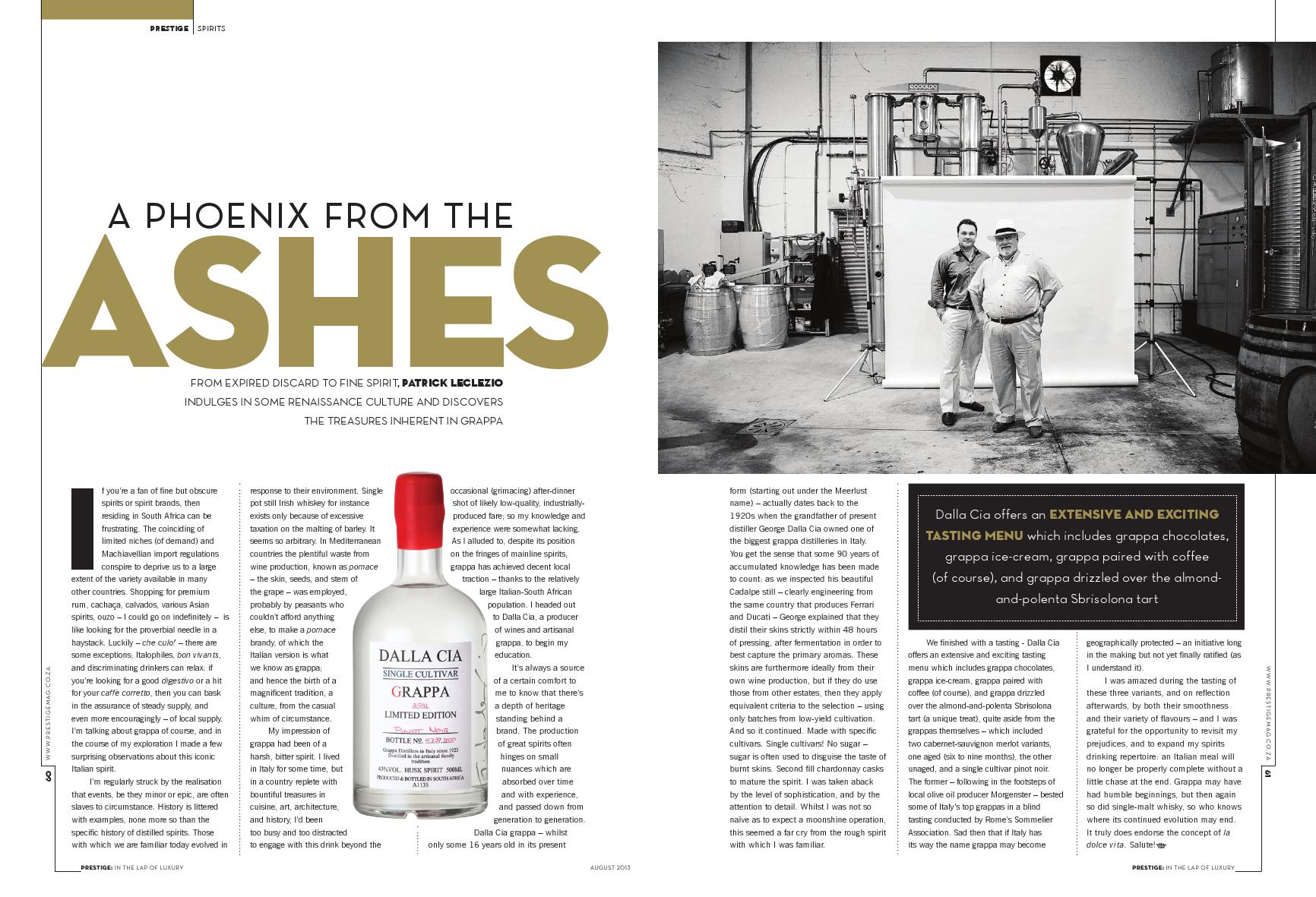
If you’re a fan of fine but obscure spirits or spirit brands, then residing in South Africa can be frustrating.  The coinciding of limited niches (of demand) and Machiavellian import regulations conspire to deprive us to a large extent of the variety available in many other countries.  Shopping for premium rum, cachaça, calvados, various Asian spirits, ouzo, I could go on indefinitely, is like looking for the proverbial needle in a haystack.  Luckily – che culo! – there are some exceptions; Italophiles, bon vivants, and discriminating drinkers can relax: if you’re looking for a good digestivo or a hit for your caffè corretto then you can bask in the assurance of steady supply, and even more encouragingly – of local supply.  I’m talking about grappa of course, and in the course of my exploration I made a few surprising observations about this iconic Italian spirit.

I’m regularly struck by the realisation that events, be they minor or epic, are often slaves to circumstance.  History is littered with examples – none more so than the specific history of distilled spirits.  Those with which we are familiar today evolved in response to their environment.  Single pot still Irish whiskey for instance exists only because of excessive taxation on the malting of barley.  It seems so arbitrary.  In Mediterranean countries the plentiful waste from wine production, known as pomace – the skin, seeds, and stem of the grape – was employed, probably by peasants who couldn’t afford anything else, to make a pomace brandy, of which the Italian version is what we know as grappa; and hence the birth of a magnificent tradition, a culture, from the casual whim of circumstance.

My impression of grappa had been of a harsh, bitter spirit.  I lived in Italy for some time, but in a country replete with bountiful treasures in cuisine, art, architecture, and history, I’d been too busy and too distracted to engage with this drink beyond the occasional – grimacing – after-dinner shot of likely low-quality, industrially-produced fare; so my knowledge and experience were somewhat lacking. As I alluded to, despite its position on the fringes of mainline spirits, grappa has achieved decent local traction – thanks to the relatively large Italian-South African population.  I headed out to Dalla Cia – a producer of wines and artisanal grappa – to begin my education.

It’s always a source of a certain comfort to me to know that there’s a depth of heritage standing behind a brand.  The production of great spirits often hinges on small nuances which are absorbed over time and with experience, and passed down from generation to generation.  Dalla Cia grappa – whilst only some 16 years old in its present form (starting out under the Meerlust name) – actually dates back to the 1920’s when the grandfather of present distiller George Dalla Cia owned one of the biggest grappa distilleries in Italy.  You get the sense that some 90 years of accumulated knowledge has been made to count: as we inspected his beautiful Cadalpe still – clearly engineering from the same country that produces Ferraris and Ducatis – George explained that they distil their skins strictly within 48 hours of pressing (after fermentation) in order to best capture the primary aromas.  These skins are furthermore ideally from their own wine production, but if they do use those from other estates, then they apply equivalent criteria to the selection – using only batches from low-yield cultivation.  And so it continued.  Made with specific cultivars.  Single cultivars! No sugar – sugar is often used to disguise the taste of burnt skins.  Second fill chardonnay casks to mature the spirit. I was taken aback by the level of sophistication, and by the attention to detail.  Whilst I was not so naïve as to expect a moonshine operation this seemed a far cry from the rough spirit with which I was familiar.

We finished with a tasting – Dalla Cia offers an extensive and exciting tasting menu which includes grappa chocolates, grappa ice-cream, grappa paired with coffee (of course), and grappa drizzled over the almond-and-polenta Sbrisolona tart (a unique treat), quite aside from the grappas themselves – which included two cabernet-sauvignon merlot variants, one aged (six to nine months), the other unaged, and a single cultivar pinot noir.   The former – following in the footsteps of local olive oil producer Morgenster – bested some of Italy’s top grappas in a blind tasting conducted by Rome’s Sommelier Association.  Sad then that if Italy has its way the name grappa may become geographically protected – an initiative long in the making but not yet finally ratified (as I understand it).

I was amazed during the tasting of these three variants, and on reflection afterwards, by both their smoothness and their variety of flavours – and I was grateful for the opportunity to revisit my prejudices, and to expand my spirits drinking repertoire: an Italian meal will no longer be properly complete without a little chase at the end.  Grappa may have had humble beginnings but then again so did single-malt whisky, so who knows where its continued evolution may end.  It truly does endorse the concept of la dolce vita.  Salute!

What’s in a glass?

It may not be as important as what’s in the glass, but choice of glassware will materially influence the whisky drinking experience.  Patrick Leclezio reviews the options.

First published in Prestige Magazine (August 2013 edition).

As it appeared.

If you’re a whisky cowboy riding about out there and exploring the range the weapon that you’re likely to be wielding more than most is a whisky glass.  A glass, if you think about it, is as basic as it gets: used for displacing liquid from bottle to mouth.  Is this worth worrying about?  Surely just about anything will do.  Well, actually, no. As with any of a wide array of ordinary, day-to-day products the features that distinguish one type of glass from another make only a subtle difference to its functioning; yet these can be sometimes be enough to both transform our experience of their use, and in many cases to command a substantial premium.  I recently assembled a panel of whisky luminaries – seasoned campaigners who’ve drawn just about every which glass from their holsters – to evaluate the various options available to us.

Our analysis focused more on casual drinking and less on professional tasting, where the opaque copita is king, but having said that we nonetheless gave due and full recognition to the appreciation of flavour.

The features that matter are both tangible and intangible; enjoyment, pleasure, even flavour are psychosomatic, so it’s important not to overlook or undervalue that latter class in a glass.  This notwithstanding in order of apparentness the conclusions from our review are as follows:

Shape

Some (many) whisky drinkers, much to their disadvantage, often overlook the aroma or nose (to use the proper parlance) of a whisky – which happens to be the most enabling medium through which to best appreciate the finer nuances of flavour, given that there are some 32 primary aromas but only five primary tastes.  A good whisky glass should taper inwards towards its rim, concentrating the rising vapours, hence promoting and focusing a person’s ability to savour the nose. Scottish manufacturers Glencairn produce the ideal glass for nosing – a bulbous receptacle at the base graduating into a narrow funnel towards the top; if I’ve had enough to drink I can almost swear that I can see the aromas swirling within it like an inverted tornado.  Doubters can employ a simple test to verify the significance of shape: stand a nosing-friendly glass side-by-side with a straight-walled tumbler and add equal measures of the same whisky (in our case we used the delicious Dewar’s 12YO) and water to both.  Nose one after the other and repeat – the difference is immediately palpable.

Rim

There are three factors relating to the rim about which we should be concerned: diameter, thickness and shape. 

The rim diameter should strike a harmonious balance between being too wide – thereby introducing sufficient area for vapour dispersal – and too narrow – obstructing the transition from nose to palate, especially for those of us with protruding proboscises (i.e. large schnozzes).  We found the Libbey 21cl L’Esprit du Vin glass to have the perfect dimensions – the inner rim measuring 45mm.

In terms of thickness there’s also a middle ground where drinking comfort becomes optimal, but this may be a matter of personal taste.  We tested a set of Normann Copenhagen rocking glasses whose chunky and cumbersome rims were almost suggestive of drinking out of a bowl.  Conversely the Glencairns are just too thin, too fine…whisky drinking requires a certain robust masculinity after all.

Lastly the shape of the rim can substantially enhance the experience of glass on lip, and subsequently of the introduction of the whisky into the mouth.  Riedel’s Vinum Single Malt glass is magnificent in this respect – a flared rim allows the whisky to pool at the lips before cascading over the teeth and onto the palate.  This glass does have its various drawbacks however: its curvature, its fragility, and its jaw-dropping cost combine to seriously inhibit one of whisky drinking’s greatest, most joyous rituals – that of toasting. 

Aesthetics and other intangibles

Design, clarity, weight, innovativeness, novelty, size and tradition all have a strong appeal; often this may not be explicitly and objectively explainable, but it is undeniable regardless.  I once owned a Mont Blanc pen (before I lost it, much to my chagrin); the shaft was ornate and substantial, the ink thick and lustrous, and the sight of it, well, it was arresting – I can still picture it perfectly now, in my mind’s eye, years later.  It was a beautiful, superbly-crafted instrument; still is I’m sure, to whoever found it.  But if I were to be measurably scientific, I’d have to say that I can write, and have subsequently written, with other pens – arbitrary, run-of-the-mill items – with much, if not exactly, the same observable results.  Yet, I definitely enjoyed writing with it, holding it, displaying it, impressing with it, far more than any of those others – for reasons that had nothing to do with its functional performance.  The experience of using it was special.  Similarly, even more compellingly – because its functional performance is undisputedly inferior – the straight-walled whisky tumbler, particularly its crystal incarnation, still occupies a certain pride of place amongst whisky lovers.  The guys at Spilhaus sent us a few of their finest examples – from Atlantis, Waterford and RCR – and we regaled in their use.  Their weight, or more descriptively, their heft, makes the suggestion of substance – of the glass, of the drink, and of the person.  It’s a serious glass for a serious drink – the badge of the gentlemen’s club tradition of whisky drinking, conveying affluence, power, civility and status.

And the winner is…

Once all these factors had been considered one glass towered above the others like a tippling titan: the Bowmore thistle glass.  It ticks all the boxes: a wide bowl, sitting on a thick, heavy base, curving pleasingly inwards before flaring to a well-proportioned rim.  It is not too small, not too large, sitting comfortably in the hand, and whilst its design may be deemed a bit tweed by younger, more modern enthusiasts, the thistle shape has a certain classic Scottish authenticity that will never be amiss for true adherents.  May the dram be with you – and in a damned good glass at that! 

Special thanks to Bernardo Gutman, Marsh Middleton, and Hector McBeth.

To your health!

It may seem counter-intuitive to some, but drinking spirits is good for you. Patrick Leclezio ponders the blessings of booze.

First published in Prestige Magazine (July 2013 edition).

As it appeared.

As it appeared.

During my adolescence one of my household tasks was to serve my father his daily libation.  This may have been the source of my affinity for whisky.  Back then however any such tendencies, if indeed they had been imbedded, were dormant.  I had no inclination to drink any alcohol, much less spirits (such were the misguided delusions of my youth).   I remember, as we went through the ritual, that he’d often attempt to instil in me the sentiment that a regular whisky was beneficial to one’s health.  The apparent authority behind this wisdom was his father, his father-in-law, and the family doctor – all three whisky drinkers too.  I was dubious.  Undoubtedly I was a cynical lad, given to questioning just about everything, but this seemed altogether too convenient.  I never quite believed it, and it slowly sunk into the recesses of my mind…until recently.

My wife works extensively with Russians.  A while ago, after a visit to the country, she mentioned that she’d been told that the average lifespan of a Russian man was 59.  In fact it’s somewhere in the late-fifties to early-sixties depending of the study consulted, and the date thereof.  A few years here and there notwithstanding this is a shockingly bleak situation; these guys are literally vodka-drinking themselves into an early grave.  Now clearly this is on the extreme end of the scale – no-one is suggesting that excessive drinking is anything but detrimental – but can this same substance, in more measured doses, actually do you good?

The answer is yes: a variety of scientific studies, one of the earliest (published in the Journal of the American Medical Association) dating back to 1904, have repeatedly proved it to be the case, to the point where it is now undisputed. It seems that my collected male progenitors and the doctor were onto something (though whether they actually gave it any scrutiny is debatable).  Liquor drunk regularly in moderation does in fact have a myriad health benefits, reducing the risks of heart disease (in middle aged and older men in particular), certain cancers, diabetes and dementia amongst others; and given that the former is the principal cause of death in most industrialised countries this is no small endorsement. Alcohol achieves these impressive feats by impacting positively on cholesterol, blood pressure, and insulin levels, by decreasing thrombosis (effectively thinning the blood), and by improving the heart’s response to stress (as those of us who’ve sunk a few after a hard day at work will gladly attest).

So how does one know good drinking from bad?  How can one separate one’s own habits from what the Russians are doing?  The (American) National Institute on Alcohol Abuse and Alcoholism defines moderation as the consumption of four drinks on any day to an average of 14 drinks per week for men, with the corresponding numbers for women being three and seven drinks.  One drink in distilled spirit terms constitutes one and half fluid ounces, or roughly 45ml, so generous enough for this to seem more indulgence than regimen.  The important point to note is that this drinking should be regular and tempered.  I should also make it clear, at the risk of being obvious, that these guidelines apply to average persons, relaxing in the comfort of their homes; and that they would specifically exclude pregnant women, people on medication, people with a history of alcohol abuse, people intending to drive thereafter, and underaged people.

The studies also haven’t been able to find a significant difference in benefits attributable to the type of liquor consumed, so whether one is drinking red wine, beer, or hard tack doesn’t discernibly matter.  I had always been concerned that brown spirits, being less pure than their white counterparts, largely due to the presence of congeners (fatty acids) from the cask maturation process, might be at health disadvantage but gratifyingly there’s no evidence to suggest it.  This is great ‘news’ – we can all stick to our favourite tipple and responsibly drink ourselves to a longer, healthier life.

I’ve noticed (it seems to be my time for subconscious realisations) that toasts the world over are dedicated to health:  santé, gezondheid, sláinte mhath, l’chaim…the list is endless (and the origins of these toasts date back centuries).  These were conceived I’m sure to express an intention not a prescription, so the added meaning is an extraordinary coincidence.  Regardless, I’ll henceforth be toasting with extra vigour and gusto.  I wish you all the very best of health.  Bottoms up!

Out and about with whisky

The Cape Town episode.  It’s much more than just a collection of whisky bottles – Patrick Leclezio checks out the bigger picture at the Bascule Bar.

First published in Prestige Magazine (July 2013 edition).

As it appeared.

As it appeared.

When I first heard about the Bascule it was with reference to its impressive assortment of whiskies – 400 odd back then, supposedly the largest of any bar in the Southern Hemisphere.  Subsequently each mention of it, in the press in particular, fixated on this same angle; and whilst it’s admittedly worth the boast – what whisky lover wouldn’t be intrigued – it has also placed the bar in a bit of a one-dimensional pigeonhole: “Ah the Bascule, that’s the place with the large selection, right?”.  Things have moved on since then.  Firstly, any whisky bar worth its salt, and there are an increasing number available to us, should offer satisfyingly vigorous variety, and whilst the Bascule’s is now over 500 strong, there are others that come close to or even exceed it.  Secondly, the Bascule is far more than the sum of its whisky parts; it would be a grossly missed opportunity (and an injustice) to remain ignorant of its wider charms.  In this spirit I decided to dedicate an evening, some quality time, to get to know the place in-depth.

The bar takes its name – in case you were wondering – from the nearby bascule bridge (a type of moveable bridge that employs counterweights to open and close, hence giving access to naval traffic), the only one of its kind in the country.  It, the bar not the bridge, is ensconced in the Cape Grace hotel, amongst the Cape’s finest and a recent recipient of high accolades (from the TripAdvisor website – second best hotel in the world in their 2013 Travelers’ Choice Awards).  In a case of narrowly averted tragedy, a less travelled road (back then) almost not taken, the bar didn’t figure in the hotel’s original plans.  It was an afterthought – its existence indebted to the then-owner’s passion for whisky.  This may go some way to explain its position in the lower reaches of the structure.  As inadvertent as this might have been it doesn’t suffer as a result of it; actually quite the contrary – the subterranean floor level, the tunnel-like passages, the restricted natural light, the ship-type staircase (a “ladder” in nautical speak), and the direct access to the quayside all combine to give the place a certain unique cachet.  It’s cosy and intimate, elegant in a welcoming and comfortable manner, and, as I was to discover, infinitely interesting and engrossing.

My host for the visit was Bascule manager George Novitskas.  We sat down together – in the delightfully opulent high-backed chairs installed during the recent renovations – over craft draughts from the Cape Brewing Company (what better than some skilfully brewed barley to break-in the palate), a bottle of Highland Park 12YO (still in my opinion one of the most complete Scotch whiskies on the market), and a couple of mouth-wateringly delicious Wagyu burgers (the meat coming from cattle originating in Japan, and renowned for being the self-same source of the world famous Kobe beef) . This burger is the star attraction on a well-considered, elaborate, but mostly tapas-based menu, which is primarily intended as a snacking accompaniment for patrons.  George is very particular on this point: the Bascule is a bar, not a restaurant…although those seeking more extensive fare can always order from the hotel’s main eatery.

Inevitably, obligatorily, the whisky discussion began with the much lauded collection, which includes highlights such as the Glenfiddich 50YO, the Glenmorangie 1963, the Laphroaig 40YO, the Ardbeg 1975, the Glen Grant 1952, the Highland Park 30, and the Dalmore 1978 – enough to keep the more (most?) demanding connoisseurs well-satisfied – but this is only the beginning of the bar’s whisky attractions:  whilst the classics and some winter warmers are already available, a bespoke whisky-specific cocktail menu is being created for the Bascule by one of the country’s top mixologists;  customers can request to have their whisky served with a perfect ice-ball, made using a Taisin copper press, one of the few, if not the only one, in the country; and the bar also offers an extensive program of whisky tastings and a well-subscribed whisky club.

It’s worth dwelling on these last two offerings. 

Whisky tastings are all the rage at the moment – for corporate functions, for bachelor parties, or just simply for one’s general enjoyment and enrichment.  The Bascule provides two types of tastings.  The first is a self-tutored ‘flight’ of whisky – basically three related whiskies presented on a tasting mat that is inscribed with relevant information.  This strikes me as an ideal vehicle for musing over a couple of drams easily and on short-notice, whether in one’s own company or as a shared experience. The second is a tutored tasting – offered at three levels – the Introductory, the Intermediate and the Sommelier’s Choice – and conducted by one of the bar’s managers, each of whom, along with the rest of the staff, would have been trained on Dave Broom’s World Masterclass series.  These tutored tasting also feature the growing and (very) agreeable trend of pairing food with whisky.

The Bascule whisky club almost defies belief.  Members enjoy the place as if they’re in their own homes – and effectively that’s the whole premise of the thing.  One of the values of the Cape Grace hotel is to make visitors feel like they’re at home, and it has certainly succeeded with the club; for a nominal annual fee members are allocated a bottle locker which they can stock at much reduced prices.  To the gregarious, whisky-loving gadabout, and I know a few, this is like the proverbial manna from heaven.  Throw in six special, catered tasting events, an end-of-year members’ party, and the option to use the club for one personal function, and you’ve got a package that’s almost too good to be true.  The Bascule also gives each member a crystal tumbler with their name engraved on it – a discreet, understated symbol of their special status.

I may be under the influence of the Orkney peat buzz, the memory of that delectable marbled beef, or the lingering pleasure of an evening well spent, so dim my effusiveness down a notch if you will: the Bascule Bar is quite simply magnificent. The whisky community has embraced it, celebrities flock to it, and both locals and tourists are drawn to it persistently.  If you’re a South Africa-residing whisky lover then it is imperative that you should visit…often.  May the dram be with you.

The beauty’s in the botanicals

What kind of far-fetched absurdity has concocted a narrative where James Bond’s drink of choice is a vodka martini?  Patrick Leclezio makes the case for gin.

First published in Prestige Magazine (June 2013 edition).

As it appeared.

As it appeared.

I’m not a gin drinker.  Somehow, inexplicably, this is a drink that has eluded me over the years, much to my regret.  It’s a habit that I’m determined to acquire though, because I’ve come to realise that there are moments when nothing but gin will do.  Think balmy, summer afternoons. White linen and bare feet.  A thick, terraced lawn of colonial proportions.  Fast friends and fine food and (slightly) fuddled conversation. Ok, I’m laying it on a bit thick, but you get the drift.  Gin offers epic possibilities.

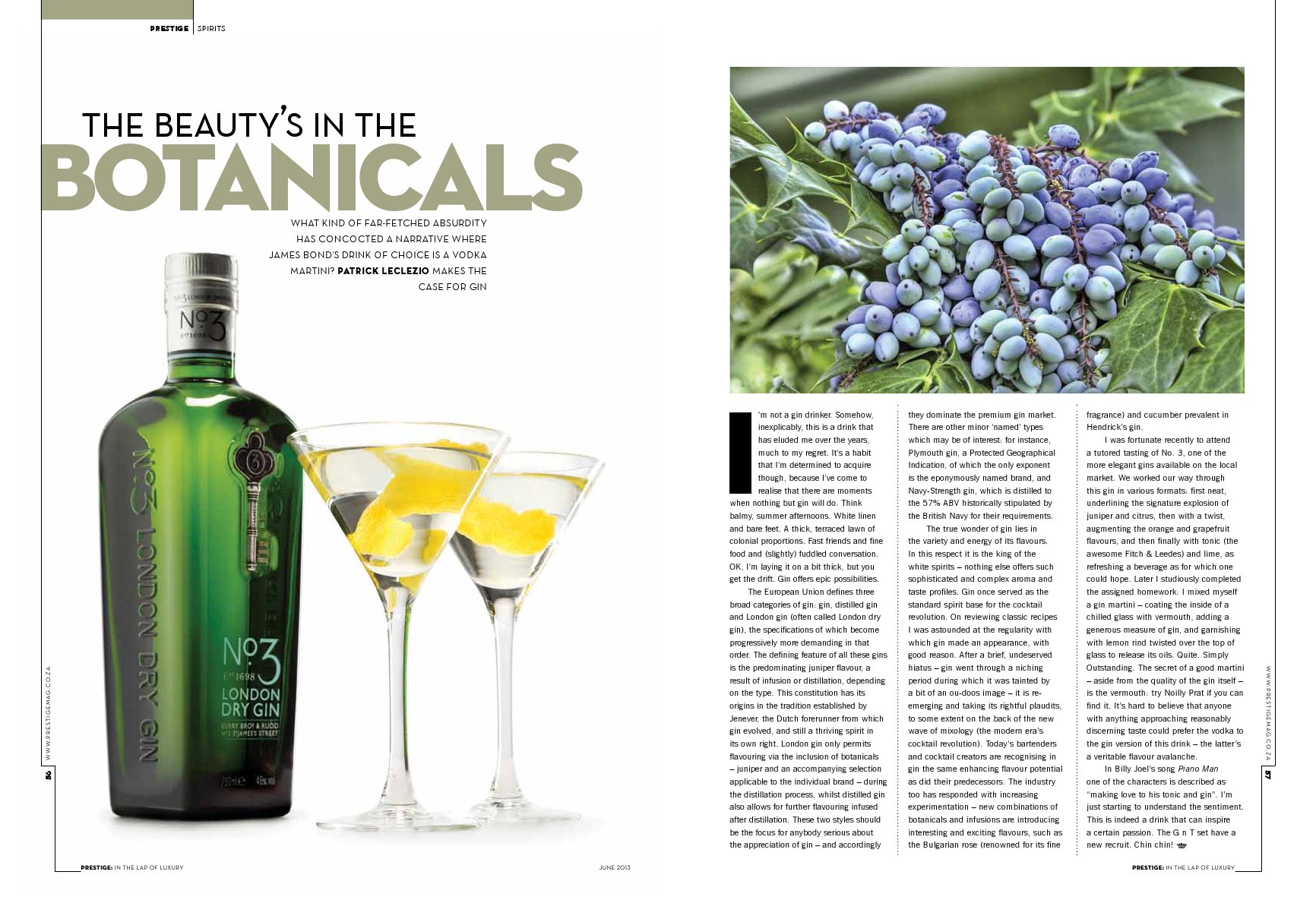
The European Union defines three broad categories of gin: gin, distilled gin and London gin (often called London dry gin), the specifications of which become progressively more demanding in that order.  The defining feature of all these gins is the predominating juniper flavour, a result of infusion or distillation, depending on the type.  This constitution has its origins in the tradition established by Jenever, the Dutch forerunner from which gin evolved, and still a thriving spirit in its own right.  London gin only permits flavouring via the inclusion of botanicals – juniper and an accompanying selection applicable to the individual brand – during the distillation process, whilst distilled gin also allows for further flavouring infused after distillation.  These two styles should be the focus for anybody serious about the appreciation of gin – and accordingly they dominate the premium gin market.  There are other minor “named” types which may be of interest: for instance, Plymouth gin, a Protected Geographical Indication, of which the only exponent is the eponymously named brand, and Navy-Strength gin, which is distilled to the 57% ABV historically stipulated by the British Navy for their requirements.

The true wonder of gin lies in the variety and energy of its flavours.  In this respect it is the king of the white spirits – nothing else offers such sophisticated and complex aroma and taste profiles.  Gin once served as the standard spirit base for the cocktail revolution.  On reviewing classic recipes I was astounded at the regularity with which gin made an appearance, with good reason.  After a brief, undeserved hiatus – gin went through a niching period during which it was tainted by a bit of an ou-doos image – it is re-emerging and taking its rightful plaudits, to some extent on the back of the new wave of mixology (the modern era’s cocktail revolution). Today’s bartenders and cocktail creators are recognising in gin the same enhancing flavour potential as did their predecessors.  The industry too has responded with increasing experimentation – new combinations of botanicals and infusions are introducing interesting and exciting flavours, such as the Bulgarian rose (renowned for its fine fragrance) and cucumber prevalent in Hendrick’s gin.

I was fortunate recently to attend a tutored tasting of No. 3, one of the more elegant gins available on the local market.  We worked our way through this gin in various formats: first neat, underlining the signature explosion of juniper and citrus, then with a twist, augmenting the orange and grapefruit flavours, and then finally with tonic (the awesome Fitch & Leedes) and lime, as refreshing a beverage as for which one could hope.  Later I studiously completed the assigned homework:  I mixed myself a gin martini – coating the inside of chilled glass with vermouth, adding a generous measure of gin, and garnishing with lemon rind, twisted over the top of glass to release its oils.  Quite. Simply Outstanding.  The secret of a good martini – aside from the quality of the gin itself – is the vermouth:  try Noilly Prat if you can find it.  I was left wondering how anyone possessing anything approaching reasonably discerning taste could prefer the vodka to the gin version of this drink – the latter’s a veritable flavour avalanche. 

In the song Piano Man by Billy Joel one of the characters is described as “making love to his tonic and gin”.  I’m just starting to understand the sentiment.  This is indeed a drink that can inspire a certain passion.  The G and T set have a new recruit.  Chin chin!

Respect for elders

Is age a bit of a red herring?  Patrick Leclezio explores one of the burning whisky questions of our time.

First published in Prestige Magazine (June 2013 edition).

As it appeared.

As it appeared.

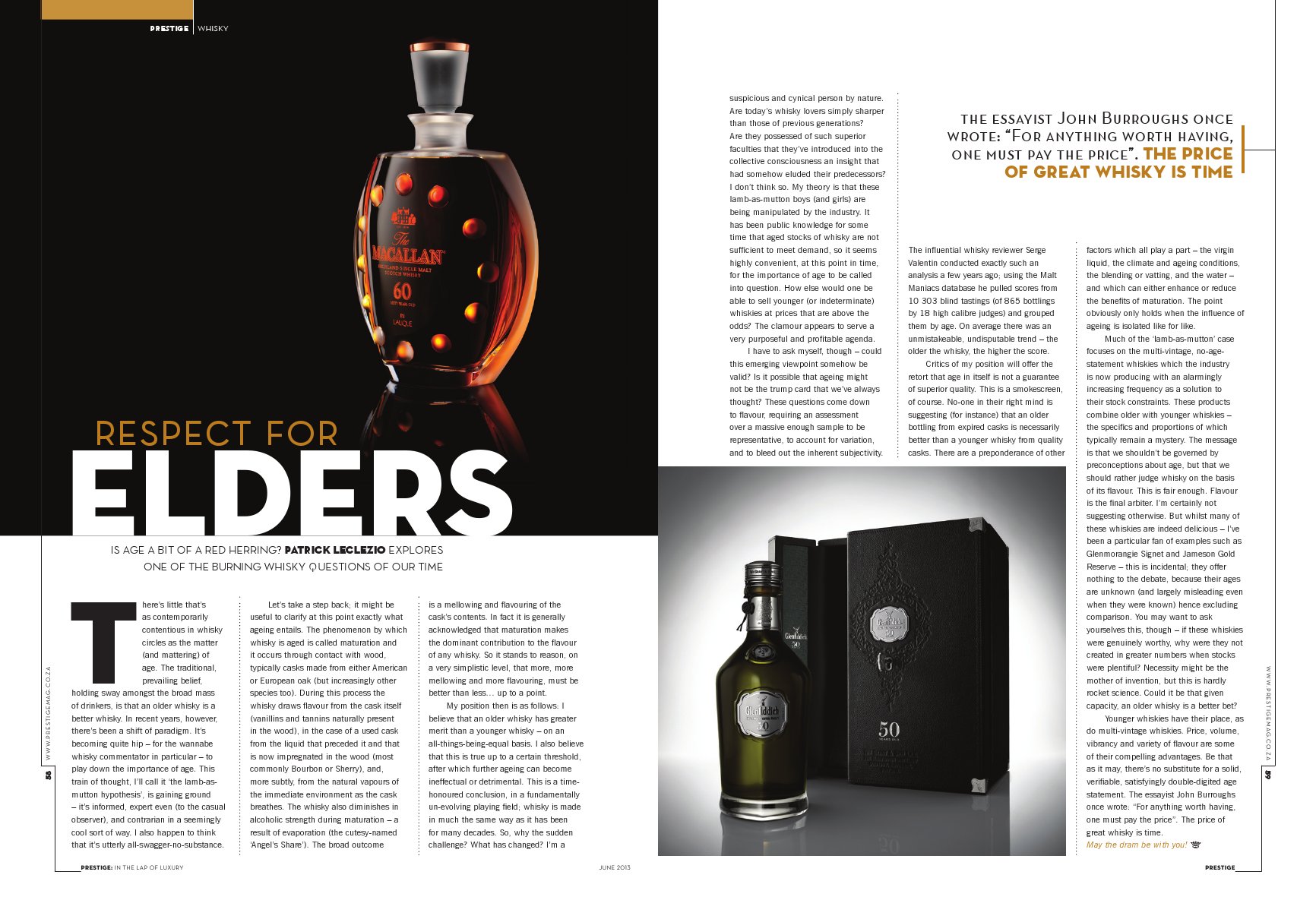
There’s little that’s as contemporarily contentious in whisky circles as the matter (and mattering) of age. The traditional, prevailing belief, holding sway amongst the broad mass of drinkers, is that an older whisky is a better whisky.  In recent years however there’s been a shift of paradigm.   It’s becoming quite hip – for the wannabe whisky commentator in particular – to play down the importance of age. This train of thought, I’ll call it the lamb-as-mutton hypothesis, is gaining ground – it’s informed, expert even (to the casual observer), and contrarian in a seemingly cool sort of way. I also happen to think that it’s utterly all-swagger-no-substance erroneous.

Let’s take a step back; it might be useful to clarify at this point exactly what ageing entails.  The phenomenon by which whisky is aged is called maturation and it occurs through contact with wood, typically casks made from either American or European oak (but increasingly other species too).  During this process the whisky draws flavour from the cask itself (vanillins and tannins naturally present in the wood), in the case of a used cask from the liquid that preceded it and that is now impregnated in the wood (most commonly Bourbon or Sherry), and, more subtly, from the natural vapours of the immediate environment as the cask breathes.  The whisky also diminishes in alcoholic strength during maturation – a result of evaporation (the cutesy-named Angel’s Share).  The broad outcome is a mellowing and flavouring of the cask’s contents. In fact it is generally acknowledged that maturation makes the dominant contribution to the flavour of any whisky.  So it stands to reason, on a very simplistic level, that more, more mellowing and more flavouring, must be better than less…up to a point.

My position then is as follows: I believe that an older whisky has greater merit than a younger whisky – on an all-things-being-equal basis.  I also believe that this is true up to a certain threshold, after which further ageing can become ineffectual or detrimental.   This is a time-honoured conclusion, in a fundamentally un-evolving playing field; whisky is made in much the same way as it has been for many decades.  So, why the sudden challenge?  What has changed?

I’m a suspicious and cynical person by nature.  Are today’s whisky lovers simply sharper than those of previous generations?  Are they possessed of such superior faculties that they’ve introduced into the collective consciousness an insight that had somehow eluded their predecessors?  I don’t think so.  My theory is that these lamb-as-mutton boys (and girls) are being manipulated by the industry.  It has been public knowledge for some time that aged stocks of whisky are not sufficient to meet demand, so it seems highly convenient, at this point in time, for the importance of age to be called into question.  How else would one be able sell younger (or indeterminate) whiskies at prices that are above the odds?  The clamour appears to serve a very purposeful and profitable agenda.

I have to ask myself though – could this emerging viewpoint somehow be valid?  Is it possible that ageing might not be the trump card that we’ve always thought?  These questions come down to flavour, requiring an assessment over a massive enough sample to be representative, to account for variation, and to bleed out the inherent subjectivity.  The influential whisky reviewer Serge Valentin conducted exactly such an analysis a few years ago; using the Malt Maniacs database he pulled scores from 10 303 blind tastings (of 865 bottlings by 18 high calibre judges) and grouped them by age.  On average there was an unmistakeable, undisputable trend – the older the whisky the higher the score.

Critics of my position will offer the retort that age in itself is not a guarantee of superior quality.  This is a smokescreen of course.  No-one in their right mind is suggesting (for instance) that an older bottling from expired casks is necessarily better than a younger whisky from quality casks.  There are a preponderance of other factors which all play a part – the virgin liquid, the climate and ageing conditions, and the blending or vatting – and which can either enhance or reduce the benefits of maturation.  The point obviously only holds when the influence of ageing is isolated like for like. 

Much of the lamb-as-mutton case focuses on the multi-vintage, no-age-statement whiskies which the industry is now producing with an alarmingly increasing frequency as a solution to their stock constraints.  These products combine older with younger whiskies – the specifics and proportions of which typically remain a mystery.  The message is that we shouldn’t be governed by preconceptions about age, but that we should rather judge whisky on the basis of its flavour.  This is fair enough.  Flavour is the final arbiter.  I’m certainly not suggesting otherwise.   But whilst many of these whiskies are indeed delicious – I’ve been a particular fan of examples such as Glenmorangie Signet and Jameson Gold Reserve – this is incidental; they offer nothing to the debate, because their ages are unknown (and largely misleading even they were known) hence excluding comparison.  You may want to ask yourselves this though – if these whiskies were genuinely worthy why were they not created in greater numbers when stocks were plentiful?  Necessity might be the mother of invention, but this is hardly rocket science.  Could it be that given capacity an older whisky is better bet?

Younger whiskies have their place, as do multi-vintage whiskies.  Price, volume, and vibrancy and variety of flavour are some of their compelling advantages.  Be that as it may there’s no substitute for a solid, verifiable, satisfyingly double-digited age statement.  The essayist John Burroughs once wrote: “For anything worth having one must pay the price”.  The price of great whisky is time.  May the dram be with you!

When Irish eyes are smiling

I recently met John Quinn, the Global Brand Ambassador for Irish whiskey Tullamore DEW and one of the consummate gentlemen of the industry, and I had the opportunity to put a few questions to him.

John Quinn watching over Tullamore DEW.

John Quinn watching over Tullamore DEW.

WOW: You’re the Global Brand Ambassador for Tullamore DEW.  Tell us a little bit about yourself, your work, and your time away from work.

JQ: Actually I don’t seem to have much time away from work these days as I’m constantly travelling – this week in RSA, last week in UK and the week before in South America. My job entails travelling the globe educating people about Irish whiskey and its history and characters and particularly talking about Tullamore DEW. On the announcement of my appointment a newspaper in Ireland wrote an article entitled “Is this the best job in Ireland?”. He might have been right – if I spent any time in Ireland !

When I’m not working I help manage a ladies Gaelic Football team – I know sounds strange but I enjoy it  when I’m at home. I also play golf most weekends, but please don’t ask me my handicap.

WOW: What do you most like and dislike about your job?

JQ: I love being in new places and meeting new people. I especially enjoy encountering new cultures and experiences. On this trip I visited Soweto – a fantastic experience giving an insight into South Africa, of yesterday, today and even of tomorrow. I also really enjoy the educational aspect of the job – it’s like being a teacher in a class full of very enthusiastic students – very rewarding. Dislikes would have to be the airport queues!

WOW: I would imagine that you meet a tremendous number of whiskey drinkers, and that you must have close insight into the latest developments in the market.  In your opinion what are the latest Irish whiskey consumer trends?

JQ: The growth of Irish whiskey itself is a worldwide consumer trend – growing at 20%+ per annum, much faster than any other whiskey category and even faster than any other international spirit category. Within Irish whiskey people are very interested in new expressions, particularly new finishes. Our own TD 12yo Special Reserve which is a triple blend is in vogue in many places while our 10yo single malt is an example of four-cask finishing, unique in Irish whiskey. The other big development is the interest in single pot still whiskeys, a small but very interesting category. New ways of finishing are always interesting, whether for blends, malts or pot stills

WOW: What sets Tullamore DEW apart from other Irish blends (such as Jameson)? What makes Tullamore DEW such a special whiskey?

JQ: Tullamore DEW is a triple distilled whiskey like most Irish whiskeys, but what makes it different is that it is also a triple blend. That is what makes it unique. Blended whiskeys tend to be blends of grain and malt whiskeys, such as blended Scotch. In Ireland we make a third type of whiskey known as “pot still” whiskey – this whiskey is unique to Ireland. Tullamore DEW is uniquely a blend of all three – grain, malt and pot still, matured is Bourbon and Sherry casks.  You ask about Jameson – it’s a wonderful whiskey. It’s a double blend of grain and pot still whiskeys. Bushmills, also a great whiskey is a double blend of grain and malt whiskeys. TD is a triple blend, so that what makes all of them different.

WOW: Irish whiskey is on the rise, led by the astounding performance of Jameson during the last decade.  What does the future hold for Irish whiskey, both in terms of volumes and styles?  How far and how wide can it go in the next ten years?

JQ: Who knows how far it can go. Both Tullamore DEW and Jameson have been leading the Irish whiskey growth globally in recent times. That is what you would expect from the two biggest brands. But there is still lots of room for more growth. For example Irish Whiskey sells 6m cases approx annually. The Scotch business alone is closer to 80m cases. So who knows what the potential can be – for sure the growth will continue as the brands enter new markets and introduce new expressions.

WOW: Specifically, in terms of Tullamore DEW, what new variants can we expect in the near-ish future?

JQ: Already in RSA we have the original and 12yo Special Reserve. We will introduce our 10yo Single Malt in the near future and we hope to have another older blend, fully matured by 2015. On top of that we do have plans to gradually introduce some small batches. Part of the difficulty has been that sales have exceeded forecasts for the past 15 years so we don’t have a lot of older whiskeys available just now. We are setting some aside though for the generations to come. On top of that we are building a new distillery in Tullamore to cope with the growing demand. This will also allow us to introduce new expressions

WOW: You’ve visited South Africa before.  What is it about the country you particularly enjoy?

JQ: I love the diversity in South Africa. The country is completely different from one region to another – The Western Cape is a world from Gauteng and vice versa – both physically and socially. I holidayed in the Cape a few years ago – it was fantastic. Jo’burg on the other hand is so vibrant, so exciting from a business perspective. We didn’t even get to Durban this time and I remember the importance of how that was different again. I also love the South African wine. I even had a chance to try some South African whiskeys and while more in the Scotch style they were very pleasant and interesting.

WOW: South Africa regularly ranks within the top 10 markets for Scotch whisky exports, and Jameson too has performed well here. Why do you think whisk(e)y has become so popular in this country?

JQ: South African consumers are a dynamic bunch. The structure of society means a lot of new younger consumers are entering the spirits market and in many cases want to try drinks different from the parents – so whiskey seems to be taking over where other spirits once led, such as brandy for example. It’s often a case of people looking for new tastes and both Irish and Scotch offer these in abundance

WOW: Wood is generally acknowledged as the principal influence on the flavour of a whisky.  How prescriptive is the Tullamore DEW wood policy?  Is this something that you oversee directly or is it largely managed by Midleton and Bushmills?  Do you have any special / interesting / distinctive cask profiles?

JQ: We manage it very closely in conjunction with our colleagues at Midleton and Bushmills. In fact as part of the William Grants Group we have a very strict policy on cask purchasing and management. The good news is that in WGs we buy our casks from many of the same suppliers as those to Midleton for example so our policies are closely aligned and of course we work in close cooperation to ensure the qualities and styles of casks are in line with our preferences.

WOW: In this regard is the liquid that you buy from these distilleries custom distilled?

JQ: From Midleton we buy the column distilled grain whiskey and the pot distilled pot-still whiskey I mentioned earlier. The malt whiskey for the blend comes from the distillery at Bushmills, obviously this is pot distilled.

WOW:  Irish whiskey (and Scotch) once upon a time used a small measure of oats in its mashbills.  Is this something that you might consider doing for Tullamore DEW?  What would be its contribution to flavour?

JQ: Yes that is true but it is not practised nowadays. The distillery being built at the moment will be for malt and pot still whiskeys and we will be using barley for both. As you can imagine we need to ensure the whiskey retains its very popular flavour. Who knows – we might look at producing whiskey from oats in the future but it’s not part of the immediate plan.

WOW: We’re very excited about the new distillery that you’re building.  Can you share some of the details with us?  When do you expect to fire up the stills and start production?

JQ: The distillery will be a pot still and malt distillery and in time we will also add column stills for grain whiskey distillation. It will be the only distillery in Ireland producing all three whiskey types. We expect the first spirit to start running from the pot stills next summer (July/August) – it is so exciting for all of us and particularly for me – the old guy

WOW: Are there plans for you to launch new brands once things are up and running, or will this distillery be dedicated to the production of Tullamore DEW?

JQ: The initial plan is for dedicated production of TD – but I expect we will look at the possibility of expanding our range as time passes – nothing hard has been planned in that regard though

WOW: What do you drink when you’re not drinking Tullamore DEW?

JQ: I love Hendricks gin and tonic, I enjoy wines of all styles but particularly Chardonnay/Chablis style in whites and Reds of all styles and countries. I enjoy a good beer when I’m thirsty but more often than not I will have a cider as I’m a coeliac (gluten allergy) so beer, sadly, is not good for me

WOW: Lastly, how do you prefer to drink your whiskey when you’re just having a casual dram with friends?

JQ: Either, with two cubes of ice or if it’s summer time I like with long with apple juice (freshly squeezed if possible – I had a great one at Cape Grace!) or with ginger ale. If it’s one of the older expressions I tend to drink it neat, slowly in a heavy crystal glass and with my eyes closed……