Tag Archives: Distilled spirits

Brave new world

The most special of South African special releases was launched last year.  I went to the source to take a look. 

First published in Prestige Magazine (February 2013 edition).
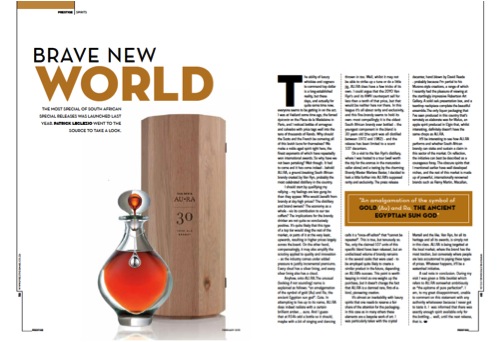
As it appeared.
As it appeared.

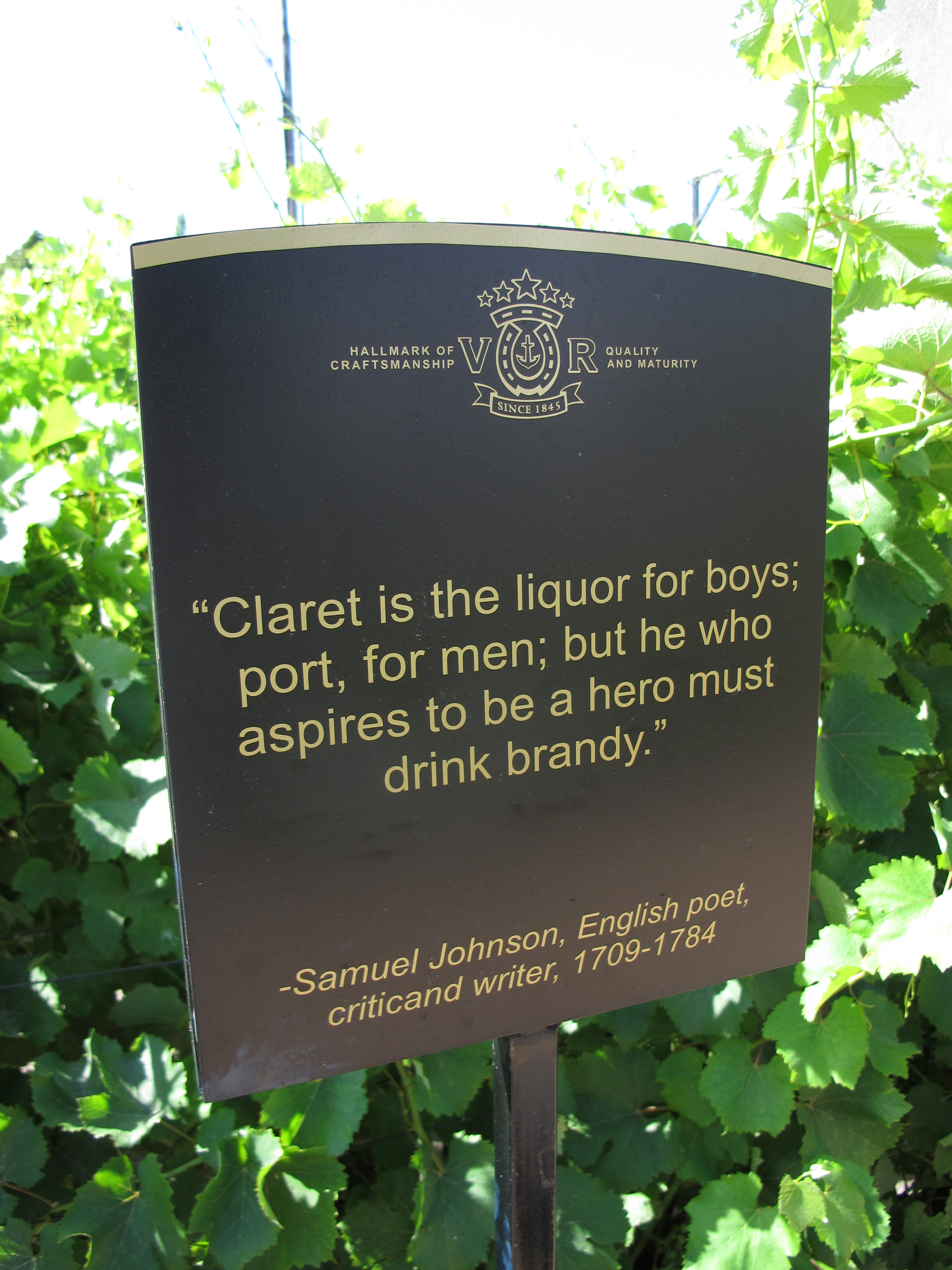
Amusing signage at the Van Ryn's distillery.

Amusing signage at the Van Ryn’s distillery.

The ability of luxury whiskies and cognacs to command top dollar is a long-established reality, but these days, and actually for quite some time now, everyone seems to be getting in on the act.  I was at Hediard some time ago, the famed épicerie on the Place de la Madelaine in Paris, and I noticed bottles of armagnac and calvados with price tags well into the tens of thousands of Rands.  Why should the Scots and the French be cornering all of this lavish lucre for themselves?  We make a noble aged spirit right here, the finest exponents of which have repeatedly won international awards.  So why have we not been partaking? Wait though.  It had to come and it has come indeed – behold AU.RA, a ground-breaking South African brandy created by Van Ryn, probably the most celebrated distillery in the country.

I should start by qualifying my rallying – my feelings are less gung-ho than they appear.  Who would benefit from brandy at sky-high prices?  The distillery and brand owners?  The economy as a whole – via its contribution to our tax coffers?  The implications for the brandy drinker are not quite so conclusively positive.  It’s quite likely that this type of a top tier would drag the rest of the market upwards, or parts of it at the very least, resulting in higher prices largely across the board.  On the other hand, compensatingly, it may also amplify the scrutiny applied to quality and innovation – as the industry comes under added pressure to justify incremental premiums.  Every cloud has a silver lining, and every silver lining also has a cloud.

Anyhow, onto AU.RA.  The unusual (looking if not sounding) name is explained as follows: “an amalgamation of the symbol of gold (Au) and Ra, the ancient Egyptian sun god”.  Cute.  In attempting to live up to its name AU.RA does indeed radiate with a certain brilliant amber…aura.  And I guess that at R14k odd a bottle so it should, maybe with a bit of singing and dancing thrown in too.  Well, whilst it may not be able to strike up a tune or do a little jig, AU.RA does have a few tricks of its own.  I could argue that the 20YO Van Ryn’s and its KWV counterpart sell for less than a tenth of that price, but that would be neither here nor there.  In this league it’s all about rarity and exclusivity, and this fine brandy seems to hold its own:  most compellingly it is the oldest South African brandy ever bottled – the youngest component in the blend is 30 years old (the spirit was all distilled between 1972 and 1982) – and the release has been limited to a scant 107 decanters.

On a visit to the Van Ryn’s distillery, where I was hosted to a tour (well worth the trip for the aromas in the maturation cellar alone) and a tasting by the charming Brandy Master Marlene Bester, I decided to look a little further into AU.RA’s supposed rarity and exclusivity.  The press release calls it a “once-off editon” that “cannot be repeated”.  This is true, but tenuously so.  Yes, only the claimed 107 units of this specific blend have been released, but an undisclosed volume of brandy remains in the several casks that were used – to be employed quite likely to create a similar product in the future, depending on AU.RA’s success.  This point is worth keeping in mind as one weighs up the purchase, but it doesn’t change the fact that AU.RA is a damned rare, first-of-a-kind, pioneering creation.

It’s almost an inevitability with luxury spirits that one needs to reserve a fair share of the attention for the packaging; in this case as in many others these elements are a bespoke work of art.  I was particularly taken with the crystal decanter, hand blown by David Reade – probably because I’m partial to his Murano-style creations, a range of which I recently had the pleasure of viewing at the startlingly impressive Robertson Art Gallery.  A solid oak presentation box, and a teardrop neckpiece complete the beautiful ensemble.  The only liquor packaging that I’ve seen produced in this country that’s remotely as elaborate was for Malus, an apple spirit produced in Elgin that whilst interesting definitely doesn’t have the same chops as AU.RA.

It’ll be interesting to see how AU.RA performs and whether South African brandy can stake and sustain a claim in this sector of the market.  On reflection the initiative can best be described as a courageous foray.  The obscure spirits that I mentioned earlier have well developed niches, and the rest of this market is made up of powerful, internationally renowned brands such as Remy Martin, Macallan, Martell and the like.  Van Ryn for all its heritage and all its awards is simply not in this class.  AU.RA is being targetted at the local market, where the brand has the most traction, but conversely where people are less accustomed at paying these types of prices.  Whatever happens it’ll be a watershed initiative.

A sad note in conclusion.  During my visit I was given a little booklet which refers to AU.RA somewhat ambitiously as “the epitome of pure perfection”. I am, to my great disappointment, unable to comment on this statement with any authority whatsoever because I never got to taste it.  I was informed that there was exactly enough spirit available only for the bottling.  Hmm…until the next release that is.

My festive spirits

Take it up a notch. You deserve it. It’s been a long year. Here are my picks to amplify the festivities this season.  

First published in Prestige Magazine (Best of the Best edition 2012).

As it appeared.

As it appeared.

There’s really no point in working hard if you’re not going to reward yourself.  So let’s just continue under the assumption that come the end of 2012 this will indeed be your very committed purpose.  You’ve put in the graft, now it’s time to ease back and treat yourself to some quality time.  If you have any sense whatsoever this will involve, at some stage or other, or at multiple stages, the displacement of a distilled alcoholic substance from bottle to bloodstream.  In case that sounds cavalier be advised that my intentions here are to advocate responsible proportions – quality over quantity.  The finer things in life…roll that around in your mouth.  It sounds good, it feels even better.  These are the elixirs to make this your mantra.

Vodka

Vodka – the most supremely versatile of spirits – is always a good place to start.  You can mix vodka with just about anything, and because of its subtle (some might say neutral) taste and aroma it’ll simply enhance its companion’s flavour with the desired kick. It will also suit any and every occasion.  Whether you’re drinking James Bond-esque martinis (shaken not stirred of course) at an elegant soiree, sipping sundowners overlooking a powder-white beach, downing iced-shots with Russian lingerie models, or priming a Red Bull injection before dancing away the night, vodka will stand you in good stead (unless you’ve had too much of it, in which case any kind of standing might be a challenge).  Now, there are vodkas and there are vodkas, and amongst the latter, towards the top of the heap, is Belvedere Vodka: Polish, made from 100% Dankowskie Gold Rye (I’m no rye expert but it sounds impressive), and quadruple distilled.  Belvedere is undoubtedly silky-smooth and of exceptional quality and heritage, but the tasting notes also suggest that there’s a little more to it: “Leaving notes of vanilla and rye on the palate, the finish is crisp and clean with lingering white pepper spice. It has a distinctive, creamy mouth feel. Its aroma is a blend of vanilla, rye and white pepper”.  Look out for their jeroboam (3l) and methuselah (6l) bottles – seated in magnificent cradles (so as not to spill a precious drop whilst pouring) – as you’re painting the town this summer.

Tequila

I shudder at the mere sound of the word. Most of us have had our fair share of misadventures involving tequila. I have a group of friends who have been known to pursue this Mexican gold with the enthusiasm of modern-day conquistadors. Once, crazed by ‘tequila feva’, two of them pinned me down whilst I was asleep, and a third squirted tomato sauce into my mouth till it seeped out of my nose. True story…probably best forgotten.  Anyhow, much as it may surprise you tequila is in fact a fine spirit, of the likes of whisky and cognac.  Once you pierce through the salt-and-lemon layer you’ll discover that there’s a wealth of elegant tequilas available to the more discerning drinker.  At least that’s the case internationally.  Here the selection is somewhat more limited; but fear not one of the world’s great tequilas is within reach.  My tequila pick for this festive season is Don Julio – the self-proclaimed “luxury drop” and Mexico’s best-selling luxury tequila.  I’m not too if “luxury tequila” is industry standard terminology but let’s not quibble – this stuff is damn good.  Aged in American whiskey barrels in the same way as is Scotch, Irish, and other whiskies, this is the type of drink that you sip and savour…but if you’re adamant about taking your tequila in shots you’ll be pleased to learn that the extensive cask maturation has smoothed out the customary rough edges: Don Julio won’t leave your face crinkled up like an old prune.

Rum

If we were to declare a definitive festive summer drink it would be rum – with its island heritage and fun-in-the-sun character it epitomises relaxation and good times; and none more so than Mauritian rum.  Renowned for its sugar plantations, which once produced more sugar than any other territory on the planet – astounding for such a small place, the island’s rum industry has exploded in recent times, with a proliferation of superb products such as those from New Grove and Chamarel.  Most recently though my fascination has been captured by Pink Pigeon, a vanilla-infused rum named after the one of the island’s more fortunate indigenous birds (that narrowly managed to avoid the same fate as its Dodo brethren).  Made at the Medine Estate, one of islands leading sucreries, it is has a stylish, laid-back aura about it – the bottle is tall, dark and sleek with a he-who-shall-no-longer-be-named style rubber bracelet around its neck and a cap covered by a pleasingly authentic wax seal.  Pink Pigeon has the potential to be the island’s first superbrand.  Ok, this is perhaps a bit optimistic but it won’t stop those of you in the know from enjoying it in the meantime – to best effect with your feet dipped in the ocean and accompanied by some sega music.  As they say in Mauritius – Position? Korek!  With the appropriate accent please.

Other

I wouldn’t want to forget my old friends gin and cognac. ‘Tis the season to be jolly, after all.  So I’ll be having my mid-afternoon tonics seasoned with Beefeater 24 and I’ll be bringing in the New Year with a few measures of Courvoisier XO (partnered with a Romeo y Julieta).  A word to the wise: their labels depict a stiff-upper lipped English yeoman and a shadowy Napoleon Bonaparte.  You may want to keep them well separated.

The ultimate liquor shopping experience

In the town where I was born lived a man who sailed to sea and he told us of his life in the land of duty-free. 

First published in Prestige Magazine (November 2012 edition).

As it appeared.

Note: Apologies on behalf of Prestige Magazine for the grammatical error in the first line of the printed version.

The Beatles’ classic is actually a children’s song – not, as many would believe, a cryptic drug anthem.  It overflows with an unbridled, childlike enthusiasm, which I wanted to reference here right now, because it’s how I feel, as I’m sure does any lover of fine spirits, whenever I step into the duty-free liquor wonderland.  The expression “like kid in a candy store” has never been more apt.  You may think that this sounds like an overblown infatuation, perhaps a contextual attraction – after all what else is there to do in airport whilst you wait for a flight?  If you did you would be wrong.  There are several rational, emphatic reasons why duty-free (sometimes referred to as travel retail) is as good as it gets when it comes to buying booze.

Price

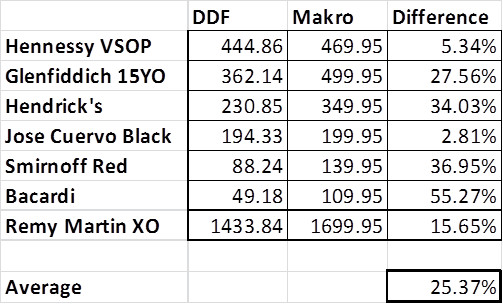
The original (and on-going) purpose of a duty-free store is to offer for sale goods that are exempt from certain taxes and duties which would otherwise be levied within that jurisdiction.  This doesn’t always guarantee good pricing – as with all retail businesses it depends on the individual operator.  It does however confer a significant advantage, and, given an efficient retailer, a nexus where competition, good purchasing, and effective management have satisfactorily come together, the results can be astounding, so much so that many of these duty-free retailers have become redistributors as well.  It’s cheaper for many in the trade to buy from them because of the volume discounts that they command than to buy directly from official distributors or even the suppliers themselves.  My regular port of call is Dubai Duty-Free, one of the muscular superheroes of this milieu.  I’ve taken the liberty of noting a few random examples, adjusted for bottle size, alcohol content and exchange rate, and comparing them to local pricing (as represented by Makro, our most cost-effective retailer, to further make the point).

The extent of the advantage varies from product to product but the general trend is unmistakable.  An average discount of 25% across this basket speaks for itself.

Premiumness

I don’t have access to any data but common sense suggests that frequent travellers would be wealthier, and have a tendency to command more disposable income than less frequent travellers or non-travellers, in a very general sense of course.  They are also a focused and entirely captive audience. Travel retail has thus evolved into a highly prestigious shopping ambit.  Airports accommodate many of the world’s most exclusive luxury brands, the Cartiers and Louis Vuittons, the Dom Perignons and Cohibas, precisely to capitalise on this phenomenon.  In the sphere of distilled spirits this translates into a benefit that I find particularly interesting.  The latest, premium offerings are almost always available in duty-free before they’re launched anywhere else.  Suppliers often use travel retail outlets, specifically those in busy high-profile airports such as Heathrow, CDG, Changi or Hong Kong, as a showcase for their brightest stars. As a result the duty-free shopper will invariably have immediate access to the best-of-the-best, and at the best pricing to boot.

Variety

A well-stocked duty-free shop is a veritable Aladdin’s cave.  You may not find the sheer volume of variety that you would in a wholesaler or liquor superstore, especially in the budget categories, but there is always broad range of quality, international brands on offer.  You’re likely to find products that may not be available at all in your home country, or limited edition duty-free exclusives that are unavailable anywhere other than duty-free.  I recently came across a Yoichi 20 year-old Japanese whisky, the 2008 World Whisky Award winner for best single malt.  Good luck finding this in South Africa.  The duty dynamic, the fact that many countries allow repatriation of duty-free purchases calculated by bottle instead of volume, has also led to the proliferation of unusual sizes in duty-free, most commonly the 1l bottle, but 3l and 4.5l bottles, rare everywhere else, also abound.

Promotions

In case the preferential price isn’t enough motivation, suppliers tend to reserve a big chunk of their promotional budgets for duty-free.  The most popular is the buy-two-get-something-free deal.  And the something-free can be significant indeed – a high-quality bag or case, or a 350ml bottle – especially when you consider that the pricing is already razor sharp.

A quick note in conclusion

The idea of a duty-free shopping was conceived by Irishman Brendan O’Regan who opened the first store at Shannon Airport in Ireland 1947.  I’m already grateful enough to the Irish for inventing whiskey, but this really puts them over the top.   I think I’m going to wear green permanently in tribute.

Big, bigger, biggest

If you thought that it was all about the motion of the…uh…potion, think again.  Size does matter.

First published in Prestige Magazine (October 2012 edition).

As it appeared.

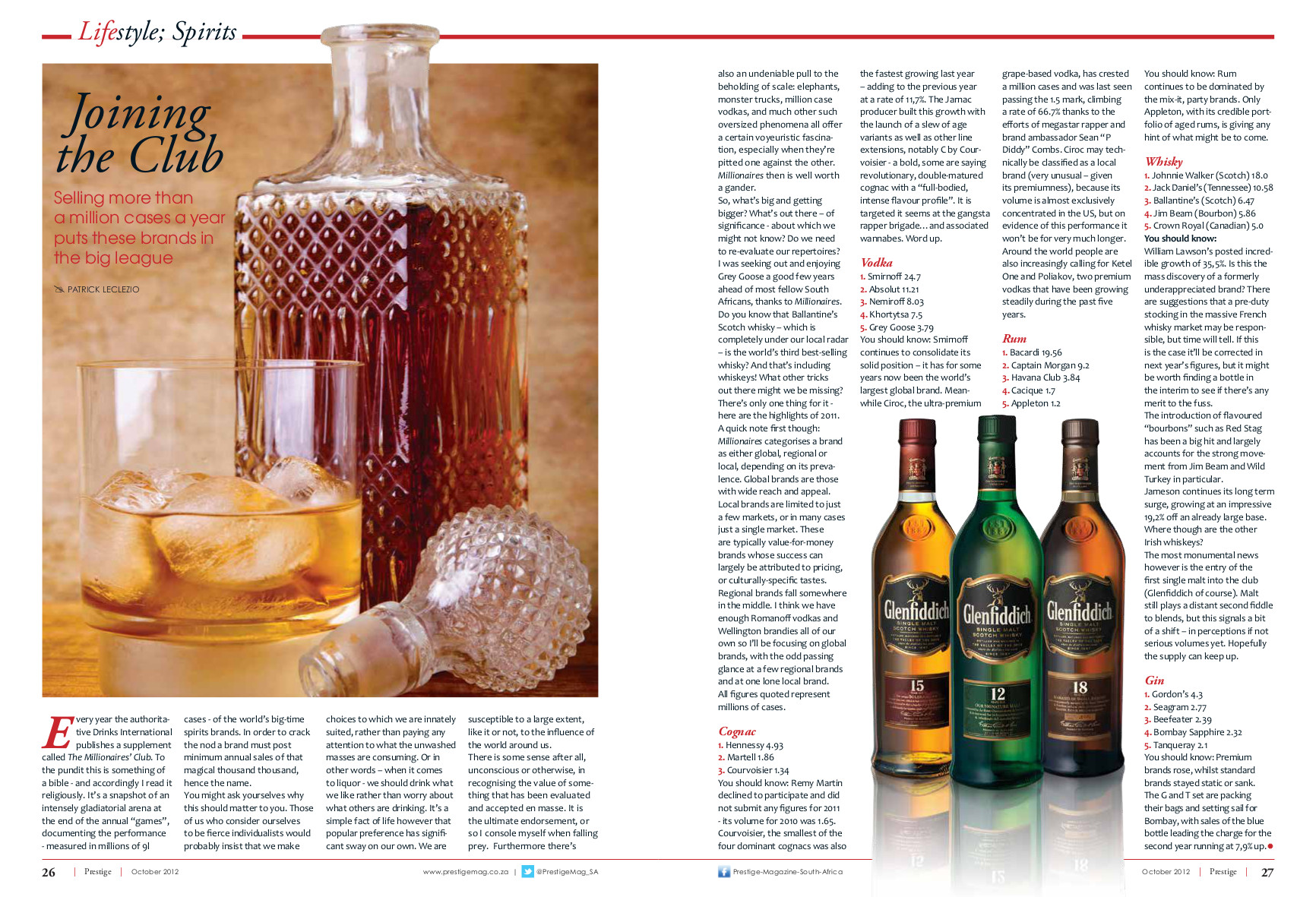
Every year the authoritative Drinks International publishes a supplement called The Millionaires’ Club.  To the pundit this is something of a bible – and accordingly I read it religiously.  It’s a snapshot of an intensely gladiatorial arena at the end of the annual “games”, documenting the performance – measured in millions of 9l cases – of the world’s big-time spirits brands.  In order to crack the nod a brand must post minimum annual sales of that magical thousand thousand, hence the name.

You might ask yourselves why this should matter to you.  Those of us who consider ourselves to be fierce individualists would probably insist that we make choices to which we are innately suited, rather than paying any attention to what the unwashed masses are consuming.  Or in other words – when it comes to liquor – we should drink what we like rather than worry about what others are drinking.  It’s a simple fact of life however that popular preference has significant sway on our own.  We are susceptible to a large extent, like it or not, to the influence of the world around us.  There is some sense after all, unconscious or otherwise, in recognising the value of something that has been evaluated and accepted en masse.  It is the ultimate endorsement, or so I console myself when falling prey.    Furthermore there’s also an undeniable pull to the beholding of scale: elephants, monster trucks, million case vodkas, and much other such oversized phenomena all offer a certain voyeuristic fascination, especially when they’re pitted one against the other.  Millionaires then is well worth a gander.

So, what’s big and getting bigger?  What’s out there – of significance – about which we might not know?  Do we need to re-evaluate our repertoires? I was seeking out and enjoying Grey Goose a good few years ahead of most fellow South Africans, thanks to Millionaires.  Do you know that Ballantine’s Scotch whisky – which is completely under our local radar – is the world’s third best-selling whisky?  And that’s including whiskeys!  What other tricks out there might we be missing? There’s only one thing for it – here are the highlights of 2011.

A quick note first though:  Millionaires categorises a brand as either global, regional or local, depending on its prevalence.  Global brands are those with wide reach and appeal.  Local brands are limited to just a few markets, or in many cases just a single market.  These are typically value-for-money brands whose success can largely be attributed to pricing, or culturally-specific tastes.   Regional brands fall somewhere in the middle.  I think we have enough Romanoff vodkas and Wellington brandies all of our own so I’ll be focusing on global brands, with the odd passing glance at a few regional brands and at one lone local brand.

All figures quoted represent millions of cases.

Cognac

  1. Hennessy 4.93
  2. Martell 1.86
  3. Courvoisier 1.34

You should know:  Remy Martin declined to participate and did not submit any figures for 2011 – its volume for 2010 was 1.65.  Courvoisier, the smallest of the four dominant cognacs was also the fastest growing last year – adding to the previous year at a rate of 11,7%.  The Jarnac producer built this growth with the launch of a slew of age variants as well as other line extensions, notably C by Courvoisier – a bold, some are saying revolutionary, double-matured cognac with a “full-bodied, intense flavour profile”.  It is targeted it seems at the gangsta rapper brigade…and associated wannabes.  Word up.

Vodka

  1. Smirnoff 24.7
  2. Absolut 11.21
  3. Nemiroff 8.03
  4. Khortytsa 7.5
  5. Grey Goose 3.79

You should know:  Smirnoff continues to consolidate its solid position – it has for some years now been the world’s largest global brand.  Meanwhile Ciroc, the ultra-premium grape-based vodka, has crested a million cases and was last seen passing the 1.5 mark, climbing a rate of 66.7%  thanks to the efforts of megastar rapper and brand ambassador Sean “P.Diddy” Combs.  Ciroc may technically be classified as a local brand (very unusual – given its premiumness), because its volume is almost exclusively concentrated in the US, but on evidence of this performance it won’t be for very much longer.  Around the world people are also increasingly calling for Ketel One and Poliakov, two premium vodkas that have been growing steadily during the past five years.

Rum

  1.  Bacardi 19.56
  2. Captain Morgan 9.2
  3. Havana Club 3.84
  4. Cacique 1.7
  5. Appleton 1.2

You should know: Rum continues to be dominated by the mix-it, party brands.  Only Appleton, with its credible portfolio of aged rums, is giving any hint of what might be to come.

Whisky

  1. Johnnie Walker (Scotch) 18.0
  2. Jack Daniel’s (Tennessee) 10.58
  3. Ballantine’s (Scotch) 6.47
  4. Jim Beam (Bourbon) 5.86
  5. Crown Royal (Canadian) 5.0

You should know:

William Lawson’s posted incredible growth of 35,5%.  Is this the mass discovery of a formerly underappreciated brand?  There are suggestions that a pre-duty stocking in the massive French whisky market may be responsible, but time will tell.  If this is the case it’ll be corrected in next year’s figures, but it might be worth finding a bottle in the interim to see if there’s any merit to the fuss.

The introduction of flavoured “bourbons” such as Red Stag has been a big hit and largely accounts for the strong movement from Jim Beam and Wild Turkey in particular.

Jameson continues its long term surge, growing at an impressive 19,2% off an already large base.  Where though are the other Irish whiskeys?

The most monumental news however is the entry of the first single malt into the club (Glenfiddich of course).  Malt still plays a distant second fiddle to blends, but this signals a bit of a shift – in perceptions if not serious volumes yet.  Hopefully the supply can keep up.

Gin

  1. Gordon’s 4.3
  2. Seagram 2.77
  3. Beefeater 2.39
  4. Bombay Sapphire 2.32
  5. Tanqueray 2.1

You should know: Premium brands rose, whilst standard brands stayed static or sank.  The G and T set are packing their bags and setting sail for Bombay, with sales of the blue bottle leading the charge for the second year running at 7,9% up.

Stocking up for spring – part 2

A bar in need

First published in Prestige Magazine (September edition).

As it appeared – p1.

As it appeared – p2.

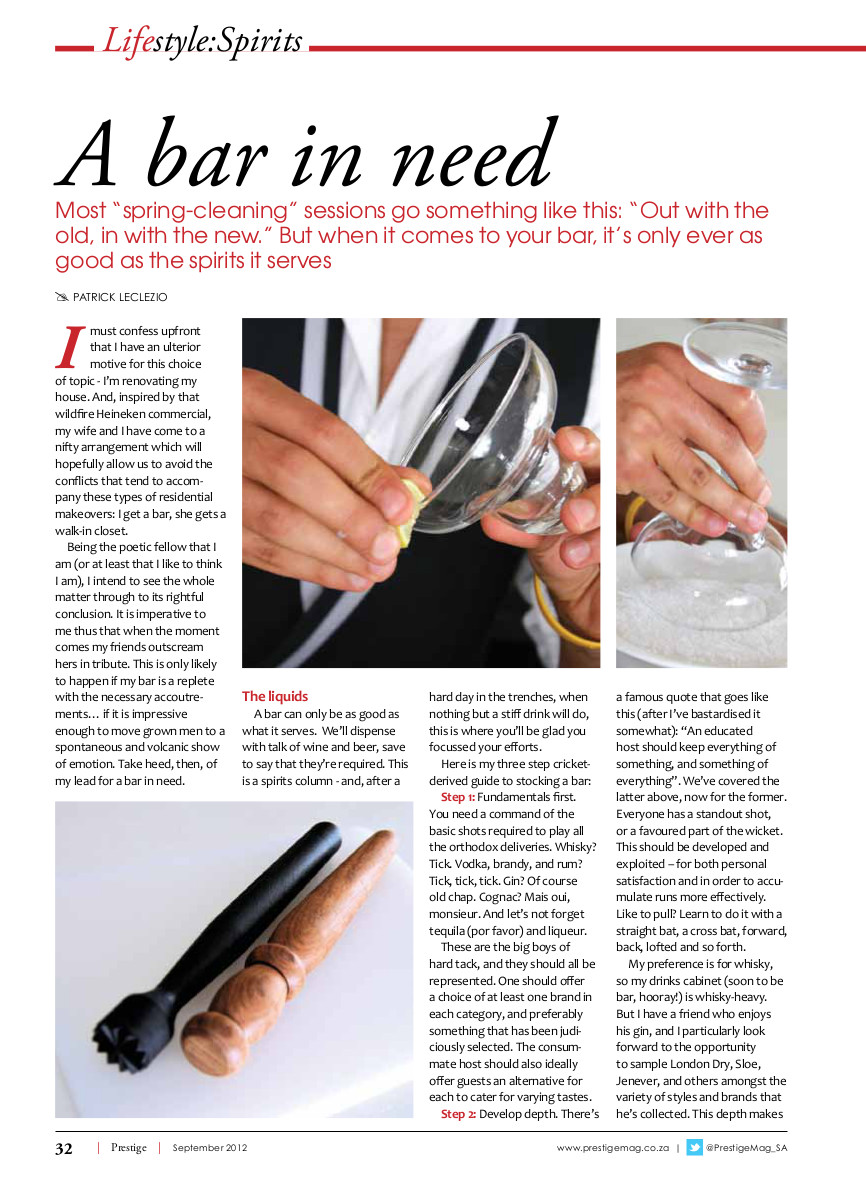
I must confess upfront that I have an ulterior motive for this choice of topic – I’m renovating my house.  And, inspired by that wildfire Heineken commercial, my wife and I have come to a nifty arrangement to attempt to avoid the conflicts that tend to accompany these residential makeovers: I get a bar, she gets a walk-in closet.  Being the poetic fellow that I am (or at least that I like to think I am), I intend to see the whole matter through to its rightful conclusion.  It is imperative to me thus that when the moment comes my friends outscream hers in tribute.  This is only likely to happen if my bar is a replete with the necessary accoutrements…if it is impressive enough to move grown men to a spontaneous and volcanic show of emotion.  Take heed then of my lead for a bar in need.

The liquids

A bar can only be as good as what it serves.   We’ll dispense with talk of wine and beer, save to say that they’re required.  This is a spirits column – and, after a hard day in the trenches, when nothing but a stiff drink will do, this is where you’ll be glad that you focused your efforts.

Here is my three step cricket-derived guide to stocking a bar:

Step 1

Fundamentals first.  You need a command of the basic shots required to play all the orthodox deliveries.  Whisky?  Tick.  Vodka, brandy, and rum?  Tick, tick, tick.  Gin?  Of course old chap.  Cognac?  Mais oui monsieur.  And let’s not forget tequila (por favor) and liqueur.

These are the big boys of hard tack, and they should all be represented.  You should offer a choice of at least one brand in each category, preferably something that has been judiciously selected.  The consummate host should also ideally offer guests an alternative for each to cater for varying tastes.

Step 2

Develop depth.  There’s a famous quote that goes like this (after I’ve bastardised it somewhat): “An educated host should keep everything of something, and something of everything”.  We’ve covered the latter above, now for the former.  Everyone has a standout shot, or a favoured part of the wicket.  This should be developed and exploited – for both personal satisfaction and in order to accumulate runs more effectively.  Like to pull?  Learn to do it with a straight bat, a cross bat, forward, back, lofted and so forth.

My preference is for whisky, so my drinks’ cabinet (soon to be bar, hooray!) is whisky-heavy.  But I have a friend who enjoys his gin, and I particularly look forward to the opportunity to sample London Dry, Sloe, Jenever, and others amongst the variety of styles and brands that he’s collected.  This depth makes visits to your bar, for yourself and your invitees, so much more interesting and fulfilling.


Step 3

Exotic elaboration.  A good batsman is made great by the ability to produce the unexpected: shots like the reverse sweep, the switch hit, and the scoop.  These are the cherries on the top – the extra efforts that allow you to excel, that can propel a team to victory, and that can provoke unabashed delight.

Looking for an unusual aperitif?  Why not try pastis, or the similar ouzo and arak.  A digestif that’ll stimulate after dinner conversation?  Whip out a bottle of grappa, or a fine Armagnac.

So, can I now raise my bat and bask in adulation for my astounding strokeplay?  One might think so, but perhaps celebration is premature.  At this stage my wife – with her collection of shoes batting on well beyond a century – still has the wood over me.  There’s a bit of work remaining to be done.

The accessories

So you’ve now put together a suitably cultured collection.  Imagine you’ve got them lined up on the back bar like a row of soldiers awaiting deployment (another metaphor you say?).  Would a General with such a quality assortment of troops just send them out willy-nilly?  Not a chance.  He needs equipment and tactics, and so do you.

Equipment

A bar’s most important accessories are its drinking vessels.  Goblets, quaichs, and steins might be good for a laugh or a theme party, but for the most part this means glasses – they are generally the vehicles that will get your drink from A to B.

Ok, before we drop a bundle we need to ask ourselves: do glasses though actually make any difference to the flavour, and consequently (or not) the enjoyment, of what one is drinking?  The short answer is yes: our perception of flavour can be psychosomatic.  A good whisky for instance will – most of the time – taste better when drunk from a crystal tumbler than from a paper cup.  So it’s really worthwhile to invest in some quality glassware.  You’ll need tumblers, highballs and zombies to start, and specialist glasses depending on your “tactics” below.

Tactics

You have the troops, and you have the equipment.  Now what?  Sometimes the engagement will be straightforward: neat, on the rocks, with water or a mixer, and maybe with a slice of lemon or lime.  But sometimes you’ll need to do something a little bit special to carry the day.  Enter the cocktail, and the science of mixology.

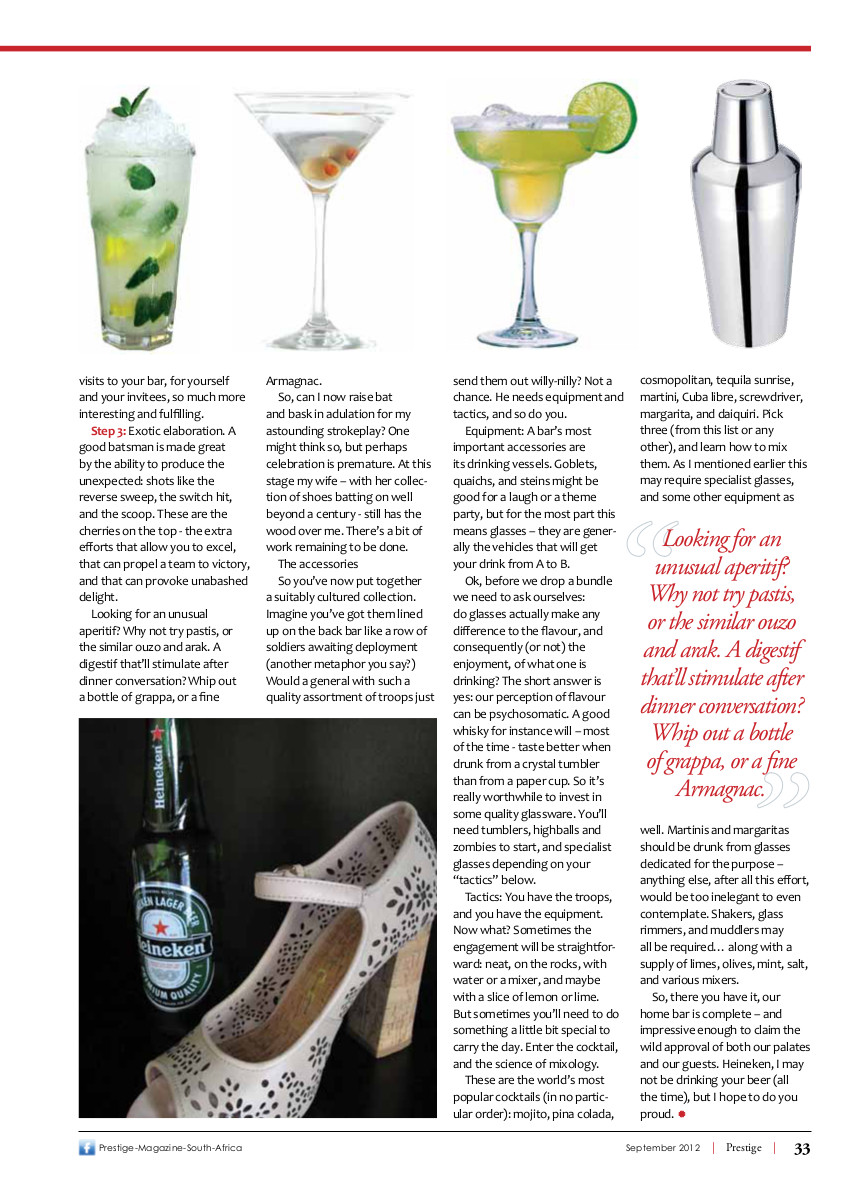
These are the world’s most popular cocktails (in no particular order): Mojito, Pina Colada, Cosmopolitan, Tequila Sunrise, Martini, Cuba Libre, Screwdriver, Margarita, and Daiquiri.  Pick three (from this list or any other), and learn how to mix them.  As I mentioned earlier this may require specialist glasses, and some other equipment as well.  Martinis and margaritas should be drunk from glasses dedicated for the purpose – anything else, after all this effort, would be too inelegant to even contemplate.  Shakers, glass rimmers, and muddlers may all be required…along with a supply of limes, olives, mint, salt, and various mixers.

So, there you have it, our home bar is complete – and impressive enough to claim the raucous approval of both our palates and our guests.  Heineken, I may not be drinking your beer (all the time), but I hope to do you proud.

The sum of all rum

From corsair to connoisseur

First published in Prestige Magazine (August 2012 edition).

As it appeared – page 2.

“Fifteen men on a dead man’s chest-

Yo-ho-ho and a bottle of rum!

Drink and the devil had done for the rest-

Yo-ho-ho and a bottle of rum!”

This is the gung-ho opening stanza of the pirate’s anthem, as sung to us in Stevenson’s ‘Treasure Island’.  It epitomises the rum ethos – that of hard-drinking bravado.  There is simply no other drink that’s quite as synonymous with masculine adventure as rum: be it boarding a Spanish galleon, or bush-diving from a balcony, it’s more likely than not to have played a part.  Whilst some of the rough edges may have been smoothed away and the fairer sex accommodated with the inception of light, spiced, and other flavoured versions, rum has nonetheless remained steadfastly raucous since its epic days of yore.  In ‘The Rum Diary’, the movie based on the Hunter S. Thompson novel of the same name, one of the characters famously says to another “I think we’re drinking too much rum”, to which the other replies “there ain’t no such thing”.  Indeed.  Rum is an all-out, balls-to-the-wall party drink.

Or, I should way, it was.  Allow me to announce, ahead of the approaching dawn, that our society’s experience of rum is set to change.  In Jekyll and Hyde fashion (also Robert Louis, how droll) this is a dissociative drink.  Whilst many of us in the Anglosphere – and it’s still very much the case in South Africa – have been distracted, or even misled, by its often emetic incarnation (which has somewhat tainted its image), discerning rum-lovers, in the Latin world in particular, have for many years now been charmed by a different, altogether more suave and elegant persona.

But let’s start at the beginning.

Before rum, there was the inventively named brum, a drink fermented from sugar cane juice by the Malay people of antiquity.  It wasn’t until much later however, half a world away (the Caribbean of the 1600’s), that distillation was introduced into the mix.  Rum quickly became a staple in the British navy, issued to sailors in rations, and from that source the habit found its way first to privateers and then to pirates, proving a hearty companion during those endless voyages on the seven seas.  These chaps took their libations as grog and bumbo respectively, concoctions including any of water, weak beer, lime or lemon juice, sugar, cinnamon and nutmeg to accompany the rum.  And these unlikely forerunners of the cocktail era set the trend of mixing rum into motion.  The Cuba Libre, rum mixed with coke (and lime, strictly speaking), then took the baton during the twentieth century and went on to become spectacularly popular, propelling Bacardi at one stage to the position of world’s best-selling international brand.

Despite this dubious, albeit colourful, legacy, rum, as I implied earlier, is actually a fine spirit, offering a variety and complexity of flavour to those who seek it out.  It makes an effortless transition from spring break to cigar lounge.  Rum is defined almost everywhere as a spirit distilled from cane sugar and its derivatives, although there has been the odd attempt, such as Sweden’s Altissima, to make “rum” from sugar beets as well.   This may seem like a blandly uniform recipe but cane derivatives are surprisingly diverse, and each has a distinct impact on flavour.  Rum producers in the majority use molasses, a thick, gooey by-product of the sugar refining process, as their primary ingredient, but sugar cane juice and sugar cane syrup (also known as sugar cane honey) are also frequently used.  Product made from sugar cane juice, known as Rhum Agricole, is a feature of the French Caribbean islands, and also of other francophone islands such as Reunion and Mauritius.  Martinique in particular has an Appellation designation (Appellation d’Origine Contrôlée or AOC being the French system for regulating certain agricultural products), giving their accordingly produced rhums a special cachet.  One of the world’s best rums, Ron Zacapa of Guatemala, is produced from sugar cane syrup – in fact these guys differentiate their ingredient further as first-press or virgin sugar-cane honey.  I’m sold on that description alone.  Most importantly though all the better rums share the same pedigree as good whisky and cognac – dictated by extensive cask maturation.  New casks, bourbon casks, sherry casks, and various wine casks are employed – often, especially in Latin territories, in a Solera system (a complicated ageing method in which liquid from one cask is blended into others at intervals) – to produce exquisite, expertly blended liquid.

Rum then it appears is a spirit for all seasons.  I’m partial to a Captain and Coke, with its foaming head and its promise of unruly fun, but increasingly I’d rather seek out Zacapa, or Barbancourt of Haiti, or others of their ilk whenever I can find them.   Whilst the awareness and acceptance of premium rums is still unfolding over here, the signs are unmistakable.  Aye me hearties, a new rum era is upon us for sure.

A lightness of winning

The gilded honours of spirits awards

First published in Prestige Magazine (July 2012 edition).

As it appeared – page 1.

As it appeared – page 2.

In the marketing of brands, whether spirits or otherwise, endorsement is the key to the kingdom.  We as consumers find a recommendation – be it from a friend, from a celebrity, from the masses, or from some other source to which we ascribe credibility – to be compellingly persuasive, perhaps even decisive, as we go about making our purchase decisions.  And when considering the population of potential sources what could be more reassuringly credible than a competition, or, more specifically, the results thereof?  In a sense these appeal to our baser, survival-of-the-fittest nature – an all-out duel, foe versus foe (well…foes), locked in combat for the ultimate prize – but they also serve a very rational purpose.  Before letting loose with our lucre we need to know which is best from the sometimes confusing array of options with which we’ve been presented.

A competition for distilled spirits (wine would be similar) works something like this: a fee is charged per entry, each of which would then be submitted to a qualified panel of judges for assessment, at the conclusion of which an award, typically a medal, would then be conferred upon each winner (and often multiple runners-up) in various categories.  Ostensibly this is a good thing.  It appears to give us the basis upon which to make that judicious choice for which we are continually striving.  If I want vodka wouldn’t it serve my purposes to know which – from amongst the dozens of brands clamouring for validation on the bottle-store shelves – is the gold medallist, the best of the best?  When though are things ever as they seem…?

Here then is the case for and against spirits awards, and, following thereafter, should one be inclined towards the argument for the former, a brief feature on one of the more notable competitions from which guidance might be derived.

For

–        The theoretical benefit already mentioned.  In a perfect world a competition would give us the basis for a satisfying purchase decision.  Hmm…a perfect world…I’m dubious already.

–        The outcome of a competition is an immediately understandable concept.  There are gold, silver and bronze medallists, or an equivalently straightforward grading.  This is something that can be readily processed by consumers.  The apparent benefits are therefore easy to access.

–        Competitions are an efficient vehicle to bring new or little-known but worthy products, about which we might otherwise never have known, to our attention.  They are, in moderation, a cost-effective promotional platform for the smaller players.

–        Competitions are usually independent and judged by credible experts.  Whilst the calibre may vary from one to the other, one can generally be confident that selections are made without bias and with competence.


Against

–        A spirits award is generally of questionable value, much like the Zimbabwean dollar.  There are far too many competitions handing out far too many awards for these to be worth very much at all, to the extent that it prompted a prominent commentator to term the phenomenon “medal fatigue”.  The “major” competitions alone number in the dozens and some these hand out awards to upward of 80% of entrants.

–        Why would a dominant brand – a Smirnoff, a Johnnie Walker, a Bacardi or an Absolut – enter a competition?  Add the fact that there’s little to be gained to the potential for humiliation and what one gets is that many (most?) don’t.  So what’s a victory worth if those who might reasonably be perceived to be the best aren’t even competing?  Not too much I reckon.

–        Conversely some of the big players, those with access to bigger budgets, enter a truckload of their brands, perhaps those that are newer or smaller, into multiple competitions.  Enter enough times in enough places with product of a reasonable standard, and a slew of awards is inevitable.  This renders the more meritorious victories anonymous and makes a mockery of the entire system.

–        Taste is subjective, and there are extrinsic, emotive factors which play a significant role in satisfaction.  Competitions are unhelpful in this regard and may even be counter-productive.

The International Wine and Spirits Competition (IWSC)

If there was claim to be the most prestigious of spirits competitions, the IWSC has it secured.  It would in all likelihood be the gold medallist in a competition for competitions.   Established in 1969, and operating continuously since, the competition regularly draws entries from some 80 countries worldwide.  It is truly as competitive a competition as one could hope to find.

A competition of this nature is only as a good as the people involved, and this is where the IWSC really shows its class.  The list of past presidents, extensive because the incumbent changes on an annual basis, makes for particularly interesting reading, with eminence clearly being a necessary criterion.  South Africa’s sole representative was no less illustrious a person than Anton Rupert.  The fact that he associated himself with the Competition speaks volumes.  I’d say though that what really matters is the quality of the judging, the foundation for a competition’s credibility, and to this end the IWSC is able to call on an impressive breadth and depth of expertise.  Entries are evaluated by panels drawn from a pool of 250 specialists from around the world.  Our own Dave Hughes, probably the country’s more prominent liquor taster (and expert in general), is an IWSC judge.  Five large platoons comprising people of his calibre is mind-boggling indeed!

Underpinning the impressive personnel is a rigorous process and an impeccable infrastructure.   The Competition itself is divided into two parts occurring over a period of six months: it involves firstly a blind tasting and secondly a precise technical analysis conducted by an independent laboratory.  The tastings take place on the Competition’s own, dedicated premises, which includes temperature controlled cellars, purpose-built tasting rooms, and storage facilities and cellaring for some 30 000 bottles.  Nothing is left to chance – judges reporting on the process have commented on the preponderance of signage warning against smoking and the wearing of fragrance (so as not to interfere with the ability to nose and taste).  It is tasting at its most professional.

I guess what I’m saying is that if one was to put any credence in an award then one should probably make sure that it’s from the IWSC.


Off the beaten path

An exploration of unusual drinks

First published in Prestige Magazine (May 2012 edition)

As it appeared – spot the auto-correction error.

A Korean, a Brazilian and a Frenchman walk into a Joburg bar…what do they order?  No, it’s not a joke, and the answers aren’t what one might think.  Even in this era of globalisation, informatisation, cosmopolitanisation and consumerisation the world of spirits is still much more diverse than what our local repertoire would have us believe.  Despite a proliferating of choice in recent times, our protagonists are at grave risk of having to leave with their thirst unquenched.  It may not seem like it – because we hospitable South Africans aim to please – but this is in fact good news.  It means that out there, somewhere, there’s the promise of something compelling that we haven’t yet really discovered.

Soju

After a hard day’s work making ships, cars and flat-screen televisions, the typical Korean relaxes with a glass of Soju (pronounced: so-jew).  To intimate that Soju is an obscure beverage is misleading.  The path to its door is not only well beaten, but paved and widened to six lanes:  Soju drinkers chug down well in excess of 100 million cases per annum.  I’ll give this a bit of context – it exceeds the cumulative volume generated by Smirnoff, Bacardi, Johnnie Walker, Absolut and Jack Daniel’s, the world’s top five so-called “international” brands.  It also dwarfs the combined yearly total spirits consumption of giant European tipplers France and Germany.  So why haven’t we heard of it?  Why isn’t James Bond ordering his shaken martinis with soju instead of vodka?  Soju and the similar Shochu are almost exclusively drunk in Korea and Japan, with little dribbles here and there in a few other countries.  So it is astronomical but not prevalent.  Without travelling to these countries one would be unlikely to have encountered it.

Soju is a colourless, clear distilled spirit.  Whilst it bears a rough resemblance to vodka it is distinguished from that spirit by its sweetness – a result of added sugar – and its on average lower alcoholic strength – ranging from the high teens to the mid-forties in ABV (alcohol by volume).  It is traditionally made from rice, but modern production also uses potato, grains, sweet potato and other starches.

A tip: given a soju-imbibing opportunity, one might want to order Jinro, the colossus of the industry.  Jinro is taking soju to the next level and making a big push into the US market, so it may not be long before we find it on our shelves as well.  As they say in Korea: “gun bae” (cheers)!

Cachaça

Is it a rum?  Is it a cane spirits?  No, it’s cachaça (pronounced: ka-sha-sa).  Outside of Brazil it is known (if at all – only 1% of total production is exported) as the prime ingredient in the caipirinha, a delicious sugar and lime cocktail.   Whilst it may sound exotic, cachaça is a staple to the Brazilian population, which annually flattens an estimated seven billion two hundred million tots of the fun-to-enunciate Pirassununga 51 alone (the largest brand).  Let me put this into relatable terms – we would need to recruit every single South African to drink a tot every second day for a year to match this consumption.  A staggering thought in itself, until one considers that there are some 4000 different brands being produced – ai caramba!

Cachaça, like the footballing superstars of its homeland, is hard to pin down.  It uses sugar cane juice as its raw material, a feature which it shares in common with the rhum agricole of the French Caribbean.  However it can in fact resemble either rum or cane spirits depending on the broad type, of which there are two.  Industrial cachaça, the most common variety and also the cheapest, is column-distilled, and the bulk of these are effectively a type of cane spirits.  Artisanal or traditional cachaça, the more sophisticated variety, is distilled in copper pots and is flavoursome like rum, although it must be noted that certain peculiarities in its crafting make it distinct from rum by definition, and the specificity of its aroma and palate make it distinct from rum by flavour.  Cachaça can be unaged and partly aged (white), or fully aged (gold).  This maturation takes place both in the typical oak barrels used by makers of fine spirits worldwide, and, more interestingly, using a variety of indigenous woods that are integral contributors to its distinctiveness.

Enough to whet one’s appetite?  Cachaça may be scarce within our borders but don’t despair – it is available.  Look out for Germana, an artisanal cachaça that can be found at some of the better cocktail bars.

Calvados

The French like nothing more than to be different.  It’s like a badge of honour.  At times this has worked out quite well for them.  Sacré bleu I’ve got it!  Let’s put some small bubbles in this wine.  At other times not so much.  Tanks?  Merci, but non, Monsieur Maginot has a better idea.  In the former category is Calvados.

Whilst it’s sometimes referred to as apple brandy, Calvados can be (and is often) made from both apples and pears.  That’s about as far as the laissez-faire extends however; the spirit is tightly regulated by the Appellation d’Origine Contrôlée, the French system for governing the production and marketing of certain agricultural products, which is largely based on the concept of terroir.  For instance, unlike Scotch Whisky, which can employ barley that is grown anywhere (some of it in France), the apples and pears used in Calvados (of which only defined cider-specific varietals are permitted) must originate from the set Calvados region of Lower Normandy.  To keep things interesting there are also sub-appellations: Calvados Pays d’Auge and Calvados Domfrontais which amongst other criteria must, respectively, be double pot-distilled, as opposed to the column distillation more common for the wider marque, and must be aged for a minimum of three years rather than the standard two.

Locally Calvados is as rare as hen’s teeth, but seeing as we produce apples by the barrel-load it was only going to be a matter of time before some enterprising fellows created something similar.  Enter Malus, “the Terroir Spirit of Elgin”.   I’ve had the privilege of tasting Malus and there can be no doubt that it’s delicious.  Be warned though it’s highly exclusive – only 1000 decanters were produced – and accordingly it’s punishing on the wallet.

Inside the bottle

Dipping into the definitions of drinks

First published in Prestige Magazine (April 2012 edition).

An aside:  The guys at Prestige Magazine have asked me to write a second column, on spirits in general, and this is the first attempt.  This column will feature whisky on the rare occasion, but it will be more focused on other spirits so that they too get some coverage.

As it appeared,

When I was offered a column writing about distilled spirits, I thought that I’d start at the beginning.  A singing nun once convinced me that this might be a very good place to start.  Sage advice – one never knows what one might otherwise miss.   The beginning in this case is not doe (as in a female deer, get it now…?) but definition.  I’ll go out on a limb and suggest that without the ability to define our society would be in utter chaos.    The definition of the world and its phenomena are the basic blocks upon which order, understanding, and communication, veritable bastions of civilization, are built.   What, one might well ask, does this portentous declaration have to do with the somewhat less solemn subject of liquor?  The implications might not be quite so all-encompassing but nonetheless, in a local context, the definitions for spirits, as enshrined in the Liquor Products Act 60 of 1989 and subsequent amendments (henceforth “the regulations”), are a treasure trove of interest for both the aficionado and the casual observer.

Two of the major players, vodka and brandy, between them command a huge swathe of the South African market.  Let’s take a tour.

Vodka

I think vodka and potatoes come to mind.  Is Vodka actually made from potatoes, as is widely believed?  Not necessarily; in fact the regulations allow for vodka to be made from any vegetable matter.  It is easily the most indiscriminate of spirits, with its come-one-come-all rallying cry.  Ironically there isn’t a single potato vodka commonly available in South Africa, not counting the sparsely distributed Chopin and others of that ilk.

Vodka originated in Poland and Russia – the lore of the potato vodka actually came out of Poland (sad then in a sense that Belvedere and Wyborowa, its most eminent scions, are made from rye and not potatoes) – and these two countries historically dominated vodka production.  In previous generations vodka had to be Polish or Russian for it to be considered credible.  The regulations, which derive from convention in this regard, dictate that vodka should “not have any distinctive characteristic, aroma, taste or colour”.  It is essentially a simple, almost neutral product, and one which is therefore easy to produce.

As a result, vodka has in recent times undergone somewhat of a de-mystification.  The success of a brand is often dependent on marketing more than any production expertise or heritage, thus creating an arena where style tends to trump substance…although purists may well disagree.    I say this without a shred of disparagement – style has its merits and is obviously important.   It’s always useful however to be explicitly aware of what it is for which one is paying, and with vodka, more so than other spirits, the active ingredient is image.  Blockbuster brands have emerged out of Finland (Finlandia), Sweden (Absolut), France (Grey Goose, Ciroc), Holland (Ketel One), and, at the extreme end of unlikely, New Zealand (42Below).  Absolut in particular has been the poster child for this new wave, blazing an advertising-orchestrated path to the vaunted position of world’s best-selling premium vodka.

A last word.  On closer examination of the regulations I was particularly struck by one of the stipulations: that a vodka must be produced “in a rectifying or fractionating column” i.e. a column still.  How then is Smirnoff Black Label (recently rebranded Small Batch no. 55 or somesuch), flagship of the world’s largest vodka brand and a product of pot-still provenance, being so prominently sold as a vodka in South Africa?  Have they somehow snuck an oversized set of studs past the referee?  Food for thought…

Brandy

Historically the mainstay of the local spirits industry, brandy has been in crisis for the past several years.  Consumers have fled like rats from a sinking ship, finding refuge in whisky primarily, but also in rum and other products.  Naturally, the question being asked is why, and the broad consensus, somewhat unhelpful in itself, is that whisky is seen as a better class of drink, as more aspirational.

So why then is whisky perceived as superior to brandy?  It may come as no surprise that an answer can to be found at the beginning – in the regulations;  very simply: whisky is better than brandy by definition.

It’s generally acknowledged that the quality of a brown spirit improves with maturation in oak casks, usually referred to as ageing.  On a like-for-like basis, and to a certain point, the (sometimes hotly disputed) rule is: the older the better.  In this regard the regulations state that a whisky, any whisky, must be aged in its entirety for a minimum of three years before it can legally be sold as a whisky in our country.

These regulations however are played out on an uneven field.  Brandy, which is locally produced, has been handed a few massive – one might be tempted to say unfair – advantages.  Most significantly the vast majority of the liquid in popular brandies is immature new-make spirit, bottled virtually straight off the still.  Only 30% of a blended brandy is required to be aged.   This situation probably arose because at some point in time stakeholders in the brandy industry had lobbied the authorities to set the bar low and thereby hand them a preferential cost platform…or maybe it wasn’t quite so conspiratorial, may this was just how things naturally evolved.  Whichever, it now appears that the advantage has boomeranged and come back to bite the industry in the arse.

In an era when the spirits drinking public is becoming increasingly curious about their consumption, and discriminating as a result, this is a debilitating predicament.  Brandy is saddled with an image problem that’s rooted deep down in its DNA, in its very definition.  The quality of South African brandy has a great reputation, with our products consistently winning awards at all the major spirits competitions world-wide – Van Ryn, Oude Molen, and Joseph Barry, to name but three, have flown the flag and flown it high – but a chain is only as strong as its weakest link and the weak link in this case happens to be the foundation upon which the entire edifice is stacked.  Only time will tell whether brandy can rekindle its former glory.   If anyone were to ask I could suggest where it should start…