Tag Archives: Whiskey

Out and about with whisky

The Singapore episode

First published in Prestige Magazine (August 2012 edition).

As it appeared.

Singapore never fails to impress me.  Looking down as one approaches from the air it’s no stretch to believe that this is one of the top three busiest ports in the world.  The Straits of Singapore is a bustling bottleneck – densely peppered with naval traffic from one horizon to the other.  The island city also happens to be one of the wealthiest countries in the world.  Singaporeans are not struggling for drinking money and it shows in the whisky scene.

In an overall Asian whisky context, Singapore would be classed as a mid-mature culture.  It sits somewhere between the refined palates evident in Japan and Taiwan, where demand for vintage whisky is de rigueur, and the still raw uptake in crazy China, where whisky drinking is karaoke-inspired mixology.  The place regularly ranks amongst the leading markets for Scotch whisky exports, and whilst most of that stock is filtered into the wider region its presence alone must be infectious.   Things are happening here.  I visited no fewer than three top-quality whisky bars during my short eight hour layover and I was so enthralled by the experience that I came within a barley whisker of missing my flight home.  My whisky-addled, panic-stricken dash to the airport, involving no fewer than three modes of transportation (four if you include the trip on the airport skytrain needed to correct my arrival at the wrong terminal), must have been quite something to behold…more amusing to onlookers than it was to me.

La Maison du Whisky (LMDW)

This legendary French whisky business was founded in 1956 by Georges Bénitah, one of the true whisky pioneers of the modern era.  Its bar in Singapore – based at the vibey Roberson Quay on the banks of the eponymous river – is a little different, not only from its other outlets but from most other bars:  it is both a shop and a bar.

I didn’t quite know what to make of it.  It’s an appealing concept in theory, if a country’s regulations allow for it.  Imagine browsing whiskies and then being able to sit down and test drive one’s options before committing.  Generally I dislike shopping but this I think I could grow to enjoy.  I also like the idea of a total whisky zone, where I can ogle whisky, talk whisky, taste whisky, and then, to make the experience complete, take-away whisky.

But in reality can anything really be all things to all men?  LMDW Singapore, in keeping with its heritage, is more shop than bar.  I’ve been there once, early-ish on a weekday evening, so take my opinion from whence it comes, but with its face of plate-glass and severe lighting that it projects to the world, it wouldn’t be my first choice for an intimate evening of mellow dramming.

Ambience aside, it ticks all the boxes with a flourish.  LDDW boasts a selection of 400 distinct Scotches and 200 other whiskies, including some rare bottlings (to which the closest we would have come here in SA is a fleeting glimpse in one of the international versions of Whisky Magazine), and some dedicated bottlings.  GM Jeremy Moreau introduced me to a Strathisla 1965 Single Cask, specially bottled for the group by Gordon & MacPhail, whose rich, bite-into sherry flavours I savoured at length…yum.  Worth the visit?  It goes without saying.

 The Quaich

A short stroll down the river and a bite of supper later I found myself at a bar named after Scotland traditional drinking vessel.  The Quaich, according to owner Khoon Hui, was Singapore’s first genuine whisky bar.  It also appears to be the most genuinely Singaporean whisky bar.  Whereas the other two I visited seemed somewhat expatified, this was refreshingly local – Khoon pointed out a radio celebrity and some government heavyweights enjoying the undisputable pleasures of his establishment.

The Quaich’s menu numbers a highly respectable 300 fine whiskies, with a focus on the distilleries that it represents as a distributor in Singapore.  These include Bunnahabhain, Springbank, Glenglassaugh, and Bowmore, amongst others.  I noticed, and was duly impressed, by a 1964 Bowmore 46YO and three dedicated single casks bottled by Springbank (Longrow) and Glenglassaugh for The Quaich.

My most lasting impression however was of the great hospitality.  Khoon and I chatted whisky over a Kavalan (a name with which the chaps at Macallan are none too pleased by the way), and then he insisted on giving me a lift to my next appointment.  The man is a gentleman and a scholar and his bar is a gem.

Auld Alliance

The Long Bar at the Raffles Hotel created the Singapore Sling, and has since been regarded as the bar in Singapore, fads aside.  Well, now there’s a new king in town and its name is Auld Alliance (a reference to the close military relationship which existed between pre-Union Scotland and monarchic France).  Let me not mince words: in my opinion this may well be the king of all whisky bars worldwide.

To say that I was blown away is an understatement.  This whisky cathedral – to call it a bar seems inadequate – is utterly, utterly (repeated for good measure) magnificent.  Auld Alliance is the brainchild of Emmanuel Dron, a whisky expert of long standing, and, as I set about acquainting myself with his spot, his expertise became explicitly evident: it is quite simply a league apart from anything that I’ve ever experienced.

Located in Chijmes, a charming entertainment complex built within the grounds and amidst the architectural structure of an old convent, the venue offers a breath-taking bar area, an elegant lounge, and two private tasting rooms.  Its collection of whiskies currently numbers 1500; so many in fact that there’s just not enough space for all of them, thus requiring 500 odd to be rotated in and out of storage periodically.  The highlights include a mint-condition first-edition 1993 Black Bowmore (S$ 12 990 ≈ R84 955 per bottle), and a Yamazaki 50YO, of which there are only a handful of bottles accessible outside of Japan.  I was particularly captivated by a menu which offers flights of the “same” whisky bottled in different decades, allowing customers to explore the evolution of the style over time.  I could go on and on.  Quite simply Auld Alliance lacks for nothing…except for South African whiskies.  One has to leave room for improvement I guess.

The moral of this story, in case you haven’t arrived at the same conclusion already – a whisky pilgrimage to Singapore is well in order.  May the dram be with you!

Winter whisky specials

This message went out to the WHISKYdotcoza database today.  Ignore if you’re not interested in a commercial punt.

Winter is upon us.  If you’re anything like me then you’re probably enjoying a dram or three to fight back the cold.  In this regard WHISKYdotcoza is offering a little bit of winter cheer.

We’ve teamed up with Macallan and Highland Park to bring you these special offers:

These promotions will be open for the next two months, but be warned that stock is limited.  It’s strictly first-come, first served.

Note too that WHISKYdotcoza has secured some stock of the Glenfiddich Age of Discovery Madeira Cask 19YO.  The South African allocation is limited, so if this is something that strikes your fancy don’t delay in getting yourself a bottle.  The numbers are too small to place the product on the site so please contact us at info@whisky.co.za to order.  Price is R1099.

We’ve also been informed by the local suppliers of Laphroaig that there’s a global shortage of the 10YO.  It’s currently out of stock – there’ll be limited stock arriving next month and then no further availability for the rest of the year.  Same deal as above – if this is your bag then get an advance order in to us at soonest convenience.

Until next time – keep well and may the dram be with you!

The why’s of whisky – episode 1

Why oats?

As I’ve travelled along on my whisky journey, I’ve come across many a confounding twist in the road.  Some are easily navigated, others not.  This series is dedicated to the latter;  questions whose answers are frustratingly arcane – buried in the past, not publicly available, kept close to the chest by the industry, or just technical and obscure – but interesting enough, at least for me, to warrant some sort of exploration.

My intention is for this to be a forum rather than a collection of posts.  I will propose questions, sometimes with answers, which may or may not be correct and/or comprehensive, and sometimes without.  My hope is that fellow whisky lovers will be encouraged to contribute to both sides i.e. suggest questions and answers, and generally express a point of view.  I’d also welcome guest posts.  This may turn out to be a great vehicle to use to address those niggling unknowns which I’m sure we’ve all encountered at some point or another…or at the very least mine.  Let’s see how it goes.

Thirteen odd years ago I read my first whisky book – the “The World Guide to Whisky” written by the legendary Michael Jackson.  In the section on Irish whiskey he writes: “It nonetheless remains the case that that Irish whiskey may contain a distillate of malt, one made in a pot still with barley, and a third portion comprising grain spirit.  Of the three, the barley distillate is central, and it contributes the greatest character to several Irish whiskeys.  In the past, a tiny proportion of oats was also used…”

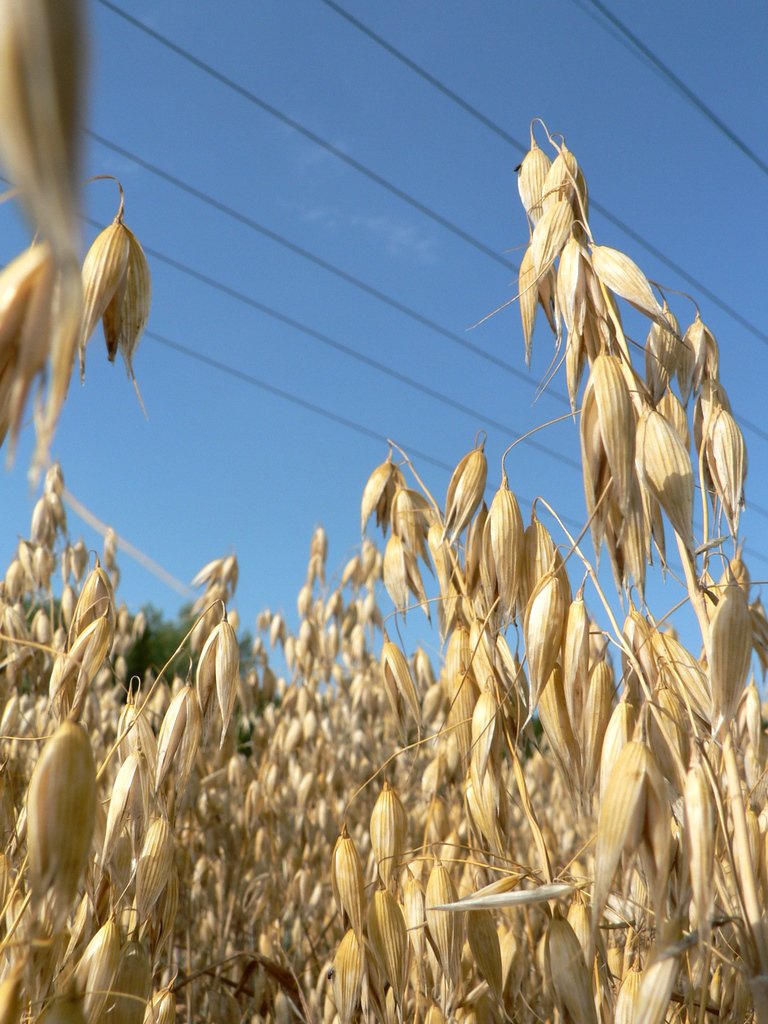
Oats growing in a field.

This was written some time ago, and it’s no longer entirely accurate.  Irish whiskey is in the springtime of a sweeping revival, and it is turning to its history for inspiration.  Last year three new single pot stills were introduced by Irish Distillers and not much less recently Cooley started to make single pot still at Kilbeggan…using oats in the mashbill.  Oats as an ingredient is no longer a thing of the past.

So then we get to the central issue – why oats?  I have them for breakfast every morning but what the hell are they doing in my whiskey?

Most ingredients used today are a result of convention.  It’s a certainty that Cooley is using oats to try to resurrect a time-honoured Irish tradition.  But at a point way back in the past it must have been motivated by some sort of functionally-driven logic.  Malt, Corn, Rye, and Wheat were used to make whisky because these ingredients were plentiful in the areas where they were used and because they made good whisky.  Unmalted barley was used to avoid the higher taxes on malted barley, and because, as any of you who have tasted a single pot still would know, it made damn good whiskey when combined with malt.  But the reason for oats, in such small proportions nogal, is less evident.

I did a bit of web research and came across this snippet on the Liquid Irish blog, which gave me a brief glimpse at the answer:

“The oats, it is said, are there to allow liquid to flow more freely through the bed of the mashtun. Alex Chasko, the Innovation Manager at Cooley, is sceptical about this, not having seen the effect in his experiments. Whatever about the filtering advantages, we are all hoping for an interesting influence on taste.”

Might the inclusion of oats then originally have been a factor of the mashing process rather than anything to do with economics, accessibility, or flavour?

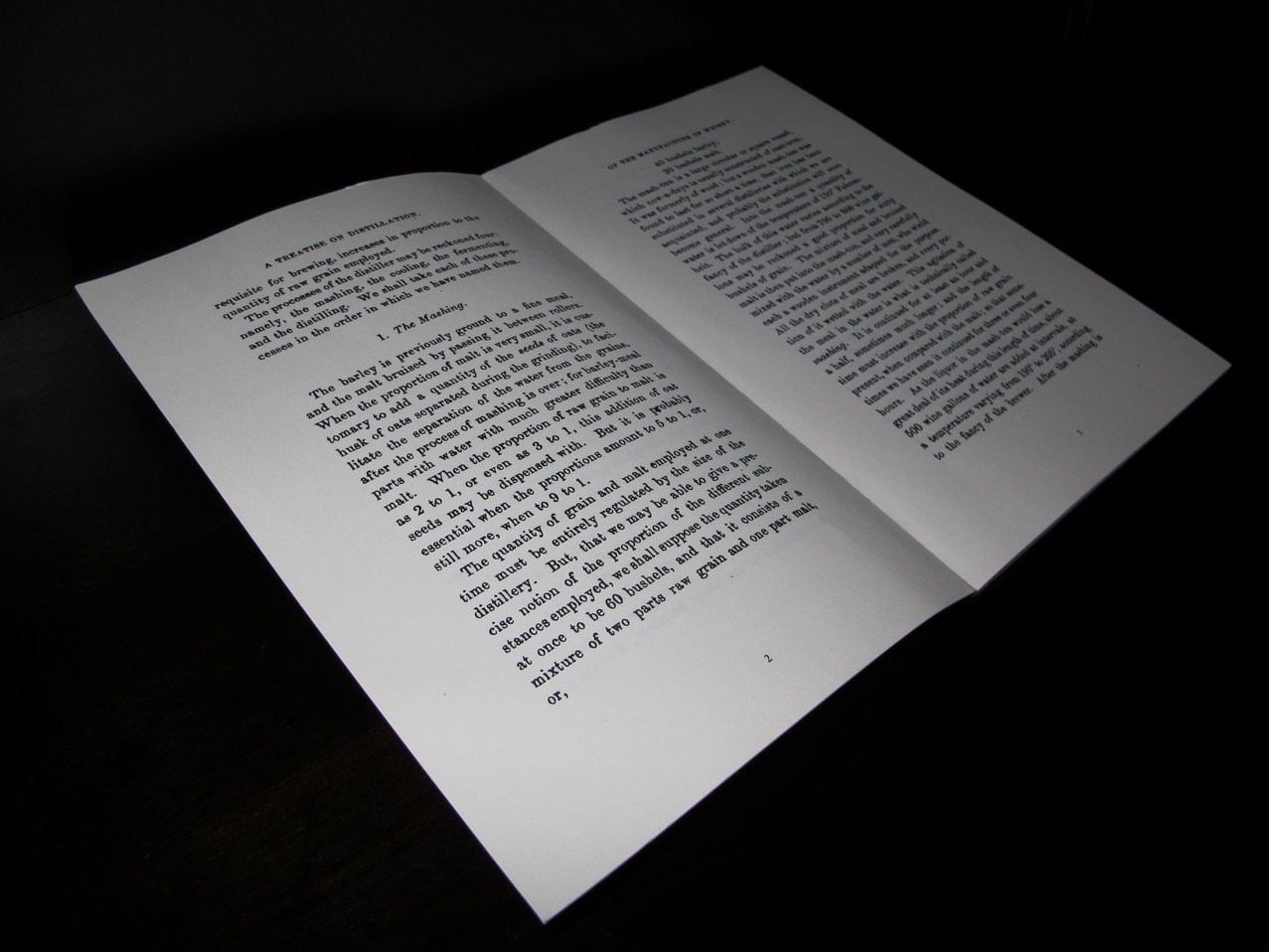
The answer, it seems, is yes.  The next (and conclusive) step of my research process was more old school.  Check this out – it’s from an old Scottish treatise by Thomas Thomson called “The Manufacture of Whisky”:

“When the proportion of malt is very small, it is customary to add a quantity of the seeds of oats (the husk of oats separated during the grinding), to facilitate the separation of the water from the grains [by grains he means unmalted barley], after the process of mashing is over; for barley meal parts with water with much greater difficulty than malt.  When the proportion of raw grain to malt is as 2 to 1, or even as 3 to 1, this addition of oats seeds may be dispensed with.  But it is probably essential when the proportions amount to 5 to 1, or, still more, when 9 to 1.”

Auld book.

This allows me to draw a few conclusions:

–        This is the likely core reason for why oats once formed part of a mashbill.

–        Scots at one stage made whisky in the style of Irish single pot still.

–        Cooley – with its mashbill for the Locke’s revival reputed to be 60% malt, 35% stone ground spring barley and 5% oats – has no technical need for the oats.  Probably the reason why their experiments are hitting a blank.

Regardless, the oats must contribute to flavour.  We may have a while yet to wait before the product is aged and ready for market, but I for one can’t wait.  This question can’t really be put to bed until the porridgey nectar runs over our palates.

May the dram be with you.

Out and about with whisky

The Hong Kong episode

First published in Prestige Magazine (July 2012 edition)

As it appeared.

There is little that’s quite as interesting for a whisky lover as a whisky excursion, whether it’s in the immediate locale, or somewhere a bit more far-flung.  Out there is a whisky world teeming with possibilities: there are maltings, distilleries, maturation warehouses, cooperages, bottlers, heritage centres, speciality shops, and bars aplenty, all waiting to be visited and explored.  I’ve tasked myself to get out and about and report back on my findings in a series of intermittent episodes, of which this, a bar tour, is the first.   It’s a tough slog of a job I know, but someone has to do it and it may as well be me.

Almost everyone it seems is travelling east these days.  China became South Africa’s leading trade partner in 2009, and its importance to our economy will almost certainly continue to grow in the future.  Despite this situation, it’s near impossible to fly there direct.  There are infrequent flights from Joburg to Beijing, but failing this somewhat impractical option one would likely be flying via the former British enclaves of Hong Kong or Singapore (subject of the next episode); and, finding oneself in either of these vibrant, cosmopolitan cities, one might be tempted to hang around for a bit.  So peripatetic whisky lovers – take note.  Here’s what one needs to know about Hong Kong.

Prince Charles was quoted as saying that Hong Kong has created one of the most successful societies on Earth.  If his opinion is valid then it would stand to reason, by my standards anyhow, that a whisky culture should be prominent.  And true it proved to be.  After a spot of preliminary research on the city’s whisky scene, and a predictably overpriced dinner in the mildly loutish Lan Kwai Fong, the famous party district, I set out to visit the two places at the top of my list: Angel’s Share and The Chinnery.

The most striking feature of Angel’s Share, dominating the entrance to the bar, is a large cask…sufficient to set the heart of any whisky lover aflutter.  My immediate impression was that this might be a “live” cask, an exciting thought.  Imagine drinking a theoretically different whisky every time one ordered from the cask!   Most distilleries however do not sell casks lock, stock, and…uh…barrel to the retail trade, and legislation now prevents single malts or single casks from being bottled outside of Scotland and effectively from being dispensed out of anything other than a bottle, so this was unlikely.  And indeed Eric Wan, my genial host, confirmed that the cask was a replica, and that its inner surface was lined with a metal membrane.  The illusion persisted nonetheless and I thoroughly enjoyed the undisputedly authentic ritual of being served from the cask – a heavy dram of Highland Park 1997 vintage having been drawn for me with a valinch*.

I would be doing the venue a disservice though if I were to fixate exclusively on the cask.  This is the ideal place to enjoy a superb evening of whisky appreciation and casual conversation – it is all dim-lit, intimate-nooked, and leather sofa’d elegance.  Whilst the brash whisky-drinking classes emerging in the Mainland might be quaffing the golden nectar with green tea (shudder), the clientele here is rather more refined and sophisticated.  Hong Kong after all has always been, and remains, the leading edge of the wedge.  The menu is somewhat modest by upper-tier whisky bar standards, but with a selection of 150 odd distinct whiskies, it is ample regardless.  I spotted a Macallan 1936 at HK$ 1240 (about the same in Rands) for a 30ml serving.  Perhaps when my ship comes in….

Eric twisted my rubber arm and had me linger longer over a glass of the excellent Laddie 17YO, his favourite of the moment.  This was my first rum-casked whisky, and its big exotic fruit flavours were well worth the wait.  Eventually however I reluctantly dragged myself away and hurried over to The Chinnery.  They hadn’t responded (in time) to my request for an appointment but I thought I’d just pitch up anyhow.  I arrived just before midnight only to encounter a massive disappointment – the place had closed for the evening.   The Chinnery has a laudable reputation, and I’m sure that it’s spectacular, but I have to ask: what kind of whisky bar closes at 11pm on a Saturday evening?  Especially in Hong Kong.  I’ll have to wait for my next visit to get an answer.

As my train headed over the horizon and my leaving became palpable I felt my spirits buoyed by this visit to a very special bar in this very special town.  If in the vicinity be sure to follow suit.  May the dram be with you!
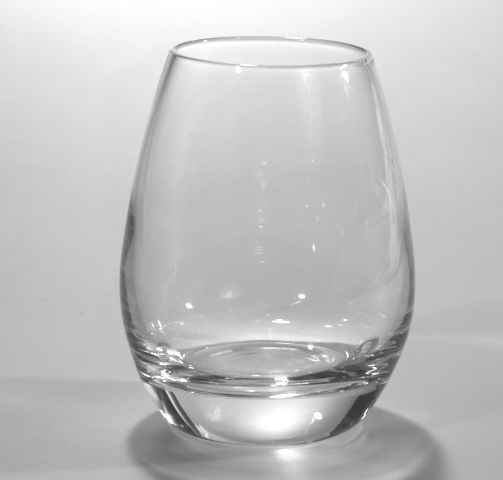
*Valinch – A tube-like instrument used for drawing liquor from a cask via its bunghole.

Liquid gifts

A spirit of generosity

First published in Prestige Magazine (June 2012 edition).

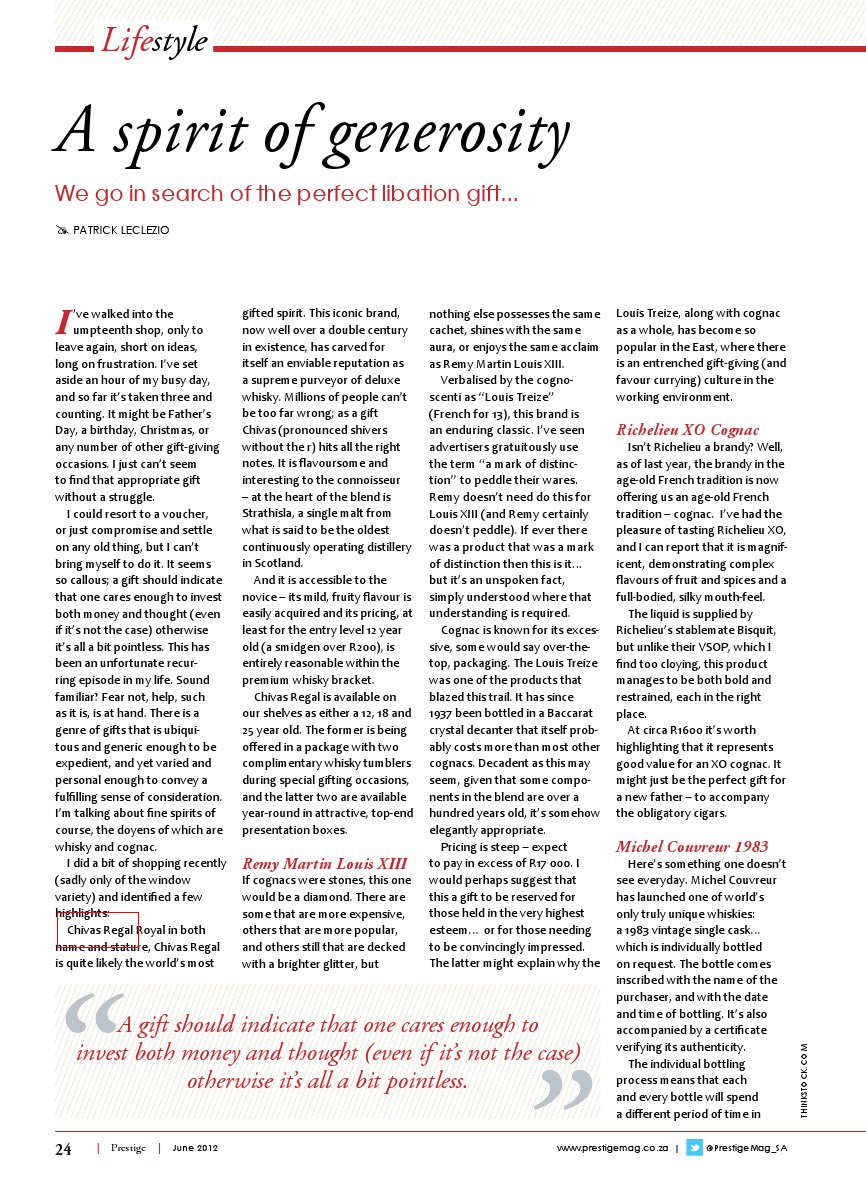
As it appeared – page 1.

As it appeared – page 2.

I’ve walked into the umpteenth shop only to leave again, short on ideas, long on frustration.  I’d set aside an hour of my busy day, and so far it’s taken three and counting.  It might be Father’s Day, a birthday, Christmas, or any number of other gift-giving occasions.  I just can’t seem to find that appropriate gift without a struggle.  I could resort to a voucher, or just compromise and settle on any old thing, but I can’t bring myself to do it.  It seems so callous; a gift should indicate that one cares enough to invest both money and thought (even if it’s not the case) otherwise it’s all a bit pointless.  This has been an unfortunate recurring episode in my life.  Sound familiar?  Fear not, help, such as it is, is at hand.  There is a genre of gifts that is ubiquitous and generic enough to be expedient, and yet varied and personal enough to convey a fulfilling sense of consideration.  I’m talking about fine spirits of course, the doyens of which are whisky and cognac.   I did a bit of shopping recently (sadly only of the window variety) and identified a few highlights.

Chivas Regal

Royal in both name and stature, Chivas Regal is quite likely the world’s most gifted spirit.  This iconic brand, now well over a double century in existence, has carved for itself an enviable reputation as a supreme purveyor of deluxe whisky.  Millions of people can’t be too far wrong; as a gift Chivas (pronounced shivers without the r) hits all the right notes.  It is flavoursome and interesting to the connoisseur – at the heart of the blend is Strathisla, a single malt from what is said to be the oldest continuously operating distillery in Scotland.  And it is accessible to the novice – its mild, fruity flavour is easily acquired and its pricing, at least for the entry level 12 year old (a smidgen over R200), is entirely reasonable within the premium whisky bracket.

Chivas Regal is available on our shelves as either a 12, 18 and 25 year old.  The former is being offered in a package with two complimentary whisky tumblers during special gifting occasions, and the latter two are available year-round in attractive, top-end presentation boxes.

Remy Martin Louis XIII

If cognacs were stones, this one would be a diamond.  There are some that are more expensive, others that are more popular, and others still that are decked with a brighter glitter, but nothing else possesses the same cachet, shines with the same aura, or enjoys the same acclaim as Remy Martin Louis XIII.  Verbalised by the cognoscenti as “Louis Treize” (French for 13), this brand is an enduring classic.  I’ve seen advertisers gratuitously use the term “a mark of distinction” to peddle their wares.  Remy doesn’t need do this for Louis XIII (and Remy certainly doesn’t peddle).  If ever there was a product that was a mark of distinction then this is it…but it’s an unspoken fact, simply understood where that understanding is required.

Cognac is known for its excessive, some would say over-the-top, packaging.  The Louis Treize was one of the products that blazed this trail.  It has since 1937 been bottled in a Baccarat crystal decanter that itself probably costs more than most other cognacs.  Decadent as this may seem, given that some components in the blend are over a hundred years old, it’s somehow elegantly appropriate.

Pricing is steep – expect to pay in excess of R17 000.  I would perhaps suggest that this a gift to be reserved for those held in the very highest esteem…or for those needing to be convincingly impressed.  The latter might explain why the Remy Treize, along with cognac as a whole, has become so popular in the East, where there is an entrenched gift-giving (and favour currying) culture in the working environment.

Richelieu XO Cognac

Isn’t Richelieu a brandy?  Well, as of last year, the brandy in the age-old French tradition is now offering us an age-old French tradition – cognac.    I’ve had the pleasure of tasting Richelieu XO, and I can report that it is magnificent, demonstrating complex flavours of fruit and spices and a full-bodied, silky mouth-feel.  The liquid is supplied by Richelieu’s stablemate Bisquit, but unlike their VSOP, which I find too cloying, this product manages to be both bold and restrained, each in the right place.

At circa R1600 it’s worth highlighting that it represents good value for an XO cognac.  It might just be the perfect gift for a new father – to accompany the obligatory cigars.

Michel Couvreur 1983

Here’s something one doesn’t see everyday.  Michel Couvreur has launched one of world’s only truly unique whiskies:  a 1983 vintage single cask…which is individually bottled on request.  The bottle comes inscribed with the name of the purchaser, and with the date and time of bottling.  It’s also accompanied by a certificate verifying its authenticity.  The individual bottling process means that each and every bottle will spend a different period of time in wood, and, as a result, will in theory be a different and unique whisky.

Couvreur is a whisky artisan of long standing, based in Burgundy in France, and known in particular for his highly cultivated maturation process, in which he ages Scottish new-make spirit in individually selected Solera sherry casks.  He and his small team are the remnants of an almost-forgotten golden era of whisky craftsmanship.

The Couvreur range of whiskies was launched in South Africa last year and is available in strictly limited quantities.  The 1983 retails for R4999.

Glenmorangie

Glenmorangie is one of the “maisons” in the LVMH group – the world’s largest single owner of luxury brands, and home to epic labels such Louis Vuitton, Dior, and Bulgari.  One would thus expect the guys at Glenmorangie to exhibit a swaggering command when it comes to gifting.  And indeed they don’t disappoint – every year bringing out gift offers that set a benchmark for the industry.  Their latest gift-pack whilst not their best is compelling nonetheless.  It’s a beautifully designed carton containing a bottle of Glenmorangie Original, and a complimentary dinky bottle of Nectar D’Or, an expression from the brand’s pioneering extra matured range (this one specifically was finished in Sauternes casks).

Pricing is at around the R400 mark.

Down the hatch

Guidelines for drinking whisky

First published in Prestige Magazine (June 2012 edition)

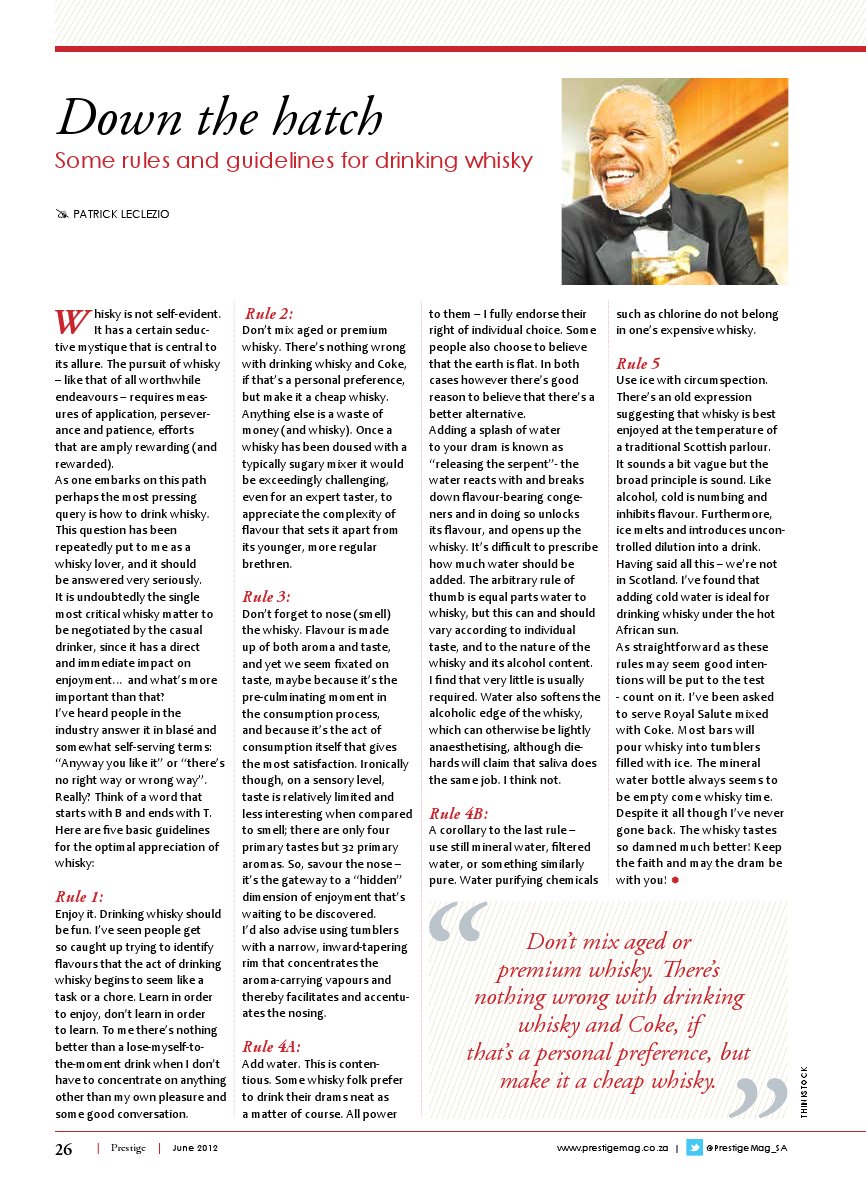
As it appeared.

Whisky is not self-evident.  It has a certain seductive mystique that is central to its allure.  The pursuit of whisky – like that of all worthwhile endeavours – requires measures of application, perseverance and patience, efforts that are amply rewarding (and rewarded).  As one embarks on this path perhaps the most pressing query is that of how to drink whisky.  This question has been repeatedly put to me (as a whisky lover), and it should be answered very seriously.  It is undoubtedly the single most critical whisky matter to be encountered by the casual drinker, since it has a direct and immediate impact on enjoyment…and what’s more important than that.  I’ve heard people in the industry answer it in blasé and somewhat self-serving terms:  “Anyway you like it” or “there’s no right way or wrong way”.  Really?  Think of a word that starts with B and ends with T.  Here are five basic guidelines for the optimal appreciation of whisky.

Rule #1:

Enjoy it.  Drinking whisky should be fun.  I’ve seen people get so caught up trying to identify flavours that the act of drinking whisky begins to seem like a task or a chore.  Learn in order to enjoy, don’t learn just for the sake of learning.  To me there’s nothing better than a lose-myself-to-the-moment drink when I don’t have to concentrate on anything other than my own pleasure and some good conversation.

Rule #2:

Don’t mix aged or premium whisky.  There’s nothing wrong with drinking whisky and Coke, if that’s a personal preference, but make a cheap whisky.  Anything else is a waste of money (and whisky).  Once a whisky has been doused with a typically sugary mixer it would be exceedingly challenging, even for an expert taster, to appreciate the complexity of flavour that sets it apart from its younger, more regular brethren.

Rules #3:

Don’t forget to nose (i.e. smell) the whisky.  Flavour is made up of both aroma and taste, and yet we seem fixated on taste, maybe because it’s the pre-culminating moment in the consumption process, and because it’s the act of consumption itself that gives the most satisfaction.  Ironically though, on a sensory level, taste is relatively limited and less interesting when compared to smell; there are only four primary tastes but 32 primary aromas.   So, savour the nose – it’s the gateway to a “hidden” dimension of enjoyment that’s waiting to be discovered.  I’d also advise using tumblers with a narrow, inward-tapering rim that concentrates the aroma-carrying vapours and thereby facilitates and accentuates the nosing.

Rule #4A:

Add water.  This is contentious.  Some whisky folk prefer to drink their drams neat as a matter of course.  All power to them – I fully endorse their right of individual choice.  Some people also choose to believe that the earth is flat.  In both cases however there’s good reason to believe that there’s a better alternative.  Adding a splash of water to your dram is known as “releasing the serpent”- the water reacts with and breaks down flavour-bearing congeners and in doing so unlocks their flavour, and opens up the whisky.  It’s difficult to prescribe how much water should be added.  The arbitrary rule of thumb is equal parts water to whisky, but this can and should vary according to individual taste, and to the nature of the whisky and its alcohol content.  I find that very little is usually required.  Water also softens the alcoholic edge of the whisky, which can otherwise be lightly anaesthetising, although die-hards will claim that saliva does the same job.  I think not.

Rule #4B:

A corollary to the last rule – use still mineral water, filtered water, or something similarly pure.  Water purifying chemicals such as chlorine do not belong in one’s expensive whisky.

Rule #5

Use ice with circumspection.  There’s an old expression suggesting that whisky is best enjoyed at the temperature of a traditional Scottish parlour.  It sounds a bit vague but the broad principle is sound.  Like alcohol, cold is numbing and inhibits flavour.  Furthermore, ice melts and introduces uncontrolled dilution into a drink.  Having said all this – we’re not in Scotland.  I’ve found that adding cold water is ideal for drinking whisky under the hot African sun.

As straightforward as these rules may seem good intentions will be put to the test – count on it.  I’ve been asked to serve Royal Salute mixed with Coke.  Most bars will pour whisky into tumblers filled with ice.  The mineral water bottle always seems to be empty come whisky time.  Despite it all though I’ve never gone back.  The whisky tastes so damned much better!  Keep the faith and may the dram be with you!

Jill Daniel’s?

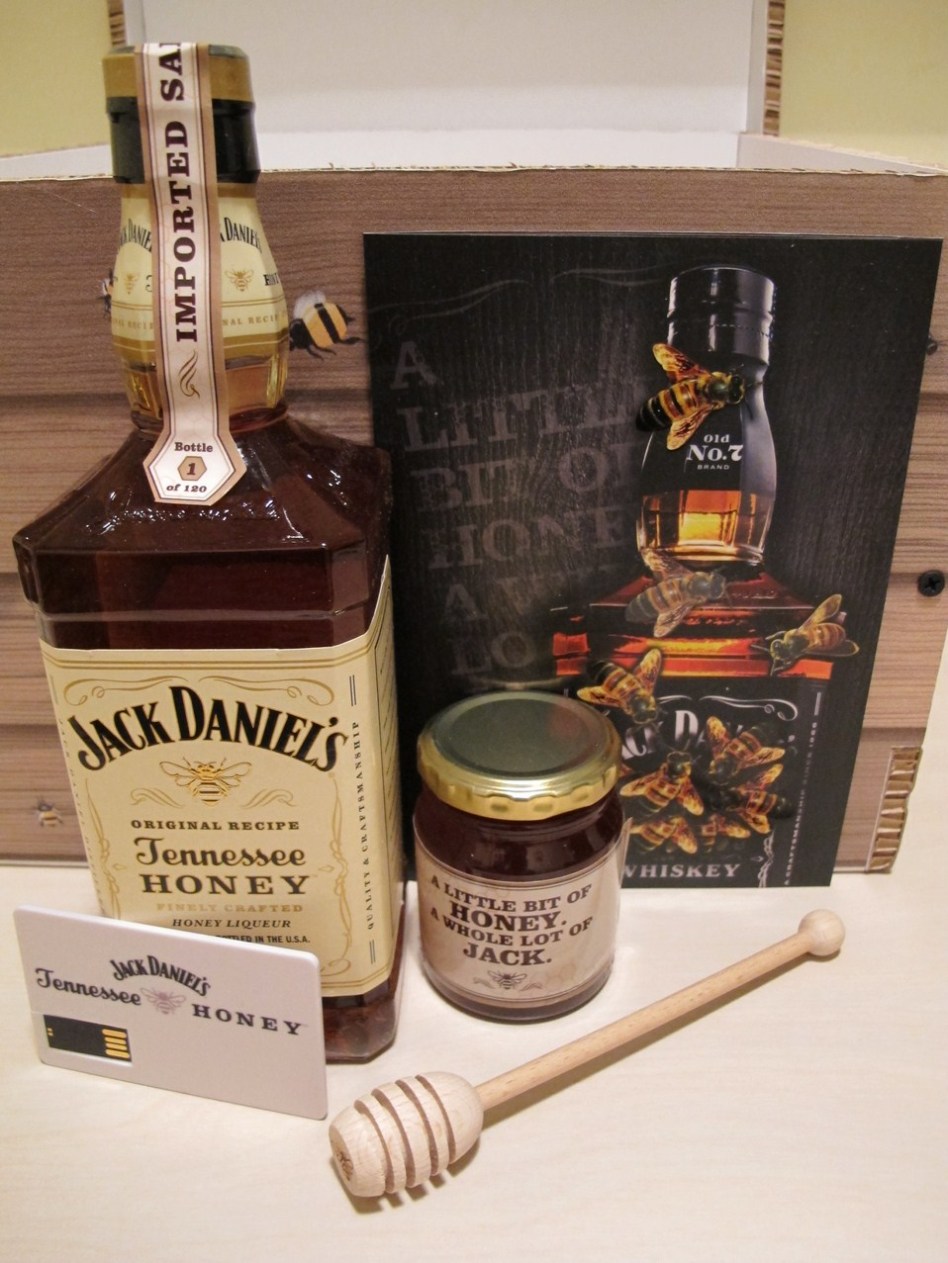
I was surprised this week by the arrival of a media pack for the launch of “Tennessee Honey”, a new whiskey liqueur – surprised because I wasn’t expecting the package and surprised because it’s an unexpected product. Actually I’m probably overstating the situation on both counts. I had heard about the global launch sometime last year, so I was aware of the product, and the marketing dude for this brand had informed me a few months ago that he’d be sending me a package. However there’s been a lot of whisky under the bridge since then so let’s just say that I was nonetheless mildly taken aback.

Image

The reason for my second source of surprise is that this drink bears the Jack Daniel’s name, and is packaged in the same square-jawed, iconic bottle. Jack is a masculine brand – a tobacco-chewing, chest pounding man’s brand. I wrote this sometime last year for my friends at Mojodojo:

“We struggle with availability of American whiskeys here in SA, but you can always count on Jack. It’s not going to blow you away with its complexity but it’s rugged and adaptable – sip it, shoot it, mix it, cocktail-ise it, it’s all good. A live fast, die young, rock star of a whiskey.”

You might also remember my review of Jack Daniel’s Single Barrel.

So how then did a liqueur that seems intended for women (and guys who like sweet drinks) get into this locker room? Al and Laura Reis (of “22 Immutable Laws of Branding” fame) were clearly not consulted. And this from a brand that has built its incredible strength on the back of a tightly focused consumer proposition. The temptation to stake a claim in new territories must be powerful indeed…but I’ll put my marketing strategy reservations to one side for now.  In terms of execution, if the pack is anything by which to go, these guys clearly don’t need any advice (or very little).

It’s high quality (without being excessive or overblown), and it’s relevant, evocative and informative. Check it out for yourselves.

Image

Image

The only thing that rung false was a label declaring my bottle to be number 1 of 120. I’m not that special, so was this just the luck of the draw? Turns out everyone else also received bottle numero uno. Either this was a concession to practicality (it’s easier to print identical labels) or it was, certainly in this Twitter era, an ill-conceived PR gimmick. We’ll forgive them because the overall effort is outstanding.

Now, before I’m labelled a fraud, I need to make a confession: I haven’t yet tasted the drink. I only received my pack yesterday and I’m currently writing this somewhere above the Horn of Africa, so I didn’t get the opportunity to crack the seal. It’s probably going to be lost on me anyhow – I’m not a fan of liqueurs, and my Spiced Gold days are behind me. I have no doubt however that it’s damn good (although I’ll get my wife to verify). These guys don’t often create new products, a fact which they point out at great pains, so you can be sure that when they do it would have been expertly concocted.

Enjoy the week ahead. May the dram bee (☺) with you!

A night of big sherry

Last week I scrounged a back-door invitation to a GlenDronach tasting.  It was hosted by the Bascule, and after I’d arrived it gradually dawned on me that I had kind-of gate-crashed a get-together of their whisky club.  I felt bad about it, but sometimes these things need to be done in pursuit of a higher purpose.

It turned out to be well worth the momentary embarrassment.  During a tasting that was expertly led by the amicable, Scottish-accented (which always lends a certain authenticity) David Wyllie, we were served a sextet of exquisite drams from a stable renowned for their sherried whiskies.   I’m a big fan of sherry-casked whisky – you could say that I’m the sherry equivalent of a peat-freak – so this was quite a treat, and also the motivation for my dubious presence at the event.

We tasted the 12, 15 and 18 YO’s from the core range, a 14YO finished in Sauternes casks, a 1992 Single Cask bottled exclusively for the South African market, and, last but not least, a whisky about which we were asked not to publicise details.  This was a special bottling, supposedly not authorised for public consumption.   It’s widely known that a whisky lover relishes nothing more than the opportunity to taste something exclusive and uncommon, so I’m pretty sure that the GlenDronach guys were blowing a bit of smoke up our arses – but I appreciated the sentiment and the whisky regardless.

Interestingly the 14YO, which is sadly not available in SA, was made from a stock of virgin-casked whisky (European oak) which was then re-racked into a variety of casks for finishing.  I found this Saturnes version interesting if somewhat overly woody.  Taste can be suggestible though and I wonder if I would have come to this same conclusion had I not known its provenance.  I suggest that you try it if you get the chance.  Virgin casks are blended into bottlings occasionally, although perhaps with increasing regularity in recent years, but whisky which is made primarily from virgin casks is exceedingly rare.  In fact this style is probably limited to the few available organic whiskies.

Finished virgins.

Amongst the core range the 15YO stood out, at least for me – the signature sherry flavours were offset by the freshness and vibrancy of a pine forest.  It also has a spectacular nose which drew oohs and aahs from the audience, myself included.  The other whiskies were similarly impressive – only enhancing my affinity for this distillery and its creations.

Corker!

I was struck by a final observation before heading home, which reinforced to me why I’m passionate about whisky rather than other potential candidates – i.e. why I’m not spending my time writing about chocolates, or teas, or bicycles, or somesuch.  There is artistry and skill required for all of these and hundreds of others, but whisky has a certain uncommon magic.  The 1992 and the mystery bottle were both from Oloroso casks, probably sourced from the same bodega.  The latter was significantly older.  And yet the 1992 was considerably darker and its sherry flavours more pronounced.  In fact the mystery whisky has citrus notes, which are unusual in sherry casks.  This is the enigma of wood.  It contributes a visceral organicity to whisky which sets it apart from other industrial production, and gives it the constant ability to surprise and to astound.

Father’s Day 2012

The below went out to the WHISKYdotcoza database today.  Please feel free to partake if it’s of interest.

Father’s Day is nearly upon us.  This year it takes place on June 17.  It’s an annual opportunity to specially celebrate one of the most important people in our lives.  My own father kindled my love of whisky, and I can’t think of a better gift for whisky-loving dads than a fine bottle of the golden nectar.

This year, for a very limited time (the offer expires at 08h00 on the morning of Wednesday 13 June), WHISKYdotcoza is offering a complimentary set of six specialist glasses (see below) with every bottle of Michel Couvreur whisky.

Epic glasses!

These are the glasses that I use to drink my whisky – they’re epic glasses for epic whisky.  Note though that stocks are limited, and will be allocated on a first come, first served basis.  However, if you miss out on the glasses, we’ll provide you with a complimentary gift bag and card – there’ll be a little extra for all fathers on this special occasion.

Michel Couvreur is a French whisky craftsman of long-standing.  Read about him and his whiskies here.  We offer his Overaged Malt, and his Special Vatting on our site, but we’ve also secured highly limited quantities (because that’s all that was available) of his super-premium products, about which you can contact us directly (on info@whisky.co.za) .  The unique (and I mean unique) 1983 might be a great option for the more patient dads, who’re willing to wait whilst we arrange an individual, customised bottling.

We wish you and your dads a wonderful Father’s Day.  May the dram be with you!
12YO blended Scotch preview

Whisky – if you’ll excuse this statement of the obvious – has been premiumising steadily in recent years.  New, expensive, lavishly packaged variants are being introduced on a weekly basis.  Older, better, more!  It’s exciting but also a little bit intimidating.  The bar is being set higher and higher, with direct impact on our daily lives.  As an example – it no longer seems enough to offer one’s guests the regular stuff.  Perhaps this is just my peculiar point of view, but I suspect that it rings true for many of us.  A 12YO blend seems to be the new minimum standard.

For this reason I’m embarking on a review of the major 12YO blended Scotches available on the South African market.  If this is the new game then I reckon someone should be carefully checking out the players and sizing them up against each other.

I’m kicking off the review with a tasting – for which I’ve enlisted some of Cape Town’s whisky luminaries to assist.  Marsh Middleton, Bernard Gutman, and Hector MacBeth will be joining me at the Bascule tonight to sample the following whiskies:

Johnnie Walker Black Label

Chivas Regal

Ballantine’s 12YO

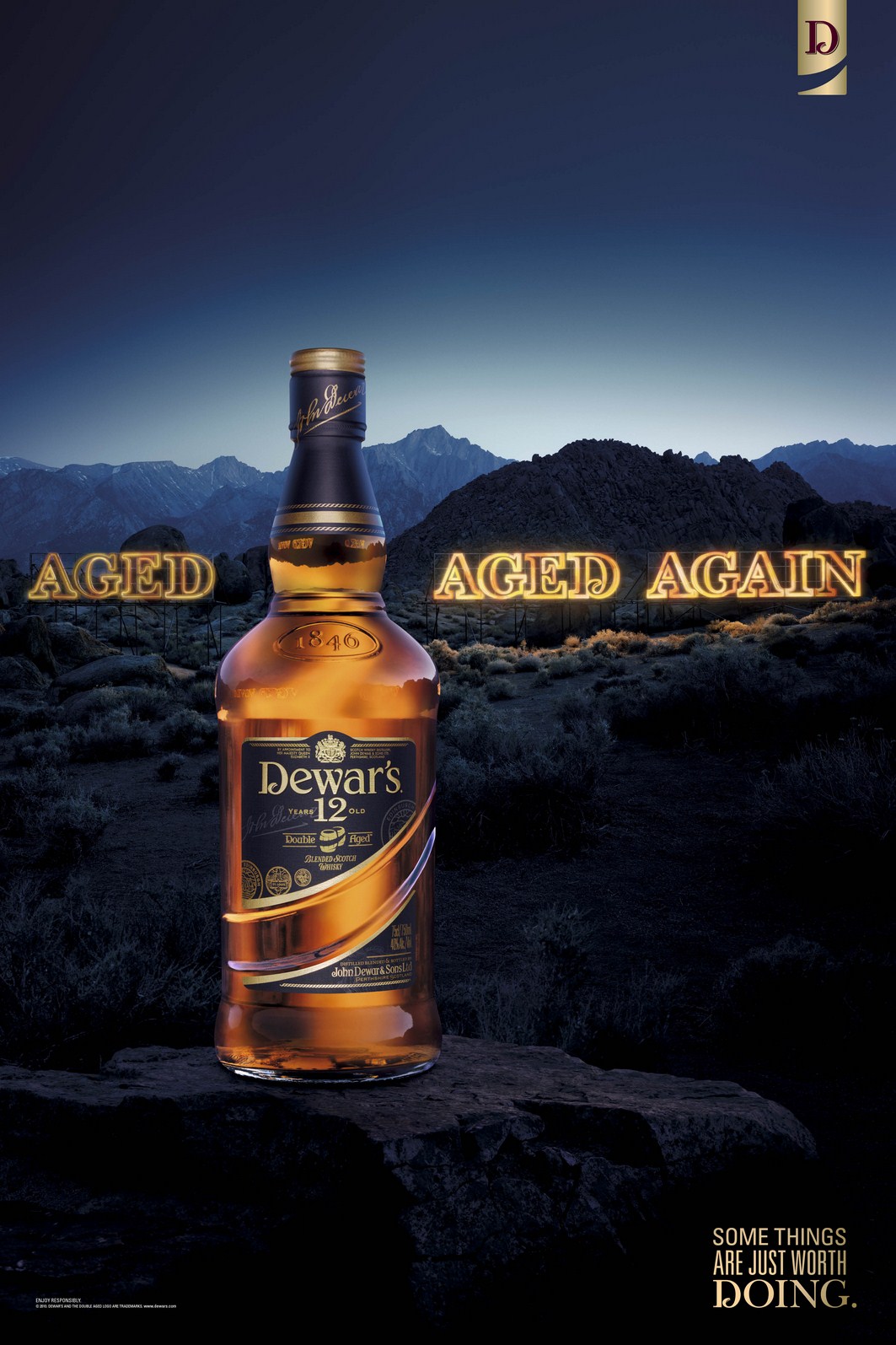
Dewar’s 12YO

J&B Jet

Grant’s 12YO

One of the whiskies we’ll be tasting.

If you happen to be in the area please join us for a dram and a chat.  There’s nothing better than whisky and good company – generally but particularly on a miserable, stormy day like this one.

The review will be published in the September issue of Prestige Magazine, and then on this blog later in September.

May the dram be with you!