Tag Archives: Whisky

Out and about with whisky

The James Sedgwick episode.   You don’t have to fly to the auld country to visit a top-notch distillery.  They’ve got the old and brown at Sedgwick’s in Wellington…and I’m not talking about sherry.

First published in Prestige Magazine (November 2012 edition).

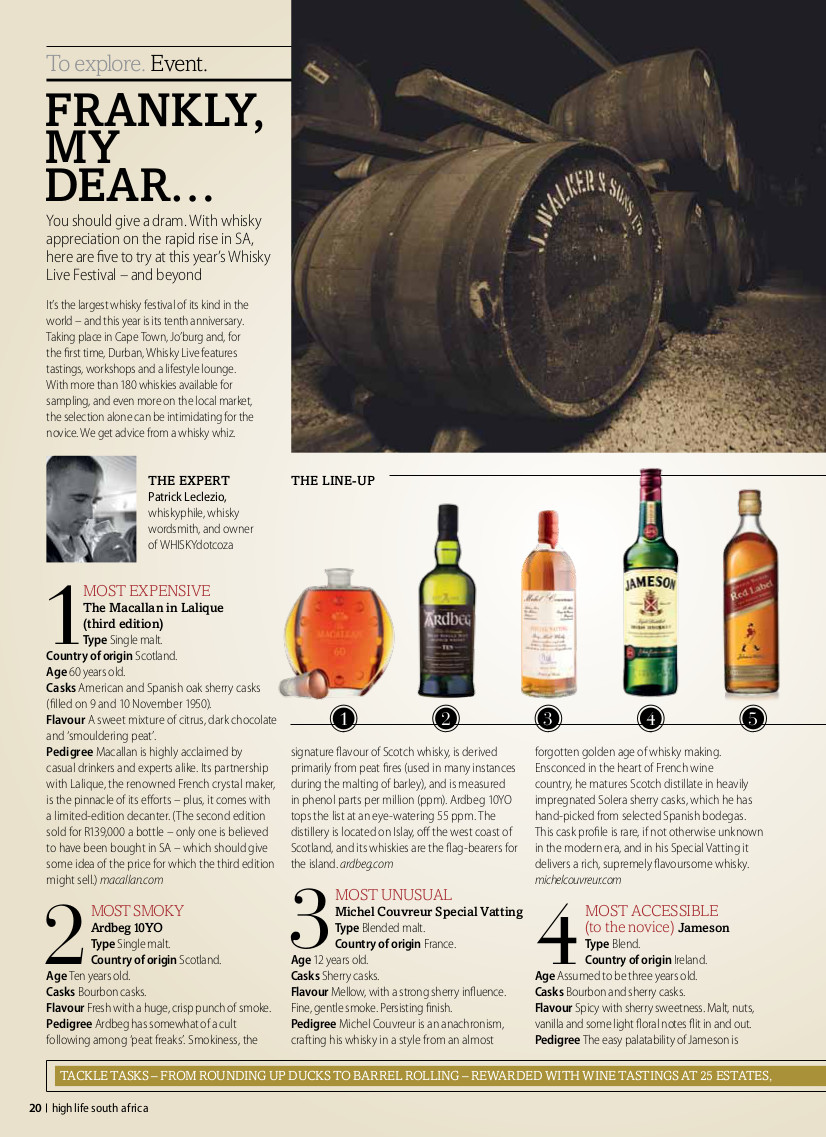
As it appeared.

PS: The title in the printed version is not mine.  I wouldn’t refer to whisky made in SA as Scotch, even jokingly.

The dominant feature at South Africa’s premier whisky distillery, the sight that first attracts the eye on arrival, is an iconic-looking pagoda.  It may be vestigial, like most of its counterparts in Scotland, but it’s impressive and imposing nonetheless; like a steeple it proclaims the presence of holy ground, although of a different sort.  This particular pagoda is modelled (like the stills too) after the one at Bowmore.  In fact it soon becomes obvious that the Scottish influence is everywhere.  Most of the whisky produced here at Sedgwick’s is clearly Scotch in style and flavour.  Even the surroundings, the arresting, picture-perfect mountain vistas, suggest a fleeting resemblance to the Highlands.  It’s an observation that stirs mixed feelings for me.  I’m glad that I’ve made the trip, but somewhat embarrassed that it’s taken me so long.

In past years the products made here were criticised for being poor quality facsimiles of the genuine thing, inferior substitutes to be bought on a budget.  Today these outdated perceptions can be consigned to a rubbish tip where they belong.  The whisky is top-class.  Of course, as if often the case with South Africans, it often takes foreign validation before we believe this of one of our own.  Three Ships, the distillery’s flagship brand, was given one of the industry’s greatest accolades earlier this year when its 5 year-old was named the best blended whisky by the World Whisky Awards.   Let me clarify in no uncertain terms exactly what this means: that’s the award for the best blended whisky in the world, including those from all the big guns: Scotland, Ireland, and even Japan, one of the most prolific countries of recent times in the accumulation of whisky prizes.  Last year Suntory’s Hibiki, the Japanese whisky which Bill Murray so memorably turned into a household name (I use the term loosely – whisky households only), specifically the 21 year-old, took this selfsame award.  So the magnitude of this achievement for a young whisky from a young, isolated, whisky producing country is massive indeed.

Strolling around the distillery it’s easy to see how this came to pass.  The word that comes to mind, appropriately in more ways than one, is “shipshape”.  It’s modern and clean, so much so that I could have eaten my lunch off the floor.  The equipment is dazzling – I mentioned the pot stills but also worth noting is a gleaming automated column that looks like it could have flown me to the moon during its leisure time.  I couldn’t put this to the test because it was hard at work distilling grain whisky.  These buggers are very expensive, so clearly there’s been sufficient confidence in the product and its prospects to have laid down some serious investment.  Most importantly however there’s a sense that these guys, the brains behind the operation, have high-level insight into the making of great whisky – which they’re systematically putting into practice; our host explained to us how malt whisky, and separately grain whisky, was best distilled during particular seasons of the year for optimal results.  It’s an operation with an undeniable pedigree.

Notwithstanding the accents, the column stills (there are two in fact – the other’s an older, manual model) and the good weather, there isn’t much difference between Sedgwick’s and the better Scotch malt distilleries.  And it’s no accident.  The source of the Bowmore connection is Master Distiller Andy Watts, who trained at that eminent Islay facility, and subsequently implemented the fruits of his early experience locally, clearly to great effect.  This is all well and good – who better to learn from than the best – but I was also hoping, maybe for no other reason than to stay my own discomfort, for some local flavour.  It had taken the award for me to pay any significant attention to the distillery and its whiskies, to my discredit as a South Africa-based whisky lover, and now it seemed important to me that they should be something more than a Scottish (or other) clone, however good.

This is obviously not a novel idea.  Sedgwick’s however is owned by Distell, a brandy-focused behemoth, for whom whisky is still a bit-part player.  There are twelve year-old casks lying around in their maturation warehouse, ready, mature, delicious, waiting for the call.  That’s not to say that nothing has happened.  Things have definitely happened – Bain’s Cape Mountain whisky, whilst not intrinsically unique (I find it somewhat bourbon-ish), makes for an interesting proposition in that it is distilled entirely from local maize – and are set to continue happening – apparently there are experiments in progress to develop whiskies with a Pinotage cask finish.

Is this enough though?  I can’t help but think of a parallel.  During the darkest days of malt whisky, when blends had completely taken over, it was the independent bottlers who kept the tradition of the single malt alive.  Sedgwick’s juice is kept strictly in-house by company policy, but imagine the possibilities if this were to be relaxed.  Something radical perhaps, a bold new genre – a muscadel cask finish or maturation in indigenous wood.  Who knows what may happen yet.  May the dram be with you!
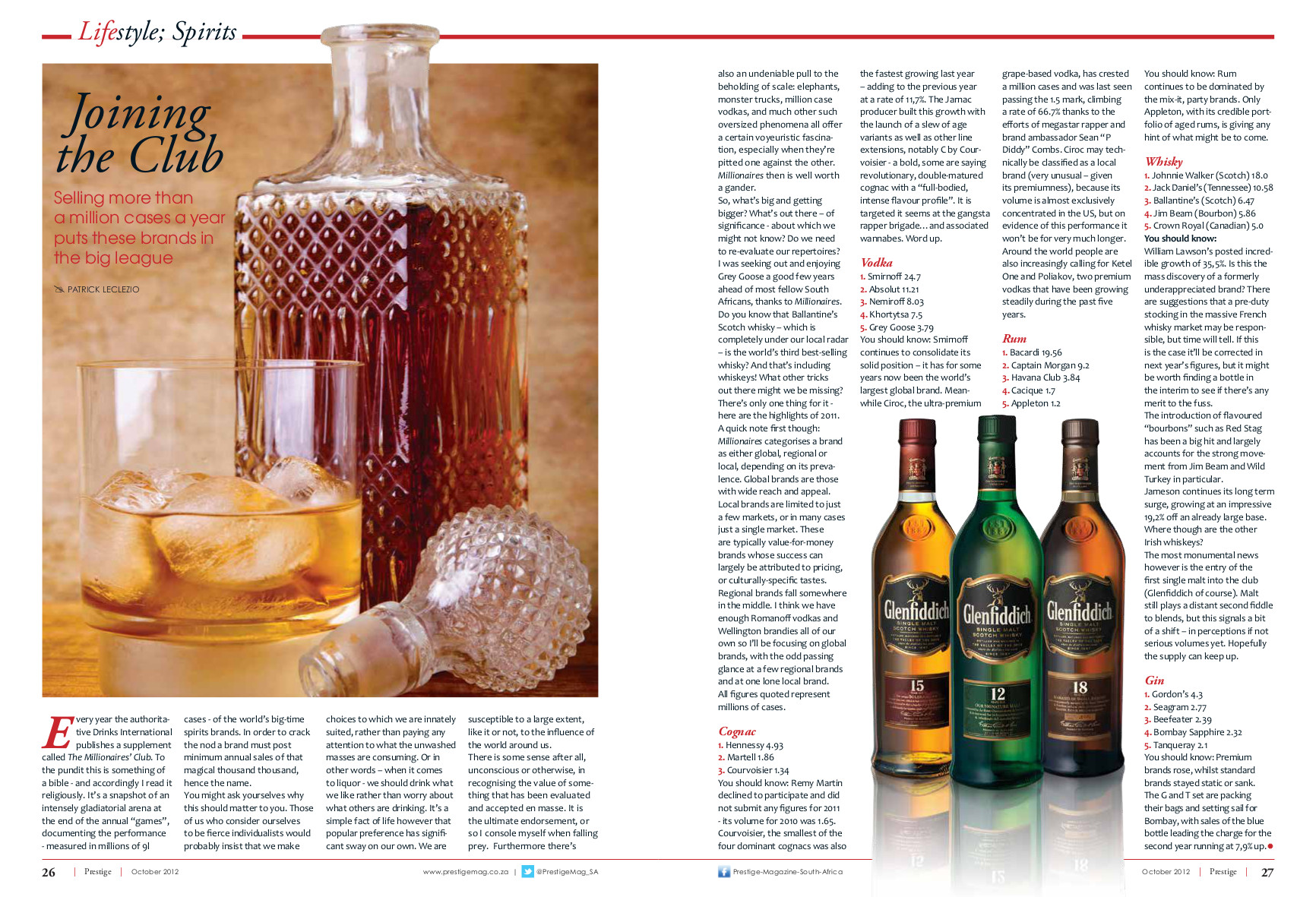
Big, bigger, biggest

If you thought that it was all about the motion of the…uh…potion, think again.  Size does matter.

First published in Prestige Magazine (October 2012 edition).

As it appeared.

Every year the authoritative Drinks International publishes a supplement called The Millionaires’ Club.  To the pundit this is something of a bible – and accordingly I read it religiously.  It’s a snapshot of an intensely gladiatorial arena at the end of the annual “games”, documenting the performance – measured in millions of 9l cases – of the world’s big-time spirits brands.  In order to crack the nod a brand must post minimum annual sales of that magical thousand thousand, hence the name.

You might ask yourselves why this should matter to you.  Those of us who consider ourselves to be fierce individualists would probably insist that we make choices to which we are innately suited, rather than paying any attention to what the unwashed masses are consuming.  Or in other words – when it comes to liquor – we should drink what we like rather than worry about what others are drinking.  It’s a simple fact of life however that popular preference has significant sway on our own.  We are susceptible to a large extent, like it or not, to the influence of the world around us.  There is some sense after all, unconscious or otherwise, in recognising the value of something that has been evaluated and accepted en masse.  It is the ultimate endorsement, or so I console myself when falling prey.    Furthermore there’s also an undeniable pull to the beholding of scale: elephants, monster trucks, million case vodkas, and much other such oversized phenomena all offer a certain voyeuristic fascination, especially when they’re pitted one against the other.  Millionaires then is well worth a gander.

So, what’s big and getting bigger?  What’s out there – of significance – about which we might not know?  Do we need to re-evaluate our repertoires? I was seeking out and enjoying Grey Goose a good few years ahead of most fellow South Africans, thanks to Millionaires.  Do you know that Ballantine’s Scotch whisky – which is completely under our local radar – is the world’s third best-selling whisky?  And that’s including whiskeys!  What other tricks out there might we be missing? There’s only one thing for it – here are the highlights of 2011.

A quick note first though:  Millionaires categorises a brand as either global, regional or local, depending on its prevalence.  Global brands are those with wide reach and appeal.  Local brands are limited to just a few markets, or in many cases just a single market.  These are typically value-for-money brands whose success can largely be attributed to pricing, or culturally-specific tastes.   Regional brands fall somewhere in the middle.  I think we have enough Romanoff vodkas and Wellington brandies all of our own so I’ll be focusing on global brands, with the odd passing glance at a few regional brands and at one lone local brand.

All figures quoted represent millions of cases.

Cognac

  1. Hennessy 4.93
  2. Martell 1.86
  3. Courvoisier 1.34

You should know:  Remy Martin declined to participate and did not submit any figures for 2011 – its volume for 2010 was 1.65.  Courvoisier, the smallest of the four dominant cognacs was also the fastest growing last year – adding to the previous year at a rate of 11,7%.  The Jarnac producer built this growth with the launch of a slew of age variants as well as other line extensions, notably C by Courvoisier – a bold, some are saying revolutionary, double-matured cognac with a “full-bodied, intense flavour profile”.  It is targeted it seems at the gangsta rapper brigade…and associated wannabes.  Word up.

Vodka

  1. Smirnoff 24.7
  2. Absolut 11.21
  3. Nemiroff 8.03
  4. Khortytsa 7.5
  5. Grey Goose 3.79

You should know:  Smirnoff continues to consolidate its solid position – it has for some years now been the world’s largest global brand.  Meanwhile Ciroc, the ultra-premium grape-based vodka, has crested a million cases and was last seen passing the 1.5 mark, climbing a rate of 66.7%  thanks to the efforts of megastar rapper and brand ambassador Sean “P.Diddy” Combs.  Ciroc may technically be classified as a local brand (very unusual – given its premiumness), because its volume is almost exclusively concentrated in the US, but on evidence of this performance it won’t be for very much longer.  Around the world people are also increasingly calling for Ketel One and Poliakov, two premium vodkas that have been growing steadily during the past five years.

Rum

  1.  Bacardi 19.56
  2. Captain Morgan 9.2
  3. Havana Club 3.84
  4. Cacique 1.7
  5. Appleton 1.2

You should know: Rum continues to be dominated by the mix-it, party brands.  Only Appleton, with its credible portfolio of aged rums, is giving any hint of what might be to come.

Whisky

  1. Johnnie Walker (Scotch) 18.0
  2. Jack Daniel’s (Tennessee) 10.58
  3. Ballantine’s (Scotch) 6.47
  4. Jim Beam (Bourbon) 5.86
  5. Crown Royal (Canadian) 5.0

You should know:

William Lawson’s posted incredible growth of 35,5%.  Is this the mass discovery of a formerly underappreciated brand?  There are suggestions that a pre-duty stocking in the massive French whisky market may be responsible, but time will tell.  If this is the case it’ll be corrected in next year’s figures, but it might be worth finding a bottle in the interim to see if there’s any merit to the fuss.

The introduction of flavoured “bourbons” such as Red Stag has been a big hit and largely accounts for the strong movement from Jim Beam and Wild Turkey in particular.

Jameson continues its long term surge, growing at an impressive 19,2% off an already large base.  Where though are the other Irish whiskeys?

The most monumental news however is the entry of the first single malt into the club (Glenfiddich of course).  Malt still plays a distant second fiddle to blends, but this signals a bit of a shift – in perceptions if not serious volumes yet.  Hopefully the supply can keep up.

Gin

  1. Gordon’s 4.3
  2. Seagram 2.77
  3. Beefeater 2.39
  4. Bombay Sapphire 2.32
  5. Tanqueray 2.1

You should know: Premium brands rose, whilst standard brands stayed static or sank.  The G and T set are packing their bags and setting sail for Bombay, with sales of the blue bottle leading the charge for the second year running at 7,9% up.

Whisky on the not-so-cutting edge

Building a better mousetrap in an industry where mice cannot be trapped

First published in Prestige Magazine (October 2012 edition)

As it appeared.

Someone recently told me that Blackberry is on its way out, eaten up by Apple and Samsung, as good as gone, kaput.  I had no idea.  It doesn’t seem like too long ago that it was the next best thing.  Admittedly I’m not the best barometer when it comes to mobile technology.  I’m currently using my wife’s hand-me-down and I always seem to be one upgrade behind everyone else.  My finger is so far from its pulse that I wouldn’t know what was happening in this market until two years later.  Regardless it can’t be disputed that change is taking place at a breakneck pace – driven by rapid innovation.  Whisky, with which I’m decidedly more familiar, offers a stark contrast by comparison.  It’s an industry in which true innovation is rare – its product has been made in largely the same way for centuries.  Here it is heritage more than anything else which is the key to success: the common thread amongst the world’s big whiskies is that they’ve all been around for a while.

Unlike the cellular phone whisky is old and deeply traditional.  Change is resisted – in many cases it is institutionally resisted.  The running gun battles – hugely entertaining by the way – between the Scotch Whisky Association (SWA), the guardians of industry, and John Glaser, the most maverick whisky maker in living memory, have become almost legendary.  His company, Compass Box, named Innovator of the Year on four separate occasions by Whisky Magazine, has continually attempted to push the boundaries.  Most recently he and his team cocked a snook at the SWA with the release of their “Last Vatted Malt” – a dig at the latest regulations.   In reality though, as inventive as these guys might be within whisky’s narrow confines, a few oak staves here and few hazy blends there would hardly qualify as innovations amongst the Steve Jobs of this world (may he rest in peace).  Compass Box has prospered but I sometimes think that it’s the resultant publicity rather than the actual merits of its inventiveness that is more responsible – and this is said without casting any aspersions on the quality of the whisky, which is good, very good.

Whisky, during its long history, has of course seen a few genuinely transformative developments.    The column still paved the way for more affordable supply in greater volumes.  Blends, which today dominate the market, made whisky more acceptable and palatable to a broader spectrum of people.  More recently, the inception of “finishing”, also known as double maturation or even extra maturation, added a new diversity of flavour to the whisky repertoire by introducing exotic casks (port, rum, cognac and others) into the ageing process.  But these have been few and far between.  Today the industry is too tightly regulated to permit much more than a few Compass Box-type peculiarities.

I often wonder whether this status-quo is in our best interests as whisky lovers.  Are we not perhaps missing out?  Would it not serve the greater good to loosen the reins and see what happens?  I’m a renegade at heart so I’m always thrilled to see guys like Glaser tangling with the Establishment and giving the what-for.  The limits should to be tested, and the agendas of entrenched interests need to be kept in check.  But equally there must to be limits, otherwise this path may take us to places where we might not want to go.  Consider this eventuality: would the addition of external flavours (blasphemy!) not make for a better, or at least a worthwhile, whisky?  This is a realistic consequence of uncontrolled innovation.  The answer?  Perhaps – but would such a concoction still be whisky, the drink we’ve come to know and love?  Whisky’s identity, and indeed its value, comes from its connection to the past and from its mystery, rather than from any kind of mechanical functionality with which to be played and manipulated.   It is only whisky because five hundred years of documented history (and several hundred more lost in the mists of time) have told us that that’s how it should be made.

I attended a tasting not long ago which reinforced to me why I’m passionate about whisky rather than anything else, cellular phones included.  During the function I tasted two whiskies aged in similar Oloroso sherry casks (probably sourced from the same bodega):  the first younger (a 1992 vintage), the second significantly older (a mystery whisky).  Strangely, inexplicably, the 1992 was considerably darker and its sherry flavours more pronounced.  Furthermore the mystery whisky exhibited citrus notes – highly unusual in sherry casks.  This is the type of phenomenon – in this case the visceral, unpredictable organicity of the casks – that makes whisky so special and so enigmatic.  There may not be the potential to release a new app every few days, but whisky makers can and do build better mousetraps just by focusing on the fundamentals and leaving the rest to a time-honoured, intangible “magic”.  In its different casks, in the shape of an individual still, and in its varying terroir whisky has the power to surprise and to astound.  May the dram be with you!

What to do at 30 000 feet

Get yourself one of those dinky bottles, take a sip, sit back and read my article in the October edition of British Airways’ High Life magazine.

As it appeared – p1.

As it appeared – p2.

May the draaam be with you!

Win with Glenfiddich!

The excitement of Whisky Live is upon us again, and in spirit appropriate of the whisky season my friends (and yours) at Glenfiddich have put together a special surprise for all you whisky-loving readers of Words on Whisky.   Here it goes.

Win a bottle of Glenfiddich 12 Year Old Single Malt Scotch Whisky, the world’s leading single malt Scotch Whisky, in the lead up to the FNB Whisky Live Festival.

Whether you’re a first-time taster, already a passionate connoisseur, or enthusiastic to learn, see, and taste more, visit the Glenfiddich gold stand at the FNB Whisky Live Festival to nose and taste a dram of the core range of Glenfiddich 12, 15 and 18 Year Old under the expert guidance of the Glenfiddich Brand Ambassador team.

Mmm….

Send your name and contact details to info@whisky.co.za to stand a chance to win a bottle of Glenfiddich 12 Year Old Single Malt Scotch Whisky valued at R320.00.

The FNB Whisky Live Festival takes place at the Cape Town Convention Centre from 3 – 5 October and is open daily from 18:00 – 22:00.  Tickets are available online at www.whiskylivefestival.co.za.  See you there and may the dram be with you!

PS – Please note that the competition is only open to residents of South Africa, or to those prepared to travel here to come and collect their prize :).  Entries must be received by midnight 5 October.

Stocking up for spring – part 1

The new serving standard

First published in Prestige Magazine (September 2012 Edition).

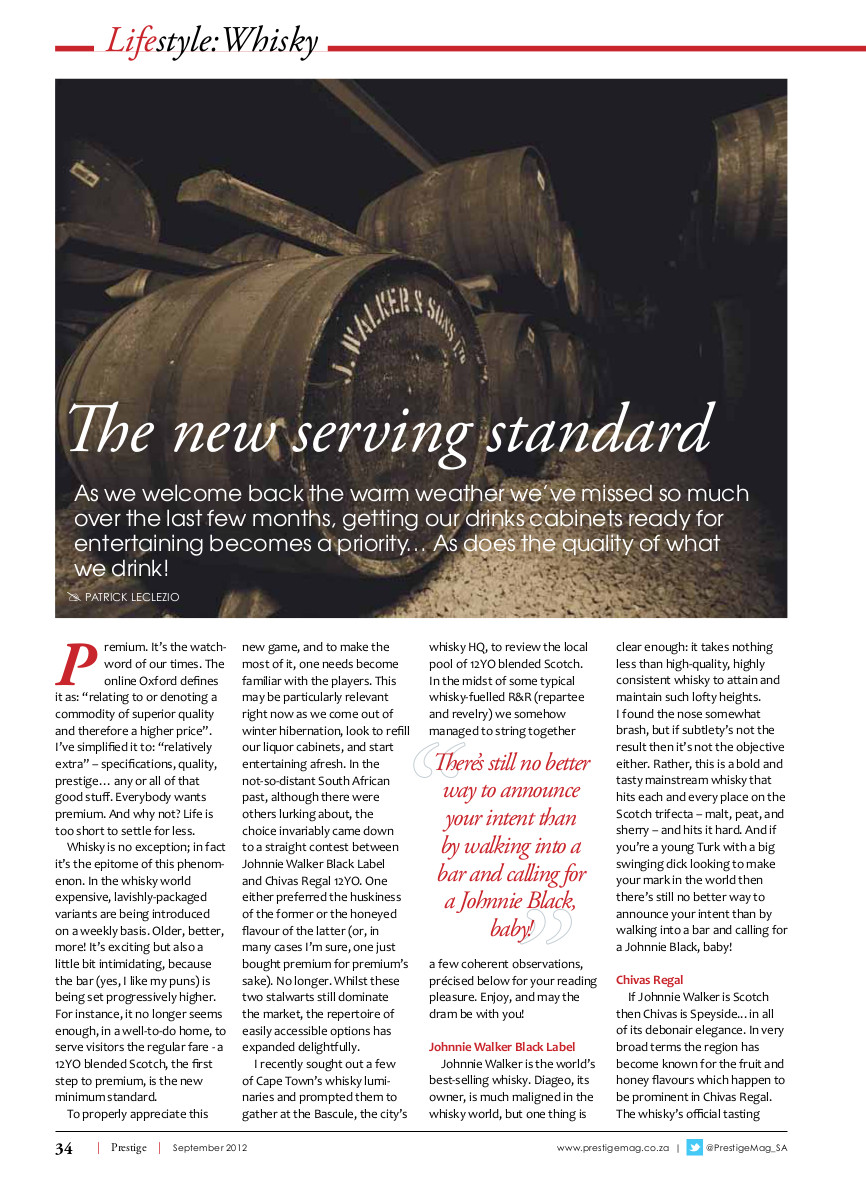
As it appeared – page 1

As it appeared – page 2

Premium.  It’s the watchword of our times.  The online Oxford defines it as: “relating to or denoting a commodity of superior quality and therefore a higher price”.  I’ve simplified it to: “relatively extra” – specifications, quality, prestige…any or all of that good stuff.  Everybody wants premium.  And why not?  Life is too short to settle for less.

Whisky is no exception; in fact it’s the epitome of this phenomenon.  In the whisky world expensive, lavishly-packaged variants are being introduced on a weekly basis.  Older, better, more!  It’s exciting but also a little bit intimidating, because the bar (yes, I like my puns) is being set progressively higher.  For instance, it no longer seems enough, in a well-to-do home, to serve visitors the regular fare – a 12YO blended Scotch, the first step to premium, is the new minimum standard.

To properly appreciate this new game, and to make the most of it, one needs become familiar with the players.  This may be particularly relevant right now as we come out of winter hibernation, look to refill our liquor cabinets, and start entertaining afresh.  In the not-so-distant South African past, although there were others lurking about, the choice invariably came down to a straight contest between Johnnie Walker Black Label and Chivas Regal 12YO.  One either preferred the huskiness of the former or the honeyed flavour of the latter (or, in many cases I’m sure, one just bought premium for premium’s sake).  No longer.  Whilst these two stalwarts still dominate the market, the repertoire of easily accessible options has expanded quite delightfully.

I recently sought out a few of Cape Town’s whisky luminaries and prompted them to gather at the Bascule, the city’s whisky HQ, to review the local pool of 12YO blended Scotch.  In the midst of some typical whisky-fuelled R&R (repartee and revelry) we somehow managed to string together a few coherent observations, précised below for your reading pleasure.  Enjoy, and may the dram be with you!

Johnnie Walker Black Label

Johnnie Walker is the world’s best-selling whisky.  Diageo, its owner, is much maligned in the whisky world, but one thing is clear enough: it takes nothing less than high-quality, highly consistent whisky to attain and maintain such lofty heights.  I found the nose somewhat brash, but if subtlety’s not the result then it’s not the objective either.  Rather, this is a bold and tasty mainstream whisky that hits each and every place on the Scotch trifecta – malt, peat, and sherry – and hits it hard.  And if you’re a young turk with a big swinging dick looking to make your mark in the world then there’s still no better way to announce your intent than by walking into a bar and calling for a Johnnie Black, yeah baby!

Chivas Regal

If Johnnie Walker is Scotch then Chivas is Speyside…in all of its debonair elegance.  In very broad terms the region has become known for the fruit and honey flavours which happen to be prominent in Chivas Regal.  The whisky’s official tasting notes also claim a slight smokiness, but this was beyond my ability to identify.  Perhaps it comes from char as opposed to peat.  Regardless, it’s not important.  Chivas is not about smoke, or anything so robust.  It is understated refinement personified.  Interestingly one of our party noted that this is not a distinctively whiskied whisky – apparance of its cereal origins is restrained, and dominated by sherry notes.  Indeed to a novice it might be difficult to distinguish from a similarly aged cognac or rum.  I’d perhaps venture to suggest that this is a whisky for all seasons.

Grant’s 12YO

This new kid on the block comes from a pedigreed background.  It’s a blend in which we can assume the famous Glenfiddich and Balvenie malts, emanating from the same hallowed stable, to be at the forefront.   Sadly for this fine whisky my attention was diverted by a claim which seems rather forced: “Grant’s 12 Year Old is the only blended Scotch whisky to ‘marry’ the finest 12 Year Old grain and single malt whiskies for six months after blending in bourbon casks”.  Technically this may be true, but it’s not quite as impressive as it sounds.  Dewar’s (and W&M) has a long tradition of marrying whisky, albeit in sherry casks, and one of the variants of the local Three Ships, albeit not a Scotch, is married in bourbon casks.  The good news – for peat freaks in particular – is that Grant’s is the smokiest whisky in this category.  Phenol-menal!  Kudos too on the best packaging amongst the lot.

Ballantine’s 12YO

The regular Ballantine’s is my favourite blended Scotch in its price category.  It reminds me of my time in Rome when I spent many an evening pondering the spectacular sights, glass in hand.  And big brother does not disappoint.  A flavoursome and interesting all-rounder – my personal runner-up.

J&B Jet

Jet’s mild flavours won’t start a party in your mouth; rather this is a whisky that’s ideal for newer initiates, and for occasions when fuller flavours might be distracting.  Fresh but not vivid – perfect as an aperitif on a spring evening.

Dewar’s 12YO

I’ve kept the best for last – and that’s not just my opinion.  Each of the heavyweights at our gathering concurred, with no hesitation whatsoever.  This whisky is magnificently integrated – it displays superb balance not only amongst it complex flavours, but also between nose, palate and finish – and is completed by a smooth, silky mouth-feel.  Hugely underrated.

Big thanks to Hector McBeth, Marsh Middleton and Bernard Gutman.

Out and about with whisky

The Singapore episode

First published in Prestige Magazine (August 2012 edition).

As it appeared.

Singapore never fails to impress me.  Looking down as one approaches from the air it’s no stretch to believe that this is one of the top three busiest ports in the world.  The Straits of Singapore is a bustling bottleneck – densely peppered with naval traffic from one horizon to the other.  The island city also happens to be one of the wealthiest countries in the world.  Singaporeans are not struggling for drinking money and it shows in the whisky scene.

In an overall Asian whisky context, Singapore would be classed as a mid-mature culture.  It sits somewhere between the refined palates evident in Japan and Taiwan, where demand for vintage whisky is de rigueur, and the still raw uptake in crazy China, where whisky drinking is karaoke-inspired mixology.  The place regularly ranks amongst the leading markets for Scotch whisky exports, and whilst most of that stock is filtered into the wider region its presence alone must be infectious.   Things are happening here.  I visited no fewer than three top-quality whisky bars during my short eight hour layover and I was so enthralled by the experience that I came within a barley whisker of missing my flight home.  My whisky-addled, panic-stricken dash to the airport, involving no fewer than three modes of transportation (four if you include the trip on the airport skytrain needed to correct my arrival at the wrong terminal), must have been quite something to behold…more amusing to onlookers than it was to me.

La Maison du Whisky (LMDW)

This legendary French whisky business was founded in 1956 by Georges Bénitah, one of the true whisky pioneers of the modern era.  Its bar in Singapore – based at the vibey Roberson Quay on the banks of the eponymous river – is a little different, not only from its other outlets but from most other bars:  it is both a shop and a bar.

I didn’t quite know what to make of it.  It’s an appealing concept in theory, if a country’s regulations allow for it.  Imagine browsing whiskies and then being able to sit down and test drive one’s options before committing.  Generally I dislike shopping but this I think I could grow to enjoy.  I also like the idea of a total whisky zone, where I can ogle whisky, talk whisky, taste whisky, and then, to make the experience complete, take-away whisky.

But in reality can anything really be all things to all men?  LMDW Singapore, in keeping with its heritage, is more shop than bar.  I’ve been there once, early-ish on a weekday evening, so take my opinion from whence it comes, but with its face of plate-glass and severe lighting that it projects to the world, it wouldn’t be my first choice for an intimate evening of mellow dramming.

Ambience aside, it ticks all the boxes with a flourish.  LDDW boasts a selection of 400 distinct Scotches and 200 other whiskies, including some rare bottlings (to which the closest we would have come here in SA is a fleeting glimpse in one of the international versions of Whisky Magazine), and some dedicated bottlings.  GM Jeremy Moreau introduced me to a Strathisla 1965 Single Cask, specially bottled for the group by Gordon & MacPhail, whose rich, bite-into sherry flavours I savoured at length…yum.  Worth the visit?  It goes without saying.

 The Quaich

A short stroll down the river and a bite of supper later I found myself at a bar named after Scotland traditional drinking vessel.  The Quaich, according to owner Khoon Hui, was Singapore’s first genuine whisky bar.  It also appears to be the most genuinely Singaporean whisky bar.  Whereas the other two I visited seemed somewhat expatified, this was refreshingly local – Khoon pointed out a radio celebrity and some government heavyweights enjoying the undisputable pleasures of his establishment.

The Quaich’s menu numbers a highly respectable 300 fine whiskies, with a focus on the distilleries that it represents as a distributor in Singapore.  These include Bunnahabhain, Springbank, Glenglassaugh, and Bowmore, amongst others.  I noticed, and was duly impressed, by a 1964 Bowmore 46YO and three dedicated single casks bottled by Springbank (Longrow) and Glenglassaugh for The Quaich.

My most lasting impression however was of the great hospitality.  Khoon and I chatted whisky over a Kavalan (a name with which the chaps at Macallan are none too pleased by the way), and then he insisted on giving me a lift to my next appointment.  The man is a gentleman and a scholar and his bar is a gem.

Auld Alliance

The Long Bar at the Raffles Hotel created the Singapore Sling, and has since been regarded as the bar in Singapore, fads aside.  Well, now there’s a new king in town and its name is Auld Alliance (a reference to the close military relationship which existed between pre-Union Scotland and monarchic France).  Let me not mince words: in my opinion this may well be the king of all whisky bars worldwide.

To say that I was blown away is an understatement.  This whisky cathedral – to call it a bar seems inadequate – is utterly, utterly (repeated for good measure) magnificent.  Auld Alliance is the brainchild of Emmanuel Dron, a whisky expert of long standing, and, as I set about acquainting myself with his spot, his expertise became explicitly evident: it is quite simply a league apart from anything that I’ve ever experienced.

Located in Chijmes, a charming entertainment complex built within the grounds and amidst the architectural structure of an old convent, the venue offers a breath-taking bar area, an elegant lounge, and two private tasting rooms.  Its collection of whiskies currently numbers 1500; so many in fact that there’s just not enough space for all of them, thus requiring 500 odd to be rotated in and out of storage periodically.  The highlights include a mint-condition first-edition 1993 Black Bowmore (S$ 12 990 ≈ R84 955 per bottle), and a Yamazaki 50YO, of which there are only a handful of bottles accessible outside of Japan.  I was particularly captivated by a menu which offers flights of the “same” whisky bottled in different decades, allowing customers to explore the evolution of the style over time.  I could go on and on.  Quite simply Auld Alliance lacks for nothing…except for South African whiskies.  One has to leave room for improvement I guess.

The moral of this story, in case you haven’t arrived at the same conclusion already – a whisky pilgrimage to Singapore is well in order.  May the dram be with you!

Winter whisky specials

This message went out to the WHISKYdotcoza database today.  Ignore if you’re not interested in a commercial punt.

Winter is upon us.  If you’re anything like me then you’re probably enjoying a dram or three to fight back the cold.  In this regard WHISKYdotcoza is offering a little bit of winter cheer.

We’ve teamed up with Macallan and Highland Park to bring you these special offers:

These promotions will be open for the next two months, but be warned that stock is limited.  It’s strictly first-come, first served.

Note too that WHISKYdotcoza has secured some stock of the Glenfiddich Age of Discovery Madeira Cask 19YO.  The South African allocation is limited, so if this is something that strikes your fancy don’t delay in getting yourself a bottle.  The numbers are too small to place the product on the site so please contact us at info@whisky.co.za to order.  Price is R1099.

We’ve also been informed by the local suppliers of Laphroaig that there’s a global shortage of the 10YO.  It’s currently out of stock – there’ll be limited stock arriving next month and then no further availability for the rest of the year.  Same deal as above – if this is your bag then get an advance order in to us at soonest convenience.

Until next time – keep well and may the dram be with you!

The why’s of whisky – episode 1

Why oats?

As I’ve travelled along on my whisky journey, I’ve come across many a confounding twist in the road.  Some are easily navigated, others not.  This series is dedicated to the latter;  questions whose answers are frustratingly arcane – buried in the past, not publicly available, kept close to the chest by the industry, or just technical and obscure – but interesting enough, at least for me, to warrant some sort of exploration.

My intention is for this to be a forum rather than a collection of posts.  I will propose questions, sometimes with answers, which may or may not be correct and/or comprehensive, and sometimes without.  My hope is that fellow whisky lovers will be encouraged to contribute to both sides i.e. suggest questions and answers, and generally express a point of view.  I’d also welcome guest posts.  This may turn out to be a great vehicle to use to address those niggling unknowns which I’m sure we’ve all encountered at some point or another…or at the very least mine.  Let’s see how it goes.

Thirteen odd years ago I read my first whisky book – the “The World Guide to Whisky” written by the legendary Michael Jackson.  In the section on Irish whiskey he writes: “It nonetheless remains the case that that Irish whiskey may contain a distillate of malt, one made in a pot still with barley, and a third portion comprising grain spirit.  Of the three, the barley distillate is central, and it contributes the greatest character to several Irish whiskeys.  In the past, a tiny proportion of oats was also used…”

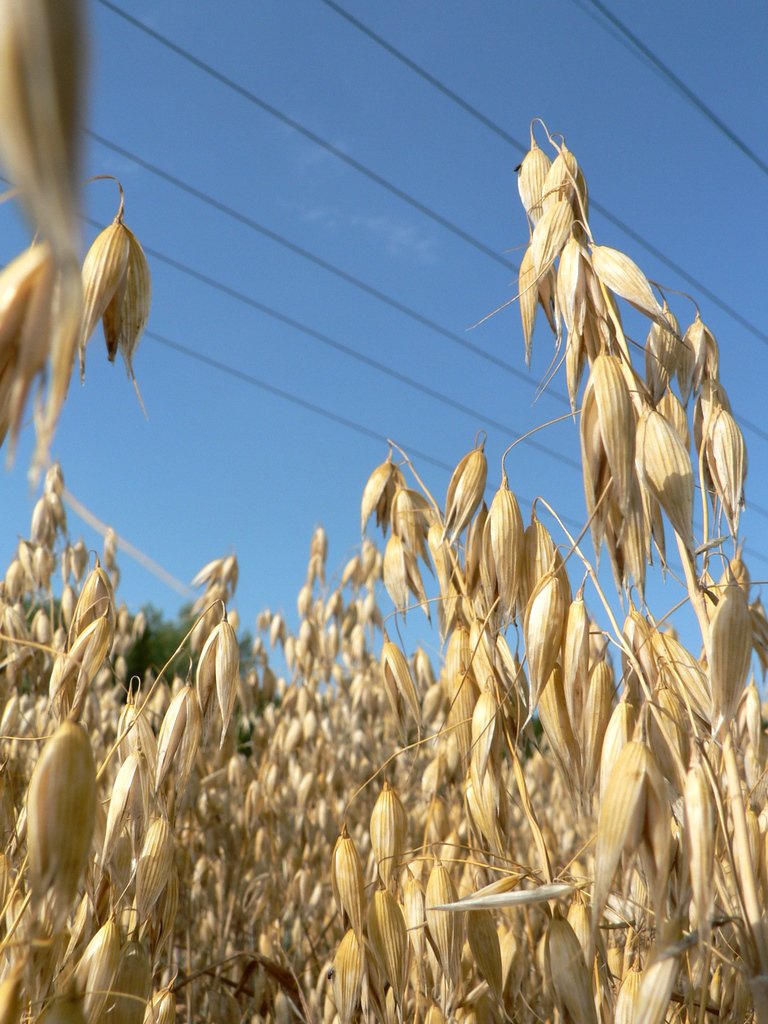
Oats growing in a field.

This was written some time ago, and it’s no longer entirely accurate.  Irish whiskey is in the springtime of a sweeping revival, and it is turning to its history for inspiration.  Last year three new single pot stills were introduced by Irish Distillers and not much less recently Cooley started to make single pot still at Kilbeggan…using oats in the mashbill.  Oats as an ingredient is no longer a thing of the past.

So then we get to the central issue – why oats?  I have them for breakfast every morning but what the hell are they doing in my whiskey?

Most ingredients used today are a result of convention.  It’s a certainty that Cooley is using oats to try to resurrect a time-honoured Irish tradition.  But at a point way back in the past it must have been motivated by some sort of functionally-driven logic.  Malt, Corn, Rye, and Wheat were used to make whisky because these ingredients were plentiful in the areas where they were used and because they made good whisky.  Unmalted barley was used to avoid the higher taxes on malted barley, and because, as any of you who have tasted a single pot still would know, it made damn good whiskey when combined with malt.  But the reason for oats, in such small proportions nogal, is less evident.

I did a bit of web research and came across this snippet on the Liquid Irish blog, which gave me a brief glimpse at the answer:

“The oats, it is said, are there to allow liquid to flow more freely through the bed of the mashtun. Alex Chasko, the Innovation Manager at Cooley, is sceptical about this, not having seen the effect in his experiments. Whatever about the filtering advantages, we are all hoping for an interesting influence on taste.”

Might the inclusion of oats then originally have been a factor of the mashing process rather than anything to do with economics, accessibility, or flavour?

The answer, it seems, is yes.  The next (and conclusive) step of my research process was more old school.  Check this out – it’s from an old Scottish treatise by Thomas Thomson called “The Manufacture of Whisky”:

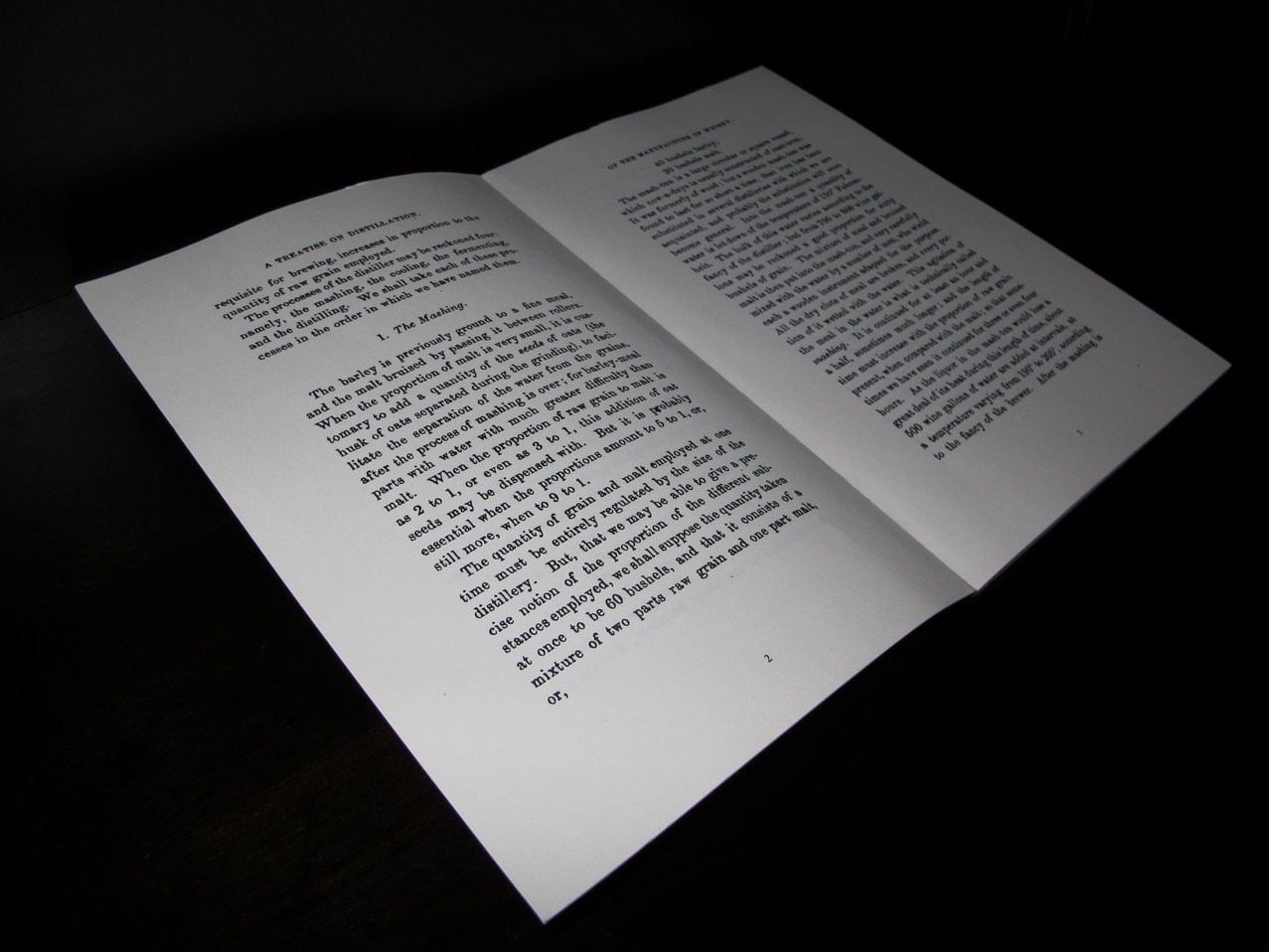
“When the proportion of malt is very small, it is customary to add a quantity of the seeds of oats (the husk of oats separated during the grinding), to facilitate the separation of the water from the grains [by grains he means unmalted barley], after the process of mashing is over; for barley meal parts with water with much greater difficulty than malt.  When the proportion of raw grain to malt is as 2 to 1, or even as 3 to 1, this addition of oats seeds may be dispensed with.  But it is probably essential when the proportions amount to 5 to 1, or, still more, when 9 to 1.”

Auld book.

This allows me to draw a few conclusions:

–        This is the likely core reason for why oats once formed part of a mashbill.

–        Scots at one stage made whisky in the style of Irish single pot still.

–        Cooley – with its mashbill for the Locke’s revival reputed to be 60% malt, 35% stone ground spring barley and 5% oats – has no technical need for the oats.  Probably the reason why their experiments are hitting a blank.

Regardless, the oats must contribute to flavour.  We may have a while yet to wait before the product is aged and ready for market, but I for one can’t wait.  This question can’t really be put to bed until the porridgey nectar runs over our palates.

May the dram be with you.

Out and about with whisky

The Hong Kong episode

First published in Prestige Magazine (July 2012 edition)

As it appeared.

There is little that’s quite as interesting for a whisky lover as a whisky excursion, whether it’s in the immediate locale, or somewhere a bit more far-flung.  Out there is a whisky world teeming with possibilities: there are maltings, distilleries, maturation warehouses, cooperages, bottlers, heritage centres, speciality shops, and bars aplenty, all waiting to be visited and explored.  I’ve tasked myself to get out and about and report back on my findings in a series of intermittent episodes, of which this, a bar tour, is the first.   It’s a tough slog of a job I know, but someone has to do it and it may as well be me.

Almost everyone it seems is travelling east these days.  China became South Africa’s leading trade partner in 2009, and its importance to our economy will almost certainly continue to grow in the future.  Despite this situation, it’s near impossible to fly there direct.  There are infrequent flights from Joburg to Beijing, but failing this somewhat impractical option one would likely be flying via the former British enclaves of Hong Kong or Singapore (subject of the next episode); and, finding oneself in either of these vibrant, cosmopolitan cities, one might be tempted to hang around for a bit.  So peripatetic whisky lovers – take note.  Here’s what one needs to know about Hong Kong.

Prince Charles was quoted as saying that Hong Kong has created one of the most successful societies on Earth.  If his opinion is valid then it would stand to reason, by my standards anyhow, that a whisky culture should be prominent.  And true it proved to be.  After a spot of preliminary research on the city’s whisky scene, and a predictably overpriced dinner in the mildly loutish Lan Kwai Fong, the famous party district, I set out to visit the two places at the top of my list: Angel’s Share and The Chinnery.

The most striking feature of Angel’s Share, dominating the entrance to the bar, is a large cask…sufficient to set the heart of any whisky lover aflutter.  My immediate impression was that this might be a “live” cask, an exciting thought.  Imagine drinking a theoretically different whisky every time one ordered from the cask!   Most distilleries however do not sell casks lock, stock, and…uh…barrel to the retail trade, and legislation now prevents single malts or single casks from being bottled outside of Scotland and effectively from being dispensed out of anything other than a bottle, so this was unlikely.  And indeed Eric Wan, my genial host, confirmed that the cask was a replica, and that its inner surface was lined with a metal membrane.  The illusion persisted nonetheless and I thoroughly enjoyed the undisputedly authentic ritual of being served from the cask – a heavy dram of Highland Park 1997 vintage having been drawn for me with a valinch*.

I would be doing the venue a disservice though if I were to fixate exclusively on the cask.  This is the ideal place to enjoy a superb evening of whisky appreciation and casual conversation – it is all dim-lit, intimate-nooked, and leather sofa’d elegance.  Whilst the brash whisky-drinking classes emerging in the Mainland might be quaffing the golden nectar with green tea (shudder), the clientele here is rather more refined and sophisticated.  Hong Kong after all has always been, and remains, the leading edge of the wedge.  The menu is somewhat modest by upper-tier whisky bar standards, but with a selection of 150 odd distinct whiskies, it is ample regardless.  I spotted a Macallan 1936 at HK$ 1240 (about the same in Rands) for a 30ml serving.  Perhaps when my ship comes in….

Eric twisted my rubber arm and had me linger longer over a glass of the excellent Laddie 17YO, his favourite of the moment.  This was my first rum-casked whisky, and its big exotic fruit flavours were well worth the wait.  Eventually however I reluctantly dragged myself away and hurried over to The Chinnery.  They hadn’t responded (in time) to my request for an appointment but I thought I’d just pitch up anyhow.  I arrived just before midnight only to encounter a massive disappointment – the place had closed for the evening.   The Chinnery has a laudable reputation, and I’m sure that it’s spectacular, but I have to ask: what kind of whisky bar closes at 11pm on a Saturday evening?  Especially in Hong Kong.  I’ll have to wait for my next visit to get an answer.

As my train headed over the horizon and my leaving became palpable I felt my spirits buoyed by this visit to a very special bar in this very special town.  If in the vicinity be sure to follow suit.  May the dram be with you!

*Valinch – A tube-like instrument used for drawing liquor from a cask via its bunghole.