Gindigenous

Hot on its heels. Patrick Leclezio tracks the local response to the global gin explosion.

First published in Prestige Magazine (February 2016 edition).

If there was even a slight hint of doubt about how searingly hot gin has become in the last few years it would be persuasively quelled by the extent of the local craft gin industry. I’d set out late last year with preparations for a review, which I’d hoped would be comprehensive, but my ambitions were thwarted by sheer numbers, and by what seemed like a constant stream of new entrants. My selection was eventually limited to nine, resulting in a mix of the more established, the new, and the brand new – in practical, manageable proportions; but keep in mind that there are a lot of others out there, with more joining by the day. There’s a gin heaven manifesting itself in South Africa and the gates are wide open. Join me for a quick tour.

It can be difficult to make any kind of systematic sense of gin. There are so few objective rules, and so much potential for variation. Juniper is ostensibly intended to be the dominant flavour – the word gin is in fact a derivative of juniper – but this has become doubtful (and somewhat controversial) in recent times, as new gins have been increasingly pushing the boundaries in attempts to carve out distinctive niches for themselves. Resistant purists claim that without the strong juniper a gin is simply a flavoured vodka. It’s a classic conflict between innovation and tradition. In fairness this was a regulation that was crying out of be trampled. How do you legislate flavour? Action may need to be taken though to tighten things up, such is the pace of developments – a subject for another time. Our local legislation is less prescriptive, simply calling for the presence of juniper amongst the botanicals, but not specifying anything further. The result is a whole new style of “African” gins – based on the use of indigenous ingredients – in which juniper is either receded into the background, or in fact entirely undetectable. I’ve had my nose in a big pot of juniper extract on more than one occasion so I’m confident that I’m familiar with its pine-y flavour – enough to identify its reticence. Anyhow, despite this departure, these gins are nonetheless is unmistakeably gin, in the nature and composition of its other botanicals.

The two most long established brands are the well-tractioned Inverroche, which has entrenched itself as the country’s flagship craft gin, and the more reclusive Jorgensen’s. The three variants of the former – Classic, Verdant and Amber – and two variants of the latter – its eponymous gin and saffron gin, were assessed for this review. The Inverroche Classic sets the benchmark for the profile of a fynbos based gin. Its base of cane spirits redistilled with limestone fynbos botanicals imparts peppery and savoury flavours – creating an interesting, edgy drink that’s likely to find favour with those who prefer their gins in the Beefeater mould. Jorgensen’s by comparison has a fuller, richer flavour – with hints of its grape base peeking through. I used it in a martini on whim, yielding impressive results, the only detraction being that it maybe lacks the “sessionability” (the dubious advisability of sessionable martini drinking is noted) of something softer. But that’s a question of personal taste. The other Inverroche variants use different recipes of botanicals, mountain fynbos for Verdant, coastal fynbos for Amber, whatever these might mean, as well as undisclosed fynbos infusions, resulting in gins that are substantially contrasted to the Classic and to each other. Most importantly both combine astoundingly well with tonic – not something that I say lightly. Jorgensen’s Saffron is a more subtle deviation from its parent – likely because the distillate used is the same, or very similar. Distillation is a dark art, one which I don’t pretend to fully understand, but what knowledge I have has made me partial to copper pot distillation – the method used by both Jorgensen’s and Inverroche – as a superior attributor of flavour. Whether this is justified or not it’s a preconception that’s certainly borne out by the well-crafted depth of flavour in these two gins.

The other bookend comprises newcomers to the scene in the form of Musgrave and Blind Tiger gins, the latter yet-to-be-launched. Musgrave is a bold gin that is African in both theme and flavour. Its broad and pronounced ginger flavour is derived from its use of African ginger as a prominent botanical. Less pronounced but discernible nonetheless is the cardamom – I’m a big fan of spicy tea, so I was particularly pleased with its inclusion. Blind Tiger occupies what seems like a separate space from its local peers, and from the defining local style. It is softer, sweeter, and more classical, more international. It also packs some additional value at 46% ABV, which shouldn’t be overlooked.  The in-betweeners are two variants from the Woodstock Gin Company. I found them to be little spirity, with flat flavours, but this may be unfair, especially since they were evaluated alongside more premium priced gins. Apples and oranges. The one is made from barley spirit and the other from a grape spirit – but both from the same recipe, offering fascinating insight into the influence of that base spirit. Worth checking out on that basis alone.

This burgeoning story of local gin is vibrant and inspiring, and hopefully it’ll continue to instil interest and gather momentum. The scene has been set, and the narrative has been populated with an expanding cast of compelling characters – refer to the handy table adjacent for a plot summary. It’s safe to say I’d venture that you can look forward to a persisting and varying injection of quality liquid for your GnT’s and your martinis. May the botanicals be with you.

Craft gin - MASTER information sheet v2

Prestige Feb 2016 Spirits p1

As it appeared – p1.

Prestige Feb 2016 Spirits p2

As it appeared – p2.

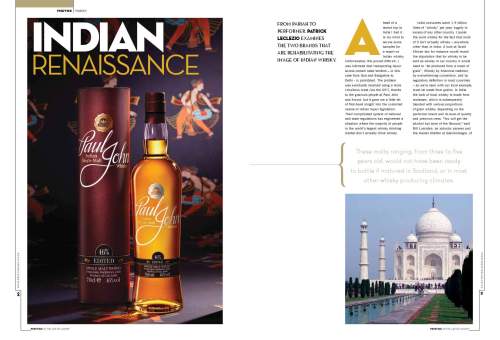
Indian renaissance

From pariah to performer. PATRICK LECLEZIO reviews the two brands that are rehabilitating the reputation of Indian whisky.

First published in Prestige Magazine (February 2016 edition).

Ahead of a recent trip to India I had it in my mind to secure some samples for a report on Indian whisky. Unfortunately this proved difficult; I was informed that transporting liquor across certain state borders – in this case from Goa and Bangalore to Delhi – is prohibited. The problem was eventually resolved using a more circuitous route (via the UK!), thanks to the gracious people at Paul John and Amrut, but the experience gave me a little bit of first-hand insight into the contorted nature of Indian liquor legislation. Their complicated system of national and state regulations has engineered a bizarre situation where the majority of people in the world’s largest whisky drinking market don’t drink whisky, and can’t drink whisky (at a reasonable price).

India consumes some 1.5 billion litres of “whisky” per year, hugely in excess of any other country. The inverted commas however account for the fact that most of it isn’t actually whisky – anywhere other than in India. A glance at South African law for instance would reveal a stipulation that for whisky to be sold as whisky in this country it would need to “be produced from a mash of grain”. Whisky by historical tradition, by overwhelming convention, and by regulatory definition in most countries – as we’re seen with our local example – must be made from grains. In India the bulk of local whisky is made from molasses, which is subsequently blended with various proportions of grain whisky, depending on the particular brand and its level of quality and premium-ness. “You will get the alcohol but none of the flavours,” said Bill Lumsden, an industry pioneer and the master distiller at Glenmorangie, of the molasses spirit in Indian whisky. This is a simplistic analysis of course – there are other concerns, maturation for instance -but it’s sufficient to make the point that Indian whisky by any objective measure is largely substandard. The buttresses that keeps these whiskies afloat, and protected from redress by healthy competition, are the regulations to which I’d earlier alluded, primarily a set of exorbitant tariffs which violate World Trade Organisation rules, and without which that local industry would collapse.

This scenario is bleak for many reasons. It’s costing the country both economically in lost revenue and blunted potential, and socially in that whisky lovers are being deceived and short changed. I don’t think I’m being dramatic in suggesting that this is probably the single biggest issue in the whisky arena today. Negotiations have been ongoing for some time, but I would imagine that the scale of entrenchment makes progress difficult. It might seem like a horse-before-cart, pie-in-the-sky prognosis but things will probably change only if India cultivates quality brands that can stand up to their international peers.

This kind of a solution is some way off for the mainstream, but faint ripples have started to appear. In the Bangalore based Amrut first, and more recently the Goa based Paul John, India has two distilleries producing world class, genuine whisky. This is exciting not only for India – primarily at this stage as an affirmation of their ability to go toe-to-toe with the best – but also for us, for whisky drinkers globally; with their emergence we have access to an exciting, dynamic new style of whisky.

My first experience of Amrut was of the ground-breaking Fusion – arguably the whisky that made its name. A fusion indeed, of Indian grown barley, with Islay peated malt, it is a delightful whisky, explicitly smoky but not overpoweringly so, leaving plenty of space for a plethora of other rich, spicy, fruity flavours. I made the mistake of serving my first bottle some five years ago at my birthday party. It was smacked out of its brief existence in short order, such was the immediate rapport that it struck. This time I intend to savour the new bottle in more fitting tribute to its indisputable merits.

The style of Fusion, and indeed the others that I examined, the Amrut Single Malt, the Paul John Brilliance, and the Paul John Edited, has been cast in the mould of Scotch single malt, with a similar-ish palette of flavours. The critical point of difference is maturation. Both Amrut and Paul John are produced in the oven that is Southern India – resulting in an intense, accelerated ageing process. These malts, ranging from three to five years old, would not have been ready to bottle if matured in Scotland, or in most other whisky producing climates. It’s a benefit and a hindrance though, the bonus of good whisky fast tempered by the unlikelihood (or, dare I say it – impossibility) of turning out anything old and superpremium. Quick to cook, quick to burn (and evaporate!), with a much reduced sweet spot. This though is the distinctive feature which will define Indian whisky as style of its own amongst aficionados.

The Amrut Single Malt and the Paul John Brilliance are solid, quaffable single malts – abundant with the vanilla and honey typical of bourbon casks. Mostly I was surprised by their poise and balance. Surely, I thought, there’s got to be a cost to the speed; but if there is it’s not apparent in these two whiskies. They may not be the fullest and richest, or the most complex, but they’re well-executed and interesting…and well worth exploring. The Paul John Edited, like the Amrut Fusion, is peated, although more lightly peated, but it’s travelled a different and imaginative road to get there. Fusion uses Scottish peated malt, Paul John uses Indian barley malted using Scottish peat. I can’t say that I could ascribe a difference to the influence of each – noting that the peat used may be different too – but it’ll be fun spending some time with both to try to identify it. Regardless, the added dimension introduced by the peating propels this variant from solid to superb, as gentle smoke wisps amongst streaks of chocolate-y sweetness.

If ever a country needed a whisky redemption, there’s no doubt that it is India – because of its diabolical rotgut (I say this relative to what it should be) and because of its importance. In response Amrut and Paul John have delivered and delivered decisively. For the country’s whisky drinkers the road may be long and hard, and the destination uncertain, but the potential is quite conclusively there. Whatever happens it seems that the rest of us can look forward to some fine Indian single malt, and who knows what else, in the years to come. May the dram be with you, and all.

Prestige Feb 2016 Whisky p1

As it appeared – p1.

Prestige Feb 2016 Whisky p2

As it appeared – p2.


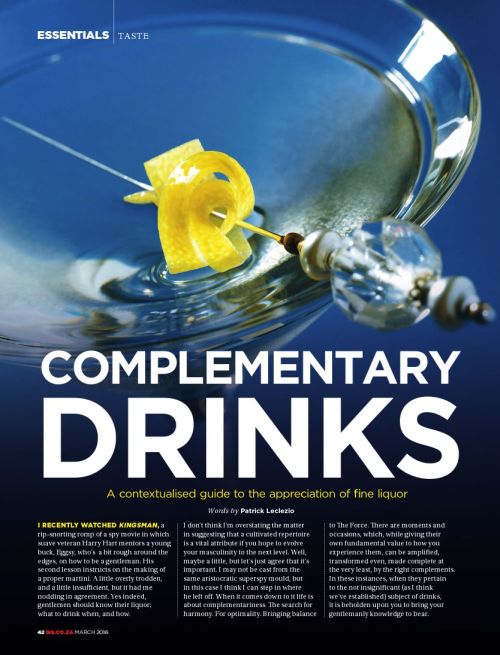
Complementary drinks

A contextualised guide to the appreciation of fine liquor

First published in GQ Magazine (March 2016 edition – South Africa).

I recently watched Kingsman, a rip snorting romp of a spy movie in which suave veteran Harry Hart mentors young buck Eggsy on how to be a gentleman, the latter being a bit rough around the edges. His second lesson instructs on the making of a proper Martini. A little overly-trodden, and a little insufficient, but it had me nodding in agreement – yes indeed, gentlemen should know their liquor. What to drink when, and how. The right juice if you will for the right occasion. I don’t think I’m overstating the matter in suggesting that a cultivated repertoire is a vital attribute if you hope to evolve your masculinity to the next level. Well, maybe a little, but let’s just agree that it’s important. I may not be cast from the same aristocratic superspy mould but in this case I think I can step in where he left off. If you thought then that this was going to be a piece on cadging free booze I have this suggestion (now that I’ve assumed the mantle) for you: a gentleman should also own a dictionary (preferably the dictionary). But that’s just in passing. The matter at hand is drinks, and it is where I’ll make my bid for a small contribution to the lexicon of gentlemanliness.

Complement: “something that completes”, “one of a pair, or one of two things that go together”.

When it comes down to it life is about complementariness. The search for harmony. For optimality. The bringing of balance to the force. There are moments and occasions, which, whilst giving their own fundamental value to how you experience them, can be amplified, transformed even, made complete at the very least, by the right complements. In these instances, when they pertain to the not insignificant (as I think we’ve established) subject of drinks, it is beholden upon you to bring your gentlemanly knowledge to bear.

When: celebrations

What: champagne
An obvious one to start. From victories and Valentines, to birthdays and betrothals, this geographically indicated sparkling wine is synonymous with celebration. The crisp, dry taste – and the tingling mouthfeel, courtesy of its hallmark fine bubbles – of brut champagne is the foundation on which it’s forged its popularity, but, as if often the case with liquor, perception plays almost as much of a role as the liquid itself. The popping of corks, launching of ships, the sabrage method, the champagne towers, and its many other rituals have all impressed this drink on our collective consciousness as something distinctly special.

Try: Veuve Clicquot Rich. I’ve marked many of the milestones in my life with Veuve, and it’s always lived up to expectations, with its superior taste, depth of heritage, and innovative approach. The Maison Veuve Clicquot in Reims too adds to the charm and is well worth the visit. Rich in particular is an accessible, versatile offering which lends itself to personalised drinking. Shake things up by mixing in some cassis for a classic Kir Royale, or by creating your own infusions.

When: landmark celebrations

What: vintage spirits
A vintage bottling refers to liquid that was distilled and put into maturation in a single calendar year – the one denoted on its label. It is individual and variable by design, differing from a distillery’s standard bottlings, which may draw from production spanning various years in order to achieve flavour consistency. As such it captures the essence of one particular year – and what better way to fete an epic birthday or anniversary than by experiencing a little “stolen” taste of that specific period in time.

Try: Balblair vintage highland single malt Scotch whisky. I’ve had the privilege of enjoying their 1983, 1989, 1990 and 2000 vintages, all occupying the zone between delicious and outstanding, and I can reliably say that each is a fitting tribute.

When: summer and sunshine
What: caipirinha
Nothing evokes summer like sand and sea – so it seems fitting to take the lead for the season’s drink from the world’s foremost beach culture. A well-made caipirinha ticks all the boxes: it’s cool and refreshing – the essential attribute of course, it builds further with its complex and interesting flavour (but without being too challenging – that type of effort would only interfere with the fun and relaxation), and it’s strong and pure enough to be taken seriously – fun is great, frivolous is a waste of your gentlemanly time.
Try: Germana cachaça. The prime ingredient in the caipirinha is Brazil’s inimitable (no, it’s not rum) home-grown spirit. This stuff ranges from the cheap and nasty to the aromatic and sublime, with corresponding results for your caipirinha. Germana – a pot-stilled, artisanal cachaça housed in an unmistakeable banana bark wrapped bottle – features within the latter category. One word of caution – easy on the sugar.

When: gala events
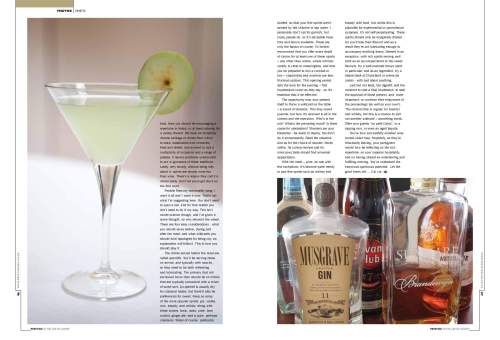
What: martini
Ah, the martini resurfaces, as we always knew it must. Whoever said clothes maketh the man had clearly not yet encountered this most elegant of drinks – or he would have supplied an addendum. Your dress attire simply isn’t complete without the iconic martini stemware dangling languidly from your hand, and conversely a martini will never taste as downright delightful as it does when you’re suited and booted. And should it turn out to be a stuffy affair…well, let’s say that your bases are covered.

Try: Bombay Sapphire. Everyone has their own take on the Martini – here’s mine: Gin, of course, not vodka – it’s so much more interesting; and preferably a soft gin like Bombay. Dry vermouth – it exists for a reason. Noel Coward’s diametrically opposed view is that “a perfect Martini should be made by filling a glass with gin, then waving it in the general direction of Italy”, but how seriously can you take someone who thinks that the vermouth deployed in a martini comes from Italy? Pas du tout, I’m afraid. A ratio of five parts gin to one part vermouth – stirred or swirled, not shaken. Pour into a chilled glass. Garnish with olives or a twist, depending on your mood.

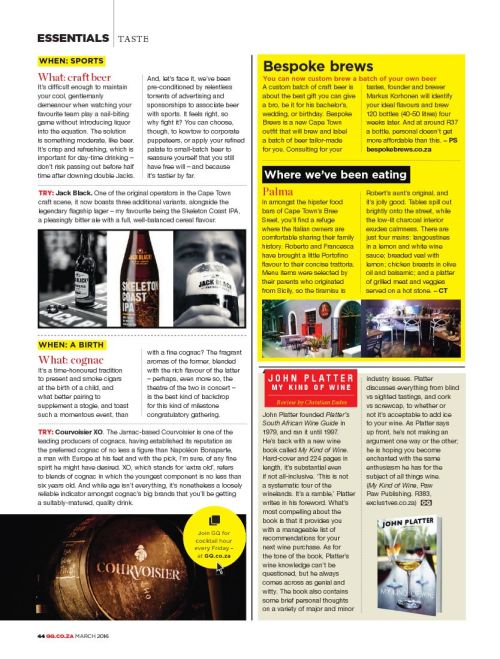
When: sports

What: craft beer
It’s difficult enough to maintain your cool, calm, gentlemanly demeanour when watching your favourite team play a nail-biting game without introducing liquor into the equation. But then again it wouldn’t be half as enjoyable as with a few drinks. The solution is something moderate, like beer. It’s crisp and refreshing, which is important for day-time drinking, it can be deliciously flavoursome, and, let’s face it, we’ve been pre-conditioned by a relentless avalanche of advertising and sponsorship campaigns to associate beer with sports. It feels right, so why fight it? You can choose though to cock a snook at those corporate puppeteers by applying your refined palate to the consumption of small-batch beer – to reassure yourself that you still have free will, and because it’s tastier by far.

Try: Jack Black. One of the original operators in the proliferating Cape Town craft scene, it now boasts the three additional variants, alongside the legendary flagship lager – my favourite being the Skeleton Coast IPA, a pleasingly bitter ale with a full well-balanced cereal flavour. The 440ml format, which seems to be a standard in the category, and the 6.6% ABV employed by Jack Black on the IPA, deliver what I would describe as an ideal per-unit level of satisfaction.

When: a birth

What: cognac
It’s a time honoured tradition, the origins of which are obscured by the mists of time, to present and smoke cigars at the birth of a child, and there’s nothing better suited to supplement a stogie and to toast such a momentous event than a fine cognac. The fragrant aromas of the former, and the rich flavour of the latter, and the theatre of two in concert, cigar between the fingers in one hand, balloon glass filled with smoke in the other, is the best of backdrops for this congratulatory gathering.

Try: Courvoisier XO. The Jarnac-based Couvoisier is one of leading producers of cognacs, having established its reputation as the preferred cognac of no less a figure than Napoleon Bonaparte, a man with Europe at his feet and with the pick I’m sure of any fine spirit he might have desired. XO, which stands for extra old, refers to blends of cognac in which the youngest component is no less than six years old, and whilst age isn’t everything, it’s nonetheless a loosely reliable indicator amongst cognac’s big brands that you’ll be getting a suitably-matured, quality drink.

GQ comp drinks p1

As it appeared – p1.


GQ comp drinks p2

As it appeared – p2

GQ comp drinks p3

As it appeared – p3.


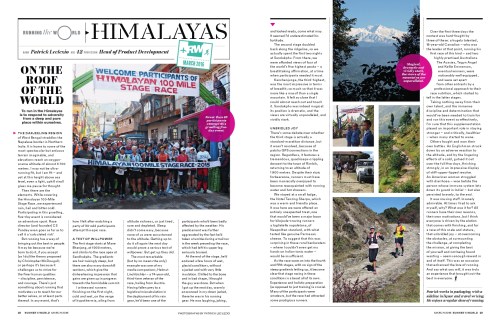
Running on the roof of the world

A tribute to the Himalayan. Patrick Leclezio reports on one of ultra-running’s unique races.

First published in Runner’s World magazine (March 2016 edition – South Africa).

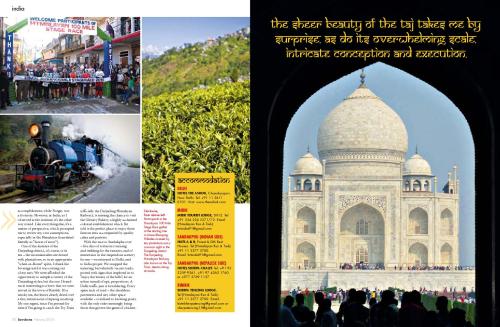
Running brings out the best in people. It may be because we are born to it and that it is our essential state of being, if you accept (as I do) the theory proposed by Christopher McDougall; it may be because it challenges us to strive for many of the finer human qualities – discipline, persistence, and courage; or it may be, perhaps, because it inspires us to respond to adversity from a deep and pure place within ourselves. There’s just something about running that motivates us to reach for our better selves, or at least parts thereof. Now I don’t claim that this observation will stand up to any kind of scientific scrutiny, but it’s how I felt recently after watching a party of some thirty odd participants attempt the epic Himalayan 100-Mile Stage Race. I bore witness to a group of runners doing some amazing things.

The Himalayan takes place over five gruelling days covering some of the most spectacular, but arduous, terrain imaginable. Run in the Darjeeling region of West Bengal in Northern India, it is as idiomatically far removed from a cup of the local produce as you could possibly fear to expect (and fear you should, at least somewhat). The race straddles the Nepalese border for much of its course, covering some ridiculous elevations, and reaches an oxygen-scarce altitude of almost 3700 metres. I may not be ultra-running fit, but I am fit – yet at this height above sea level even a light uphill stroll gave me pause for thought. Throw in the elements – we experienced rain, hail and bitter cold – and it became clear why this type of running is considered an adventure sport, and why this race is touted to be India’s premier adventure event. As I found the Race Director (and founder), the inimitable and voluble C. S. Pandey, to be fond of saying: an adventure is a “calculated risk”, and indeed the Himalayan delivered its fair share of uncertainty, on this its 25th anniversary as I’m guessing it did in previous years, for many if not most of the competitors.

The first stage sets out from Mane Bhanjang at some 1900m and climbs to the race apex at Sandhakphu, delivering gradients of hair-raising steepness during its course, uphill naturally, but also downhill – prompting I’m sure the disheartening sense of gains being given up in the progress towards this formidable summit. As a runner finishing in the cold and wet, on the verge of hypothermia, or ailing from altitude sickness, or just tired, sore and depleted, that first night, with sleep at such an unaccustomed altitude difficult, the thought of getting up to do it all over again the next day would have been a serious test of will. Yet get up they did, to a man (and woman, as the case had been).

The most, but by no means the only, remarkable example, was one my media companions, Helmut Linchbichler of Austria, a 74 year old, third-time Himalayan veteran. He’d been one of those badly affected by the weather, prey to a logistical miscalculation in the deployment of his rain gear. His predicament had been further aggravated when he’d taken a tumble during a trail run in the week preceding the race, leaving his upper leg badly bruised. On arrival at the finish he was chilled to the bone and looked in bad shape. 25 miles of torture. Wet, glacial conditions. No jacket and little insulation. 74! This guy was done…or so I had thought. But when I got up the next day, warmly ensconced in my down jacket, there he improbably was, in his running gear, smiling and joking, looking ready for come what may. I had clearly underestimated the fortitude of the man, of the running mindset, and of the Himalayan spirit.

The first two nights, with the second stage doubling back on itself along the ridge line, were spent at the summit at Sandakphu, where we were afforded the opportunity to sight four of the world’s five highest peaks – a breathtaking, affirming experience, when the participants would have needed it most. Kangchenjunga in particular, the third highest, and the most impressive in terms of breadth, more a massif than a single mountain, is so close that you can almost reach out and touch it. The place is both magically beautiful, its position dramatic, its views unparalleled (virtually), and vividly stark, the accommodation spartan, the comforts few. It is the perfect backdrop to test yourself in and against the majesty of nature.

The third stage also happened to be a marathon, the 263rd (!) for one of the runners – RAF retiree David Green, although there was some debate over whether it was standard or not, never resolved because of the patchy GPS connections in the region. Regardless, it featured a tremendous, quadriceps-crippling descent to the town of Rimbik, a return to approximately 1900m, where if I was delighted then the runners, despite their stoic forbearance, must have been maniacally overjoyed, to become reacquainted with running water and hot showers. Our little lodge (Hotel Tenzing Sherpa), made excellent by the earlier deprivations, but a warm and friendly place of its own accord, also offered another, entirely unexpected treat, which would have been a major boon for the calorie-craving runners: a tagliatelle napoletana of Neapolitan standard (poetic licence, apologies), with what tasted like genuine parmesan cheese. To suggest that this was surprising in these rural backwaters – where I couldn’t even get my hands on Indian tonic water – would be entirely insufficient.

As the race wore on into the fourth and fifth stages, with any significant flat stretch of track still to be taken into evidence (did I say gruelling?), it gradually started to become clear that stage racing is a beast all of its own. Experience and holistic preparation (as opposed to just training) would be crucial. The Himalayan is more about participation than competition – something that would have been apparent to any bystander from the camaraderie that prevailed throughout. To underscore the point the 2015 participants were each amateurs. All the same it is a race and it had attracted some prodigious runners. Over the first three days the contest was hard-fought by three of these – a hugely talented, 18 year-old Canadian, the leader at that point, running his first race of the kind, and two highly practiced Australians. The Aussies, Tegyn Angel and Kellie Emmerson, eventual winners, were noticeably well equipped, and were set apart by a professional approach to their race nutrition, which started to tell in the latter stages. The aid stations provided small oases of respite and nourishment, but their fare of bananas, potatoes, biscuits and water wasn’t enough for peak performance. Taking nothing away from their own talent, and the immense discipline and determination that would have been needed to train for and run this event so effectively, I’m sure nevertheless that this supplementation played an important role in staying stronger, and, critically, healthier, when many started to wane.

Others too fought and won their own battles. An Englishman struck down by an adverse reaction to the altitude and by the lingering effects of a cold gutsed it out over the full five days and finished strongly, in an impressive display of stiff-upper-lipped resolve. An American woman struggled with diarrhoea – woe betide the person whose immune system lets down its guard in India! – but also persisted bravely, to the end. It was rousing stuff. Insanely admirable. At times I had to ask myself why. What was it for? All runners have their own reasons, their own motivations, but I think everyone is driven by the elation that comes with finishing, and, for a race of this scale and stature, that unbridled joy – at overcoming the obstacles, at surmounting the challenge, at completing the mission, at giving the best of yourself and not being found wanting – seemed enough reward in and of itself. It was an occasion that enhanced the lore of running. And, say what you will, scrutiny or no scrutiny, it was truly an experience that brought out the best.

RW RUN THE WORLD MAR16

As it appeared.

India from the top

From Delhi to the Himalayas and back again. Patrick Leclezio recounts the highlights of a journey through northern India.

First published in Sawubona magazine (February 2016 edition).

No view can compare to the view from the roof of the world. I’m completely certain then that for as long as I live I’ll see few sights to rival a sunrise over Sandakphu. It’s difficult to describe the extent of its impact. The unfolding of it was so spectacular, its searing magnificence so pronounced, that the experience, spiritual if ever there was one – and if you’ll humour such an overused and underappreciated expression, will remain with me forever. If you’re lucky a trip will be defined by a staggering moment, that on its own justifies (and amplifies) the time, the expense and the effort. Standing there on that mountain, amidst a jumble of emotions, that was my sense of things. I felt completely fulfilled. Sated. I had the powerful realisation that – wow! – I didn’t need anything more.

The journey to Sandakphu, located on the Singalila Ridge in the Darjeeling district on the Indian border with Nepal, is long and progressively arduous: starting with a long haul flight to Delhi, then onto the lottery of Indian air travel with a domestic leg to Bagdogra, followed by an initially chaotic, later winding and precipitous road transfer to Mirik (in my case) and then Mane Bhanjang, and ending with a bone-jarring, at times hair-raising, ride to the 3700m summit in ancient, bald-tyred Land Rovers. The final stage is hiked over a few days by many visitors to the area, or, as was the case with the party I was accompanying, an audacious few, the participants of the Himalayan 100 Mile Stage Race, it can be run. The result is the same, give or take a few doses of exhaustion. You find yourself off the grid – no running water, no plumbing, no mobile phone signal, and if that’s off-putting then it’s your loss – in a rustic place that it would be trite to describe as beautiful. It was overcast when I arrived: grey velvet draped over a dramatic landscape, primed for a grand reveal. We were up at 04h30 the next day, ready for the show, anticipation now properly heightened. And then there it was. When the sun rose shortly thereafter, it gradually illuminated four of the world’s five highest peaks. Everest of course, iconic, clustered with Lhotse and Makalu, but at a distance. The most impressive – huge, dwarfing the others from our point-blank perspective – was the broad Kangchenjunga massif, culminating in the world’s third highest peak. Its presence was so imposing that I felt it more than I saw it. I had no doubt that I had experienced something profound.

The experience of the Himalayas proved central to my enjoyment of India. The prime objective of travel is to experience new places and new cultures, but the real reward comes from stepping outside of yourself and of your fixed views and habits, and of experiencing their reality through the eyes of the locals, or even of your fellow travellers. I was prompted with this “insight” whilst visiting the fascinating Himalayan Mountain Institute in Darjeeling early in the trip. Everest was first summited by Edmund Hillary and Tenzing Norgay in 1953. When I was growing up, learning history, Hillary was the central figure in the accomplishment, whilst Norgay was a footnote. In India, as I remarked at the Institute, those roles are reversed.  A matter of perspective. It reminded me to review my own preconceptions – which made the trip, especially the parts of it in the Himalayan region, literally translated as “house of snow”, considerably more enriching.

One of the features of the Darjeeling district  is of course its tea – the mountainsides are dotted with plantations – so in a when-in-Rome spirit I drank tea until it was coming out of my ears. We were afforded the opportunity to sample a variety of the Darjeeling styles but the one I found most interesting was a brew that we were served in the town of Rimbik – a smoky variety, the leaves clearly dried over a fire, reminiscent of lapsang souchong. My one regret, being pressed for time to make the departure of the Toy Train (officially the Darjeeling Himalayan Railway), was missing the chance to visit the Glenary Bakery, a highly reputed old colonial establishment which I’m told is the perfect place to enjoy these famous teas accompanied with some quality cakes and pastries.

With the race finished – five days of what seemed like torturous running and trekking for the participants, five days spent drinking deep of the stupendous scenery for me – we returned to Delhi, and to India proper. We would swap the teetering but relatively vacant roads, posted with signs imploring you to “enjoy the beauty of hills”, for an urban tumult of epic proportions. A Delhi traffic jam is bewildering. Every spare inch of road, the shoulders, the pavements and whatever other space is available, is utilised to bursting point, with the only rules seemingly being the same ones that govern the game of chicken. The city’s highlights for sightseeing include the Minaret, a structure that marks the onset of Muslim rule in the area, India Gate, the massive Arc de Triomphe style monument to the unknown soldier, surrounded by festive (during the weekend) parks, its many bazaars, which are overwhelmingly crowded, and the Gandhi Monument – at which I found it particularly interesting to tour the perimeter, where trees have been planted by representatives from countries around the world in tribute to this great leader, whilst everyone else was focused on the eternal flame at the centre.

A trip to India would not be complete without visiting its most celebrated structure – the Taj Mahal. I can’t say that I’m a connoisseur of architecture , but I’ve travelled Europe extensively and I’ve visited some of its most impressive historical structures, from the Colosseum and the Tower of London to Notre Dame and St. Peter’s Cathedral, and whilst I wouldn’t say that I’m blasé about it all I thought I’d be inured to more of the same. The impression that the Taj made on me though took me by surprise. It stands apart because of its simple, stunning beauty – both in conception and execution. The former is particularly meaningful. The significant buildings of human history are dedicated almost exclusively to the display of military, political or religious power, whereas the Taj is a memorial to love – the tribute of a king to his dead wife. Located some two hours (they say – in reality longer) south of Delhi, in Agra, a typically messy Indian town of haphazard construction, wandering livestock, and dense population, its pristine, shimmering white form in contrast eventually appears through the haze like a mirage in a desert. I was particularly taken with the impermeable white marble with which it was built, its feel and texture being as impressive as its appearance. It’s with no small reason that the Taj has become one of the most recognisable structures in the world.

India is a jewel of incomparable value and beauty, sometimes rough and unpolished, sometimes cast aside unknowingly. It’s worth taking the time to pick it up, clean it off and look at it with unencumbered appreciation. You get the feeling here that your experiences are often earned rather than just accessed or bought. And once earned it’s the type of place that rewards you tenfold. Bon voyage!

Travel tips

Cuisine: Their curries are legendary, vegetarians in particular will rejoice, but less well widely celebrated are the Indian desserts. I highly recommend the yoghurt based Shree Khand, a two thousand year old dish that has stood the test of time.

Airports: You’ll be required to show some proof of your ticket before being granted access to an Indian airport, which can take you unawares in this electronic age. Have a printout ready.

Yes or no?: Indians will shake their heads to signal an affirmative response, the opposite meaning to the rest of the world.

Lunch in Delhi: Escape the frantic bustle of the city with lunch at Lutyen’s Cocktail bar, one of Delhi’s hottest new eateries. Its colonial décor is a quaint throwback to the British Raj period, but more importantly – for me at least – is its wide range of imported beers, which provides a welcome respite from the diabolical (!) Indian fare.

Himalayas Sawubona 1

As it appeared – p1.

Himalayas Sawubona 2

As it appeared – p2.

Himalayas Sawubona 3

As it appeared – p3.


Rocking the repertoire

Entertaining with spirits.  A rough guide by Patrick Leclezio.

First published in Prestige Magazine (December 2015 edition).

Prestige Spirits Dec 2015 p1

As it appeared – p1.

Prestige Spirits Dec 2015 p2

As it appeared – p2.

So you’re hosting a dinner and you’re fussing over the wine. Chenin with the fish. Or maybe a Chardonnay. And then a robust Shiraz with the fillet. Cool, sorted. Well, no, not really. Don’t feel bad though. This is a trap into which you’re easily ensnared. It’s become bizarrely commonplace to spend time and effort (and money!) selecting great wines for our guests, whilst then at the same time absentmindedly relying on whatever happens to be around, or perhaps just grabbing a six-pack or two, for the balance of the beverages. I’ve lost count of the occasions during which I’ve been disappointed by an absence of whisky, or gin, or been elated to find some gin, only to be told that there’s no tonic (vermouth – forget it!)…and that’s without even delving into the less popular drinks. There’s clearly something wrong with this picture.

And that’s that it doesn’t make sense. It is illogical, for three reasons. Firstly, the time spent eating is actually in the minority. That’s not to say that you can’t enjoy wine before or after the meal – but there are so many spirits out there that are considerably more interesting for the purpose. It brooks no argument that more attention can and should be devoted to making your guests happier during the larger part of their time with you. Secondly, if you harbour ambitions as a good host, a complete and cultivated host, then you should be encouraging a repertoire in tastes, or at least catering for a variety thereof. We have an incredibly diverse heritage of drinks from which to draw, established over centuries, tried and tested, and evolved to suit a multiplicity of occasions and a range of palates. It seems positively uneducated to act in ignorance of these traditions. Lastly, very simply, without being silly about it, spirits are simply more fun than wine. There’s a reason they call it a dinner party. Don’t let yours get stuck on the first word.

Freddie Mercury memorably sang: I want it all and I want it now. That’s not what I’m suggesting here. You don’t need to open a bar. And for that matter you don’t need to do it my way. This isn’t rocket science though, and I’ve given it some thought, so why reinvent the wheel. There are four easy considerations: what you should serve before, during and after the meal, and what wildcards you should hold (apologies for being coy, an explanation will follow). This is how you should play it.

The drinks served before the meal are called aperitifs. You’ll be serving these on arrival, and typically with snacks, so they need to be both refreshing and lubricating. The primary (but not exclusive) focus then should be on drinks that are typically consumed with a mixer of some sort. An aperitif is usually dry for classical tastes, but there’ll also be preferences for sweet. Keep an array of the more popular spirits: gin, vodka, rum, brandy, and whisky, along with these mixers: tonic, soda, coke, lime cordial, ginger ale, and a juice, perhaps cranberry. Water of course, preferably bottled, so that your fine spirits aren’t tainted by the chlorine in tap water. I personally don’t opt for garnish, but many people do, so it’s advisable have lime and lemon available. These are only the basics of course. I’d further recommend that you offer some depth of choice for at least one of these spirits – any other than vodka, where intrinsic variety is close to meaningless, and that you be prepared to mix a cocktail or two – caipirinhas and martinis are less frivolous options. This opening period sets the tone for the evening – first impressions count as they say – so it’s essential that it be effective.

The opportunity may now present itself to throw a wildcard on the table – a round of shooters. This may sound juvenile, but how it’s received is all in the context and the execution. Who’s in the mix? What’s the prevailing mood? Is there cause for celebration? Shooters are your firestarter – be ready to deploy, but don’t do it unnecessarily. Read the situation. And as for the choice of shooter: frozen vodka. Its curious texture and its innocuous taste should find universal appreciation.

With the meal – wine, as rule with few exceptions. It’s become quite trendy to pair fine spirits such as whisky and brandy with food, but whilst this is plausible for experimental or promotional purposes, it’s not self-perpetuating. These spirits should only be marginally diluted (or you’ll lose their flavour) and as a result they’re not lubricating enough to accompany anything heavy. Dessert is an exception, with rich spirits serving well both as an accompaniment to the sweet flavours; try a well-matured brown spirit in particular, and as an ingredient, try a liberal dash of Chambord or crème de cassis – with just about anything.

Last but not least, the digestif, and the moment to cast a final impression, to seal the approval of those present, and, more importantly, to continue their enjoyment of the proceedings (as well as your own!). The obvious fare is cognac (or brandy) and whisky, but this is a chance to pull out another wildcard – something exotic. Offer your guests “un petit Calva”, or a sipping rum, or even an aged tequila.

You’ve now successfully avoided the wine tunnel-vision trap. Hopefully, as they’re reluctantly leaving, your partygoers would now be reflecting on the rich repertoire, on your superior hospitality, and on having shared an entertaining and fulfilling evening. You’ve unleashed the enormous spirituous potential. Let the good times roll. Chin chin.

From one whisky to another

Painting the town a golden amber. Patrick Leclezio looks back at 2015’s whisky calendar.

First published in Prestige Magazine (December 2015 edition).

Prestige Whisky Dec 2015 p1

As it appeared – p1 (except with whisky spelling corrected).

Prestige Whisky Dec 2015 p2

As it appeared – p2.

It’s been another lively period on the scene. Year-in year-out South Africa offers a wide variety of interesting diversions to the whisky devotee, from festivals and shows, to dinners and launches, with fanciful and sometimes extravagant events in between. We are one of the world’s largest (and still growing) markets for Scotch whisky. This pretty much ensures a continuous cycle of activity. There’s little I enjoy more than drinking whisky, but one of those things is drinking whisky with other people who enjoy little more than drinking whisky. If you’re one of those then it’s worth keeping your eyes and ears open, and staying abreast of the possibilities. These were the highlights from 2015. May the dram be with you.

The Wade Bales Wine & Whisky Affair

This is one of my not-to-be-missed favourites. I’m almost never ill, but in 2013 I managed to contract a 24-hour virus concurrent to this event, and I was absent as a consequence. The regret still hangs over me like a pall. Its eponymous founder is a wine specialist, but he’s fluently extended the “affair” into whisky, and he gives it enough focus for the result to be meaningful. It is an outstanding show in every respect: well-catered, I particularly enjoy the enormous parmesan wheel which makes an annual appearance (I hope I’m not jinxing it), relaxed and elegant, it draws a fun-loving but refined crowd, and diverse, the association with wine is natural, beneficial, and convenient, giving you the rare advantage most especially to attend with friends who may not particularly like whisky (yes, there are such people, unlikely as it may seem). I love the ambiance of the occasion – it affords the opportunity to engage, with the various whiskies’ representatives, and with other whisky lovers, without having to battle a crowd.

Checkers single casks

Earlier this year the retail juggernaut launched the latest batch in its series of single cask whiskies. Single casks, as the name implies, are single malts drawn from a single cask. One style, one source, one cask – they epitomise the romance of whisky. With each expression limited to no more than some 600 bottles, the Checkers range represent a golden (and in SA virtually unique) opportunity to sample a small share of fleeting whisky uniqueness. I had a few reservations about some of the previous offerings but these latest few variants are a step ahead, mostly sourced directly from the distillery owners, which is a good indication both of quality and of the group’s expanding influence in the industry. Expect more in the years to come.

Three Ships PX finish

It’s been an open secret for some time that Three Ships (and Bain’s) Master Distiller Andy Watts has been busily cultivating some extra special whiskies. This year, prompted by a Twitter campaign – #DistellAreYouListening – orchestrated by blogger Mark Hughes and whisky luminary Marsh Middleton, distillery owner Distell duly stepped up and decided to release one of these onto the market. We were witness thus to a shot across the bows of whisky’s big boys (ok, maybe not quite that dramatic) with the launch of the heraldic Three Ships single cask PX finish – a vatting of Three Ships whiskies finished in a single Pedro Ximenez sherry cask. The whisky is deliciously well crafted of course, but, more importantly, it signals the advent of a brave new era in South African whisky-making.

Whisky Live

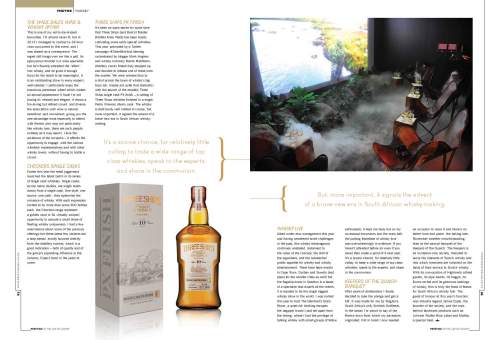
Albeit under new management this year, and having weathered some challenges in the past this whisky extravaganza continues unabated, testament to the value of the concept, the skill of the organisers, and the substantial public appetite for whisky and whisky entertainment. There have been events in Cape Town, Durban and Soweto (and plans for the smaller cities as well) but the flagship event in Sandton is a beast of a spectacle that dwarfs all the others; it is reputed to be the single biggest whisky show in the world. I was invited this year to host The Glenlivet’s Dram Room, a quiet-ish (nothing escapes the bagpipe music!) pod set apart from the throng, where I had the privilege of talking whisky with small groups of fellow enthusiasts. It kept me busy but on my occasional excursions into the main hall the pulsing heartbeat of whisky love was overwhelmingly in evidence. If you haven’t attended before (or even if you have) then make a point of it next year. It’s a scarce chance, for relatively little outlay, to taste a wide range of top class whiskies, speak to the experts, and share in the communion.

Keepers of the Quaich banquet

After years of deliberation I finally decided to take the plunge and get a kilt. It was made for me by Staghorn, South Africa’s only Scottish Outfitters, in the tartan I’m proud to say of the Breton town from which my ancestors originated. Kilt in hand I now needed an occasion to wear it, and there’s no better time and place, the baking late-November weather notwithstanding, than at the annual banquet of the Keepers of the Quaich. The Keepers is an invitation-only society, intended to serve the interests of Scotch whisky, and into which members are inducted on the basis of their service to Scotch whisky. With its convocation of Highlands attired guests, its pipe bands, its haggis, its Burns recital and its generous lashings of whisky, this is truly the feast of feasts for South Africa’s whisky folk. The guest of honour at this year’s function was industry legend James Espey, the founder of the society, and the man behind landmark products such as Johnnie Walker Blue Label and Malibu, a special treat.

The spirit of the game

A world cup is inevitably a time of reflection about how we approach our rugby.   Following this last iteration Patrick Leclezio prescribes how to get the most from your viewing.

First published in Prestige Magazine (November 2015 edition).

As it appeared - p1.

As it appeared – p1.

As it appeared - p2.

As it appeared – p2.

I lost the plot during that fateful 2011 quarter-final. As in berserk. At the special viewing arranged for us by the hotel at which I was staying in Mauritius, attended by me and two Brits, I conducted myself in less than ambassadorial fashion. We lost both the game and a couple of potential tourists on that day. Reflecting on it now, I needed fortification. I needed the pleasantly tranquilising effect of a stiff drink. I don’t drink before 11am as a rule, so the time zones conspired against me on that occasion. This time I didn’t make the same mistake. The combination of rugby and liquor (enjoyed responsibly people…), apart from being a time honoured tradition, presents you, me and all bibulous fans with a win-win scenario. The highs are higher – oh that victory buzz! – and the lows are higher – the pain of defeat is cushioned in a warm haze. This year I set out to do it properly. I came up with a spirit pairing for some of the leading teams, so that I could enjoy the drink, the rugby, and a little slice of each country’s culture, all at the same time. It’s the ultimate rugby viewing template – for World Cups and for between World Cups. In the future, regardless of how we fare, I’m confident of some great memories, and being able to look back on tournaments and matches savoured to the fullest. Join me on my journey.

Argentina
There’s a bizarre category of drinks known as bitters, and, whilst the constituent products differ substantially one from another they’re typically a witch’s brew of herbaceous ingredients. One of the world’s best-selling bitters is Fernet Branca, for which the brand largely has Argentina to thank. The Argies love this stuff, knocking back millions of litres per year – with coke or soda, or neat as a digestif. These guys are a bit dodgy with their application of the laws – give them a clueless French referee and they’ll make hay till the final whistle blows – but one has to admire how their game has progressed, and the passion with which they play it. When they started bawling during the singing of their national anthem I was raising my glass of Fernet Branca to the West in salute.

Australia
“ I’ll have a Bundy mate”. Well, not exactly. I did want to make the effort for our Aussie cousins, and the fortuitous absence over here of their mainstay – the infamous Bundaberg Rum – greased this wheel for me. I’m not averse to the mix-with-coke variety of rum to which Bundaberg belongs, but I’d much rather partake of something a bit finer. So I joined them in rum-drinking rugby kinship with a few fingers of Ron Zacapa, the sugar-cane honey derived, high-altitude matured, petate-attired Guatemalan favourite. Now I just need to learn to sing Waltzing Matilda in Spanish…

England
After those feet in ancient times walked upon England’s mountains green they would have been grateful I’m sure for a cool, tall glass of Pimm’s – maybe on a pleasant pasture – to refresh and restore. There is no more quintessentially English drink. Garnished with strawberries to colour match the red rose on an England jersey, and entwined as it is with a setting of green English turf, it is an all-appropriate accompaniment to that country’s rugby endeavours.

France
French rugby is a bit hit and miss, much like the drink I’m advising for watching their matches. Pastis, an anise-flavoured (specifically using star anise as an ingredient), unmistakeably Mediterranean spirit, is one of France’s most popular drinks, particular in the south of the country – corresponding loosely (more east than west) to the area where rugby also predominates. It’s a cliché of French rugby that they either pitch up or they don’t. Similarly you either like the polarising anise flavour or you don’t. There’s limited choice in SA but Ricard pastis, bedrock of the eponymous liquor giant Pernod Ricard, is generally available in local stores. It’s usually mixed with chilled water and ice, resulting in an iconically cloudy, superbly refreshing liquid – best enjoyed whilst watching French rugby…or at a street-side café in Marseille.

Ireland
The most underrated style of whiskey, like its perennially underrated team, comes from Ireland. Single pot still is Ireland’s traditional style, a full bodied whiskey made from both malted and unmalted barley that inexplicably lost popularity at one time, but that’s now back with a test-match winning intensity. I recommend answering Ireland’s call with Green Spot, an orchard-in-a-bottle exponent that’ll transform your rugby viewing into a total sensory experience. It’s a great reason to catch as many of Ireland’s games as possible. The colour correspondence by the way is completely coincidental, but surprisingly pleasing nonetheless.

South Africa
Our flagbearing sports team and our signature spirit – it’s a union ordained by the sporting and spirituous gods. Rugby in this country is synonymous with brandy, particularly blended brandy, so I’ll signal my support accordingly – with one of the best blended brandies that I’ve yet had the opportunity to taste: the Carel Nel 15YO from Boplaas. Let’s hope we’ll be drinking it in more frequently victorious circumstances in the future.

A map to nowhere

The malt whisky regions.  Patrick Leclezio disputes the validity of some deeply held Scotch whisky dogma.

First published in Prestige Magazine (November 2015 edition).

As it appeared - p1.

As it appeared – p1.

As it appeared - p2.

As it appeared – p2.

In my last column I pondered the influence of stories – with their inherent ability to capture our attention – in the appeal and the success of single malt whisky. This phenomenon can be observed in the efforts of Scotch whisky to subtly propagate the romantic notion of terroir. We have been led to believe that single malts differ one from another partly because of the influence of the ground on which they stand – a premise that has specifically found voice in the classification of malts by geographic region, both officially and unofficially. The reasoning on which this is based is that whiskies from the same region, having been forged in similar environments, using similar ingredients, and stemming from the same traditions, share commonalities in style. The designation is considered of sufficient importance by the industry that it is typically printed on the label, second in prominence only to the name of whisky. In reality though the extent of its relevance to the average malt whisky drinker warrants some exploration.

There are five official Scotch whisky regions, as prescribed by the Scotch Whisky Association, the industry’s governing body: the Lowlands, Islay, Cambeltown, the Highlands, and Speyside – the latter being geographically within the Highlands, but of sufficient distinction and of such abundance as to justify its own separate identity. In this regions paradigm particular styles and flavours are ascribed to each region, some more persistently manifest than others.

Speyside: In very broad terms the better known malts from the region have become known for flavours evoking heather, flowers, fruits and spices. They’re sometimes lightly peated, but usually not. This is the cultural hub of Scotch whisky – and consequently the impression of a Speysider is one of elegance and refinement. The embodiment of its whisky, or rather this idea of a Speyside whisky, is Longmorn – the drinking of which invokes, for me at least, the strudel scene from Inglourious Basterds. Yes, it’s that delicious.

Highlands: The Highlands is so vast and so sparse that it’s difficult even theoretically to conceive of the evolution of a unified style. There’s salt and peat, think Talisker, a rich overflow from Speyside in whiskies like Glengoyne and Dalmore, and spices, heather and grass here and there. They can be light (Glenmorangie), waxy (Clynelish), rich (Macallan), smoky (Ardmore) or nutty (the recent Wolfburn). Even close neighbours can be poles apart, consider Highland Park and Scapa for instance The range is so broad, touching on just about everything on the Scotch palette, as to render the Highlands meaningless as a flavour denoting region.

Campbeltown: The whiskies here are known for being smoky, oily, and briny – they’re seafaring whiskies. The peninsula is the smallest of the regions, and whilst it once flourished only three active distilleries now feature, the most well-known of which is the outstanding Springbank – which produces three different brands of whisky. I’m relatively familiar with the Springbank range, the 10YO in particular – and whilst it’s often difficult to distinguish one type of peating from another, Springbank’s has a maritime fog quality to it, if I can put it that way, that you don’t find in others. Then again perhaps I’m just falling prey to the story…

Islay: This famous, dare I say legendary, west coast island builds the strongest case for classification by regions. It has forged its reputation on the influence of peat, specifically the local peat which is redolent of medicinal seaweed – giving rise to robust whiskies with phenolic, pungent, smoky flavours. This regional character is consistent(-ish) and unmistakable. Its most highly peated exponent, with a standard peating level of 55ppm – enough to register on the Richter scale – is Ardbeg. I particularly recommend the Uigeadail (if you can get it), a variant where this powerful peat component, whilst no less evident, has been beautifully balanced with some judicious sherry cask maturation, resulting in a magnificently layered, complex whisky that flits between hard flint and sweet velvet. Even here on Islay though there are reasons to question the model, with Bunnahabhain and Bruichladdich producing unpeated (or lightly peated) contrarian whiskies.

Lowlands: These malts are generally light, soft and floral, and, with notes of cereal and zest. The fresh and sweet Glenkinchie, from Diageo’s Classic Malts collection, is arguably the most recognised.
This classification gives a certain poetic order to the malt universe but the supposed kinship is less than consistent. There is no pure terroir in whisky, as it would be understood in wine, except in the contribution of peat, and even there, as I’ve mentioned, it takes some distinguishing one from the other. Water is a ruse, its individuality is not even vaguely apparent. There are other direct factors – such as still shape and maturation – which play a far greater role in dictating flavour, and these are independent of region. Indirect factors, such as the traditional regional adherence to a style, still play a role but this has somewhat meandered, dissipated and migrated with time.

So then, whilst whisky regions are a quaint concept, they have limited merit and should be considered a loose guide (at best!) rather than a fixed rule. Individual whiskies can and do vary significantly within regions, even the most harmonised regions. It can be comforting to the novice to have a gateway into the initially baffling array of malt whisky choices, but I’d suggest that this one is largely a false comfort. Next time you see Highland Single Malt Scotch Whisky on a bottle don’t assume that it necessarily bears resemblance to that other Highlands whisky that you like so much. Explore, experiment, and enjoy, by all means, but do so on the counsel of other reasoning. May the dram be with you.

The song of the single cask

How bias governs the malt universe, and why it doesn’t matter. Patrick Leclezio runs the rule over blended malts, single malts, vintages and single casks.

First published in Prestige Magazine (August 2015 edition).

As it appeared p1.

As it appeared p2.

As it appeared p2.

With whisky there is the spirit and then there is the story. And make no mistake the story is important. In his bestselling book on cognitive biases: “The Art of Thinking Clearly”, Rolf Dobelli explains that people have an innate need to seek the meaning in or the understanding of a thing through the vehicle of a story – something he calls the ‘story bias’. A narrative – a suggested meaning – that may be irrelevant or inconsequential to the underlying matter, such as the concept of single malt is to the actual, real quality of the whisky for instance, can nonetheless be found to be irresistible and compelling. Whisky lovers, as much as we’d want to deny it, are not immune to this logical lapse – but whether it’s a problem in this sphere, ignoring the ostensible exploitation of pricing by producers, is less evident. I’ve always found that even if certain factors don’t affect the liquid they may well indirectly influence a person’s perception of the liquid. This is whisky after all, not the Matrix – we’re not being deceived so much as inspired.

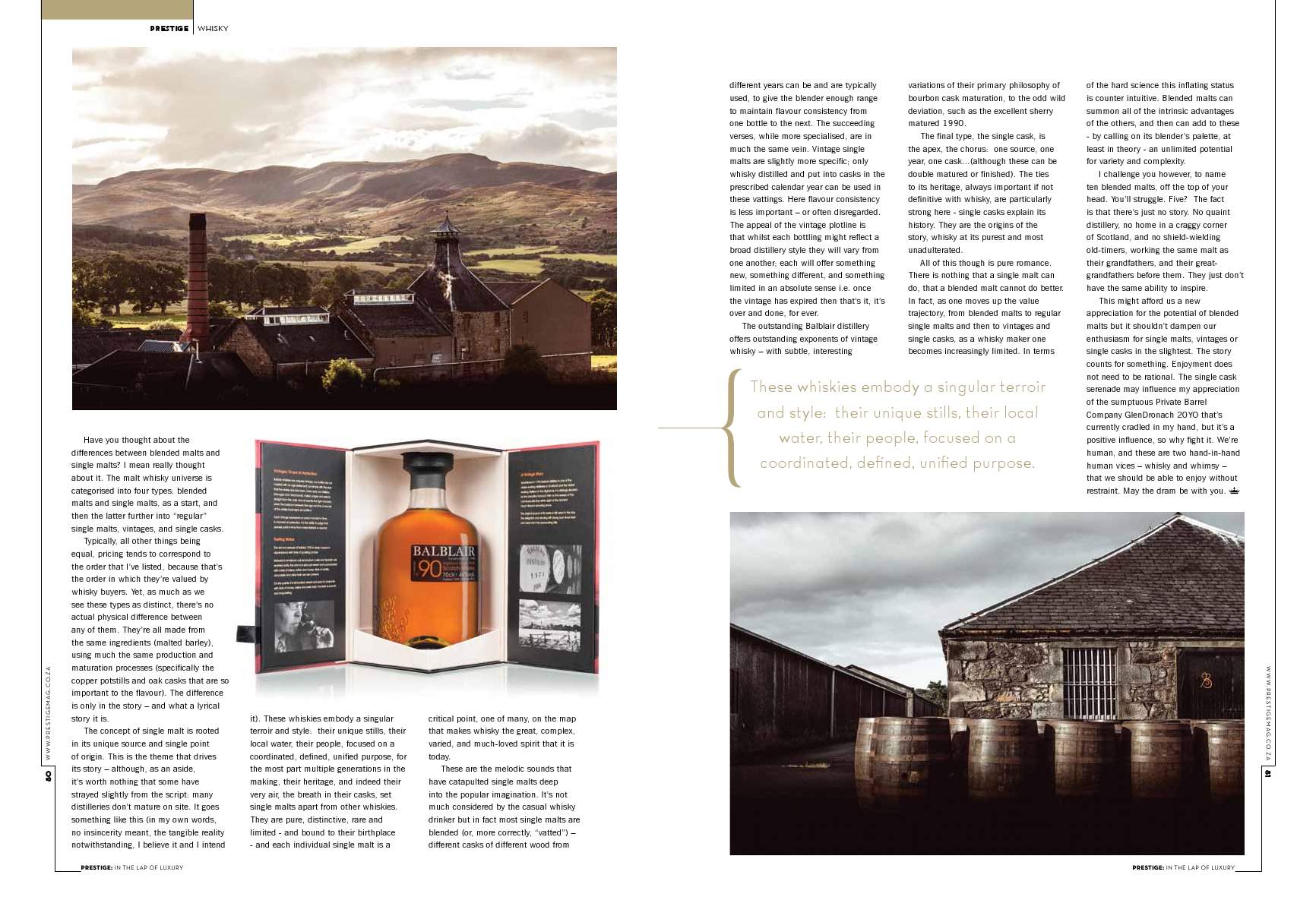
Have you thought about the differences between blended malts and single malts? I mean really thought about it. The malt whisky universe is categorised into four types: blended malts and single malts, as a start, and then the latter further into “regular” single malts, vintages, and single casks. Typically, all other things being equal, pricing tends to correspond to the order that I’ve listed, because that’s the order in which they’re valued by whisky buyers. Yet, as much as we see these types as distinct, there’s no actual physical difference between any of them. They’re all made from the same ingredients (malted barley), using much the same production and maturation processes (specifically the copper potstills and oak casks that are so important to the flavour). The difference is only in the story – and what a lyrical story it is.

The concept of single malt is rooted in its unique source and single point of origin. This is the theme that drives its story – although, as an aside, it’s worth nothing that some have strayed slightly from the script: many distilleries don’t mature on site. It goes something like this (in my own words, no insincerity meant, the tangible reality notwithstanding, I believe it and I intend it). These whiskies embody a singular terroir and style: their unique stills, their local water, their people, focused on a coordinated, defined, unified purpose, for the most part multiple generations in the making, their heritage, and indeed their very air, the breath in their casks, set single malts apart from other whiskies. They are pure, distinctive, rare and limited – and bound to their birthplace – and each individual single malt is a critical point, one of many, on the map that makes whisky the great, complex, varied, and much-loved spirit that it is today.
These are the melodic sounds that have catapulted single malts deep into the popular imagination. It’s not much considered by the casual whisky drinker but in fact most single malts are in fact blended (or, more correctly, “vatted”) – different casks of different wood from different years can be and are typically used, to give the blender enough range to maintain flavour consistency from one bottle to the next. The succeeding verses, whilst more specialised, are in much the same vein. Vintage single malts are slightly more specific; only whisky distilled and put into casks in the prescribed calendar year can be used in these vattings. Here flavour consistency is less important – or often disregarded. The appeal of the vintage plotline is that whilst each bottling might reflect a broad distillery style they will vary from one another; each will offer something new, something different, and something limited in an absolute sense i.e. once the vintage has expired then that’s it, it’s over and done, for ever. The outstanding Balblair distillery offers outstanding exponents of vintage whisky – with subtle, interesting variations of their primary philosophy of bourbon cask maturation, to the odd wild deviation, such as the excellent sherry matured 1990. The final type, the single cask, is the apex, the chorus: one source, one year, one cask…(although these can be double matured or finished). The ties to its heritage, always important if not definitive with whisky, are particularly strong here – single casks explain its history. They are the origins of the story, whisky at its  purest and most unadulterated.

All of this though is pure romance. There is nothing that a single malt can do, that a blended malt cannot do better. In fact as one moves up the value trajectory, from blended malts to regular single malts, and then to vintages and single casks, as a whisky maker one becomes increasingly limited. In terms of the hard science this inflating status is counter intuitive. Blended malts can summon all of the intrinsic advantages of the others, and then can add to these – by calling on its blender’s palette, at least in theory – an unlimited potential for variety and complexity.

I challenge you however to name ten blended malts, off the top of your head. You’ll struggle. Five? The fact is that there’s just no story. No quaint distillery, no home in a craggy corner of Scotland, and no shiel-wielding old-timers, working the same malt as their grandfathers, and their great-grandfathers before them. They just don’t have the same ability to inspire. This might afford us a new appreciation for the potential of blended malts but it shouldn’t dampen our enthusiasm for single malts, vintages or single casks in the slightest. The story counts for something. Enjoyment does not need to be rational. The single cask serenade may influence my appreciation of the sumptuous Private Barrel Company GlenDronach 20YO that’s currently cradled in my hand, but it’s a positive influence, so why fight it. We’re human, and these are two hand-in-hand human vices – whisky and whimsy – that we should be able to enjoy without restraint. May the dram be with you.