Whisky in the winelands

The collection at Cavalli

First published in Private Edition magazine (December 2014 edition).
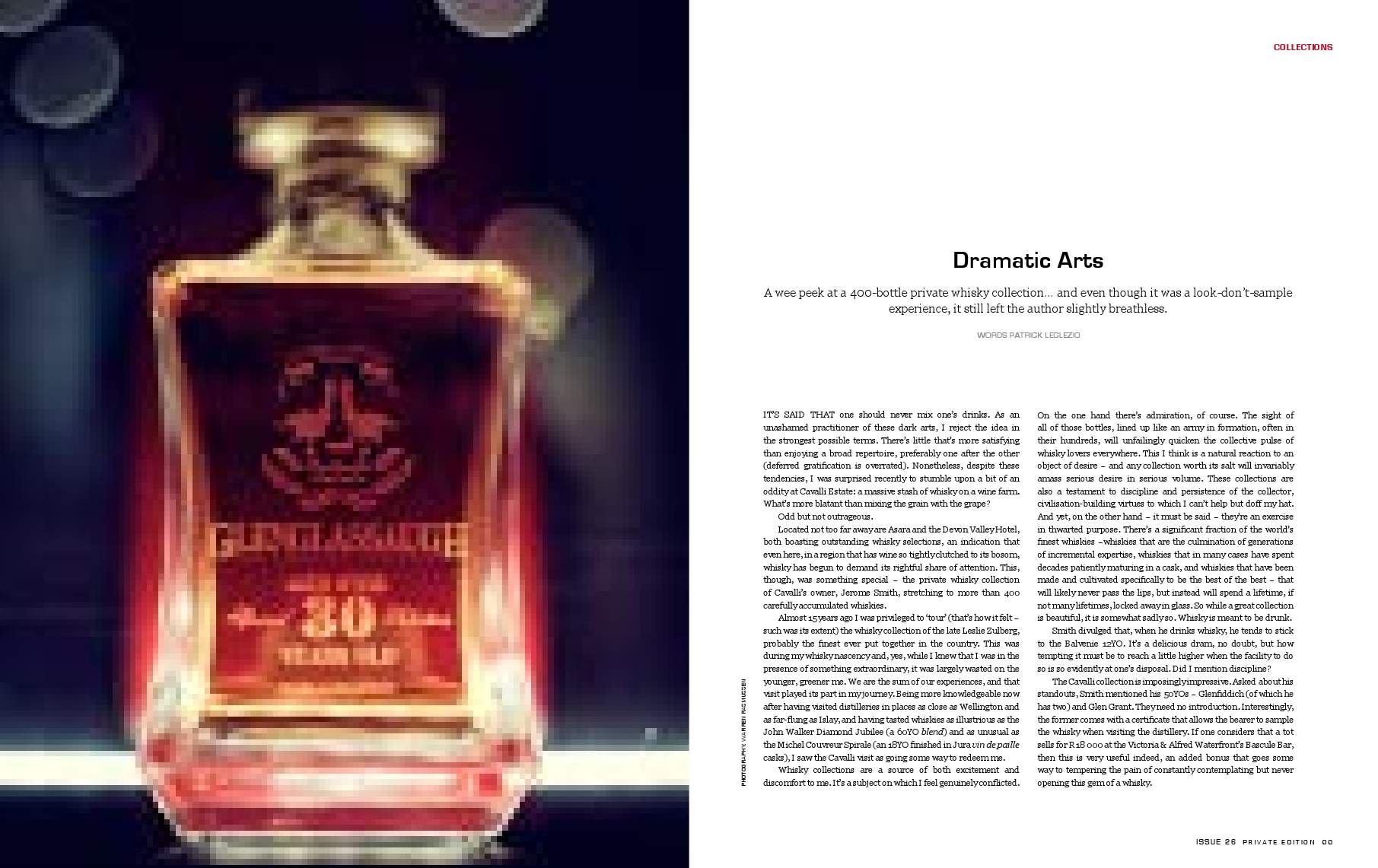
As it appeared - p1.

As it appeared – p1.

As it appeared - p2.

As it appeared – p2.

It’s said that one should never mix one’s drinks. As an unashamed practitioner of these dark arts, I reject the idea in the strongest possible terms. There’s little that’s more satisfying than enjoying a broad repertoire, preferably one after the other (deferred gratification is overrated). Nonetheless, despite these tendencies, I was surprised recently to stumble upon a bit of an oddity at Cavalli Estate: a massive stash of whisky on a wine farm. What’s more blatant than mixing the grain with the grape?

Odd but not outrageous. Located not too far away are Asara and the Devon Valley Hotel, both boasting outstanding whisky selections, an indication that even here, in a region that has wine so tightly clutched to its bosom, whisky has begun to demand its rightful share of attention. This one though was something special – the private whisky collection of Cavalli owner Jerome Smith, stretching to over 400 carefully accumulated whiskies.

Almost 15 years ago I was privileged to “tour” (that’s how it felt – such was its extent) the whisky collection of the late Leslie Zulberg, probably the finest ever put together in the country. This was during my whisky nascency, and yes, while I knew that I was in the presence of something extraordinary, looking back now I realise that it was largely wasted on the younger, greener me. We are the sum of our experiences, and that visit played its part in my journey, but being more knowledgeable now after having visited distilleries in places as close as Wellington and as far-flung as Islay, and having tasted whiskies as illustrious as the John Walker Diamond Jubilee (a 60YO blend) and as unusual as the Michel Couvreur Spirale (an 18YO finished in Jura vin de paille casks), I saw the Cavalli visit as going some way to redeem me.

Whisky collections are a source of both excitement and discomfort to me. It’s a subject on which I feel genuinely conflicted. On the one hand there’s admiration, of course. The sight of all of those bottles, lined up like an army in formation, often in their hundreds, will unfailingly quicken the collective pulse of whisky lovers everywhere. This I think is a natural reaction to an object of desire – and any collection worth its salt will invariably amass serious desire in serious volume. These collections are also a testament to discipline and persistence of the collector, civilization-building virtues to which I can’t help but doff my hat. And yet, on the other hand – it must be said – they’re an exercise in thwarted purpose. There’s a significant fraction of the world’s finest whiskies – whiskies that are the culmination of generations of incremental expertise, whiskies that in many cases have spent decades patiently maturing in a cask, and whiskies that have been made and cultivated specifically to be the best of the best – that will likely never pass the lips, but instead will spend a lifetime, if not many lifetimes, locked away in glass. So whilst a great collection is beautiful, it is somewhat sadly beautiful. Whisky is meant to be drunk.

Smith divulged to me that when he drinks whisky he tends to stick to the Balvenie 12YO. It’s a delicious dram, no doubt, but how tempting it must be to reach a little higher when the facility to do so is so evidently at one’s disposal. Did I mention discipline?

The Cavalli collection is imposingly impressive. When I asked him for his standouts Smith mentioned his 50YO’s – Glenfiddich (of which he has two) and Glen Grant. They need no introduction. Interestingly the former comes with a certificate which allows the bearer to sample the whisky when visiting the distillery. If one considers that a tot sells for R18k at the V&A’s Bascule Bar, then this is very useful indeed, an added bonus which goes some way to tempering the pain of constantly contemplating but never opening this gem of a whisky.
My slightly morose reflection on collections should be further balanced by the value of whisky as an investment – not necessarily the raison d’être for collecting, but always playing a part. I don’t have a crystal ball and I hesitate to recommend whisky in general as an area of ongoing value growth, but it’s unarguable that its performance over the last decade has been exceptional – a case of dramatically rising demand that was, completely and critically, unanticipated by the industry. Under-supplied, highly-aged stock has consequently been selling for a fortune. This is the drawback to whisky production – it’s a slow and time consuming process. Any whisky is at least three years in the making, great whisky considerably more.

As I laboriously pored over the collection, one shelf after the other, I suddenly came to an abrupt standstill. There is one particular whisky that lives largest in the dreams of all whisky investors…(cue drumroll) the 1964 Black Bowmore (cue cymbals). My itinerant preoccupation with whisky has taken me to a few memorable places, Bowmore included. Funnily enough though my opportunity to see the Black Bowmore in the flesh came not at the Islay distillery but at Auld Alliance in Singapore, which at the time accommodated a first edition in pristine condition with a near-as-damn-it original fill level. These bottles had initially retailed for some £80 when they were first released in 1993 – they now fetch upwards of £6500. You don’t need to do the maths. It’s a staggering performance, by any standard. The second and third editions, which followed in 1994 and 1995, were similarly (if marginally less) spectacular. Together they created a dynasty. The Cavalli bottle is from the final edition (bottled in 2007 from what remained of those same casks, and sold for considerably more), but regardless it retains its claim as one of the most iconic products in the history of whisky. The collection’s other highlights read like Scotch whisky’s roll of honour (not that these whiskies are dead, far from it): Macallan 1937, Highland Park 1962, Bowmore 1968, and Macallan 1969. I was inclined to bow.

The Zulberg collection, when I had encountered it, was locked away in a basement in the declining Johannesburg suburb of Orange Grove. The discordance of it has stayed with me all these years. Luckily the Cavalli collection suffers no such obscurity. It’s not as loud as it is proud – viewings are by appointment only – but it is accessible to a wider audience and, being exquisitely presented in display cabinets, it sensibly fosters a look-but-preferably-don’t-touch appreciation.

As if the whisky wasn’t enough (it was), I was awed by Cavalli in its entirety. The only thing I can reliably inform you about its eponymous horses is which are the front and back ends. I like horses but the less I say about them the better. The rest of it though was in closer vicinity to my comfort zone, so I feel I can pass comment with some measure of assurance. The food is faultless, in fact my rib-eye was literally perfect, the wine is delicious, the sommelier having recommended the Warlord (the estate’s flagship red blend) to accompany my steak, the gallery and other scattered artworks are delightful, with Pierneefs aplenty, and the view is astonishing, taking in the full broad swathe of the Helderberg. Cavalli then is a close to perfect outing for the bon vivant with a whisky bent. May the dram be with you.

Hobnobbing with the scions of Scotland

First published in Compleat Golfer magazine (November 2014 edition).

As it appeared.

As it appeared.

My earliest memories of golf are of the Open. The sights and sounds of Turnberry, Carnoustie, Muirfield, and, naturally, St. Andrew’s – the infamous road hole in particular – ring clear amidst the echoes from my childhood. I seized the opportunity to visit Troon some years ago, but it was just for a quick lunch before catching a flight from nearby Prestwick (ironically home to the first ever Open); so my connection to the tournament has remained regrettably removed…until this year. Timings coincided, distances contracted, and fates converged when I was invited on a monumental tour to celebrate the launch of Glen Grant’s 50YO whisky – a tour featuring the final day’s play of golf’s foremost competition.

Golf and whisky share a common bond – a familial bond. The Irish may dispute it but history officially pronounces whisky to have first emerged in Scotland in 1494, when mention of it was recorded in the country’s Exchequer Rolls for that year. Less than 40 years earlier, the first reference to golf was noted when it was banned (in vain, clearly) by the King of the Scots. Fruits of the same loins, and not too far apart; it’s small wonder then that these veritable twins often keep the same company – in this case fifteen avid South Africans, raring to spend time with both.

Ensconced in the Champions Club, our lavish hospitality area at Hoylake, we embarked on frequent sorties – cheering Charl Schwartzel, who played well but failed to ignite a real challenge, Sergio Garcia who was looking good until he floundered at the 15th, and finally Rory McIlroy, who held his nerve to clinch the title. It was a day long in the making. And whilst I registered the absence of the links weather which had coloured my recollections – I would not get to trudge lashed and sodden in the footsteps of this era’s Tom Watson – it lived up to all expectations.

Later in the tour, as I raised a snifter of the majestic whisky that we’d travelled all this way to honour, I called to mind the image of McIlroy with Claret Jug aloft. There was no need for any kind of envy. He was tight with one sibling and I with the other. All was right with the world. May the dram be with you.

The rituals of drinking

Slamming shots, filling flasks, cradling crystal and everything in between. Patrick Leclezio considers the contexts of consumption.

First published in Prestige Magazine (October 2014 edition).

As it appeared.

As it appeared.

On a trip to Zanzibar some time ago I brought with me two flasks, charged to their brims. The much anticipated contents, when I finally disgorged them, were undrinkable. Now I was entirely to blame – I hadn’t properly seasoned the one, and I’d left the liquor inside for far too long – but the experience left me with an aversion to these vessels. I’ve come to associate them with the potential for contamination. Yet, come rugby season every year, I bring out my flasks religiously. It’s a tradition, a custom, a ritual, a habit – call it what you will – that starts with the filling, progresses to the sneaking (past security), and culminates in the sharing and swigging (in the stands during the course of the game). I love it. It’s a routine that amplifies my pleasure, for both the drink and the game. Make no mistake – these contexts in which we drink are important. I’ve often maintained that our enjoyment (and interpretation) of flavour is psychosomatic i.e. influenced by factors external to the liquid itself. So whilst we should absolutely prioritise our picking – if we don’t get that right it’ll be a losing battle – we should also pay heed, increasingly, to the how, when and where the object of our selection will be consumed. Here are a few suggestions to heighten the appreciation of fine spirits.

Caffè corretto

I don’t drink coffee myself, but I have it on good authority – as misguided as it seems to me – that the majority of people find it delicious, so I’m going to take a leap of faith on this one. The caffè corretto is an espresso served with a shot of grappa, literally a “corrected” coffee, suggesting that this might be the best way, or at least the right way, albeit a conclusion attributed to a vague Italian terminological decree, to ingest this brew.
I’ve tasted grappa formally on several occasions, most recently during a comparative evaluation of the excellent Alexander range from Distilleria Bottega, and there’s no doubt, despite the musty-ish apparentness of the base pomace in its flavour, that it offers a distinct, varied and interesting consumption experience. I found the striking difference between variants using different varietals to be especially remarkable – considering that these are just the stems, skins, pulp and pips of those grapes, and not the fruit itself.
My intention here though is not to commend grappa, or even its pairing with coffee. We’d all surmise quite probably that this is an agreeable relationship – on the evidence of Irish coffee and coffee liqueurs. Rather, I’m laying this elaborate platform in homage to Italy’s coffee culture – borrowed from the world over – and to its influence on our engagement with the country’s signature spirit. When we drink a caffè corretto we’re not just enjoying coffee and grappa, we’re tasting a way of life, we’re imbibing a heritage, and we’re inheriting – if only for a few moments – a small measure of Italian chic.

Black tie

I don’t often drink martinis – partly because finding good vermouth in this country is a futile exercise, and partly because it’s a drink that demands (well, almost) a certain attire and consequently a certain occasion. But earlier this year I found myself appropriately suited and booted – black tuxedo, dress shirt, bow tie, pocket square…the whole nine yards – and suddenly the moment was upon me. Nothing but a martini (I’m not even going to dignify that there might be a choice of which) would do. It defies the coldest logic, but it’s simply not possible to equate the pleasure of a martini with and without black tie. The former is infinitely superior. As I sipped my Hendricks martini (go bold or go home), flashed the cuffs of my Viyella jacket, and introduced myself surname first followed by first name and surname again, I lived the realisation that this was an indisputable conclusion.

Stogie

I’m not a prolific brandy drinker but recently I’ve become increasingly inclined to partake of our local potstills. They’re generally excellent and they’re available in ever-widening variety – as I began to better appreciate at a sampling of the Mount Nelson’s brandy and tapas menu. Boutique or craft potstill brandies are the order of the day – with names such as Savingnac, Uitkyk, Tokara, and Joseph Barrie leading the charge. Whilst these and their more mainstream fellows are just fine all on their own (I remain dubious about pairing spirits with meals, little tapas snacks maybe…at a stretch), they’re propelled into the stratosphere when partnered with a good cigar. The intersection of a mild cigar (Davidoff Classic No. 2 for me, but stronger if you’re a veteran), a rich potstill (Van Ryn’s 15YO?) and a balloon glass (think swirling smoke), offers the perfect vantage point from which to contemplate life and sigh contentedly.

Out and about with whisky

The Speyside episode. Patrick Leclezio toasts the highlights from a tour to end all tours.

First published in Prestige Magazine (October 2014 edition).

As it appeared.

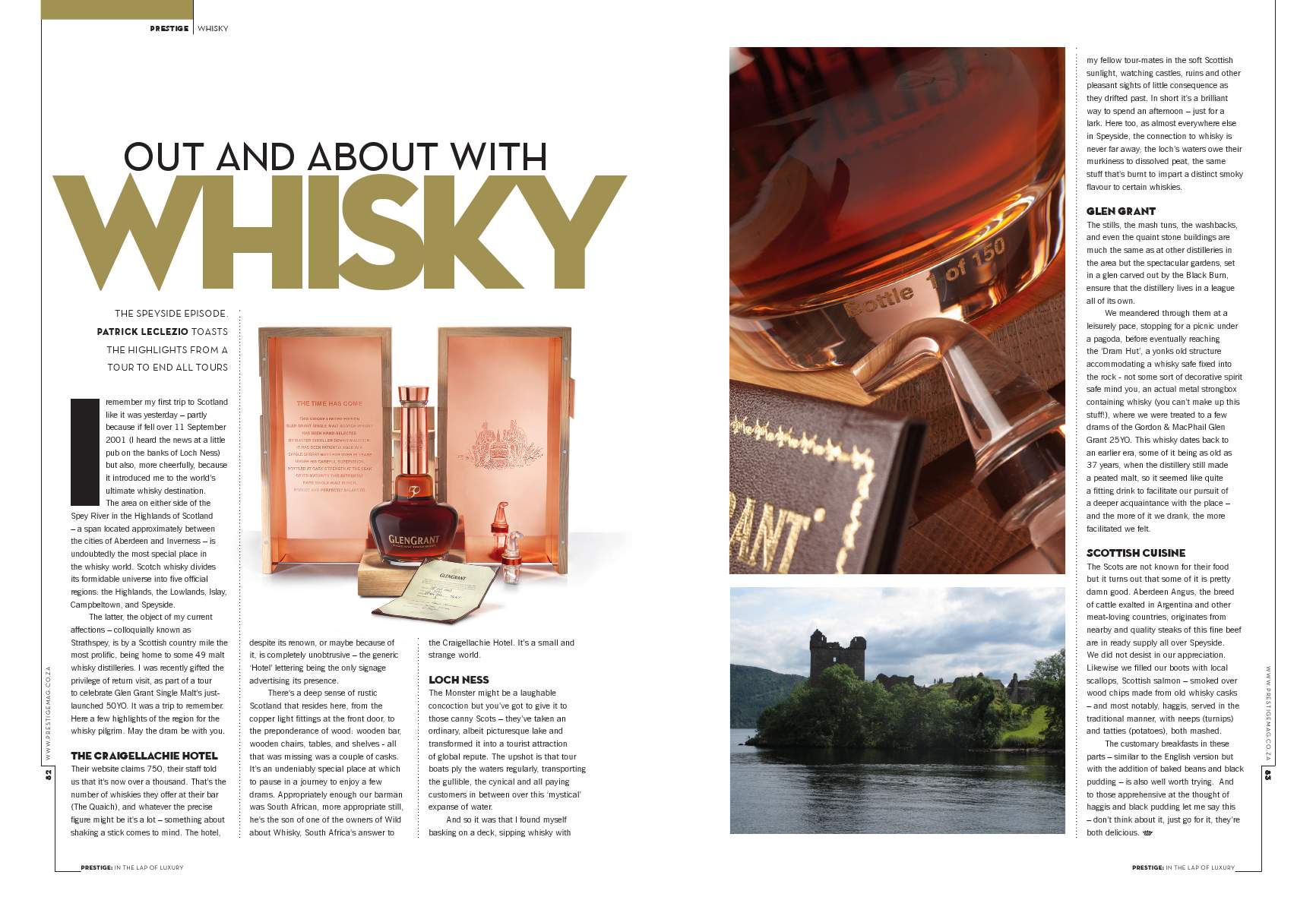
I remember my first trip to Scotland like it was yesterday – partly because if fell over 11 September 2001 (I heard the news at a little pub on the banks of Loch Ness), but also, more cheerfully, because it introduced me to the world’s ultimate whisky destination. The area on either side of the Spey River in the Highlands of Scotland – a span located approximately between the cities of Aberdeen and Inverness – is undoubtedly the most special place in the whisky world. Scotch whisky divides its formidable universe into five official regions: the Highlands, the Lowlands, Islay, Campbeltown, and Speyside. The latter, the object of my current affections – colloquially known as Strathspey, is by a Scottish country mile the most prolific, being home to some 49 malt whisky distilleries. I was recently gifted the privilege of return visit, as part of a tour to celebrate Glen Grant Single Malt’s just-launched 50YO. It was a trip to remember. Here are a few highlights of the region for the whisky pilgrim. May the dram be with you.

The Craigellachie Hotel

Their website claims 750, their staff told us that it’s now over a thousand. That’s the number of whiskies they offer at their bar (The Quaich), and whatever the precise figure might be it’s a lot – something about shaking a stick comes to mind. The hotel, despite its renown, or maybe because of it, is completely unobtrusive – the generic “Hotel” lettering being the only signage advertising its presence. There’s a deep sense of rustic Scotland that resides here, from the copper light fittings at the front door, to the preponderance of wood: wooden bar, wooden chairs, tables, and shelves – all that was missing was a couple of casks. It’s an undeniably special place at which pause in a journey to enjoy a few drams. Ironically enough our barman was South African, more ironic still, he’s the son of one of the owners of Wild about Whisky, South Africa’s answer to the Craigellachie Hotel. It’s a small and strange world.

Loch Ness

The Monster might be a laughable concoction, but you’ve got to give it to those canny Scots – they’ve taken an ordinary, albeit picturesque, lake and transformed it into a tourist attraction of global repute. The upshot is that tour boats ply the waters regularly, transporting the gullible, the cynical and all paying customers in between over this “mystical” expanse of water. And so it was that I found myself lazily basking on a deck, sipping whisky with my fellow tour-mates in the soft Scottish sunlight, and watching castles, ruins, and other pleasant sights of little consequence as they drifted past. In short it’s a brilliant way to spend an afternoon – just for a lark. Here too, as almost everywhere else in Speyside, the connection to whisky is never far away; the loch’s waters owe their murkiness to dissolved peat, the same stuff that’s burnt to impart a distinct smoky flavour to certain whiskies.

Glen Grant

The stills, the mash tuns, the washbacks, and even the quaint stone buildings are much the same as at other distilleries in the area, but the spectacular gardens, set in a glen carved out by the Black Burn, ensure that the distillery lives in a league all of its own. We meandered through them at leisurely pace, stopping for a picnic under a pagoda, before eventually reaching the “Dram Hut”, a yonks old structure accommodating a whisky safe fixed into the rock – not some sort of decorative spirit safe mind you, an actual metal strongbox containing whisky (you can’t make up this stuff!) – where we were treated to a few drams of the Gordon & MacPhail Glen Grant 25YO. This whisky dates back to an earlier era, some of it being as old as 37 years, when the distillery still made a peated malt, so it seemed like quite a fitting drink to facilitate our pursuit of a deeper acquaintance with the place – and the more of it we drank, the more facilitated we felt.

Scottish cuisine

The Scots are not known for their food but it turns out that some of it is pretty damn good. Aberdeen Angus, the breed of cattle exalted in Argentina and other meat-loving locales, originates from nearby, and quality steaks of this fine beef are in ready supply all over Speyside. We did not desist in our appreciation. Likewise we filled our boots with local scallops, Scottish salmon – smoked over wood chips made from old whisky casks – and most notably, haggis, served in the traditional manner, with neeps (turnips) and tatties (potatoes), both mashed. The customary breakfasts in these parts – similar to the English version but with the addition of baked beans and black pudding – is also well worth trying. And to those apprehensive at the thought of haggis and black pudding let me say this – don’t think about it, just go for it, they’re both delicious.

A Scotch major

Patrick Leclezio harnesses his big dram temperament as he goes in pursuit of the title

First published in Golf Digest (September 2014 edition).

As it appeared - p1

As it appeared – p1

As it appeared - p2

As it appeared – p2

As it appeared - p3

As it appeared – p3

“To see a world in a grain of sand”. I was reminded of Blake’s words – perhaps in a less metaphorical sense than he had intended – as I watched Sergio Garcia visit the 15th hole bunker at Hoylake during the final day of the 2014 Open Championship. It was a portentous moment. I joined the surge to the green, knowing, like everyone else in that gallery, that the fate of the title might well rest on whatever happened next. This was golf appreciation at its pinnacle – the decisive period at the game’s home major. The atmosphere was simply electric.

The rest of course is history. Garcia fluffed his trap shot and his challenge disintegrated. Instead of holding infinity in the palm of his hand, there was probably just a fist clenched in frustration. I was disappointed, but only mildly so; my horse might not have come in but it had been an epic day on a fantastic links course (luckily with distinctly unlinks-like weather – my British fellow course-goers were for the most part tinted bright red). I returned to drown my sorrows, such as they were, at the Champions Club, our opulent (remember that word) hospitality area, with the rest of our major-going party – actually, let me qualify that: our double-major-going party. A group of us had flown to Britain, less for the golf than for another major – a whisky major.

In whisky the equivalent of a major, the prizes to which most patrons of the golden nectar aspire, are the old and the rare – most conventionally manifest in the form of a 50 year old. These are the “big shows” of the whisky world, eagerly awaited and widely publicised.

It might be useful at this point to consider what the age of a whisky entails, and why 50 years of it might be regarded to be so special. The ageing phenomenon is called maturation and it occurs through contact with wood, in casks made from oak. A whisky can only age in maturation – once it is decanted from a cask it is in a sense frozen in time. During maturation the whisky absorbs flavour from the cask itself (vanillins and tannins naturally present in the wood), from the liquid that preceded it and that remains impregnated in the cask (most commonly Bourbon or Sherry), and, less overtly, but in many cases distinctly nonetheless, from the cask’s environment as it breathes. The whisky also reduces in alcoholic strength during this ageing process – a result of evaporation (the twee-named Angel’s Share). The broad (and very important) result is a mellowing and flavouring of the liquid. In fact it’s widely acknowledged that maturation is the single factor that makes the greatest contribution to the flavour of any whisky. So it stands to reason, on a very simplistic level, that more ageing, more mellowing and more flavouring, must be desirable…up to a point. 50 years for many whiskies is well past that point, so when a cask continues to improve as it marches onwards towards that magical milestone, it’s cause for a celebration of top tournament proportions.

Which explains (but not really) how a crew of enthusiastic South Africans came to be at Royal Liverpool for the culmination of golf’s greatest major: we were on route to Scotland for one of whisky’s greatest majors – an unveiling of the Glen Grant 50YO. Sixteen men, an unlimited drinks budget, and a fierce love of whisky: all the makings of an unforgettable adventure.

Our base in Scotland was the town of Elgin (that’s with a hard-g good people), the very one from which ours in the Cape takes its name. There were no apple orchards here, but this was more than compensated for by a preponderance of whisky, nowhere more so than at our lodgings. The Mansefield Hotel is an unassuming place; it is comfortable and hospitable – we were frequently, and graciously, attended to by the owner and his family – but in most respects it gives the impression of being quite middling…an impression that is dramatically arrested and turned on its head at sight of its bar. The Mansefield bar is quite simply a showstopper, boasting a selection of whiskies that would put all but a paltry few of the world’s best hotels to shame. A Glenfiddich 50YO in alliance with various 40YO’s, including a Dalmore, a Balvenie, and some 60 odd from the Glenfarclas Clans collection, holds sway over a substantial, entrancing host. Whisky porn. It was near impossible to look away. The hotel has quite rightly as a result become the accommodation of choice in the area for whisky tourists from all over the world. We shared the place, and a few drinks naturally, with a festive band of whisky “ambassadors” who’d made the long pilgrimage from Hong Kong – an impromptu coming-together of the whisky brotherhood in one of whisky’s truly special places.

The highlight of the trip, indeed the purpose for which we’d teed up at the start, was of course -and I say “of course” with some contemplation, not because I’m doubtful of its veracity, but rather because it demanded something exceptional to qualify so obviously for the accolade – our visit to the Glen Grant distillery, to crown this much anticipated champion dram. The other contenders clamouring for the honour had included a personalised tour of Old Trafford, a cruise on Loch Ness, a round of golf at Castle Stuart, clay pigeon shooting, the aforementioned attendance at the Open, and a one-after-the-other succession of exquisite meals – we’d gorged ourselves on Scottish salmon, scallops, steaks of Aberdeen Angus, and haggis with neeps and tatties, accompanied by a repeating roll-call of delicious Sancerres, Barolos and Chateauneufs du Pape with which to wash it down. Did I say opulent? These though were all about to take a back seat.

We’d prepared for the visit by topping up our Glen Grant education at the Mansefield. No-one in their right mind plays a major without substantial practice – and then a bit of loosening up on the range before the start of the round. Back home we regularly get to enjoy the Glen Grant Major’s Reserve, the 10YO and the 16YO. This is the distillery’s core range – incidentally representing some of the best value single malt drinking on the market – with which we wasted no time in reacquainting ourselves. Occasionally, it also releases a few limited editions, most recently the 170th Anniversary edition, last seen in SA some two years ago, and the Five Decades, which came and went in a blur last year. I’d lamented the latter’s brief existence. It was an outstanding whisky: rich, creamy and full-flavoured – but I’d resigned myself to its expiry. So it was with no small measure of joy – a high-five dispensing type of joy – that I noticed a few bottles behind the bar, accompanied by the 170th no less. We sipped these drams into the wee hours with a it’s-hard-work-but-someone-has-to-do-it stoicism, retiring only when we felt ready to tackle the big one.

Now, I’ll be perfectly honest with you. Once you’ve seen the inner workings of one distillery, you’ve almost seen them all. A few have their own maltings, all but a few have their own unique stills, and there’s always a bit of variation here and there, but for the most part it’s more of the same. I’ve visited a dozen odd in my time, and whilst it’s always interesting to delve into the processes, there’s a limit to how excited I can get about it. In this respect however the excursion to Glen Grant – the 50YO moments not even counted – was an absolute exception, for two reasons.

Firstly, for any whisky loving layman, a distillery is less about its industrial functioning than about the setting (and the stories). Atypically for what are essentially factories, they tend to be quaint structures located in pretty surroundings – much like a clubhouse and its golf course. In that sense Glen Grant is the Augusta National of distilleries – its charismatic beauty is nothing short of exceptional. The bubbling burn, the stone buildings, and coach-house-cum-visitors-centre paint a picture of olde worlde elegance, that is then elevated to fine art by a glen of elaborate, splendorous gardens. And even there amidst the trees, flowers and birds, the presence of whisky is never far away – we were delighted to stop for a dram at the “secret” whisky safe set into the rock in the upper reaches of the garden.

Secondly (two reasons, remember), our tour of the distillery was conducted by the man who runs the place and makes all of its important whisky decisions – Scotland’s longest-serving Master Distiller, straight-talking Glen Grant supremo Dennis Malcolm. It puts a different spin on things when the guy who pulls the strings is the one who’s showing you around.

The big moment when it came was a spiritual experience. I’m never going to raise the claret jug (or any kind of golfing trophy for that matter), but holding that precious liquid gifted me with just an inkling of how that must feel. We put mouth (and nose – never forget the nose) to glass in the dunnage warehouse, the squat, thick walls imbuing the space with a cool, reflective quiet, the stacked rows of casks with a reverent, imposing gravitas. Few would get to drink this nectar, fewer still would drink it here on such hallowed ground. The whisky when it permeated my senses was big, very big, almost overwhelming, as one would expect from something this ancient; the pool of flavour so profound that it seemed to be reaching back, drawing from each and every one of those 50 years. This was eternity in an hour. May the dram be with you.

The boys are back in town

First published in MUDL Magazine (September 2014 edition).

As it appeared.

As it appeared.

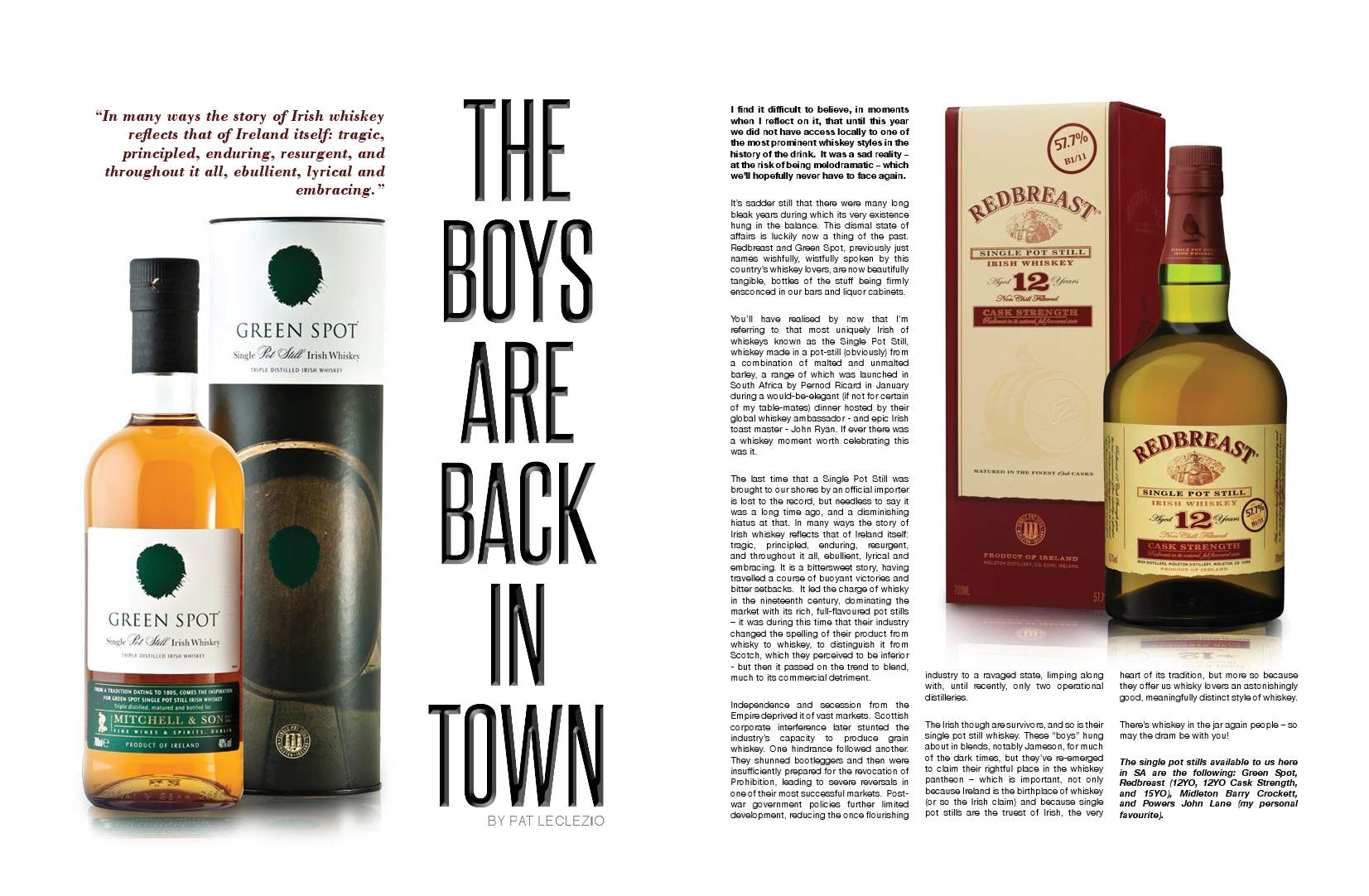
I find it difficult to believe, in moments when I reflect on it, that until this year we did not have access locally to one of the most prominent whiskey styles in the history of the drink. It was a sad reality – at the risk of being melodramatic – which we’ll hopefully never have to face again. It’s sadder still that there were many long bleak years during which its very existence hung in the balance. This dismal state of affairs is luckily now a thing of the past. Redbreast and Green Spot, previously just names wishfully, wistfully spoken by this country’s whiskey lovers, are now beautifully tangible, bottles of the stuff being firmly ensconced in our bars and liquor cabinets.

You’ll have realised by now that I’m referring to that most uniquely Irish of whiskeys known as the Single Pot Still, whiskey made in a pot-still (obviously) from a combination of malted and unmalted barley, a range of which was launched in South Africa by Pernod Ricard in January during a would-be-elegant (if not for certain of my table-mates) dinner hosted by their global whiskey ambassador – and epic Irish toast master – John Ryan. If ever there was a whisky moment worth celebrating this was it.

The last time that a Single Pot Still was brought to our shores by an official importer is lost to the record – but needless to say it was a long time ago, and a diminishing hiatus at that. In many ways the story of Irish whiskey reflects that of Ireland itself: tragic, principled, enduring, resurgent, and throughout it all, ebullient, lyrical and embracing. It is a bittersweet story, having travelled a course of buoyant victories and bitter setbacks. It led the charge of whisky in the nineteenth century, dominating the market with its rich, full-flavoured pot stills – it was during this time that their industry changed the spelling of their product from whisky to whiskey, to distinguish it from Scotch, which they perceived to be inferior – but then it passed on the trend to blend, much to its commercial detriment. Independence and secession from the Empire deprived it of vast markets. Scottish corporate interference later stunted the industry’s capacity to produce grain whiskey. One hindrance followed another. They shunned bootleggers and then were insufficiently prepared for the revocation of Prohibition, leading to severe reversals in one of their most successful markets. Post-war government policies further limited development, reducing the once flourishing industry to a ravaged state, limping along with, until recently, only two operational distilleries.

The Irish though are survivors, and so is their single pot still whiskey. These boys hung about in blends, notably Jameson, for much of the dark times, but they’ve re-emerged to claim their rightful place in the whisky pantheon – which is important, not only because Ireland is the birthplace of whisky (or so the Irish claim) and because single pot stills are the truest of Irish, the very heart of its tradition, but more so because they offer us whisky lovers an astonishingly good, meaningfully distinct style of whiskey. There’s whiskey in the jar again people – may the dram be with you!

The single pot stills available to us here in SA are the following: Green Spot, Redbreast (12YO, 12YO Cask Strength, and 15YO), Midleton Barry Crockett, and Powers John Lane (my personal favourite).  Watch this space for a more detailed evaluation of these fine whiskeys.

The king of white spirits

It’s gin of course, but who will win its crown? Patrick Leclezio casts an eye over the claimants.

First published in Prestige Magazine (July 2014 edition).

As it appeared.

As it appeared.

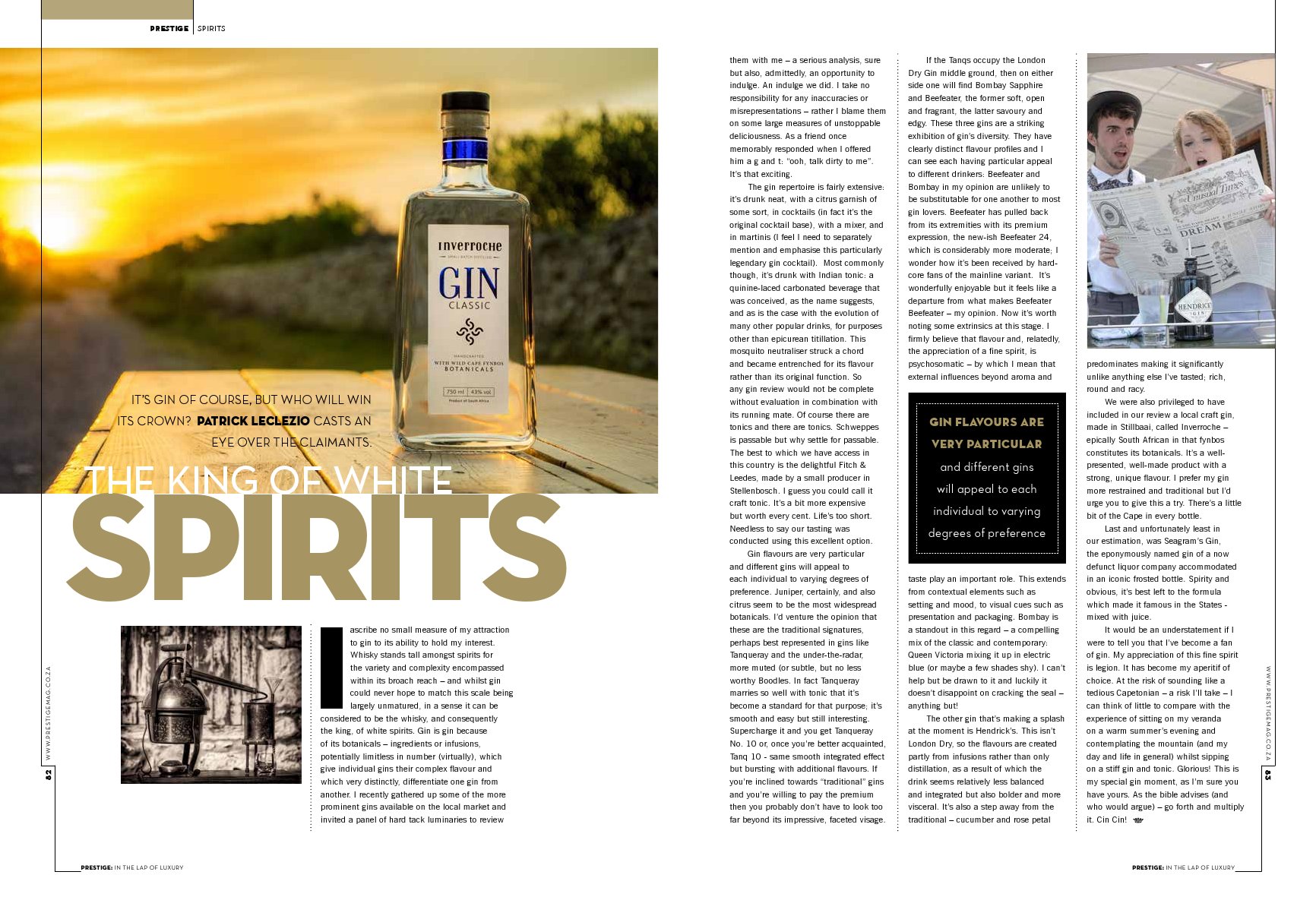
I ascribe no small measure of my attraction to gin to its ability to hold my interest. Whisky stands tall amongst spirits for the variety and complexity encompassed within its broach reach – and whilst gin could never hope to match this scale, being largely unmatured, in a sense it can be considered to be the whisky, and consequently the king, of white spirits. Gin is gin because of its botanicals – ingredients or infusions, potentially limitless in number (virtually), which give individual gins their complex flavour, and which very distinctly differentiate one gin from another. I recently gathered up some of the more prominent gins available on the local market and invited a panel of hard tack luminaries to review them with me – a serious analysis, sure, but also, admittedly, an opportunity to indulge. And indulge we did. I take no responsibility for any inaccuracies or misrepresentations – rather I blame them on some large measures of unstoppable deliciousness. As a friend once memorably responded when I offered him a g & t: “ooh, talk dirty to me”. It’s that exciting.

The gin repertoire is fairly extensive: it’s drunk neat, with a citrus garnish of some sort, in cocktails (in fact it’s the original cocktail base), with a mixer, and in martinis (I feel I need to separately mention and emphasise this particularly legendary gin cocktail). Most commonly though, it’s drunk with Indian tonic: a quinine-laced carbonated beverage that was conceived, as the name suggests, and as is the case with the evolution of many other popular drinks, for purposes other than epicurean titillation. This mosquito neutraliser struck a chord, and became entrenched for its flavour rather than its original function. So any gin review would not be complete without evaluation in combination with its running mate. Of course there are tonics and there are tonics. Schweppes is passable, but why settle for passable – life’s too short. The best to which we have access in this country is the delightful Fitch & Leedes, made by a small producer in Stellenbosch. I guess you could call it craft tonic. It’s a bit more expensive but worth every cent. Needless to say our tasting was conducted using this excellent option.

Gin flavours are very particular – and different gins will appeal to each individual to varying degrees of preference. Juniper, certainly, and also citrus seem to be the most widespread botanicals. I’d venture the opinion that these are the traditional signatures, perhaps best represented in gins like Tanqueray, and the under-the-radar, more muted (or subtle), but no less worthy Boodles. In fact Tanqueray marries so well with tonic that it’s become a standard for that purpose; it’s smooth and easy, but still interesting. Supercharge it and you get Tanqueray No. 10, or, once you’re better acquainted, Tanq 10 – same smooth integrated effect but bursting with additional flavours. If you’re inclined towards “traditional” gins and you’re willing to pay the premium then you probably don’t have to look too far beyond its impressive, faceted visage.

If the Tanqs occupy the London Dry Gin middle ground, then on either side you’ll will find Bombay Sapphire and Beefeater, the former soft, open, and fragrant, the latter savoury and edgy. These three gins are a striking exhibition of gin’s diversity. They have clearly distinct flavour profiles and I can see each having particular appeal to different drinkers: Beefeater and Bombay in my opinion are unlikely to be substitutable for one another to most gin lovers. Beefeater has pulled back from its extremities with its premium expression, the new-ish Beefeater 24, which is considerably more moderate; I wonder how it’s been received by hard-core fans of the mainline variant. It’s wonderfully enjoyable but it feels like a departure from what makes Beefeater Beefeater – in my opinion.

Now it’s worth noting some extrinsics at this stage. I firmly believe that flavour, and, relatedly, the appreciation of a fine spirit, is psychosomatic – by which I mean that external influences beyond aroma and taste play an important role. This extends from contextual elements such as setting and mood, to visual cues such as presentation and packaging. Bombay is a standout in this regard – a compelling mix of the classic and contemporary: Queen Victoria mixing it up in electric blue (or maybe a few shades shy). I can’t help but be drawn to it and luckily it doesn’t disappoint – anything but! – on cracking the seal.

The other gin that’s making a splash at the moment is Hendrick’s. This isn’t London Dry, so the flavours are created partly from infusions rather than only distillates, as a result of which the drink seems relatively less balanced and integrated but also bolder and more visceral. It’s also a step away from the traditional – cucumber and rose petal predominate making it significantly unlike anything else I’ve tasted; it’s rich, round and racy.

We were also privileged to have included in our review a local craft gin, made in Stillbaai, called Inverroche – epically South African in that fynbos constitutes its botanicals. It’s a well-presented, well-made product, with a strong, unique flavour. I prefer my gin more restrained and traditional, but I’d urge you to give this a try. There’s a little bit of the Cape in every bottle.

Last, and unfortunately least, in our estimation was Seagram’s Gin, the eponymously named gin of a now defunct liquor company accommodated in an iconic frosted bottle. Spirity and obvious, it’s best left to the formula which made it famous in the States – mixed with juice.

It would be an understatement if I were to tell you that I’ve become a fan of gin. My appreciation of this fine spirit is legion. It has become my aperitif of choice. At the risk of sounding like a tedious Capetonian – a risk I’ll take – I can think of little to compare with the experience of sitting on my veranda on a warm summer’s evening, and contemplating the mountain (and my day and life in general) whilst sipping on a stiff gin and tonic. Glorious! This is my special gin moment, as I’m sure you have yours. As the bible sort-of advises (and who would argue) – go forth and multiply it. Chin chin!

Special thanks to Marsh Middleton and Bernard Gutman.

State of the nation 2014

South African whisky. PATRICK LECLEZIO visited Wellington to take a reading.

First published in Prestige Magazine (July 2014 edition).

As it appeared.

As it appeared.

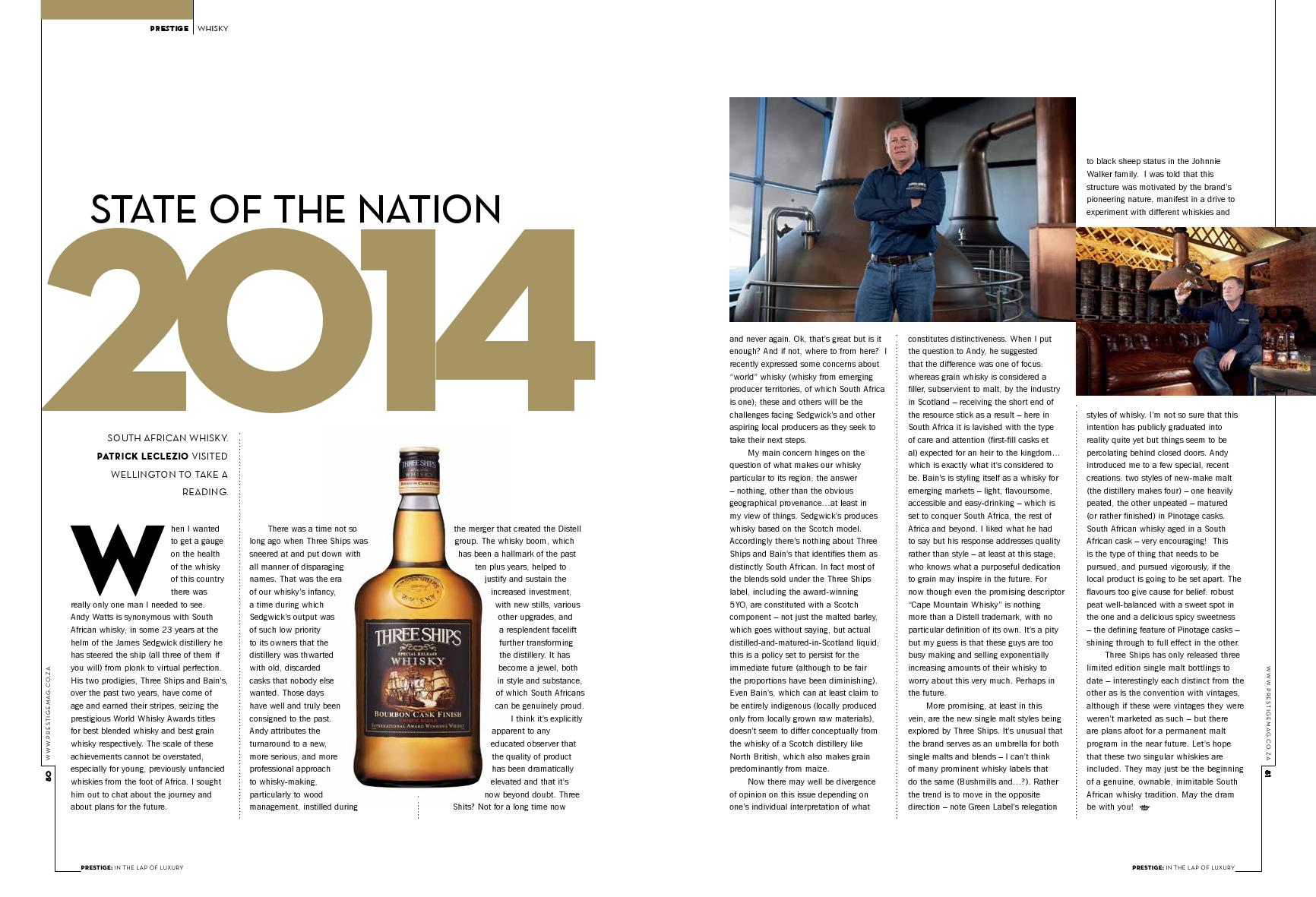
When I wanted to get a gauge on the health of the whisky of this country there was really only one man I needed to see. Andy Watts is synonymous with South African whisky; in some 23 years at the helm of the James Sedgwick distillery he has steered the ship (all three of them if you will) from plonk to virtual perfection. His two prodigies, Three Ships and Bain’s, over the past two years, have come of age and earned their stripes, seizing the prestigious World Whisky Awards titles for best blended whisky and best grain whisky respectively. The scale of these achievements cannot be overstated, especially for young, previously unfancied whiskies from the foot of Africa. I sought him out to chat about the journey and about plans for the future.

There was a time not so long ago when Three Ships was sneered at and put down with all manner of disparaging names. That was the era of our whisky’s infancy, a time during which Sedgwick’s output was of such low priority to its owners that the distillery was thwarted with old, discarded casks that nobody else wanted. Those days have well and truly been consigned to the past. Andy attributes the turnaround to a new, more serious, and more professional approach to whisky-making, particularly to wood management, instilled during the merger that created the Distell group. The whisky boom, which has been a hallmark of the past ten plus years, helped to justify and sustain the increased investment, with new stills, various other upgrades, and a resplendent facelift further transforming the distillery. It has become a jewel, both in style and substance, of which South Africans can be genuinely proud.

I think it’s explicitly apparent to any educated observer that the quality of product has been dramatically elevated, and that it’s now beyond doubt. Three Shits? Not for a long time now, and never again. Ok, that’s great, but is it enough? And if not, where to from here? I recently expressed some concerns about “world” whisky (whisky from emerging producer territories, of which South Africa is one); these and others will be the challenges facing Sedgwick’s and other aspiring local producers as they seek to take their next steps.
My main concern hinges on the question of what makes our whisky particular to its region; the answer – nothing, other than the obvious geographical provenance…at least in my view of things. Sedgwick’s produces whisky based on the Scotch model. Accordingly there’s nothing about Three Ships and Bain’s that identifies them as distinctly South African. In fact most of the blends sold under the Three Ships label, including the award-winning 5YO, are constituted with a Scotch component – not just the malted barley, which goes without saying, but actual distilled-and-matured-in-Scotland liquid; this is a policy set to persist for the immediate future (although to be fair the proportions have been diminishing). Even Bain’s, which can at least claim to be entirely indigenous (locally produced only from locally grown raw materials), doesn’t seem to differ conceptually from the whisky of a Scotch distillery like North British, which also makes grain predominantly from maize.

Now there may well be divergence of opinion on this issue depending on one’s individual interpretation of what constitutes distinctiveness. When I put the question to Andy, he suggested that the difference was one of focus: whereas grain whisky is considered a filler, subservient to malt, by the industry in Scotland – receiving the short end of the resource stick as a result – here in South Africa it is lavished with the type of care and attention (first-fill casks et al) expected for an heir to the kingdom…which is exactly what it’s considered to be. Bain’s is styling itself as a whisky for emerging markets – light, flavoursome, accessible and easy-drinking – which is set to conquer South Africa, the rest of Africa, and beyond. I liked what he had to say but his response addresses quality rather than style – at least at this stage; who knows what a purposeful dedication to grain may inspire in years to come. For now though even the promising descriptor “Cape Mountain Whisky” is nothing more than a Distell trademark, with no particular definition of its own. It’s a pity, but my guess is that these guys are too busy making and selling exponentially increasing amounts of their whisky to worry about this very much. Perhaps in the future.

More promising, at least in this vein, are the new single malt styles being explored by Three Ships. It’s unusual that the brand serves as an umbrella for both single malts and blends – I can’t think of many prominent whisky labels that do the same (Bushmills and…?). Rather the trend is to move in the opposite direction – note Green Label’s relegation to black sheep status in the Johnnie Walker family. I was told that this structure was motivated by the brand’s pioneering nature, manifest in a drive to experiment with different whiskies and styles of whisky. I’m not so sure that this intention has publicly graduated into reality quite yet, but things seem to be percolating behind closed doors. Andy introduced me to a few special, recent creations: two styles of new-make malt (the distillery makes four) – one heavily peated, the other unpeated – matured (or rather finished) in Pinotage casks. South African whisky aged in a South African cask – very encouraging! This is the type of thing that needs to be pursued, and pursued vigorously, if the local product is going to be set apart. The flavours too give cause for belief: robust peat well-balanced with a sweet spot in the one, and a delicious spicy sweetness – the defining feature of Pinotage casks I’m told – shining through to full effect in the other.

Three Ships has only released three limited edition single malt bottlings to date – interestingly each distinct from the other as is the convention with vintages, although if these were vintages they were weren’t marketed as such – but there are plans afoot for a permanent malt program in the near future. Let’s hope that these two singular whiskies are included. They may just be the beginning of a genuine, ownable, inimitable South African whisky tradition. May the dram be with you!


Big on brandy

I don’t think that the emphasis on cocktails is the right way to restore faith in South African brandy. They’re easy-come easy-go, not fostering a relationship with the base spirit itself. And if the barmen serving them are clown incompetent and tortoise slow, it doesn’t help. This was the principle drawback – said and out of the way now – to an otherwise outstanding Brandy Festival 2014 (officially Fine Brandy Fusion), held at the Cape Town Convention Centre recently.
The most encouraging feature of the Festival was the increasing emphasis on pot still brandy. This stuff is the real deal – made in copper pots, as the name suggests, fully matured, and entirely credible. It is as it should be the flag-bearing style for the industry. Brandy is our signature spirit, a spirit that we can claim to be ours more than any other, and in pot still we have an expression of which we can be truly proud.
It became apparent to me as I was touring the exhibitions that there are now four strong mainstream brands each producing a significant range of excellent pot still brandies – not to mention the growing array of boutique creations, which hopefully will be better represented at the Festival in future years. In Van Ryn’s, KWV, Oude Molen and Oude Meester the style is being manifest in a manner befitting its tradition.
My introduction to Oude Meester was perhaps was the most encouraging experience of the evening. This was a brandy to which I hadn’t paid much attention in the past. Despite the Jamie Foxx-fronted reinvention it had always struck me as a bit stale and “ou doos”. Anything but! Oude Meester is the sipping brandy for a new generation. The 8YO “Demant” was perhaps the greatest revelation; bold, fresh and flavoursome, it is an easy-drinking and affordable entre to the genre – a welcoming gateway to the world of pot stills. The brand offers a graduated transition to a 12YO and then to its amazing 18YO – also bold and flavoursome, but evolving a generous measure of complexity that was missing in the more obvious Demant. I highly recommend a lingering acquaintance with these brandies, for novices and aficionados alike.
Oude Molen, since our last interaction, has doubled the size of its family – the impressive René Single Cask and Solera Grand Reserve joining the legendary VOV and the stalwart 100 Reserve – giving brandy lovers an added variety of terrain for exploration. I believe that their distillery in Elgin is well worth a visit too so that’s something to remember next time you’re in apple country and looking for an agreeable diversion.

Maturation at Oude Molen.

Maturation at Oude Molen.

Whilst I’m more familiar with both Van Ryn’s and KWV, which offer similarly structured portfolios of pot stills each consisting of 10, 12, 15 and 20 YO’s, than any other brandies this was nonetheless a rare opportunity (and privilege) to taste and compare their ranges side by side. The former’s aggressive flavour profiles contrasted with the more subtle, restrained character of the latter, but both are undoubtedly excellent, and deserving of their positions at the head of the pack.
The Brandy Festival is still in its infancy, so it may well have escaped your notice – if so then make sure you schedule it in your agenda for next year. It’s a must for anyone with so much as a passing interest. Its purpose is evidently to promote education about and consequently the appreciation of brandy, and in that regard it packs a punch – I particularly liked the nosing beakers isolating some of the more typical brandy flavours – but it does so with a velvet glove: the delicious food (really impressive for this type of large public event), the atmospheric décor, and the supplementary entertainment all contribute to make it a big brandified blast of an evening.

Meeting your match

I love whisky events – I get to drink interesting whiskies, with my whisky friends, whilst learning a little more about whisky. They tend to occur at cool venues, serving delicious food and playing great music, and usually I’ll leave at the end of these things with an enhanced ability to write meaningfully about whisky and the goings-on in whisky. What’s not to love? Some are better than others of course but on the whole – nothing. Okay okay, push me and I’ll reluctantly admit that many (the majority – tastings excepted) follow a formula of favouring style over substance, enjoyment over education if you will, form over function if I must.
It was refreshing thus, upon accepting an invitation to the launch of Johnnie Walker’s (JW) online profiler, to see that emphasis reversed. Not that this wasn’t fun – it was, but there was a real intent here to impart something more.
JW has for some years now been tilting its “king of flavour” platform. This ostensibly intrinsics-centric approach is sometimes communicated in a somewhat extrinsics-centric manner and could be considered at odds with JW’s other glitzy activities, but there can be no arguing its relevance. To you the whisky lover flavour should be the single most important feature to seek out in a whisky. Do you like it, and if so, what is it about it that you like? The online profiler attempts to answer these questions for you, albeit within the narrow confines of the JW universe.
I was treated to a somewhat upweighted experience – although the general principles are the same as the one you’d find online. It works like this: one is tasked to select two preferred aromas and two preferred tastes (online it’s three) from a wide-ish range of each. My real-life version provided small vials for nosing and small morsels for tasting, whilst online these selections need to made conceptually. An algorithm then processes the selections to determine a match to one of the JW whiskies. There’s also a choice of “vibe” in the form of a music snippet (online you’ll be asked for mood, setting and serving) but I was told that this makes little to no difference to the outcome.

Intriguing.

Intriguing.

So does this really work? Is the result valid? My match was JW Black Label, which I’d be hard-pressed to agree as my favourite whisky in the JW range; not necessarily a failing on the part of the profiler I guess; its output can only be as good as my inputs, and these types of preferences, for me at least, are not definitive in isolation. Do I prefer the taste of figs or cherries, or the aroma of oak or cut wood in whisky? It’s really impossible to say. I’m as likely to prefer one whisky’s manifestation of fig as I am another’s of cherry. The whole is more than the sum of the parts.
I was struck by a few other concerns. A brand promotion is and should be self-serving by definition, but this facet of it can sometimes be achieved better indirectly. I would have been more grateful to JW for a steer beyond its own products and into the wider world of whisky, but maybe this is something for the next generation profiler. It can also be frustrating (rather than aspirational) to be matched to something that’s beyond your budget – yet there’s nothing to guard against this eventuality.
Where does that leave us? In the real world I suppose – where nothing is perfect. The profiler may not be pin-point precise, and it may have some minor drawbacks, but don’t let this put you off. It is pioneering tool – a great, genuinely value-adding effort, and hopefully the first foray of many, at solving the problem of how to make a whisky purchase decision that’s right for you. Give it a spin at www.meetyourmatchsa.co.za, and may the (right) dram be with you.