Category Archives: Spirits column

My monthly spirits column in Prestige Magazine

Rousing resolutions

There’s no more universally potent an impetus for change than the onset of a new year.  PATRICK LECLEZIO recommends a few adjustments to your potational proclivities.

First published in Prestige Magazine (February 2014 edition).

As it appeared p1.

As it appeared p1.

As it appeared p2.

As it appeared p2.

Another holiday bites the dust.  They call it the FESTIVE season for good and obvious reasons, a description which for many – would it be ungenerous to say most? – extends to their consumption of distilled spirits.  The period in which we now find ourselves, the calm after the storm, is a time of contemplation and reflection – hence the emblematic resolutions that are bandied about, with anything varying from iron resolve to gay abandon depending on the individual.   I’d like to add to your list for 2014…if I may be so bold.  My suggestion is in two parts.  Firstly drink quality over quantity.   Ok, I never claimed that these offerings would be rocket science, but simple as this may seem its application is not a foregone conclusion:  it’s easy to slip back into old habits, and quality tends to cost, so price can be a deterrent (or an excuse).  Fine, high-quality spirits enhance all the wonderful, positive attributes of the genre, whilst inhibiting its less savoury elements (responsible drinking shouldn’t be just a tagline).  Secondly, try new drinks.  There are a myriad of different spirits out there offering an array of different flavours – and most of them have a pleasing depth of heritage; it’s reassuring to know that something has evolved over hundreds of years, and that it’s been exhaustively tried and tested…and trusted.  Hike out of the rut.  Reach out and embrace the wonders of the spirituous world in their multitude.

Here then is a short guide to get you started on your journey, to move you from vague generalities to actionable specifics.  Carpe diem!

KWV 10YO

I recently attended a delicious lunch during which KWV showcased their core range of premium brandies.   The focus seemed to be on their new 12YO, which is admittedly very good, but my attention was drawn to the less fashionable 10YO – for various reasons: it’s a great, flavoursome brandy (I particularly enjoyed the tart apricot on the palate); it’s been selling at a ridiculously good price (good for us, not sure if it’s so good for KWV or for the standing of premium brandies – we’ll just have to trust that they know what they’re doing); and, most compellingly, it’s signalling a promising shift in the industry.   I’ve written in the past about how I believe that South African brandy is being hampered by the presence of unmatured wine spirits in its compositions – a situation, by the way, which now only applies to the blended and vintage categories.  Well done then to KWV for taking their 10YO and transforming it from vintage to potstill (100% pot distilled, matured brandy).  This is the direction in which the industry should / must / has to travel.   The vintage labelling however still remains on the bottles (and on the tasting notes provided to us at the lunch!) –  I’m told that “they have yet to effect a label change” – which I find puzzling (disquieting?); these types of product changes don’t happen overnight and I would have thought they’d want to shout this out.  Regardless, ditch your coke and take the step up.

Hennessy XO

Brandy may not have the range of a spirit like whisky, but there’s no shortage of ground to be explored – and explore it you should.  Cognac is effectively a brandy produced in a designated region (the areas surrounding the town of Cognac in France), according to certain defined processes and regulations.  The quality of South African potstill brandy bows down to no man, so to speak, but when it comes to luxury the French are still well out in front.  XO is the new cognac black, and Hennessy – a great Irish name for a quintessentially French product…somewhat bemusedly – is the iconic leader of the pack.  I can confidently attest that their XO will make an outstanding accompaniment to any fruitcake that may have survived the Christmas gorge.  With some luck, if you hurry, you’ll also still be able to pick up their gift pack featuring a high-end, complimentary flask.

Mainstay 54

The proliferation of premium vodka over the last decade (and a bit) is remarkable, especially locally where premium white spirits have traditionally been the green, wet wood of the liquor industry.  Last year witnessed the introduction of our own home-grown, big-brand premium vodka – Mainstay 54.   Made from a distillation of “sun ripened molasses through a 5 column distillation process” – the type of vodka blah-blah which in my experience matters more to the perception rather than the actual quality of the liquid – this vodka actually does have an important point of difference from most of its synonymous brotherhood: the 54 denotes the alcohol by volume (ABV), well in excess of the category norm.  The tangible benefits to you the drinker will be twofold:  if you take your vodka in shots you’ll significantly boost your consumption experience, and if you dilute your vodka with a mixer you’ll extract considerably more value.   The lower freezing temperature also makes Mainstay 54 the ideal beverage for one’s occasional Arctic expeditions – in fact I’ll write to them to suggest a change of advertising theme; clearly the tropical island settings are not doing the product full justice.

Disarronno

I’m not a frequent liqueur drinker, but I’ve selectively come to both appreciate their worth and enjoy them on an occasional basis.  Amaretto – a diminutive of the Italian word amaro (bitter) – is probably one of the oldest and proudest styles of liqueur in existence, dating its origins back to the early 16th century.  Disarronno, supposedly the original amaretto and certainly the leading purveyor, is actually more bittersweet than bitter, and, unlike many others, it contains no almonds (or any other kinds of nuts); rather its signature fruity, nutty notes are derived from an infusion of apricot kernel oil.  Look out for Disaronno’s Valentine’s Day limited edition pack – produced in association with the Italian fashion label Moschino.  It presents the ideal opportunity to introduce yourself and your significant other to this delicious gem of a spirit.  Best enjoyed neat over ice.

Café culture classics

An exercise in acclimatisation.  Patrick Leclezio ponders the ultimate in acquired tastes.

First published in Prestige Magazine (Best of the best edition 2013).

As it appeared.

As it appeared.

I have this belief, a general life rule if you will – that some might interpret as masochistic, that anything worthwhile is not easy.  Perhaps this explains my fascination with acquired tastes.  The first time I ate an olive, as a child, I thought it vile, spitting it out in disgust.   My parents laughed and told to me that I’d have to eat lots of them before I started to understand them and enjoy them.  I think that’s what galvanised my resolve – the idea that I should earn this cultivated pleasure – rather than the detection of any promise in that initial experience.  Today I eat olives on a daily basis, devouring them like peanuts.  The turnaround has been complete, and pervasive; they’ve become one of my firm favourites.  It was an important lesson, I think – not life-saving, or anything quite that dramatic, but certainly life affirming.  We’re here so we may as well make the most of the varied delights on offer (within reason of course, I’m not advocating debauched hedonism), and in pursuit of such first impressions can sometimes get in the way.  But they call them that for a reason, because other, different impressions may well follow. Some spirits are burdened with this barrier – who can genuinely say that they enjoyed whisky from the very first sip, for instance? – none more so than the strange breed known as bitters.

Years ago, I enjoyed what I’d describe as an iconic Tuscan experience.  Ok, I should admit that it wasn’t actually in Tuscany, more like Lazio – a inconsequential distinction.  I had come across a small countryside town, a village really, called Sutri; built on a hill, a cobbled, hemmed-in street winding its way to the top, where it opened up onto a piazza, this was the traditional Italy of a past era.  I had wanted to soak up the scene with an appropriate aperitif – and when asked the local bartender recommended something called Crodino, which I soon discovered was a non-alcoholic version of bitters: astringent yes – to my uninitiated palate – but intriguing. It struck a chord; whilst I can’t say I’ve drunk much Crodino since, the encounter prompted me to persist with bitters, and I’ve kept a bottle in my cabinet ever since.

Ok, so hopefully I’ve convinced you now by that this is something worth some further consideration.  It’s a stretch though to refer to it as a unified drink.  Bitters are possibly the most fragmented category in classic spirits – the only common feature which they share is a broad, bitter (as the name suggests) flavour, created by either an infusion of the essences from one of or a combination of herbs, spices, roots, fruits and barks, or a distillation of these ingredients.  Since these recipes vary greatly from product to product the specific flavours can also be miles apart.  They’re also distinguished by significant variations in alcohol content and drinking formats. 

Here’s a quick run-down of the four types of bitters over which you’re most likely to trip in a local bar or bottle-store.

Jägermeister

This is one taste that I just haven’t been able to acquire.  It’s a hotchpotch concoction of an over-the-top 56 ingredients which continues to taste like cough syrup to me…but I must be in the minority.  All round the world people are chugging Jäger shots and Jäger bombs (a shot of Jägermeister depth-charged into a Red Bull), and the odd few might even be drinking it old school as a digestif.  In volume terms this stuff is the king of the bitters – some 80 million bottles are sold every year – and it packs a punch at 35% ABV, especially since it’s largely drunk neat.

Angostura

Originally intended as a stomach tonic way back at its inception in 1824, Angostura has now evolved into a pretty much unique (its imitators notwithstanding) style of spirits.  Whereas most are drunk neat or with a mixer added, this highly concentrated potion is used primarily as a drop-by-drop additive – for flavouring and / or colouring other drinks.   It is well-known for pink gin and the almost-teetotalling rock shandy, and it is easily distinguished from other seasoning bitters by its legendary, mistakenly-then-deliberately oversized label. 

Campari

The definitive Italian bitters has been given a run for its money in recent years, particularly by arch-rival Fernet Branca – which ironically counts South African aloe amongst its ingredients despite not being available here.  Synonymous with style and elegance, as epitomised by its annual (is that redundant?) calendar, the drink has garnered an anecdotal reputation (which I don’t have the data to quantitatively verify) for a distribution footprint that far outreaches its actual consumption.  If it’s true then this is good news for us aficionados – we’re unlikely to be disappointed, wherever we might be, in our quest for a Negroni, an Americano, or any other Camparied libation.

Aperol

The distinguishing feature of Campari’s little brother is its low alcohol content: it weighs in at 11% ABV, versus the former’s 25%, although I should note that it is bottled at 15% for the hard-core Germans, with whom it has become extremely popular; thanks to them its volumes have almost come to match Campari’s.  It has a similar flavour to Campari but is milder and not as bitter. So all round a moderate bitters.  It’s highly recommended in a Spritz: three parts Prosecco (a Cap Classique will do), two parts Aperol, and one part soda water.  Picture yourself in a little Mediterranean alfresco bar and let rip!


Syrupy spirits

Can liqueurs be taken seriously?  Patrick Leclezio steps out of his comfort zone.

First published in Prestige Magazine (October 2013 edition)

As it appeared.

I can’t say that I’m a huge fan of liqueurs. They’re very sweet, they’re sometimes creamy – attributes which I can appreciate in a dessert but which seem frivolous in a drink – and they’re also usually undercooked; our legislation, likely a reflection of global standards, only stipulates a minimum 24% ABV for liqueurs and an even limper 15% for cream liqueurs. I still shudder from the residual effects of the many cloying, unavoidable ‘springboks’ that those of us growing up here would inevitably have drunk.  Hard tack is meant to be…well…hard, at least in my view of things. On reflection – and it can be rewarding to reflect on preconceptions – I have to concede though that mine is a rather narrow view, which deserves some reconsideration.  Many liqueurs have a deep and rich tradition, rivalling and sometimes exceeding some of the other classic spirits.  Others yet have remodelled the perception of spirits – and made them accessible to an otherwise resistant audience.  These attributes and this effort command enough credit to warrant a little exploration so I set out on a search and found four liqueurs which gave me pause for thought (albeit when limited to small doses).

Chambord

The little booklet hanging around this unusual, globular bottle (styled on the globus cruciger – a medieval Christian symbol) reads as follows: “According to legend Chambord was inspired by a luxurious raspberry liqueur produced for King Louis XIV during his visit to Chateau Chambord in the 17th Century”.  This is typical of liquor brands – the creation of a heritage, or appearance thereof, or association thereto.  Dubious, but no matter; the product itself stands quite securely on its own two feet. It seems to have taken the niche previously occupied by the poorly-branded, undifferentiated crème de cassis market and claimed it as its own.  Note that crème de cassis is a blackcurrant flavoured grape brandy (or sometimes neutral spirit) whereas Chambord is a cognac base infused with black raspberries, blackcurrant, and vanilla – similar enough to share a broad flavour profile but different and premium enough to be set apart.  Sipped neat (and chilled), partnered with a brut sparkling wine in an approximation of a Kir Royale, or indeed, if my small sampling is reliable indication, splashed into any one of their recommended cocktails (also to be found in the little booklet), it is simply a magnificent drink.

Magnum

Magnum, like all other cream liqueurs, owes a debt of gratitude to Bailey’s Irish Cream liqueur – which in 1974 introduced people to the idea of a mix of liquor and cream (with the implied, utterly invented suggestion that such concoctions were part of Irish rural traditions). Today Bailey’s sells six and half million nine litre cases per annum, so clearly this is a format which has since enjoyed significant traction.  Magnum may be an imitator, the latest in a fairly long line, but it’s a damn good one.  It’s also local – developed and bottled right here in Cape Town.  From its exceptional milk-churn fashioned container, and its Scotch-malt-whisky content (distinct from Bailey’s, which is blended Irish whiskey), to its delicious, luxuriant flavour, it ticks all the boxes.  This drink might even tempt me to revisit the springbok…(I said might).

Cointreau

There’s an ice-cream parlour in Franschhoek that sells a delicious orange-chocolate ice-cream; I never miss the opportunity to pop in and savour a few scoops when I’m in the area.  My favourite pastry also happens to be the cannolo, a fried dough tube filled with an orange-zest ricotta cream.  I could go on but I’m sure the point is made – clearly I’m partial to citrus flavours.  So it’ll be no surprise that Cointreau, the king of Triple-Sec, is on my list (I could just as well have selected Grand Marnier – also orangey, also superb, great on crêpes – but its local distribution is a bit patchy, so why build up anticipation that may end in disappointment).  Cointreau is one of those liqueurs to which I had earlier alluded – boasting a long and proud (and genuine) history constituting some 150 palate-pleasing years.  It is notable for having produced one of the (if not the) first motion-picture liquor advertisements, featuring an iconic Pierrot character, and for its inclusion in one of the world’s most popular cocktail, the Margarita (any triple-sec might do, but life’s too short to settle for anything less than the best), but mostly it’s just notable for being downright delicious.

Frangelico

Ok, I’ll admit, you’re not going to catch me drinking much of this stuff, if any at all.  I find its nutty sweetness overpowering in the mouth.  But I do like its aroma, and, whilst smell might not be as satisfying as taste, it is in a sense a lot more interesting: there are 32 primary aromas and only five primary tastes.  One whiff and I can imagine that I’ve dunked my head in a bag of hazelnuts.  In typical fashion the brand harks back to ye olden times with its talk of legends and monks and past centuries, and with its Friar-Tuck-habit (or rather the Italian Franciscan counterpart) bottle – rope belt included.  Would it be cynical to suggest that the drink was probably synthesised in a Piedmontese laboratory not too long ago?  Snide remarks aside, it’s worth keeping a bottle in the liquor cabinet, if for nothing else other than dousing a bowl of ice-cream.


Whisky 101

Want to brush up on your whisky knowledge?  Why not take the Masterclass.  PATRICK LECLEZIO signs up for some tutelage.

First published in Prestige Magazine (October 2013 edition).

As it appeared.

I grew up in whisky on the books of Michael Jackson, the leading whisky writer of the modern age.  His wealth of knowledge and his astute delivery thereof – striking, in engaging prose, a beautiful balance between the accessible and the meaningful – made a pleasure of my early education.  I’ve reached the age now when in a somewhat dismal turn of events I’m starting to look back on my journey, my experiences, and indeed my life as a whole with certain wistfulness.  New things sometimes just don’t seem to measure up to my rose-tinted view of the past. With the benefit of progress of course this is less than likely to be the reality, so I know in my rational mind that fixation on blissful bygones comes with the risk of missing out on something really good…which I nearly did. Enter MJ’s (yes, we were that close) erstwhile successor, Dave Broom, a prolific drinks journalist and writer of whisky and other books in his own right, who along with a team of intrepid South Africans has been ushering in a new era.

I’m not questioning MJ’s status as a top-drawer legend, or suggesting that the other great whisky writers should not be read – he is and they should; but times have changed, technology has proliferated, and the public is more demanding.  We now have another option – an online, audio-visual, interactive option – that’s just too compelling to ignore, and, indeed, that might just warrant being preferred: it’s quite aptly called The World Masterclass of Whisky – and to all appearances it is the most comprehensive, most definitive, most all-encompassing publicly available whisky education instrument ever created.

This is not a statement that can be made lightly, and it isn’t.  The Masterclass is quite evidently encyclopaedic, spanning 50 individual lessons (or chapters) structured across five levels (or sections), 150 video clips of distillers and distilleries (including both scenic footage and actual tutorials by industry experts), and over 100 tasting clips.  The action is focused on a “classroom”- with Broom stationed in front of shelves laden with enough variety and volume of whisky to motivate even the most delinquent of students – but it diverts to a rich panoply of whisky-related footage as and when required to enhance the presentation. 

Now this is not a slick Hollywood production: the camera occasionally seems distracted, I noticed a section where the video and audio are out of synchronisation, and Broom’s characteristic shaggy, wild-Scotsman look shows no evidence of hair-and-makeup; but then again I don’t think it’s meant to be. It is basic but competent – and I felt that any shortcomings did more to add to rather than detract from its charm.  The true value of this initiative is in the content and the context: it is jam-packed with everything from basic explanations for the novice to more advanced insights for the aficionado – all delivered by some of the most credible possible sources at the most credible possible sources.

One of the little nuggets that opened up a new vein of knowledge for me was the commentary about charring (and toasting).  This is a subject which whilst always mentioned in whisky literature is rarely interrogated – at least beyond trivialities about levels.  Why is it done? I had in my wanderings heard various interpretations: for the sterilisation of casks previously used for other purposes (such as storing pickled produce); for the imparting of colour to the spirit at an accelerated rate; for sealing pockets of sap (perhaps in the era before adequate seasoning); for caramelising the sugars in the wood; or, at least in the US, for attempting a smokiness redolent of the peat of the old country. Some or even all of these reasons might have triggered the practice but it wouldn’t have continued unless its contribution to flavour was worthwhile.  Broom’s explanation thus – as evidenced in the Masterclass – is spot on and gets to the heart of the matter: the carbonised wood acts as a sponge adsorbing unpleasant impurities from the base spirit, although I might have also added that it provides a passage for the spirit into the pores of the oak.

The tasting clips are equally meaningful and in-depth.  Broom deconstructs each whisky with gusto – delving into not only its flavour, at length, but also into its history and its peculiarities.  I’d suggest accompanying him in real time with the same whisky – it’s most enjoyable and instructive, and a damn sight better than looking over some tasting notes.  I joined him in savouring a Bunnahabhain 12YO and his repeated enunciation of the name’s pronunciation, his description of the distillery (its size its isolation), and his precise summation of the whisky reminded me of my visit to the site, and generally raised my appreciation of this fine whisky.

The Masterclass is also intended as a formal “course” in whisky for service staff – the force behind the project is a dynamic South African hospitality education company called Lobster Ink – and as such it’s accompanied by an assessment system (the interactive element that I mentioned earlier) which you can use to evaluate yourself, if inclined to do so.  I have different ideas about how to put new found whisky knowledge into practice (and a test is not it), but to each their own.

This impressive body of work can be accessed at www.theworldmasterclass.com.  Wherever you might be on your whisky journey I think I can safely say that there’ll be value in it for you.  Register, watch, learn, enjoy, and may the dram be with you.

Beleaguered brandy

What’s happening to South Africa’s signature spirit? PATRICK LECLEZIO looks below the surface.

First published in Prestige Magazine (September 2013 edition).

As it appeared.

As it appeared.

There’s a philosophy which suggests that dissent is the highest form of patriotism. I generally subscribe to this type of thinking, be it for political or any other pursuits (in this case spirituous), because I believe it to be true – absolutely – but also, I have to admit, because I’m just a bit of a truculent character. I have in the past been a critic of South African brandy – not because I don’t like it (I do) and not because I have any kind of hidden agenda (I don’t). Simply, I believe that discussion, discourse and dissemination can only do good to the lots of both the brandy industry, and more importantly, the brandy layman; brandy drinkers – former, current and potential – need to be informed and empowered because it’s only through pressure to serve their interests that anything meaningful will get done. Let’s stoke the necessity – it is, as they say, the mother of invention.

The backdrop here, for those you don’t know it, is that local brandy has taken a battering in recent years. It is mired in a downward spiral – with no immediate recovery in sight, despite some encouraging developments (of which details later); its once-majority share of the country’s spirits market has plummeted by approximately 20% (give or take, depending on the source) over the last seven years. I think it’s fair to say that this is a business in crisis.

In a sense, this situation seems rather surprising. Our brandy compares favourably to most others, exceedingly so – consistently winning awards at the world’s most credible spirits competitions; Van Ryn, KWV, and Oude Molen in particular, but by no means exclusively, have flown the flag and flown it high, bagging the prestigious IWSC trophy for worldwide best brandy on no fewer than 11 occasions during the past three decades, quite aside from a plethora of more minor accolades. So what’s the deal? Why is performance on the swigging field not living up to potential on the calligraphed certificates?

I would suggest, perhaps contentiously, that South African brandy’s status relative to foreign brandies is largely irrelevant. The overwhelming bulk of sales are derived from the local market, in which, for all intents and purposes, there isn’t a single one of the theoretically vanquished present for actual vanquishing. These competitors compete for little more than pride and bragging rights.

Rather, the real threat is cross category; and it’s in this context – the measuring up against a drink like whisky, a go-to brown spirits alternative – that the problem becomes evident. As brandy’s fortunes have waned so whisky’s have risen. Broadly this can be – and often is –ascribed to macroeconomic circumstances (the exchange rate in particular making appealing imports such as whisky more affordable), and cyclical fluctuations in consumer choice (the inevitable ebb and flow of trends); and there’s no doubt that these are impacting factors. However there’s an additional Occam’s Razoresque explanation – a reality from which the industry seems to shy – that surely must have occurred to anyone who’s given it any thought: that it may be the case, just maybe, that people are switching because whisky is inherently simply a better drink than brandy.

My logic on this point hinges on one single but vitally important component of the brandy and whisky-making processes: the wood. Let’s start with whisky – and I’m focusing on the Scottish variety because that’s the overwhelming majority of what’s being consumed locally: every drop of any Scotch, be it a grain whisky, a single malt, a blended malt or a blend, can be fully, absolutely, completely relied upon to have been matured (aged) in oak casks for no less than three years. Age matters, and it matters greatly – it is universally acknowledged as the single most important contributing element to the flavour (read ‘quality’) of brown spirits. Conversely, of the three defined types of South African brandy – potstill, vintage and blended – there isn’t one that is legislatively required (yet) to be completely matured; each allows, in what are clearly short-sighted cost concessions, for a proportion of new-make (ie ‘unaged’) spirit. Whisky thus, subjectivities aside, is by definition a superior spirit, and this is something which, by osmosis if not explicitly, has become apparent to an increasingly discriminating and knowledgeable public.

Encouragingly, some attempt has been made to address this problem: two years ago the industry regulated of its own accord to strip this unaged… I’ll call it ‘impediment’… from the constitution of potstill brandies; so all bottlings since that decision have been fully matured. Hooray! But why did it take this crisis, one might reasonably ask, to prompt the initiative? Regardless, it’s certainly a move in the right direction; much is the pity, however, that courage could not be found for more widespread changes. Potstill is a small – but, also encouragingly, growing! – and premium segment of the wider market, so this would have been a relatively easy and painless motion to carry. Vintage brandy is even smaller – as far as I can tell there are only three currently being produced – yet its regulatory makeup remains unchanged. Why?

The guts of the problem, though, reside in the mass-volume Blended sector – where up to 70% of the bottle can be filled virtually straight off the still. The scale of the problem is appreciable. How can this type of product, in this day and age, be expected to compete with blended whisky? It can’t. In my estimation it’s obvious that there’s a tier missing in the brandy hierarchy – ie that of a fully-aged blended brandy – but correcting this might be a step too far for a conservative industry; it would put a spotlight on this ‘weakness’ in their titan brands. A large part of the challenge here is that brandy’s innards have always been kept somewhat defensively shrouded – like a family secret, made shameful more by its guarding than anything else. The typical response I’ve been given when I’ve engaged with stakeholders on the subject of blended brandy is that it’s “designed to be mixed”. This is a nonsensical position, not only because it’s untrue: it’s designed to be cost-effective to produce, the mixing is incidental (ie to make it palatable); but also because it’s hardly flattering – I wouldn’t publicise that I’d designed a drink to have its flavour camouflaged. It’s also a justification that is at odds with almost every product-use image generated by the industry, which shows brandy poured neat or “met ys ja…met ys”. Why not just be forthright? Perhaps the product doesn’t justify the pricing… but that’s just conjecture; I really don’t know.

This attitude is changing to some extent. I’ve been impressed with the education and promotional programmes initiated by the SA Brandy Foundation – although the cocktail malarkey is dubious. Brandy is our signature spirit. It’s part of the fabric of our country. No-one wants to see it fail. Here’s hoping it reclaims lost ground and rises to new heights. Gesondheid!

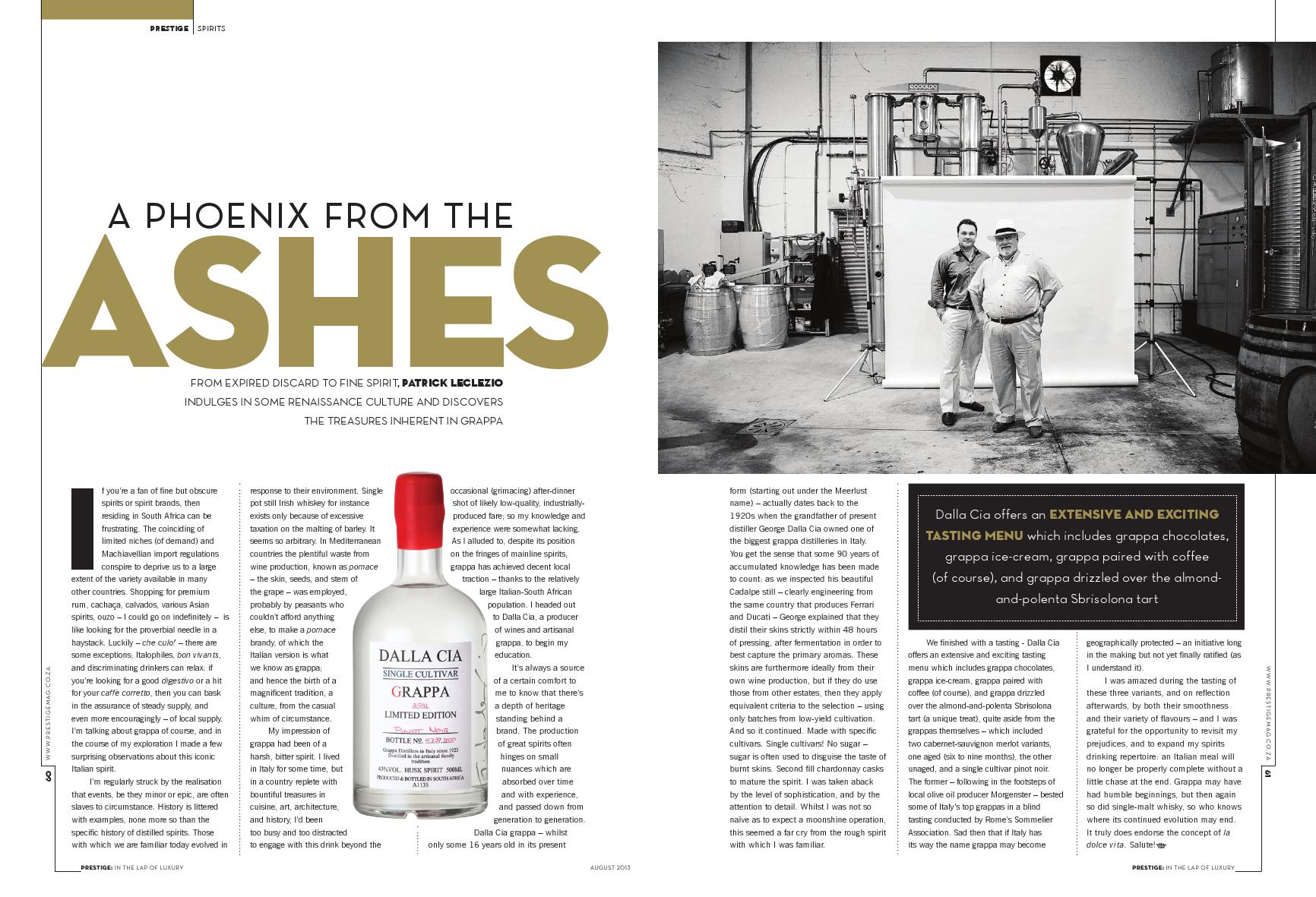
A phoenix from the ashes

From expired discard to fine spirit. Patrick Leclezio indulges in some renaissance culture.

First published in Prestige Magazine (August 2013 edition).

As it appeared.

If you’re a fan of fine but obscure spirits or spirit brands, then residing in South Africa can be frustrating.  The coinciding of limited niches (of demand) and Machiavellian import regulations conspire to deprive us to a large extent of the variety available in many other countries.  Shopping for premium rum, cachaça, calvados, various Asian spirits, ouzo, I could go on indefinitely, is like looking for the proverbial needle in a haystack.  Luckily – che culo! – there are some exceptions; Italophiles, bon vivants, and discriminating drinkers can relax: if you’re looking for a good digestivo or a hit for your caffè corretto then you can bask in the assurance of steady supply, and even more encouragingly – of local supply.  I’m talking about grappa of course, and in the course of my exploration I made a few surprising observations about this iconic Italian spirit.

I’m regularly struck by the realisation that events, be they minor or epic, are often slaves to circumstance.  History is littered with examples – none more so than the specific history of distilled spirits.  Those with which we are familiar today evolved in response to their environment.  Single pot still Irish whiskey for instance exists only because of excessive taxation on the malting of barley.  It seems so arbitrary.  In Mediterranean countries the plentiful waste from wine production, known as pomace – the skin, seeds, and stem of the grape – was employed, probably by peasants who couldn’t afford anything else, to make a pomace brandy, of which the Italian version is what we know as grappa; and hence the birth of a magnificent tradition, a culture, from the casual whim of circumstance.

My impression of grappa had been of a harsh, bitter spirit.  I lived in Italy for some time, but in a country replete with bountiful treasures in cuisine, art, architecture, and history, I’d been too busy and too distracted to engage with this drink beyond the occasional – grimacing – after-dinner shot of likely low-quality, industrially-produced fare; so my knowledge and experience were somewhat lacking. As I alluded to, despite its position on the fringes of mainline spirits, grappa has achieved decent local traction – thanks to the relatively large Italian-South African population.  I headed out to Dalla Cia – a producer of wines and artisanal grappa – to begin my education.

It’s always a source of a certain comfort to me to know that there’s a depth of heritage standing behind a brand.  The production of great spirits often hinges on small nuances which are absorbed over time and with experience, and passed down from generation to generation.  Dalla Cia grappa – whilst only some 16 years old in its present form (starting out under the Meerlust name) – actually dates back to the 1920’s when the grandfather of present distiller George Dalla Cia owned one of the biggest grappa distilleries in Italy.  You get the sense that some 90 years of accumulated knowledge has been made to count: as we inspected his beautiful Cadalpe still – clearly engineering from the same country that produces Ferraris and Ducatis – George explained that they distil their skins strictly within 48 hours of pressing (after fermentation) in order to best capture the primary aromas.  These skins are furthermore ideally from their own wine production, but if they do use those from other estates, then they apply equivalent criteria to the selection – using only batches from low-yield cultivation.  And so it continued.  Made with specific cultivars.  Single cultivars! No sugar – sugar is often used to disguise the taste of burnt skins.  Second fill chardonnay casks to mature the spirit. I was taken aback by the level of sophistication, and by the attention to detail.  Whilst I was not so naïve as to expect a moonshine operation this seemed a far cry from the rough spirit with which I was familiar.

We finished with a tasting – Dalla Cia offers an extensive and exciting tasting menu which includes grappa chocolates, grappa ice-cream, grappa paired with coffee (of course), and grappa drizzled over the almond-and-polenta Sbrisolona tart (a unique treat), quite aside from the grappas themselves – which included two cabernet-sauvignon merlot variants, one aged (six to nine months), the other unaged, and a single cultivar pinot noir.   The former – following in the footsteps of local olive oil producer Morgenster – bested some of Italy’s top grappas in a blind tasting conducted by Rome’s Sommelier Association.  Sad then that if Italy has its way the name grappa may become geographically protected – an initiative long in the making but not yet finally ratified (as I understand it).

I was amazed during the tasting of these three variants, and on reflection afterwards, by both their smoothness and their variety of flavours – and I was grateful for the opportunity to revisit my prejudices, and to expand my spirits drinking repertoire: an Italian meal will no longer be properly complete without a little chase at the end.  Grappa may have had humble beginnings but then again so did single-malt whisky, so who knows where its continued evolution may end.  It truly does endorse the concept of la dolce vita.  Salute!

To your health!

It may seem counter-intuitive to some, but drinking spirits is good for you. Patrick Leclezio ponders the blessings of booze.

First published in Prestige Magazine (July 2013 edition).

As it appeared.

As it appeared.

During my adolescence one of my household tasks was to serve my father his daily libation.  This may have been the source of my affinity for whisky.  Back then however any such tendencies, if indeed they had been imbedded, were dormant.  I had no inclination to drink any alcohol, much less spirits (such were the misguided delusions of my youth).   I remember, as we went through the ritual, that he’d often attempt to instil in me the sentiment that a regular whisky was beneficial to one’s health.  The apparent authority behind this wisdom was his father, his father-in-law, and the family doctor – all three whisky drinkers too.  I was dubious.  Undoubtedly I was a cynical lad, given to questioning just about everything, but this seemed altogether too convenient.  I never quite believed it, and it slowly sunk into the recesses of my mind…until recently.

My wife works extensively with Russians.  A while ago, after a visit to the country, she mentioned that she’d been told that the average lifespan of a Russian man was 59.  In fact it’s somewhere in the late-fifties to early-sixties depending of the study consulted, and the date thereof.  A few years here and there notwithstanding this is a shockingly bleak situation; these guys are literally vodka-drinking themselves into an early grave.  Now clearly this is on the extreme end of the scale – no-one is suggesting that excessive drinking is anything but detrimental – but can this same substance, in more measured doses, actually do you good?

The answer is yes: a variety of scientific studies, one of the earliest (published in the Journal of the American Medical Association) dating back to 1904, have repeatedly proved it to be the case, to the point where it is now undisputed. It seems that my collected male progenitors and the doctor were onto something (though whether they actually gave it any scrutiny is debatable).  Liquor drunk regularly in moderation does in fact have a myriad health benefits, reducing the risks of heart disease (in middle aged and older men in particular), certain cancers, diabetes and dementia amongst others; and given that the former is the principal cause of death in most industrialised countries this is no small endorsement. Alcohol achieves these impressive feats by impacting positively on cholesterol, blood pressure, and insulin levels, by decreasing thrombosis (effectively thinning the blood), and by improving the heart’s response to stress (as those of us who’ve sunk a few after a hard day at work will gladly attest).

So how does one know good drinking from bad?  How can one separate one’s own habits from what the Russians are doing?  The (American) National Institute on Alcohol Abuse and Alcoholism defines moderation as the consumption of four drinks on any day to an average of 14 drinks per week for men, with the corresponding numbers for women being three and seven drinks.  One drink in distilled spirit terms constitutes one and half fluid ounces, or roughly 45ml, so generous enough for this to seem more indulgence than regimen.  The important point to note is that this drinking should be regular and tempered.  I should also make it clear, at the risk of being obvious, that these guidelines apply to average persons, relaxing in the comfort of their homes; and that they would specifically exclude pregnant women, people on medication, people with a history of alcohol abuse, people intending to drive thereafter, and underaged people.

The studies also haven’t been able to find a significant difference in benefits attributable to the type of liquor consumed, so whether one is drinking red wine, beer, or hard tack doesn’t discernibly matter.  I had always been concerned that brown spirits, being less pure than their white counterparts, largely due to the presence of congeners (fatty acids) from the cask maturation process, might be at health disadvantage but gratifyingly there’s no evidence to suggest it.  This is great ‘news’ – we can all stick to our favourite tipple and responsibly drink ourselves to a longer, healthier life.

I’ve noticed (it seems to be my time for subconscious realisations) that toasts the world over are dedicated to health:  santé, gezondheid, sláinte mhath, l’chaim…the list is endless (and the origins of these toasts date back centuries).  These were conceived I’m sure to express an intention not a prescription, so the added meaning is an extraordinary coincidence.  Regardless, I’ll henceforth be toasting with extra vigour and gusto.  I wish you all the very best of health.  Bottoms up!

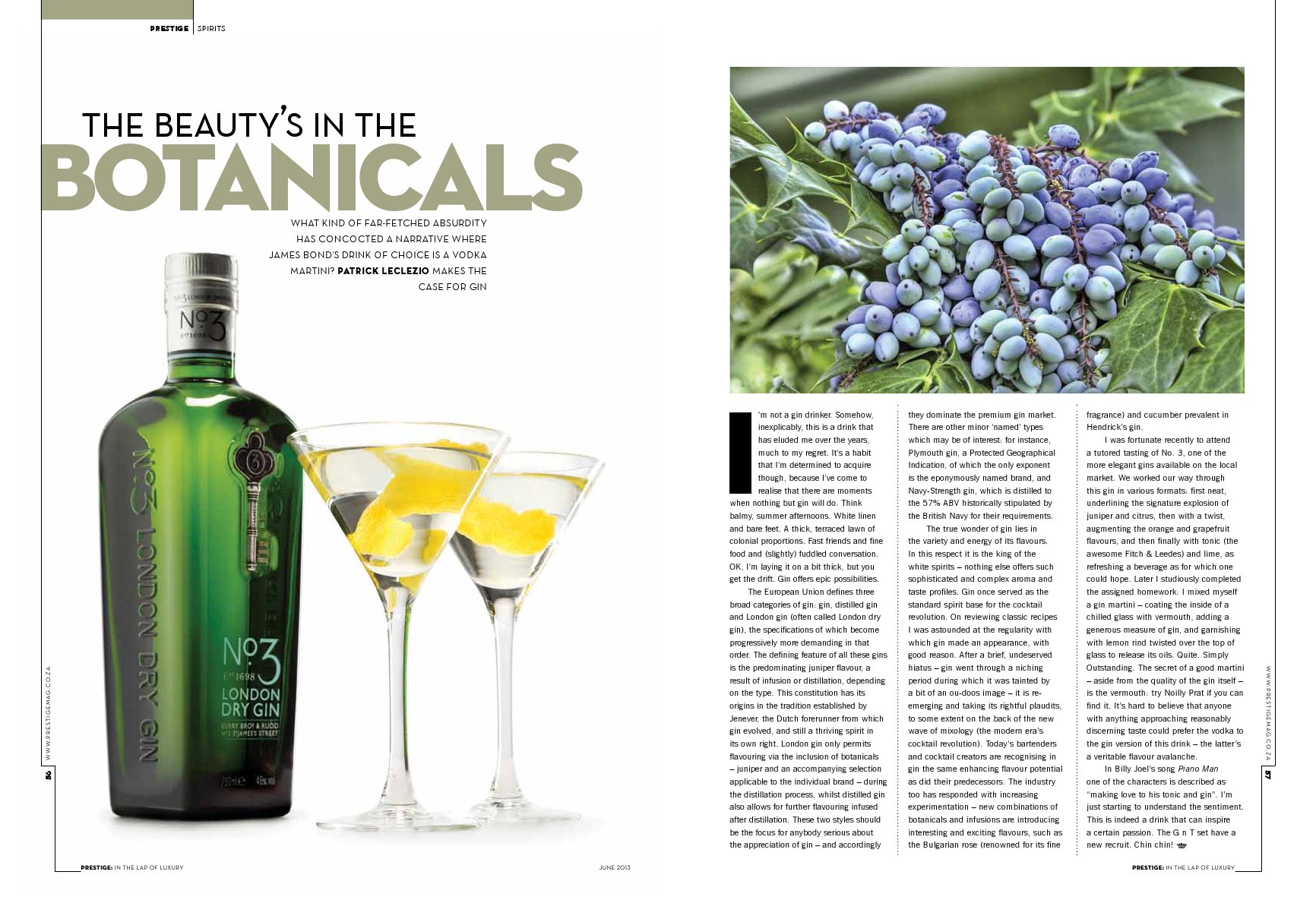
The beauty’s in the botanicals

What kind of far-fetched absurdity has concocted a narrative where James Bond’s drink of choice is a vodka martini?  Patrick Leclezio makes the case for gin.

First published in Prestige Magazine (June 2013 edition).

As it appeared.

As it appeared.

I’m not a gin drinker.  Somehow, inexplicably, this is a drink that has eluded me over the years, much to my regret.  It’s a habit that I’m determined to acquire though, because I’ve come to realise that there are moments when nothing but gin will do.  Think balmy, summer afternoons. White linen and bare feet.  A thick, terraced lawn of colonial proportions.  Fast friends and fine food and (slightly) fuddled conversation. Ok, I’m laying it on a bit thick, but you get the drift.  Gin offers epic possibilities.

The European Union defines three broad categories of gin: gin, distilled gin and London gin (often called London dry gin), the specifications of which become progressively more demanding in that order.  The defining feature of all these gins is the predominating juniper flavour, a result of infusion or distillation, depending on the type.  This constitution has its origins in the tradition established by Jenever, the Dutch forerunner from which gin evolved, and still a thriving spirit in its own right.  London gin only permits flavouring via the inclusion of botanicals – juniper and an accompanying selection applicable to the individual brand – during the distillation process, whilst distilled gin also allows for further flavouring infused after distillation.  These two styles should be the focus for anybody serious about the appreciation of gin – and accordingly they dominate the premium gin market.  There are other minor “named” types which may be of interest: for instance, Plymouth gin, a Protected Geographical Indication, of which the only exponent is the eponymously named brand, and Navy-Strength gin, which is distilled to the 57% ABV historically stipulated by the British Navy for their requirements.

The true wonder of gin lies in the variety and energy of its flavours.  In this respect it is the king of the white spirits – nothing else offers such sophisticated and complex aroma and taste profiles.  Gin once served as the standard spirit base for the cocktail revolution.  On reviewing classic recipes I was astounded at the regularity with which gin made an appearance, with good reason.  After a brief, undeserved hiatus – gin went through a niching period during which it was tainted by a bit of an ou-doos image – it is re-emerging and taking its rightful plaudits, to some extent on the back of the new wave of mixology (the modern era’s cocktail revolution). Today’s bartenders and cocktail creators are recognising in gin the same enhancing flavour potential as did their predecessors.  The industry too has responded with increasing experimentation – new combinations of botanicals and infusions are introducing interesting and exciting flavours, such as the Bulgarian rose (renowned for its fine fragrance) and cucumber prevalent in Hendrick’s gin.

I was fortunate recently to attend a tutored tasting of No. 3, one of the more elegant gins available on the local market.  We worked our way through this gin in various formats: first neat, underlining the signature explosion of juniper and citrus, then with a twist, augmenting the orange and grapefruit flavours, and then finally with tonic (the awesome Fitch & Leedes) and lime, as refreshing a beverage as for which one could hope.  Later I studiously completed the assigned homework:  I mixed myself a gin martini – coating the inside of chilled glass with vermouth, adding a generous measure of gin, and garnishing with lemon rind, twisted over the top of glass to release its oils.  Quite. Simply Outstanding.  The secret of a good martini – aside from the quality of the gin itself – is the vermouth:  try Noilly Prat if you can find it.  I was left wondering how anyone possessing anything approaching reasonably discerning taste could prefer the vodka to the gin version of this drink – the latter’s a veritable flavour avalanche. 

In the song Piano Man by Billy Joel one of the characters is described as “making love to his tonic and gin”.  I’m just starting to understand the sentiment.  This is indeed a drink that can inspire a certain passion.  The G and T set have a new recruit.  Chin chin!

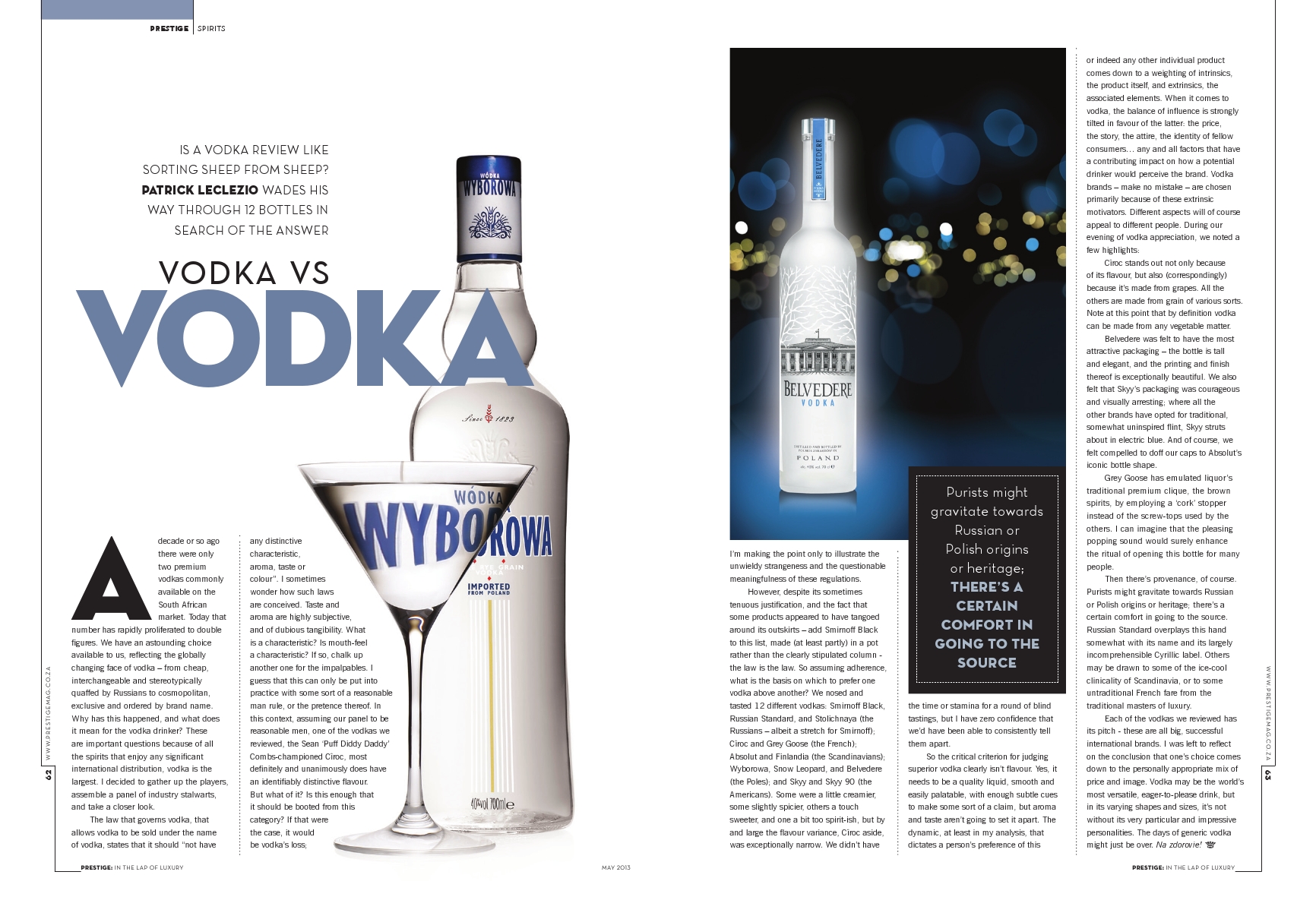
Vodka versus vodka

Is a vodka review like sorting sheep from sheep?  I waded my way through twelve bottles in search of the answer.

First published in Prestige Magazine (May 2013 edition).

As it appeared.

As it appeared.

A decade or so ago there were only two premium vodkas commonly available on the South African market. Today that number has rapidly proliferated to double figures.  We have an astounding choice available to us, reflecting the globally changing face of vodka – from cheap, interchangeable and stereotypically quaffed by Russians to cosmopolitan, exclusive and ordered by brand name.  Why has this happened, and what does it mean for the vodka drinker?  These are important questions because of all the spirits that enjoy any significant international distribution vodka is the largest. I decided to gather up the players, assemble a panel of industry stalwarts, and take a closer look.

The law that governs vodka, that allows vodka to be sold under the name of vodka, states that it should “not have any distinctive characteristic, aroma, taste or colour”.  I sometimes wonder how such laws are conceived.  Taste and aroma are highly subjective, and of dubious tangibility.  What is a characteristic?  Is mouth-feel a characteristic?  If so chalk up another one for the impalpables.  I guess that this can only be put into practice with some sort of a “reasonable man” rule, or the pretence thereof. In this context, assuming our panel to be reasonable men, one of the vodkas we reviewed, the Sean “Puff Diddy Daddy” Combs-championed Cîroc, most definitely and unanimously does have an identifiably distinctive flavour.  But what of it? Is this enough that it should be booted from this category?  If that were the case it would be vodka’s loss; I’m making the point only to illustrate the unwieldy strangeness and the questionable meaningfulness of these regulations.

However despite its sometimes tenuous justification, and the fact that some products appeared to have tangoed around its outskirts – add Smirnoff Black to this list, made (at least partly) in a pot rather than the clearly stipulated column – the law is the law.  So assuming adherence what is the basis on which to prefer one vodka above another?  We nosed and tasted twelve different vodkas: Smirnoff Black, Russian Standard, and Stolichnaya (the Russians – albeit a stretch for Smirnoff); Cîroc and Grey Goose (the French); Absolut and Finlandia (the Scandinavians); Wyborowa, Snow Leopard, and Belvedere (the Poles); and Skyy and Skyy 90 (the Americans).  Some were a little creamier, some slightly spicier, others a touch sweeter, and one a bit too spirit-ish, but by and large the flavour variance, Cîroc aside, was exceptionally narrow.  We didn’t have the time or stamina for a round of blind tastings but I have zero confidence that we’d have been able to consistently tell them apart.

So the critical criterion for judging superior vodka clearly isn’t flavour.  Yes, it needs to be a quality liquid, smooth and easily palatable, with enough subtle cues to make some sort of a claim, but aroma and taste aren’t going to set it apart.  The dynamic, at least in my analysis, that dictates a person’s preference of this or indeed any other individual product comes down to a weighting of intrinsics, the product itself, and extrinsics, the associated elements.  When it comes to vodka the balance of influence is strongly tilted in favour of the latter: the price, the story, the attire, the identity of fellow consumers…any and all factors that have a contributing impact on how a potential drinker would perceive the brand.  Vodka brands – make no mistake – are chosen primarily because of these extrinsic motivators.  Of course different aspects will appeal to different people; during our evening of vodka appreciation, we noted a few highlights:

Cîroc stands out not only because of its flavour but also (correspondingly perhaps) because it’s made from grapes.  All the others are made from grain of various sorts.  Note at this point that by definition vodka can be made from any vegetable matter. 

Belvedere was felt to have the most attractive packaging – the bottle is tall and elegant, and the printing and finish thereof is exceptionally beautiful.  We also felt that Skyy’s packaging was courageous and visually arresting; where all the other brands have opted for traditional, somewhat uninspired flint, Skyy struts about in electric blue.  And naturally we felt compelled to doff our caps to Absolut’s iconic bottle shape.

Grey Goose has emulated liquor’s traditional premium clique, the brown spirits, by employing a “cork” stopper instead of the screw-tops used by the others.  I can imagine that the pleasing popping sound would enhance the ritual of opening this bottle for many people.

Then there’s provenance of course.  Purists might gravitate towards Russian or Polish origins or heritage – there’s a certain comfort in going to the source.  Russian Standard overplays this hand somewhat with its name and its largely incomprehensible Cyrillic label.  Others may be drawn to some of the ice-cool clinicality of Scandinavia, or to some untraditional French fare from the traditional masters of luxury.

Each of the vodkas we reviewed has its pitch – these are all big, successful international brands.  I was left to reflect on the conclusion that one’s choice comes down to the personally appropriate mix of price and image.  Vodka may be the world’s most versatile, eager-to-please drink but in its varying shapes and sizes it’s not without its very particular and impressive personalities.  The days of generic vodka might just be over. Na zdorovie!

Big thanks to Hector McBeth, Ross Shepherd, and Grant McDonald.

The water of life

A short, distracted history of distillation, and a tribute to those who made it happen.  I ponder the origins of the fine spirit.

First published in Prestige Magazine (April 2013 edition).

As it appeared.

As it appeared.

An elegant bar.  The gentle clink of rocks glasses.  An array of bottles on burnished shelves.  Unobtrusive service.  Another, sir?  I don’t mind if I do.  Small, measured sips.  An explosion of flavour.  Expanding ripples of relaxation.  Laughter and conversation.  This is a ritual enjoyed by spirits drinkers the world over – a ritual made possible by the magic of distillation.

I’ve often sat back and wondered to myself how it was that this phenomenon came to pass.  By whom, how, and where, in the distant past, the product of a startling imagination, was this remarkable exploitation of nature conceived?  Fermentation I get.  It lends itself to accidental discovery; the juice of a fruit or a sugary plant left standing, the presence of the right organisms, and cheers: a realistic, probable happenstance.  The details of the theory might have had to wait for Pasteur and others, but fermentation was evident enough that people were getting merrily toasted for multiple millennia beforehand.  Distillation though would have been a tougher, altogether-more-deliberate nut to crack.

The basic process, once known, is actually very simple. It uses the different boiling temperatures of the components of a liquid to separate them from each other, and then, once separated, to specifically collect or concentrate one or the other; it is the conversion of sugar to alcohol in fermentation which provides the base which is then concentrated.  The legendary Homer (Simpson, not the guy who wrote the Iliad and the Odyssey) once said:  “In America, first you get the sugar, then you get the power, then you get the women!”  Truer words have never been spoken.  The alcohol from sugar, specifically ethyl alcohol, has a lower boiling temperature than water, its most abundant companion in fermented mixtures, so it can easily be evaporated in isolation and then condensed elsewhere in the form of a powerful, infinitely interesting, and complex liquid known as a distilled spirit.

It is likely then that nature served as the inspiration.  The observation of evaporating and condensing water, and then other liquids put on the boil, would have triggered a dawning realisation.  There are suggestions that distillation was being conducted in various places in the distant past, as far back as 800 BC in China, but the first undisputed evidence of it dates to the Greek colonies in Egypt in the first century AD, where it was being used by alchemists to distil essences for perfumes, balms and other such uninteresting purposes.  It was only much later, certainly in terms of documented fact, in the now teetotalling Arab world ironically (although to be fair it was intended for medicinal purposes), that distillation techniques were applied to alcohol, using a device called an alembic – al-anbīq in Arabic, meaning “still”.

This technology spread gradually to various areas, most impactfully to Europe, where it was added to and refined upon, and used vociferously for the making of acqua vitae, the water of life, which became the basis for our modern spirits tradition.  Stills were developed in various shapes and forms, notably the Charentais used to make Cognac, and the bulbous pot stills used to make whisky.  The structure of a still is believed to have a significant influence on the character of the final liquid, to the point where whisky makers will deliberately reproduce dents and other structural blemishes when replacing their exhausted stills.  Later still (sorry), starting in the early 1820’s and culminating with the device invented by Aeneas Coffey, the Coffey Still, came the onset of continuous distillation, just in time for the Industrial Age with its greater yields, and purer distillates.

Today, sitting in that bar, we’re able to reap the fruits of the toil of our long-gone brothers, selecting from a broad multitude of spirits to satisfy our every whim.  Let’s take break, every now and again, between the brandy and the Benedictine, to doff our caps to those who came before and made all of this possible.  It’s not classical Greek, but let’s not split hairs: Stin Iyiamas!