Category Archives: Uncategorized

This is the Chivas life

After my recent tasting of Pride I began to see myself as a bit of a whisky hero.  I’d ripped back that dram with what I was coming to believe was a practiced hand.  Yes, it’s true that I drive around on a scooter, but such realities fade after a few drinks.  From now on when it comes to whisky the sky would be the limit.  In a field of barley when I called it they would come!

Ok, who am I kidding?  That delusion died quickly. In the real world I embrace thrifty efficiency as a way of life…although I’ve heard others describe my philosophy in somewhat less glowing terms – water off a duck’s back.  Anyhow, it was thus somewhat out of character when I made the decision to break the seal on a bottle of Chivas Brothers 30yo that I’d been hoarding for some time.

Out into the light

My thought process was as follows:

–        The Whisky Exchange sells this bottle for £425 ≈ R5100.

–        Further, mine just happened to be signed by Master Distiller Colin Scott – making it a limited edition of a limited edition and adding I’d hazard about 20% to its value.  So let’s call it at R6k, or just over.

–        Cue in the delicious Glenmorangie Lasanta, going for R469.99 a pop on WHISKYdotcoza.

–        The opportunity cost?  13 bottles of sherry barrelled bliss.

You’ve now probably guessed that I didn’t buy this bottle myself, and you’d be correct.  It was a gift from my erstwhile employer, Seagram, given to certain staff on the event of Chivas Brothers’ 200th anniversary (2001).   The special occasions for which I’d been saving it had come and gone, the bottle either forgotten or the opening thereof deferred.  My major remaining milestone is the arrival of my first-born, but I reckon I’ll need my wits about me if and when that happens.

So, sometime last year, I thought #u%& @t, I’m going to crack this bad boy.  Perhaps it was a remnant of Pride-induced grandeur, perhaps it was a stupor induced by who-knows-what, or perhaps, just perhaps, it was a glimmer of good sense.  Whatever it was I don’t regret it for an instant.  You should look back on life as a collection of the greater moments, and this one was epic.

How was I to go about executing this brave decision though?  I quite enjoy the expression “to cast pearls before swine”.  It tickles my fancy…I can almost hear the crunching noises.  Needless to say it’s a situation best avoided.  This whisky had to be properly appreciated.  It was a MUST.  The answer was simple enough – I would share it with some of Cape Town’s pre-eminent whisky personalities, most of whom I’ve come to know as both fellow travellers and friends.  We would also quest for the glory of documenting what I believe is this whisky’s first set of tasting notes, although I can’t 100% verify that this would be either glorious or true.

In attendance at the cathedral (the Bascule) were Candice Baker and Niel Hendriksz, the charming ambassadors for Glenmorangie, Macallan and other esteemed whisky brands, Bernard Gutman, that local whisky legend of prolific extent, Marsh/Miles/Mash Middleton, Whisky Magazine’s editor of the ether, and, of course, yours truly.  A quick aside: big thanks George for allowing me to bring in the bottle so that we could enjoy it in appropriately ‘Grace-ful’ surroundings.

And so it was that on a picture perfect Cape Town afternoon, the five of us seated ourselves adjacent to some luxury yachts – owned by people who probably drink this dram daily, curse them.  Things started badly.  The cork broke eliciting some momentary panic.  This though was quickly resolved with a fine sieve.  Disaster averted we cascaded the golden liquid into our glasses and sat back to ponder this whisky, whisky in general, and just about everything else.
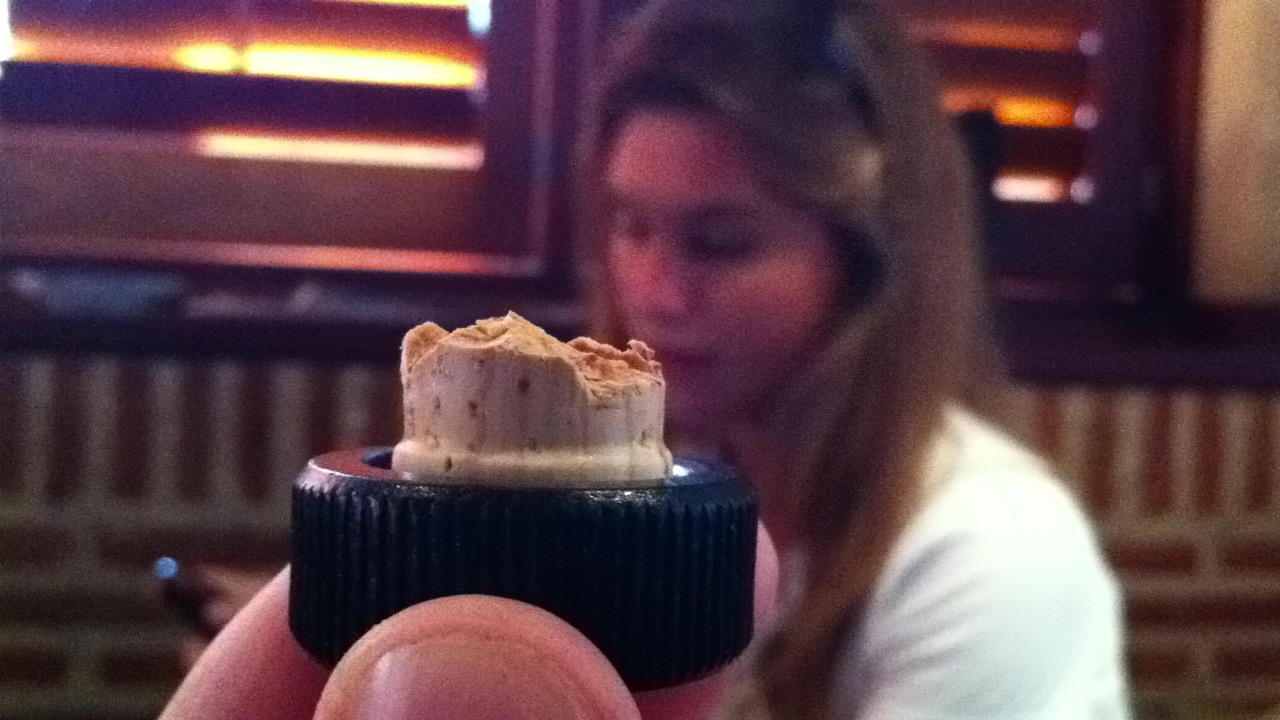
Close call

I’m not really a tasting notes kind of guy.  So despite coming up with this quest I didn’t have the diligence to actually make any notes.  Luckily some of the others were more conscientious so I have some fairly reliable information to add to the flotsam left in my memory.

Packaging:

Elegant, dark bottle with dodgy cork closure.  Simple board box with silk-like fabric covering the interior.  Adequate in 2001.  Somewhat below par in the current era of decadent over-the-top presentation.

Appearance:

Dark burnished gold, betraying a substantial sherry provenance.

Nose:

Wonderful  treacle marzipan nose, delicate hint of espresso.  Dusty dates baked under the Sahara sun.  Caramel.  Toffee.  Sherry, and lots of it.

Palate:

Caramelised tropical fruits, slight bitterness.  Dryish cigar smoke.  Comes to life with water.  The grain component ostensibly lends a wonderful oily-textured mouthfeel.

Finish:

Long lingering, flavoursome, well-balanced finish.

Conclusion:

A classic heavy-hitting blend.  Luxuriant, but stops short of mind-blowing.

Drinking the fair share that I appropriated for myself I felt like a bear drizzling honey down its throat.  I was lightly toasted by the time I left and I couldn’t help but reflect that I was on whisky buzz that could best be described as premium.  There would be no ill-effects.

A gift from the gods. Ok, actually from Seagram – more bootleggers than gods. You get the idea.

It was an afternoon to be savoured for a long while.  The chaps made some noises about regular gatherings to enjoy fine whisky of the same ilk, so I wait with bated breath to see with what they’ll come up.

From me on this fine February evening – may the dram be with you!

Photos courtesy of Marsh Middleton.

2012 ahoy!

Greetings fellow whisky lovers, and compliments of the season!  A new year has dawned which promises to be exciting indeed (if you don’t agree just fake some enthusiasm anyhow).  2012, or, more specifically, most of 2012, is also the Year of the Dragon.  In fact people born during this period will be known as Water Dragons, and since whisky is the water of life, this should be a prolific year for recruitment to our ranks.  I myself am a Water Ox so clearly the logic is airtight.

2012 Year of the Dragon

My personal whisky calendar begins with a satellite tasting next week with the highly reputed and regarded Dr Bill Lumsden of Glenmorangie.  The depths of his whisky knowledge and experience must be staggering, so I look forward to plumbing them for a few nuggets.  I hope too that we get to taste something interesting but whatever the case I have no doubt that the event will set a great tone for the year ahead.  Thereafter, early next month, I’ll be participating in my first “twasting” – a whisky tasting conducted on Twitter.  This particular twasting is courtesy of Mackmyra, a Swedish whisky that’s been taking the industry by storm.   I received my samples a few days ago and despite the not inconsiderable temptation to crack them open I’ve shown remarkable restraint…so far.

From the land that brought us Volvos, great massages and dragon tattoos...

So it’s looking like a year that’s sure to be packed with all sorts of interesting experiences and occasions.  I’ll be giving some special focus to a new venture – my own monthly magazine column.  The good folk at Prestige Magazine have offered me the opportunity to take my whisky musings into print.  My first piece – about the “new” whisky producing countries – will feature in the February issue.  Let me know what you think if you happen to read it.

Don't deny it - you know you want to subscribe.

I wish you all an inspiring, rewarding and gratifying year.  May the dram be with you!

Answering Ireland’s call

I have on this blog repeatedly expressed my gushing affection for Irish whiskey – you may remember my review of Black Bush in particular.  If fans were bottles  I would be a Melchizedek.  So yesterday was a bit of a sad day for me and all my fellow lovers of Irish, or certainly that was my first impression at the unfolding of events.  On reflection I feel mixed emotions rather than sadness as such.  The trigger was an announcement that Beam Global – the large US liquor group which owns mega-brands such as Jim Beam, Maker’s Mark, Teacher’s and Courvoisier – had bought Cooley, Ireland’s last remaining independent whiskey distiller.  Has a light that has long flickered, and sometimes waned, gone out for good?

In the midst of these morose musings my mood was buoyed by memories of a recent Irish experience.  I was lucky enough some ten days ago to attend “Find-the-Craic”, the culminating event in the “Make it 2 Bushmills” global competition.  Two young South Africans, Sean Tickner and Jonathan ‘Oros’ Oliff, won this competition, beating out 3600 other teams in the process.  As if these guys weren’t righteous enough for having “brought the distillery home” the fact that we share an alma mater elevated them further in my esteem.  If I were a rah-rah jolly hockey sticks type, or rather the male equivalent thereof, I’d say “Go School!”, but I’m not so I won’t.  There is nonetheless a certain kinship to having been forged in the same fire.

Oros, Colum and Sean

A bit of context at this point.  I have attended countless liquor and tobacco promotions.  These are industries not known to be shy to flash their cash.  They are also categories where brand (the extrinsics) can tend to often overshadow product (the intrinsics), which is all well and fine, but extrinsics are costly and that cost eventually finds its way into the price of the product.  I once organised a Benson & Hedges party where we bussed (by luxury coach) a large group of celebrities into the Tswaing meteorite crater for a party of unjustifiable proportions.  It bordered on the ridiculous.  A few years later I was at a Lucky Strike concert where Violent Femmes played for a crowd of less than 300 people.  And I can quote dozens of similar examples.  I think I’ve reached the point where I can no longer be impressed by wanton expenditure…although I don’t really mind having this hypothesis tested from time to time :).

At Find-the-Craic I was teamed up with a group of similarly blasé whisky veterans: the legendary Bernard Gutman, whisky supplier extraordinaire Hector McBeth, and Whisky Mag SA digital editor Marsh Middleton, sometimes also known as Miles.  This was as hardened a group as for which you could hope, and yet despite our ho-hum preconceptions we were at the end of the day – to a man – all impressed by what we had experienced.

After a leisurely lunch at the Chapman’s Peak Hotel, where we were seated with Master Distiller Colum Egan, we separated into our respective teams and followed clues to the sites of the various challenges that were awaiting us.

We've already found the craic!

The program was essentially a replication of what Sean and Oros had faced during their epic victorious journey; it was comprised of barrel rolling, whisky tasting, beach golfing, and cocktail making, all of which was great craic (fun), especially in good company, and it was followed by a party at the Bascule, the Cape Town whisk(e)y HQ, where we were entertained by an excellent Irish singer with the interesting name of Foy Vance.  Foy incidentally comes from the French word “foi” meaning faith, although I can’t confirm that this was the basis upon which this particular Foy was named.

Foy Vance in action

Anyhow, I digress.  The day was organised with metronomic precision.  It can’t be easy managing six separate sites (seven if you include the collection point) and yet it was all seamless.  I didn’t notice a single misstep – even though I tried to throw a spanner in the works by tweeting misleading information to lead the other teams astray.

The fun and games aside, what was most impressive was the whole philosophy of the promotion, and by projection the brand.  Money was spent, make no mistake – this can’t have been a cheap endeavour – but there was heart, warmth and a genuineness about the proceedings.  I felt this way primarily for the two following reasons:

–        The theme of the promotion was closely tied to the core brand message of friendship.  Of course this was a marketing exercise, but it was kept relevant, responsible, related to the product, and within reason.  The Bushmills team was generous but not excessive.  I didn’t at any time feel like I was being arbitrarily schmoozed.  This is a brand that seems well grounded, secure and true to itself – no pretence was necessary.

–        The event was a standout largely due to the presence of Colum Egan.  Colum is a real Master Distiller (the best there is if his tongue-in-cheek comments are to be believed), unlike others who spend more time pounding the PR trail than doing any actual distilling.  I had the sense that we were his personal guests, as opposed to invitees at a brand function.  He was a relaxed and congenial host, chatting about the cost of a column still one moment, making stirring toasts the next, all the while making sure we had a great time and having a great time himself.

Taking a short break from distillation duties.

Now, back to my earlier worries about the Cooley situation.  Bushmills is owned by the liquor colossus Diageo, and you just don’t get more corporate than Diageo.  If it’s possible to substitute a process for any element of human initiative the Diageo machine will typically find a way to do it.  And yet, on the evidence of this experience, is there any real cause for concern?  The spirit of Ireland – which history has shown can never be tamed – and of Irish whiskey clearly still thrives within Bushmills.  I have a feeling that independence in Irish whiskey, despite superficial appearances to the contrary, will not be lost to us.

Check out Marsh’s video summary here and Bernard’s endorsement of the post-event here.

Photos courtesy of Tony Niemeyer.

How much is too much?

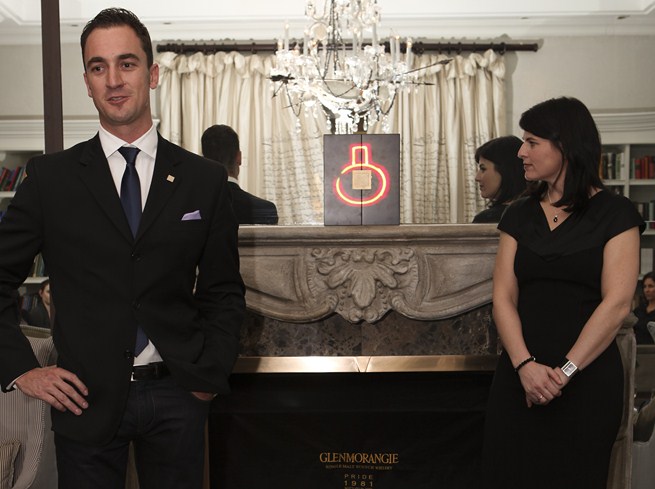
I was privileged a few weeks ago to attend the launch of Pride 1981, the new glittering gem in the Glenmorangie crown.  I say privileged because at R30 000 per bottle, and with only 1000 bottles available worldwide (and – at this stage – only one in South Africa), I am destined to be amongst the rare few ever to taste this whisky.  It’s my guess that this is a big part of what Pride is about: making people feel special.

Hot chicks. Is there anything they can't sell?

I can, with little persuasion, wax lyrical about this wonderful whisky and I will be doing so.  It is without a doubt magnificent.  But, let’s not deny it, its single most remarkable attribute, jumping out at you suddenly like sixteen men in the dark Scottish night, is its price.   It’s bloody expensive.  Insanely expensive!  But then any whisky costing what I’d anticipate spending to refurbish a bathroom seems excessive to me.  Sadly, I’m simply not in this league…or anywhere near it for that matter.  Nevertheless, in the pursuit of objectivity, to give Pride and its hefty price tag a fair shake, I decided to cast myself in the role of a realistic potential buyer.  As a suave Bugatti driving, supermodel dating, beachfront habitating, yacht sailing, island owning, whisky loving billionaire, would Pride get me reaching for my Hermes wallet?

Wow!

To answer this question I had evaluate how the whisky stacks up against its peers.  This required a little twenty-first century window shopping (Windows browsing?).  Strap yourselves in.

I based my review on an analysis of the following criteria:

Style and scarcity – Pride is a vintage, single malt Scotch whisky.  This means that all of the liquid used in the bottling of Pride was distilled in the same year, specifically 1981.  The typical single malt will usually combine whiskies of different ages from distillations having occurred in different years.  This is done to ensure consistency of flavour from bottling to bottling.  Vintage whiskies are unique in flavour, and usually very limited in quantity, hence they attract a premium.  Pride – with a release of 1000 1L bottles – is indeed limited, but not really limited enough to justify its price.  Other heavyweights punching in this class – such as the Dalmore 1974 Aurora and the Talisker 1973 – were limited to 200 and 100 70cl bottles respectively, so considerably more exclusive.  It should also be noted that many of Pride’s contemporaries are single casks, a style that appears to command an additional premium.  I personally don’t see the justification.  In commercial terms a vintage is by definition equivalent to a single cask (or maybe not: I guess there’s always the possibility of releasing more of a vintage, whereas once a single cask is done, it’s done).   Whichever, the fact is that these further diminish Pride’s claims on the basis of this criterion.  If we were to stop the analysis here this wouldn’t seem to be such a clever purchase.

Age – Older whiskies are typically more expensive.  Pride is a 28 year old whisky, old but not that old.  There are equivalent and older whiskies available which represent much better value for money purely given their age.  For instance I came across a Glenlivet 1965 – a 40 year old whisky – at £999.  Pride at the same outlet sells for £2450.

ABV – Ok, so now the momentum starts to swing.  Cask strength generally fetches more than standard bottling strength, because it’s the undiluted real deal.  Pride, at a whopping 56.7%, would significantly stretch my billionaire persona’s per bottle drinking pleasure.

Volume – Pride is bottled in litres.  That warrants a bottle price of up to 43% more than if it were 70cl.

Brand – Glenmorangie is single malt aristocracy, and it should be priced accordingly.  It is the natural order that a prince would be ransomed at a higher price than a peasant.  Sorry, that’s just the way it is.

Packaging – Ultra-premium products are intended to impress, and packaging has a big part to play in this regard.  Pride has some of the most elaborate packaging that I’ve ever seen in the category – the Baccarat crystal decanter and the cantilevered box set a new standard.

At this stage I was still hesitant.  There may after all be no need to reach into the pocket of my Saville Row suit.  One important bit of information was still to be considered however, and here’s where Pride really comes into its own.

Maturation – Pride is double-matured, having been accommodated for the latter iteration, a duration of some 10 years, in some very special Sauternes casks from the legendary Chateau D’Yquem vineyards.  I doubt that there’s anything out there that’s even remotely similar.  To make the matter even more compelling double-maturation (and the specific instance of it known as finishing) is unusual in older whiskies.  I’m guessing that as a whisky ages there’s increasingly more value at stake, and it becomes less and less sensible to fool around with it.  High risk deserves high rewards.  Once I’d taken into account this interesting, highly unusual ageing process and the exceptional casks in which it was executed there was only one possible conclusion: Pride is a standout.

It is this alone – the quality and rarity of its maturation – that seals the deal.  It might be expensive, but justifiably so.

Now that that’s settled onto the whisky itself.  I’ll keep my musings down to two impressions:

–        Firstly, this is a rich, intense whisky.  It is magnetic, commanding of attention, all-consuming.  It brooks no distractions.  Perhaps it was the hype, perhaps the dramatic pre-amble, or even the knowledge that this would be my first and last dram of Pride, whatever it was, and I believe that the flavour had no small part to play, I was fixated on it with single-minded focus, drawn to it like a moth to a flame.  The experience was almost spiritual.

–        Secondly, the fruity, jammy, treacly flavours reminded me, quite strikingly, of a delicious, dense, dried-fruit compote that was part of my Mom’s culinary repertoire back in the day.  I was transported to my youth as I nosed and sipped, and nursed the precious dregs.  All that was missing was the “crème à la vanille” by which that compote was usually accompanied.  Mmm, I’m licking my lips as I’m writing this…

The long and short of it, as I mentioned at the beginning of the post, is that Pride is magnificent.  If you’ve got the dough then I strongly recommend that you don’t miss the show.  If you don’t got the dough, then you may want to try Nectar D’Or, the budget version of Pride, 10 year old Glenmorangie Original finished in Sauternes casks for some 2 years, a fine whisky that I’ve often enjoyed, but poured for me immediately after my dram of Pride had expired it lacked its usual lustre.  How easy it is to become accustomed to the finer things…

Photos are courtesy of David Lazarus, with special thanks to Patrick Leslie.

Our charming host and hostess, Niel Hendriksz and Karen Fullerton from Glenmorangie.

Fiona MacDonald from Whisky Magazine and some guy whose name I don't know. Wait, hang on, it's Marcus.

SA whisky legend Bernard Gutman. Seems he prefers his whisky with a twist 🙂

The Thomas Edison of whisky makers

November is Whisky Festival time in South Africa.  I’m not going to rehash the details – they’ve already been put out there by every Tom, Dick, and their uncles.  Safe to say it’s a whisky extravaganza; if you’re even remotely partial to the golden nectar then you shouldn’t miss it.  The participating brands shell out some long dollars to be present, a fair portion of which goes to subsidising the tasting stock that you’ll be imbibing.  So there’s really only one thing for it – make hay whilst the sun shines.

How to approach the Whisky Festival

You’ll be tempted to gravitate to your old favourites, or maybe to the big boys with their flashy stands.  However the single most appealing feature of the Festival, for me anyhow, is that it brings a wide range of whiskies together under one roof, giving you and me, the whisky lovers, a magic opportunity to sample some off-the-beaten track, sparsely available, sometimes obscure but equally worthy, and often superior whiskies.

Top of my list for this year’s Festival is the new Compass Box initiative: the Great King Street range, or if you want to be whisky-hip, just GKS.  They’ve named the first-born “Artist’s Blend” and it’s been making quite the buzz in whisky circles.

GKS takes its name from the address of Compass Box's Edinburgh HQ

If you’re unfamiliar with Compass Box whiskies then this is something that you should remedy at your very soonest convenience.  There tends to be a common thread amongst premium brown spirits the world over – by and large they share a critical success factor: heritage.  It seems that if you want to make it to the big time, you need to have been around for a while.  So when a brand breaks the mould, especially in whisky, you know that there’s got to be something very, very special about it.  Interesting then, compelling even, that Compass Box is barely 10 years’ old…

The home page on their website touts them as “Four-time Whisky Magazine Innovator of the Year”, and this, innovation, is really what sets them apart.  Very simply they do things differently – not just different-different, but better-different.  Whisky has been made in largely the same way for hundreds of years – this is an old, conservative, traditional industry with deeply entrenched interests.  Change is resisted, and true innovation is rare.  Not long ago the guys at Compass Box ran afoul of the Scotch Whisky Association (SWA) with the production technique used to create their Spice Tree product.  This whisky was given a secondary maturation in casks fitted with new oak staves, judged by the SWA, who exist to make sure that those entrenched interests stay entrenched, to be contrary to the law that stipulates that whisky be produced in “the traditional way”.  The product was forced to be withdrawn but Compass Box later replaced the staves with barrel heads – made from the same new oak – to even better effect.  In whisky this is innovation of Apple-like proportions.

Why was I wasting my time with light bulbs?

The man behind Compass Box, John Glaser, has, like most whisky makers, emphasised the importance of wood in creating great whisky.  Unlike many others he’s backed up the talk with hard facts, which gives me some serious confidence in his products.   My default assumption when a whisky brand is secretive is either that disclosure is unflattering, or that the bar is likely to be lowered on occasion.  Compass Box is entirely, refreshingly transparent.  When Glaser claims that they use better wood than the majority of the Scotch whisky industry, I’m inclined to believe him.  Specifically Compass Box eschews the use of older, tired casks, which are commonplace, instead ageing whisky exclusively in either first-fill oak, or in a wood style that it has effectively pioneered: superior quality, slow growth, air-dried (as opposed to kiln dried), virgin French oak.

The only Scotch whisky blend aged in new wood

Here are the wood specifications for the GKS Artist’s Blend:

WOOD (Flavour Impact)

1             First Fill American Oak Barrel (vanilla)        62.3%

2             New French Oak Finish {New-Headed Barrel}         27.7%

(Grilled Marshmallow, toastiness, roasted coffee)

3             First Fill Sherry Butt (wine, dried fruits)      10.0%

I was fortunate enough to get a sneak-preview – a tasting at the Bascule last week.  It was a quick in-and-out which didn’t give me the time to study the whisky at length and compose detailed tasting notes (which I find somewhat tedious anyhow), so I’m only able to share general impressions.

Firstly, in appearance the whisky is satisfyingly hazy – no ice or cold water needed.  It is out-of-the-closet, proud-as-you-like, riding-on-a-float non-chill filtered.  This may not seem, in this enlightened whisky era, like something particularly distinguishing, but bear in mind that this is a blend, and that it is significantly aged in new wood.  In either case, never mind both, how many others can make this same claim?  Very few I’ll warrant.

I'm Scottish, I'm non-chill filtered and I want everbody to know it

Secondly, it is without a doubt the creamiest whisky I’ve ever tasted, a feature attributable, according Compass Box Tweetmeister Chris Maybin, to the quality of the grain whisky used (their grain is fully aged in first fill American oak), but I’d venture that my first point also plays a big role.  Well worth drinking for the luxuriant mouth-feel alone.

Thirdly it is a gunslinger of a whisky.  Probably not the most complex or sophisticated, but with flavours that are big, bold, and well-balanced.  I picked out vanilla, biscuit (paste of chewed up Maries), fruit, spicy wood and nut as they came thundering past.

Compass Box have heralded the GKS range as the “Rebirth of the Blend”, on the premise that the reputation of blended whisky has been tainted by low-quality, inferior products.  This makes for great copy but I’m not sure if blended whisky in the price range at which GKS is certain to be bracketed particularly needs a rebirth.  Regardless, the wordplay aside, this is an unusual, vastly interesting, hugely enjoyable whisky that carries forth with great aplomb the mantle of innovation established by its predecessors.  I’ll be seeking it out and so should you.

Liebster Award for WoW

I’ve been the blogging equivalent of a bad friend.  We all know the type – they take weeks to respond to a message, if at all, and then claim that they’ve been “super busy”.  Not good enough.  In my case it’s time to make things right.

I was recently done the honour of being nominated for a Liebster Blog Award by my fellow whisky blogger Whisky Woman.  WW: firstly – apologies for the delay in formally acknowledging the award, and secondly – big thanks for choosing me.

Cool bananas!

The Liebster, I’m given to understand, is awarded to emerging bloggers, the purpose being to spotlight their work and hopefully boost their following.

It works like this:

  1. Thank the giver and link back to their blog.  Tick.
  2. Pass on the award to 3-5 selected bloggers and let them know by leaving a comment on their blogs. See below.  Half-tick.
  3. Copy and paste the award on your blog.  Tick.

So, here are some bloggers worthy of extra attention:

Another Damned Food Blog

Magic stuff.  A class act.  This guy wields words like a hammer.  Witty irreverence at its hard hitting best, fuck you very much.

MojoDojo

I was chuffed to contribute a post to the Dojo some time ago – check it out here.  These dudes have the inside line on popular culture, Joburg style!  Prolific, and consistently witty.

South African whisky bloggers

We’re a rare breed.  There are only a handful of whom I’m aware.  These sterling gentlemen are out there flying the whisky flag in darkest Africa– please give them your support.

Whisky Brother

Whisky Tasting Fellowship

Let’s Talk Whisky.  I believe Marsh’s blog is down due to other commitments.  Here’s hoping it’s temporary.

To all you bloggers out there – keep the faith and may the dram be with you!

The whisky tasting deconstructed part 3

Wow, I’ve been so caught up by the World Cup (let’s say no more about it), by my regular work (the irksome distraction that puts bread on the table), and by my recent holiday (less irksome) that I’ve let the blogging slip.  Well I’m now breaking out of the post-vac funk.  This series on tasting was not in fact prematurely cancelled by the networks: here’s the final episode.

We left off at appearance before I meandered about somewhat gratuitously.

Next up then the nose or aroma.  In part 2 I made a strong case – or so I thought – for giving the nose its pre-eminent due.  It seems however that when it comes to my powers of persuasion a gap exists between my perception and cold reality.  My own brother – he who is flesh of my flesh, and blood of my blood – ridiculed my new whisky glasses (I can still feel the hurt 😦 ) and was generally disdainful about the whole notion of nosing.  Pretentious, he called it.  For a split second – before logic prevailed – it made me question myself: have I managed to get sufficiently far up my own arse that I’ve become one of those anoraks whom I despise?  Is nosing just the expected form for a whisky lover?  This is actually an important question to consider.  It’s easy to get caught up in ritual.  Let’s break away from whisky for a moment.  Imagine bread, freshly baked, voluptuous, just out of the oven.  A thick steaming slice is spread with rich Danish butter, which then melts into the hot bread.  You reach for a pot of ripe youngberry jam.

Yum

Freeze it there.  Now give yourself a blocked nose – you can’t smell a thing – and picture the scene again.  Hell, you might as well be eating a dog biscuit.  No, I would suggest, and most would agree I think, that nose is undisputedly important…nay, critical.  The aromas in whisky may be more subtle than those in baking, but understated charms have their own powerful appeal.  Scientists have identified multiple hundreds of distinct flavour bearing compounds in whisky.  The nose is essential to “unlocking” and enjoying these flavours.  It deserves dedicated attention.

I don’t like to oversell.  But here I’m going to chuck in a little extra – some hard-earned knowledge that I managed to prise from the internet.  Our sense of smell is derived from the olfactory bulb which is part of the brain’s limbic system, a region also closely linked with memory and emotion.  This physiological connection is the reason why smell has the ability to call up memories and emotional responses almost instantaneously.  So, on a deep and personal level aromas, or at least certain aromas to certain people, are intrinsically interesting.    The nose of my Redbreast 12yo was redolent of cut-grass and caramelised sugar.  It evoked memories of cricket games on mowed turf, of sprinting across the outfield to cut off a boundary, and of the toffee-ish crust on my Mom’s apple-bake.  Why would I or anyone else want to ignore such an evocative part of this experience?  I, we, don’t.

Those halcyon days

So how do you go about nosing a whisky thoroughly?  Do you just stick your snoot in the glass and inhale?  When it comes to whisky be prepared to be humbled.  There’s always more to learn, and sometimes it’s basic stuff.  I was recently invited to an event hosted by The Macallan – an excellent evening spent viewing fine photography and sampling even finer whisky – to which I was accompanied by my non-noseworthy brother, his wife (also unconverted), and an old friend, a local film producer of such legendary status that dropping his name would be downright gauche.  For the purposes of this post let’s call him Carson.  Carson had recently been to a tasting where he’d been prompted to open his mouth whilst nosing whisky.  I was dubious but gave it a try, and wow, what a difference it makes!  It was the equivalent of fuzzy vision suddenly being focused – everything seemed more precise, more acute, more definitive.  Cats apparently smell in this way.  There are organs in their mouths, called vomeronasal organs, that supplement their sense of smell.  These organs are also present in humans but are thought to be vestigial (i.e. like the appendix no longer serving a function).  Maybe not though.  Or maybe there’s some other simple explanation for Carson’s nosing style – Google can only get you so far.  Regardless, if you weren’t aware of this nifty little trick, give it a go – it’s easy and it works.

There are a few other “tricks” worth investigating, if you’re so inclined:

–        When you start nosing whisky, and even if you’ve been doing it for a while, you’re likely to be asking yourself whether you’re really smelling some of these subtle aromas, or whether they might be a figment of your over-exuberance.  You think that you smell something but you can’t quite put a finger on it.  Consider this: you met someone briefly years ago.  Unexpectedly you see the person whilst you’re out and about in a public space.  The face seems familiar, but you can’t place it, or associate it to a name.  This is the olfactory predicament.  Our sense of smell is the poor relative – deprioritized, often ignored, and mostly deprived of attention.  Recognition comes with repetition.  You may not remember that fleeting face in the crowd, but you won’t forget your wife’s.  It’s got to do with observation.  Smells can be observed just like sights and sounds.  Pay greater heed to aromas in daily life and it’ll enhance your ability to more readily identify these in your whisky.  To what extent will this amplify your enjoyment, if at all?  I’m not sure.  The optimal fun/work balance is different for each of us.

–        Alternate between two different, and somewhat polarized, techniques. Firstly focus on a particular reference point, i.e. a single aroma, and attempt to identify this in the nose.  This reference can be sourced from tasting notes about the whisky, from the impressions of others who may be tasting the whisky with you, or from a standardized model.  Secondly, make your mind blank and indulge in some free association.  Let your imagination loose.  There are no wrong answers.  I favour the latter because of its fun factor domination.

These tips above are of equal relevance for the taste of a whisky, but the next one is specific to the nose:

–        You now know about the cat thing, so try varying it up some more:  long draws, short sniffs, and, discreetly (I wouldn’t let my brother see me do this), block one nostril at a time.  Each iteration might give you a different perspective.

Although I’ve focused on this aspect of it, nosing isn’t just isolated to aromas.  You should also be aware of the nosing effects – the sensation on the epithelium or lining of the nose (like mouthfeel for taste) – and how these influence your personal impressions of a whisky.  One of the flavour standardization models which I have at hand labels these effects as any one of pungent, prickling, nose-warming and nose-drying.  I’m not convinced that it’s particularly necessary to get caught up in these details, but getting a gauge on the level of prickling can be useful in guiding reduction, since this can largely be attributed to the bite of the alcohol.     Add water gradually from neat until the prickling dissipates.

Moving on.  You’re now ready to toss it back.  This is where formal tastings can really get pedantic.  Let’s struggle through it.

First up you should evaluate mouthfeel.  I was given an old Glenmorangie tasting manual which provides some useful vocabulary to guide you through this process.  According to the venerable gentlemen who bring us this fine Highland malt (there are apparently sixteen of them, residing in a place called Tain) a whisky can either be mouth-coating (oily, creamy or smooth), mouth-warming (like Nando’s peri-peri mild to fiery), mouth-watering, or mouth-furring (astringent or dry).  Related – in that it influences mouthfeel – but separate is the body or texture of the whisky, ranging from light and watery to full and dense.  The aromatics have now been fully appraised and are nevertheless trapped in your mouth so feel free to roll the whisky about as if it were Listerine.

Secondly, you’re now finding yourself in the home-stretch, the taste.  Remember that it can be meaningful to taste both neat and reduced.  There are 4 primary tastes – bitter, salty, sour, and sweet – which may be present in a whisky, either individually or, more likely, in combination.  Other flavours, which you interpret as taste, are in fact aromas detected by the nasal passage at the back of your mouth.  Swallow and savour the finish, the persisting flavour of the whisky after consumption.  Does it linger long or is this whisky lingerless?   Is there an aftertaste – new nuances that were not initially evident but might appear after a second sip or after a few minutes have elapsed?

I copped some flak from smokers because on my comments in part 1.  I’m going to try to make it up to them.  You’ve now reached the point where you can sit back with a self-satisfied look on your face, light up a smoke, and consider your overall impressions of the whisky.

These ones are better for you. The tobacco equivalent of broccoli really...

I tend to focus on one aspect alone – balance.  Are the various flavours in harmony with each other or is this whisky wearing black shoes with a brown belt?  Is the taste consistent with the nose, or does it just talk the talk, but not walk the walk?  Weighty matters indeed…

Incidentally I found the Redbreast 12yo to be beautifully balanced, nimbly performing cartwheels on a tightrope.  I have tears in my eyes as I look at the dregs that are all that remain in the bottle.

On that bittersweet note I’m going to abruptly terminate this series of haphazard musings.  Enjoy the week ahead, and may the dram be with you.

A visit to the Scotch Whisky Experience

My promised contribution to this blog is long overdue. It’s been more than a month since my visit to Scotland, and, more specifically, the Scotch Whisky Experience (SWE) situated on the Royal Mile, a stone’s throw from Edinburgh Castle.

The slick SWE entrance set amidst old Edinburghian stone

Before I continue, let me make it very clear that I know next to nothing about whisky. What I do know has been gleaned from many a night listening to my husband wax lyrical about his favourite drink.  So any knowledge that I might have acquired has been incidental.

I was in Edinburgh to visit my dad – a very Italian whisky lover, conveniently living in Scotland.  The last time I visited we took a lovely drive through the Highlands and stopped off at a few well-known distilleries along the way.  On this occasion we didn’t have the time to travel out of the city however we had been offered a complimentary visit to the SWE, courtesy of the very friendly and welcoming team (thanks to Angela in particular!) that WoW had come to know through this post.

The SWE building is surprisingly modern, considering the historic nature of its immediate surrounds.  The tour options cater for varying needs, from those wanting a relatively quick introductory circuit, to those wanting something a bit more in-depth (with a couple of extra tastings thrown in of course!).  We were offered the Silver tour, which lasted approximately 1 hour.

It began with an entertaining audio-visual presentation: we were seated in a “vehicle”, aesthetically fashioned like a still, which then moved around like the teacups and saucers ride at a fairground.  This was followed by a ten minute browse in a room decorated with photos and information that explained the whisky-making process in some detail.  For foreigners there is a very nifty tool, resembling one of the original Motorola cell phones, which takes you through whisky-making blow-by-blow in your preferred language.  My father tried out the handset and was highly impressed with the quality of the Italian translation!  It saved me from having to explain some of the more technical English terms.

The next stop was a small auditorium, where all the seats were accompanied by a tasting glass, and a colour and taste chart.  A short presentation followed, which took you through key information about the whisky industry, the difference between single malts and blends, the defined whisky regions in Scotland, and the styles of whiskies that emanate from each region and why.  This presentation is great for novices like myself and even for the more informed I would imagine that it would be very entertaining, if not terribly educational.

Our colour charts were divided into the 4 whisky regions and as we were introduced to the characteristics of each region we were prompted to scratch the corresponding section on the cards to release aromas typical of the whiskies from that region.  This was a very interactive and engaging way of demonstrating the various flavour groups.  We were then given the opportunity to choose the profile that most appealed to us so that we could have a tasting of a whisky from that region (if you were fortunate enough to be on the platinum tour you got to have a dram from each region).  I chose a whisky from the Lowlands, because whiskies from this region were described as being light and fragrant, and more palatable for those of us who are not yet accustomed to drinking whisky.  For the first time in my life I can honestly say that I thoroughly enjoyed a whisky!  I fell in love not only with the whisky, but with its lyrical name – “Auchentoshen”.  The distillery is actually owned by the famous Japanese whisky company Suntory.  Unfortunately I haven’t come across it again since returning home to Cape Town.

Triple-distilled Lowland Scotch whisky

Our final destination, and the real highlight of the tour, was a viewing of the worlds’ largest whisky collection.  Previously owned by Claive Vidiz of Brazil, who had amassed over 3300 bottles during the course of many years, in 2009 the collection was sold to Diageo, the world’s largest distributor of whiskies.  To be in a room surrounded by so many different, special whiskies was awe-inspiring.  Claive did not discriminate and his love of whisky led him to collecting all sorts from blends to malts – some young, some very old.  The collection is very well looked after with the bottles cleaned regularly (I would hate to be entrusted with that responsibility – I recall not too long ago knocking over what remained of my husband’s Chivas Century of Malts, much to his dismay!).  The tour pretty much wrapped up as we finished our drams, while looking on in awe at the incredible collection of bottles that lay before us.

The well preserved Claive Vidiz Collection

The experience managed to be highly informative, without being overwhelming.  As I already mentioned, there are a number of tours to suit one’s specific needs – the silver, gold and platinum tours which are 50mins, 1h10 and 1h30 long respectively.  Each tour offers slightly more value, although the 50min tour was just perfect for me, as a relative newcomer to the world of whisky.  I would imagine that the gold and platinum tours would suit those of you who are already passionate.  The staff were extremely knowledgeable and although Diageo is a major player supporting the SWE, there was no bias at all (except toward Scotch whisky in general!).  All in all, well worth the visit.   Don’t miss out if you happen to be in Edinburgh.

A journey to the heart of whisky

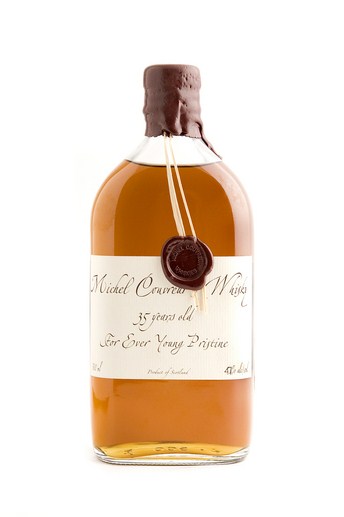
A good while back I was having dinner with a friend at his home when he pulled out an unusual-looking bottle of whisky.  It had a distinctive hand-applied wax seal, and it didn’t have the type of slick label that big brands spend thousands developing.   The thing radiated an authentic old world charm. “You’ve got to try this whisky”, he urged, “it’s made by Michel Couvreur”.  “Who?” I replied.

Michel Couvreur, that’s who!

Fast forward a couple of years and I’m at another dinner – just outside the city of Beaune in Burgundy – with none other than Monsieur Couvreur himself.  He’d invited me to an amazing restaurant.  Aperitifs and amuse-bouches on a pagodaed terrace to the dulce sounds of a string quartet.  Three courses of lobster, each paired with an exquisite wine.  A cheese trolley of astounding proportions and variety.  Grand Marnier soufflé with sorbet.  Coffees (of the civet variety no doubt).  An audience with the head chef.   If he’d set out to impress he’d succeeded in spades.  Next time someone mentioned Michel Couvreur I wouldn’t be hooting like an owl.

That epic dinner was the culmination of events put in motion at the previous dinner.  We had ruminated deep into the night about the sorry selection of whiskies in South Africa.  You’d struggle to find a regular independent bottling, but something like this – an artisanal whisky, of the style that was originally made by the doyens of Scotch whisky before their names became mass brands, something truly special and out of the ordinary – was completely beyond grasp.  So, motivated by nothing other than the love of this fine whisky and a thirst (pun intended) for the adventure, we decide to seek out Michel Couvreur and convince him to ship us his goods.

Checking out Michel Couvreur’s Special Vatting

Eventually I ended up in the small village of Bouze-les-Beaune, iconically midway between Scotland, from whence Monsieur Couvreur has “clerach” (a fancy name for new-make) distilled to his personal specifications, and Andalusia, where he sources many of his casks.  The whisky philosophy of this deeply philosophical man is simple – it is based on the conviction that 90% of a whisky’s character and quality can be attributed to the wood in which it has been aged.  This has raised some ire amongst certain whisky commentators.  The influential Malt Maniac Serge Valentin had this to say in 2008: “Indeed, twelve years ago or so, I attended a Michel Couvreur session where they claimed that the distillery didn’t matter, that only the casks did, thus implying that displaying the distillery’s name on a Scotch single malt whisky was useless.  No need to say that that did really put me off, and that anything branded ‘Michel Couvreur’ used to make me frown – at best – since that very session”.  It may be an extreme position – and I’m not sure that Monsieur Couvreur uses the word, or even implication, “useless” – but I don’t know of anyone who argues against wood as the dominant influence on the flavour of a whisky.  I personally wouldn’t put a number to it, the specifics would vary I’m sure from whisky to whisky, but I’ve seen it done:  the guys at Glenrothes have it at 60%.  Is 90% categorically unreasonable?  I’m not so sure.  My host during the tasting at the Couvreur cellar was Jean-Arnaud Frantzen, a young guy with an advanced science degree (I forget the discipline) who decided to pack it all in to study whisky at the feet of this master.  He presented me with the results of an experiment – identical new-make aged for 7 years (if I remember correctly) in two separate casks, one bourbon, one sherry.  I’m a taster-in-training, and I will be for many years to come.  I don’t claim any extraordinary talent.  Nevertheless it was obvious that the two were significantly different.  60% different?  90%?  Why quibble?  Michel Couvreur has focused his efforts on indisputably the most important aspect of whisky-making, and in doing so he has forged a reputation as a maturation specialist of incomparable skill.  In fact, despite his conceptual misgivings, Serge went on to hand out impressive scores of 88-90 points to the flagship Couvreur malts.

Today most industrial whisky producers favour Bourbon barrels because they are dramatically less expensive than sherry casks (from which traditional whisky flavours evolved).  Monsieur Couvreur has resisted this impulse.  Over the course of decades he has unwaveringly dedicated himself to seeking out the highest quality casks, personally visiting small bodegas in the great sherry producing regions of Spain, particularly Andalusia, to individually select the best of the best.  These are then transported to his estate, filled with whisky (or whisky-to-be), and placed in his subterranean cellar.  This cellar, a maze-like structure with a couple of casks around every corner, mostly sherry but some bourbon and a smattering of the exotic (notably the Jura Vin Jaune), offers the ideal conditions for ageing whisky.  Down there, guided through passages hewn from the rock, I felt transported back in time to a golden age of whisky, captivated by the aura of the man, by his passion for his craft, and by the almost holy setting.

MC in the cellar

It is no surprise then that his small-batch whiskies, unheralded and unadvertised, have found their way from his legendary cellar to the four corners, promoted by nothing more than word of mouth and a recognition of their excellence, in the process making him a cult figure amongst connoisseurs and aficionados.  His premises, whilst impressive, are inconspicuous, un-signposted, just another elegant building in the elegant French countryside, and yet, whilst I was visiting, a group of whisky fans had managed to track him down and were knocking on his door requesting a visit.  He shrugged and asked to be excused – apparently this was a standard occurrence.

I was lucky enough to be offered a taste of his Ever Young Pristine 35yo during my visit – as was my wife, not the most avid whisky drinker, so from whom I then inherited a second dram.  I’m not one to ascribe the descriptors “best” or “favourite” to a whisky but if I were then this would be a strong contender.  It was utterly magnificent.  Sadly, I’ll be one of the last few people to have the honour of tasting this whisky.  Like many Couvreur single malts, this is a vintage single cask, of which few bottles remain.

The Big Daddy

Whether you agree with his ideas or not, in this era when the industry is defined by rampant corporate proliferation, when it is the trade and not the craft that calls the tune, Michel Couvreur and his small team of successors truly stand apart.  Hailed as “the last of the Mohicans”, a moniker bestowed on him by the Danish press, he is a hidden treasure and the heir to an endangered heritage.    He adds colour, heart and charm – and damn good drinking – to the whisky landscape.

The whisky tasting deconstructed part 2

If you missed it, part 1 can viewed by clicking here.

So what is flavour?  Most people think of flavour as taste.  In general language we would equate taste with flavour and aroma with fragrance.  In a whisky context however it is an umbrella term referring to both taste and aroma (or nose).  And whilst it’s easy to get side-tracked by peripheral discussions to do with casks, chill filtration, stills, and so forth – all admittedly interesting and all impacting on flavour – this, the actual flavour itself, is where you’ll find the real action.

You’ll have picked up by now that I’m not huge on rigid protocol in whisky tastings.  The alphabet aside, fun should come above formula.  Nevertheless, as you get down to the business end, there are some important basic “rules” to bear in mind.   Allow me a little soliloquy then before I continue on with the ritual of the thing.

Rule #1:  Don’t ignore the nose (or your other senses).  People tend to become fixated on the taste of the whisky – probably because taste is the pre-culminating moment in the consumption process, and it’s the act of consumption that gives satisfaction.  However, on a sensory level, taste is relatively limited when compared to smell; there are only 4 primary tastes but 32 primary aromas.   In fact, calling the whole experience a “tasting” is a bit of a misnomer, since smell is integral and indeed all the other senses – feeling (texture), sight (appearance), and sound (hearing others’ impressions) – should be involved to some extent or another.  So, savour the nose – it’s a “hidden” dimension of enjoyment waiting to be discovered.  With just this in mind I’ve recently invested in some new, nose-accentuating whisky tumblers.  In fact I liked the look of them so much that I bought a few sets for my whisky loving friends as well, and now I’m getting some for my twitter friends too.

Cool bananas!

Rule #2:  Use water.  If you want to be pedantic, and strictly conducted whisky tastings are pedantic, nose and taste the whisky neat first.  I don’t really bother with this anymore, but I’ll concede that it can on occasion give you an added perspective on the flavour.  Nose with restraint – the alcohol fumes coming off neat whisky can be lightly anaesthetizing.  Some people prefer to drink their whisky neat as a matter of course.  All power to them – I fully endorse their right of individual choice.  Some people also choose to believe that the earth is flat.  In both cases however there’s reason to suggest that the alternative is better.  Adding a splash of water to your dram is what’s known as “releasing the serpent”- the water reacts with the flavour-bearing congeners in the whisky and in doing so unlocks its aromas.  It’s meaningless to prescribe how much water should be added.  The rule of thumb is equal parts water to whisky, but this can and should vary according to individual taste, and the nature of the whisky and its alcohol content.  Water also softens the alcoholic edge of the whisky, which can otherwise be numbing and/or obstructive, although die-hards will tell you that saliva does the same job.  I think not.

To each their own

A corollary to this rule – use still mineral water, or something similarly pure.  Water purifying chemicals such as chlorine do not belong in your expensive whisky.

Rule #3:  Remember to enjoy yourself.    I mentioned earlier that tastings play out on an enjoyment-education continuum.   On the one end you get the serious – the people who do this for a living:  industry professionals, heavyweight reviewers, and the like; and sidling up to them the anoraks – those pseudo-expert whisky fans who’re slightly too far up their own arses.  The latter are easy to spot: they’ll swirl the whisky about dramatically, peer at it intently, nose and taste it ponderously, and agonise over each nuance of flavour, with suitably meaningful pauses in between, and the odd, highly focused, introspective stare into the distance.  Don’t be one of these guys.  Stick to (or at least towards) the other end.  Drinking whisky should be fun.

I’m satisfied much of the time with contemplating just a single nugget of flavour, the one that floats unprompted to the top and builds my overall impression, and that distinguishes that whisky from others.  In Bushmills 10yo it was turkish delight, in Bain’s it was overripe fruit, in Highland Park 12yo the gentle honeyed smoke.

I write about whisky, so often I’ll persevere, concentrate, tease out a greater array of flavours – but when I do I can feel myself shifting on that continuum – my day at the beach takes on that heavy Sunday evening cloudiness.  The fun starts to seeps away.

Rule #4:  Learn something.  Hang on, you’re telling yourself, what’s with this dude?  Ok, it might seem like I’m contradicting myself but give me a chance.  As you’re aware, when you love whisky, you want to know more about it.  And no matter how expert you believe you may be, there’s always more to learn.  A certain measure of incremental learning is essential, and each tasting presents an opportunity to add to your knowledge, and with it your affinity.  Your goal here is to understand the whisky relative to others – so that you can continue on your epic journey.

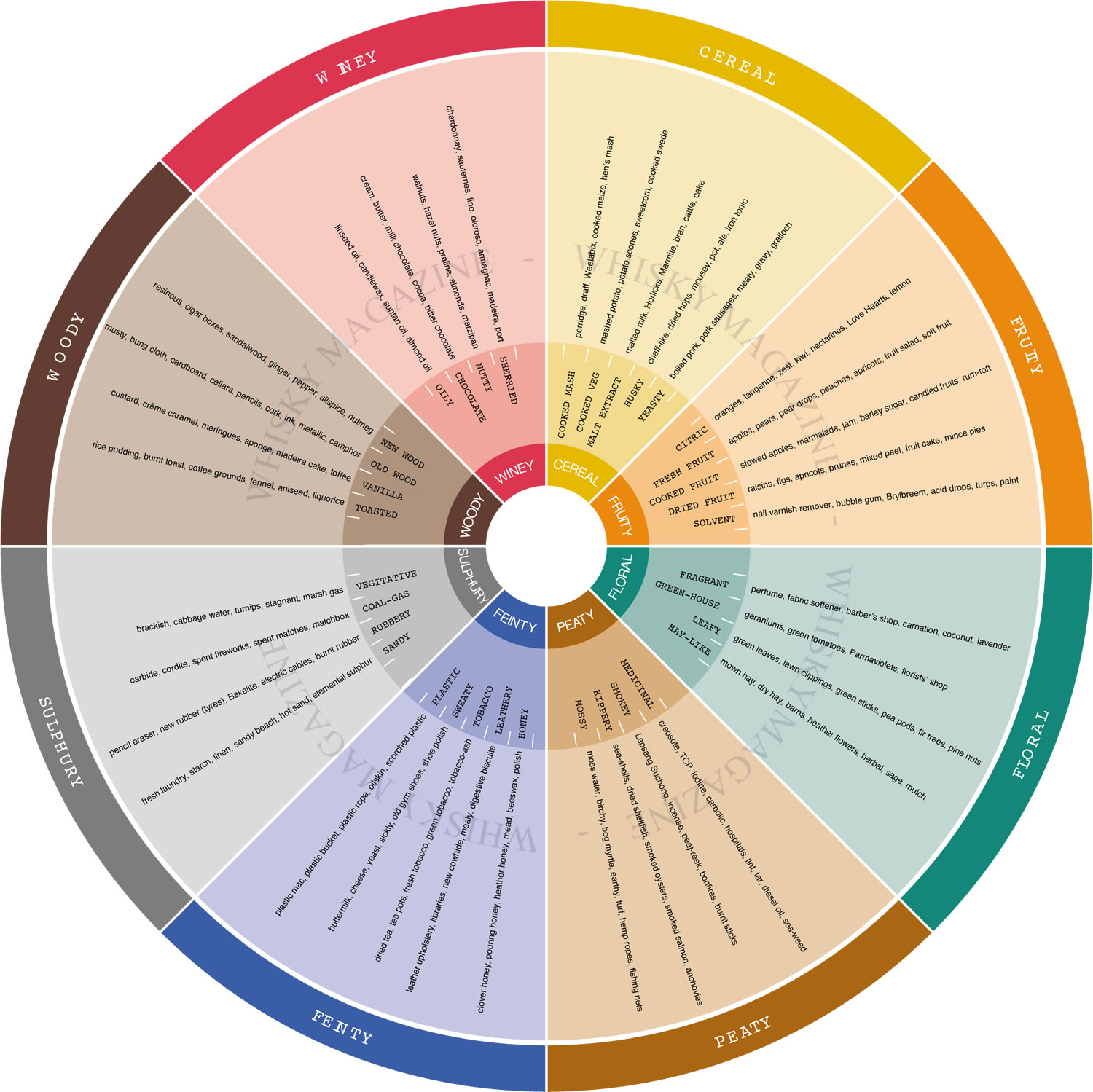
We can all identify the same basic flavours – admittedly to various degrees of proficiency – but we may not be able to describe them in a way that makes sense to or resonates with others…or reference them in relation to other flavours.  The answer is standardization.   There are various models – the Pentlands Wheel, the Diageo/Dave Broom inspired Flavour Map and its associated Flavour Camps, Serge Valentin’s SGP system, and I’m sure many others – all of which seek to standardize the flavour describing lexicon and get some sort of order and classification in place.  It’s worthwhile to be familiar with these models, or at least with their vocabulary, so that you can identify whiskies that you may want to try.  I’m all for prolific experimentation but premium whiskies cost long dollars – so unless you have a wallet built like a prop forward (the World Cup’s starting today, here’s my contribution to the rugby excitement) some discrimination may well be necessary.

Pentlands Wheel - courtesy of Whisky Magazine

Rule #5: The T in tasting is for team.  Share your whisky, share the fun, share your impressions.  Enough said.

Ok, that’s my bit of preaching done.  Part 3 – the rest of the formula for an optimal tasting (coming soon to Words on Whisky) – will conclude this series.

Fellow rugby fans – we’re caught in a bastardly time zone predicament.  I’m quite partial to sipping on a dram whilst watching my team pound others into submission, but not at 10h30.  How early is it reasonable to start drinking whisky?

To the Springboks – may the dram be with you!  Preferably after the games though.