Tag Archives: Whiskey

BBR launch

This evening I’m off to attend the local launch of the Berry Bros & Rudd (BBR) spirits portfolio, which includes the Glenrothes single malt.  The name is pronounced Glen-roth-this (this as in thistle, not as in this gaelic pronunciation is a bugger).   I’m excited, not only because it’s an opportunity to savour a great whisky, but also because of the historical interest value.

Glenrothes comes in a cool sample-type bottle with a hand-written label

BBR is Britain’s oldest wine and spirits merchant, having been established in 1698, and it has since cemented a world-leading position as a supplier of fine wines and super-premium spirits.  Its most famous creation was Cutty Sark, the blended whisky named after the Scots-made tea clipper, at one time the world’s fastest ship.  Cutty Sark claims to be the first light-coloured blended whisky ever made, having originally (not sure if it’s still the case today) shunned the use of spirit caramel, which many whisky makers use to darken their products and ensure colour consistency, but which is also thought to mask more subtle flavours.  It was formulated by Charles Julian, who went on to create J&B in its image, as well as having a hand in putting together the Chivas Regal that we drink today.  From its origins in the early 1920’s Cutty Sark went on to become a prohibition-era success story and eventually the best-selling Scotch whisky in the US (at one time).  The brand, I guess because of its stature in American society, has featured repeatedly in popular culture.  Its epic name and distinctive bottle and label really made it stand out; I remember seeing it in movies such as Caddyshack and Goodfellas, marvelling at how much Chevy, Bob and others seemed to like the stuff, and wondering why I’d never come across it locally.

Glenrothes is the signature malt in Cutty Sark, and a significant contributor to other blends such as Famous Grouse and Chivas Regal.  BBR no longer owns Cutty Sark – in a contorted-sounding deal it recently sold the brand to the Edrington Group (owners of the Macallan, Famous Grouse, and Highland Park), in return acquiring the rights to the Glenrothes brand.  The Glenrothes distillery remains in Edrington’s hands, ostensibly to ensure control of supply for Cutty Sark et al.  The good news coming out of all of this for whisky lovers is that there should now be an increased focus on Glenrothes as a single malt, compared to past years where it served primarily as an ingredient for blends.  I’ll report back tomorrow on what we can expect from Glenrothes in SA.

Incidentally one of Cutty Sark’s first “distributors” was the smuggler Captain Bill McCoy, who had a reputation for supplying uncut, unadulterated spirits at a time (prohibition) when this was more exception than rule…hence the expression “the real McCoy”.

Bill and crew

Whisky bloody whisky

Where are you…? Search as I might, by the end of the evening I still hadn’t found what I was looking for. I’m referring of course, in case you haven’t deciphered my subtle-as-a-sledgehammer turns of phrase, to the U2 concert held on Friday at the Greenpoint Stadium, where there wasn’t a drop of whisky to be begged, borrowed or stolen. The dram was most definitely not with us.  Strange I thought because Heineken, one of the sponsors, resides in the Brandhouse stable, home also to the largest whisky portfolio in the country, including the County Antrim-based Bushmills. What could have been more fitting under a…uh…moonlit sky than watching these Irish gods of rock music whilst sipping Black Bush, the tipple reputedly favoured by Bono? But it was not to be. Make no mistake the people at Brandhouse are sharp operators, and not likely to resist the prospect of having their whiskies available to an 80 000 strong captive audience. So then, what manner of perniciousness was it that conspired to deny us? I decided to call Brandhouse to get some answers. They put me onto Big Concerts COO John Langford who explained that it was very difficult to get a special events liquor licence covering spirits, so they generally don’t bother applying (unless it’s specific to restricted areas like a VIP room). Bad news for us whisky-loving concert goers. It seems that the authorities just don’t trust us with hard tack in large groups. I guess situations like these are why the flask was invented.

Hey, I'm not happy about it either but no need to go all Woodward and Bernstein on us

This whisky fiasco notwithstanding the concert was top-drawer, although for many people the live experience must have been diminished somewhat by viewing most of the proceedings on their cell-phone screens; one of my mates with whom I attended the concert recorded so much footage that I’m expecting him to release a bootleg DVD.

Bascule photo shoot part 2

Well, our excursion to the Bascule was most enjoyable, if not entirely successful.  They were out of pure pot still (damn!) so I had to think quickly to appease my palate.  I ended up trying the Sazerac 6yo rye whiskey, and the Nikka Hokkaido 12yo pure malt (which prompted me to wonder if the Japanese will follow the Scottish lead and change this descriptor to “blended malt”).  Earlier this year I had tasted the delicious, award-winning Sazerac 18yo rye, courtesy of my friends at Liquidity (thanks Emil), and I must say that its little brother isn’t too far behind: all the zinging spiciness that you’d expect from a rye but well-balanced and with a smooth finish.  The Hokkaido also had a pleasing equilibrium, dancing in the mouth from buttery to fragrant.  My drinking companions took the paths more travelled, thoroughly relishing the Macallan 12yo sherry oak and Glenfiddich 15yo solera reserve.

The photo-shoot objective was accomplished to our satisfaction, with my brother Fred behind the lens.  I’ll be the first to admit that our family wasn’t front of the queue when artistic talents were handed out, but we seemed to have grabbed a few nuggets here and there.  Judge for yourselves.

Bascule photo shoot

This afternoon the WHISKYdotcoza team is off to Cape Town’s whisky mecca, the Bascule Bar, for a photo shoot.   Bascule manager George Novitskas has kindly agreed to let us do our thing at his venue, which is reputed to have the largest whisky collection in the southern hemisphere.  It should be perfect for the atmospheric images that we’re after.  One of my favourite magazines, Drinks International, recently commissioned an authoritative (I say this because they call it “The most authoritative bar industry survey ever”, so its authoritativeness cannot be overstated) survey to rate the world’s 50 best bars, and whilst South Africa is well represented – Café Caprice and Planet Bar crack the nod – for my money the Bascule can feel hard done by.  The supplement was published in November last year and if you’re inclined to do so it can be downloaded here: http://www.drinksint.com/files/Supplements/2010/Bar-Supplement-2010.pdf.  I’ve written to them to see if there are any plans to feature the world’s best whisky bars, whereupon the Bascule, and Katzy’s in Johannesburg, will I’m sure keep the flag flying.

Drinks International best bars supplement

I’m also going to be taking the opportunity of this afternoon’s visit to remedy a glaring omission in my whisky repertoire.  I have tasted and enjoyed all the significant types of whisky bar one – pure pot still Irish.  I can’t drink in Irish company again – and what better drinking company is there – until I set this right.  For those of you unfamiliar with it, this is the definitive Irish style of whiskey, much as single malt is to Scotch.  Pure pot still must be made in a pot still and, by convention (there are no regulations, as there are for Scotch, defining Irish whiskey styles), from a mixed mashbill (i.e. recipe) of malted and predominantly unmalted barley.

The pot stills at the Midleton distillery

The unmalted (or “raw”) barley is what gives Irish whiskey its distinctive flavour.  Most of the Irish whiskey available – for instance popular brands such as Jameson and Tullamore Dew – are blends, made of pure pot still, single malt, and grain whiskey, or any two thereof.  Most of these blends would contain grain whiskey (I only know of 1 pot still-malt blend, known as a “pot still blend” because both components are distilled in a pot still), which, unlike Scotch grains, are distilled close to neutrality, and intended only as a lightening agent so as not to interfere with the flavour of the “master” component…which is more often than not the pure pot still.  So whilst I’m familiar with the flavour from drinking these blends, I’m really looking forward to tasting the real thing.  Now I’m just hoping that the Bascule has it in stock…

Check in tomorrow for excerpts from our shoot and (hopefully) my impressions of pure pot still.  Until then – may the dram be with you.

Legendary but rare - Green Spot pure pot still whiskey

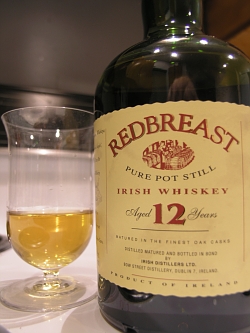
The acclaimed Redbreast pure pot still whiskey

Ancient whisky

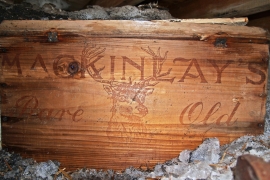
One of Shackleton's whisky crates

Whisky hit the mainstream news headlines last year when a crate of 100 odd year old whisky was retrieved from an Antarctic hut abandoned in the early 1900’s by explorer Ernest Shackleton.  I’m not going to rehash the story – if you’re unfamiliar with the details you can read up on it further at http://www.bbc.co.uk/news/uk-scotland-12202880 and elsewhere.  The whisky is Mackinlay’s: a brand owned by Whyte & Mackay, which was discontinued some time back.

There are two elements to this story which caught my attention in particular.  Firstly the whisky has been estimated to be worth US$69 000 per bottle on the open market.  Clearly not because of its intrinsics – at this time no-one even knows whether this is a blend, a blended malt, or a single malt.  Further whisky doesn’t mature in the bottle, so the age in terms of the liquid itself is at best irrelevant, at worst of detriment to quality.  As an aside I think it would have been considerably more interesting had Shackleton taken casks with him.  In typical conditions 100 years of wood would overpower a whisky, but who knows what cycles of freezing and thawing over that period would have accomplished.  Anyhow, throw in the risk of taint, musty aroma, and particulate from these corked bottles, and it becomes clear that the value comes from provenance and not product (drinkable though it may still be).  It thus absolutely amazes me that people would be prepared to spend this much for items that, to be frank, are of dubious historical significance; after all, heroic though Shackleton may have been, his missions failed to achieve their objectives.  And the bottles are not even particularly rare – there are some 35 of them in existence.   Perhaps then it’s for the best that this is all academic.  The Antarctic Preservation Trust has made it clear that they won’t be put on sale.

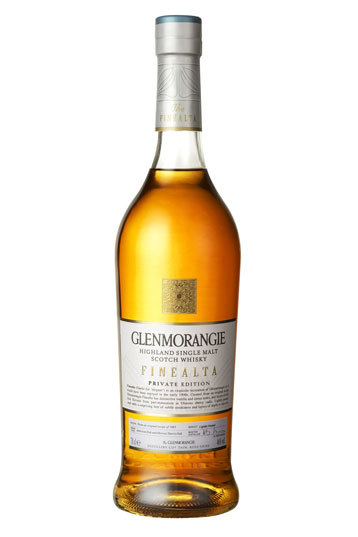
The second point of interest is that 3 bottles have been flown back to Scotland for analysis – by Whyte & Mackay Master Blender Richard Paterson, who was quoted as saying: “It is an absolute honour to be able to use my experience to analyse this amazing spirit for the benefit of the Trust and the whisky industry”.  Very noble.  Owner of Whyte & Mackay Vijay Mallya was more forthright: “to us it might well be a huge marketing opportunity”.  His plan is to use the results of the analysis to recreate the whisky’s recipe.  Personally I’m not sure what this window into the past can teach us about making better whisky.  Whisky-making is part-art, part-science, but the best of the art has been retained, refined, and passed on over generations, and the science has improved somewhat since Shacketon’s whisky was made.  Nonetheless, if there are any insights to be gained I welcome it.  Perhaps they’ll identify and be able to recreate a particularly appealing strain of barley.   My suspicion though is that this is about marketing pure and simple.  Given our fascination with the past, it’s a great angle to be able to offer whisky as it was drunk a century ago.  Unfortunately for Whyte & Mackay they’ve been beaten to the punch.  A few days ago Glenmorangie officially launched Finealta, a recreation of a 1900’s recipe found in the distillery’s archives.  If anyone’s tasted it I’d be interested to hear if history’s bounty justifies the hype.  Even better, if someone from Glenmorangie happens to read this, kudos and don’t hesitate to send me a bottle.

Glenmorangie Finealta

Whisky or whiskey?

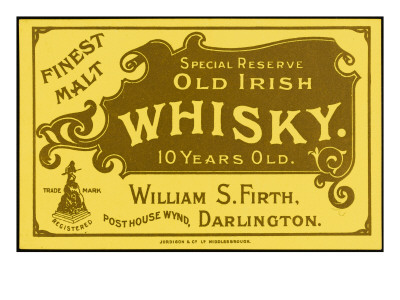
I’m a language purist.  You should know that about me.  Things like spelling, grammar, structure and fluency matter to me.  I say this despite the risk of being called anal retentive and of tripping up over my own performance (both of which do happen now and then).  This notwithstanding the crux of it is that language is beautiful, and like all beautiful things should be cherished.   Details can be important and laden with meaning.  Take the spelling of whisky.  Most of us probably know that there are two forms of the word: whisky, and whiskey.  Some of us may even know that whiskies are Scotch (and Canadian and Japanese) and whiskeys are Irish and American.  The why is less well-known.  I looked into this recently and it seems that whisky is the original spelling of the word, and at one time was used to denote all whiskies.  The “ey” spelling supposedly arose because the typical Scotch of the mid to late 19th century was of such poor quality that Irish producers wanted to make their product distinct.   Most American producers followed suit with some exceptions, such as Maker’s Mark and George Dickel, both of which are still called whisky to this day.  So we have a whole swathe of history and a striking insight into the development of an industry…all communicated by the addition of a letter.  In the modern era whisk(e)y production is proliferating all over the world.  There are serious producers all over Europe, in India, in Taiwan, in Australia, and of course right here in South Africa: the expression Highveld Malt has entered the lexicon.  To the best of my knowledge all these recent entrants seem to be using “whisky”, even those producing American-style products.  Does anyone know of any “new” producer that has chosen to use the form “whiskey”?

One last thing: the images shown above date from before the name change came into comprehensive effect in Ireland.

Welcome to Words on Whisky!

I’m taking the opportunity of this my first post to introduce myself and my motivation to blog on this subject.  I’m in my mid-30’s and looking back my partiality to whisky seems inevitable. I come from a community where whisky has almost exclusively been the drink of choice for generations.  Sure there was beer and wine, but my grandparents, parents, aunts and uncles were largely oblivious of any spirit other than whisky.  I was pouring my father his evening Scotch before I could read, and the drink’s colour and rich aroma made a lasting impression.  In my teens many of the bands to which I listened seemed inspired by the muse of whisky (there was no doubt also a fair amount of abuse)…and so my fascination grew.  Songs such as Thin Lizzy’s “Whiskey in the Jar”, and the Doors’ “Whisky Bar” remain amongst my favourites.  Later I joined the industry, and since then I’ve had the opportunity to work in various capacities with some of the world’s most renowned whisky brands, and visit a few epic distilleries in the whisky father and motherlands (Ireland and Scotland, of course).  More recently I’m involved in the launch of an online shop specializing in whisky.  It’s called WHISKYdotcoza, located if I may state the obvious at www.whisky.co.za, and it should be up and running in the next 2 months.  On this blog though I look forward to sharing my experiences and thoughts on all things whisky and engaging with fellow enthusiasts, whisky novices, and indeed anyone interested in this golden nectar of the gods.  Thanks for visiting – and may the dram be with you!